
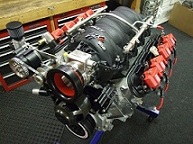



My 347ci build

thanks Rezin....I'm hoping for first start up sometime this summer, I honestly don't have a timetable on it because the chassis it's going into is nowhere close to being ready. If anything happens in the near future it will have to be on an engine dyno -there's a few places that do it locally and one that's supposed to be pretty good but part of me wants to pick up hp tuners and give it a whirl. Haven't decided yet because I've been focusing on assembly lol. Do you know of anywhere on the east coast that does good work? Willing to make a drive if I'm going to get good results.
painted the front timing cover today

work on the caps also continues. I'm going to full on resize all of them by sanding as shown on the previous page - I'm almost a full thou out of spec on bore size (#1 and #5 were the worst of the group), which has a negative effect on bearing crush and resistance to spinning. I got the first cap done, took the bore from 2.7519" to 2.7507" (in spec). will post before after measurements for all the caps once they're done. to say the process is tedious would be an understatement for sure.
work on the caps also continues. I'm going to full on resize all of them by sanding as shown on the previous page - I'm almost a full thou out of spec on bore size (#1 and #5 were the worst of the group), which has a negative effect on bearing crush and resistance to spinning. I got the first cap done, took the bore from 2.7519" to 2.7507" (in spec). will post before after measurements for all the caps once they're done. to say the process is tedious would be an understatement for sure.
painted the front timing cover today
work on the caps also continues. I'm going to full on resize all of them by sanding as shown on the previous page - I'm almost a full thou out of spec on bore size (#1 and #5 were the worst of the group), which has a negative effect on bearing crush and resistance to spinning. I got the first cap done, took the bore from 2.7519" to 2.7507" (in spec). will post before after measurements for all the caps once they're done. to say the process is tedious would be an understatement for sure.
work on the caps also continues. I'm going to full on resize all of them by sanding as shown on the previous page - I'm almost a full thou out of spec on bore size (#1 and #5 were the worst of the group), which has a negative effect on bearing crush and resistance to spinning. I got the first cap done, took the bore from 2.7519" to 2.7507" (in spec). will post before after measurements for all the caps once they're done. to say the process is tedious would be an understatement for sure.
You may not need that half shell oversize (thicker) bearing now.....it should be interesting to see how this effects your clearances (they will be tighter without a doubt but not necessarily on a one to one basis if you know what I mean....(probably damn close to that though). I wouldn't go any tighter then 2.7507....stay between there an 2.7509 and you should be golden. Most of the OEM blocks are at max tolerance to a tenth or two over right out of the GM crate but yours has slightly more room at the parting line so your reduced vertical should give you plenty of bearing crush right now....just like a stock block with an OEM hone/line bore.
Have you tried to spin the crank in this block yet? Before you go crazy modding the rest of the caps you might want to see how it spins now. And you need to tighten the cat bolts to crush the bearings or they will pinch on the crank slightly just sitting in the saddles so it feels like something is lightly binding.....you don't need full torque....just hand tight with a 3/8 ratchet will do it for this exercise.....check your end play also before you even do that.....1 out of 2 engines I build I find I have to open up the end play by carefully sanding the bearing face as you did the cap surfaces....your honing plate is already ready to go!
Keep up the good work Chuck! This is the kind of stuff I'm always trying to convey to folks when they inquire about having me build an engine or a shortblock.....to really do it right and "****-ize" over every last detail in an effort to get max performance and max reliability, the hours you have to invest to do so is retarded. Without investing the time to pour over every small detail (especially when it comes to the critical shortblock assembly), your simply rolling the dice when it comes to the final product and how it will run and how it will live.
I just had one of my customers lose a shortblock with 200 miles on it.....I helped him with the whole recipe (entire top end, complete valvetrain, pistons, etc.). Every rod bearing was toast....he hadn't pulled the mains last I spoke with him but they are probably shot as well (crank needs a light cut to be reused for sure). I'm pretty sure a local shop helped him with the assembly labor/machine work. Now he's hosed and cant afford to fix it.....must have spent six months paying for and gathering all the optimized components I helped him with. It kills me to see it end this way.....per my customer the engine screamed for the short life it had and then it developed a lower end knock....rest is history. He is happy he finally got to experience it even for just a little while but what a heartbreak. Its an expensive hobby when things go right......far uglier when things go wrong so "measure twice and cut once" as they say.....check, double check, and triple check or more if need be.....leave nothing to chance.
-Tony
Last edited by Tony Mamo @ AFR; Jun 3, 2013 at 02:26 AM.
Timing cover looks great....wrinkled finish I'm guessing?
You may not need that half shell oversize (thicker) bearing now.....it should be interesting to see how this effects your clearances (they will be tighter without a doubt but not necessarily on a one to one basis if you know what I mean....(probably damn close to that though). I wouldn't go any tighter then 2.7507....stay between there an 2.7509 and you should be golden. Most of the OEM blocks are at max tolerance to a tenth or two over right out of the GM crate but yours has slightly more room at the parting line so your reduced vertical should give you plenty of bearing crush right now....just like a stock block with an OEM hone/line bore.
Have you tried to spin the crank in this block yet? Before you go crazy modding the rest of the caps you might want to see how it spins now. And you need to tighten the cat bolts to crush the bearings or they will pinch on the crank slightly just sitting in the saddles so it feels like something is lightly binding.....you don't need full torque....just hand tight with a 3/8 ratchet will do it for this exercise.....check your end play also before you even do that.....1 out of 2 engines I build I find I have to open up the end play by carefully sanding the bearing face as you did the cap surfaces....your honing plate is already ready to go!
Keep up the good work Chuck! This is the kind of stuff I'm always trying to convey to folks when they inquire about having me build an engine or a shortblock.....to really do it right and "****-ize" over every last detail in an effort to get max performance and max reliability, the hours you have to invest to do so is retarded. Without investing the time to pour over every small detail (especially when it comes to the critical shortblock assembly), your simply rolling the dice when it comes to the final product and how it will run and how it will live.
I just had one of my customers lose a shortblock with 200 miles on it.....I helped him with the whole recipe (entire top end, complete valvetrain, pistons, etc.). Every rod bearing was toast....he hadn't pulled the mains last I spoke with him but they are probably shot as well (crank needs a light cut to be reused for sure). I'm pretty sure a local shop helped him with the assembly labor/machine work. Now he's hosed and cant afford to fix it.....must have spent six months paying for and gathering all the optimized components I helped him with. It kills me to see it end this way.....per my customer the engine screamed for the short life it had and then it developed a lower end knock....rest is history. He is happy he finally got to experience it even for just a little while but what a heartbreak. Its an expensive hobby when things go right......far uglier when things go wrong so "measure twice and cut once" as they say.....check, double check, and triple check or more if need be.....leave nothing to chance.
-Tony
You may not need that half shell oversize (thicker) bearing now.....it should be interesting to see how this effects your clearances (they will be tighter without a doubt but not necessarily on a one to one basis if you know what I mean....(probably damn close to that though). I wouldn't go any tighter then 2.7507....stay between there an 2.7509 and you should be golden. Most of the OEM blocks are at max tolerance to a tenth or two over right out of the GM crate but yours has slightly more room at the parting line so your reduced vertical should give you plenty of bearing crush right now....just like a stock block with an OEM hone/line bore.
Have you tried to spin the crank in this block yet? Before you go crazy modding the rest of the caps you might want to see how it spins now. And you need to tighten the cat bolts to crush the bearings or they will pinch on the crank slightly just sitting in the saddles so it feels like something is lightly binding.....you don't need full torque....just hand tight with a 3/8 ratchet will do it for this exercise.....check your end play also before you even do that.....1 out of 2 engines I build I find I have to open up the end play by carefully sanding the bearing face as you did the cap surfaces....your honing plate is already ready to go!
Keep up the good work Chuck! This is the kind of stuff I'm always trying to convey to folks when they inquire about having me build an engine or a shortblock.....to really do it right and "****-ize" over every last detail in an effort to get max performance and max reliability, the hours you have to invest to do so is retarded. Without investing the time to pour over every small detail (especially when it comes to the critical shortblock assembly), your simply rolling the dice when it comes to the final product and how it will run and how it will live.
I just had one of my customers lose a shortblock with 200 miles on it.....I helped him with the whole recipe (entire top end, complete valvetrain, pistons, etc.). Every rod bearing was toast....he hadn't pulled the mains last I spoke with him but they are probably shot as well (crank needs a light cut to be reused for sure). I'm pretty sure a local shop helped him with the assembly labor/machine work. Now he's hosed and cant afford to fix it.....must have spent six months paying for and gathering all the optimized components I helped him with. It kills me to see it end this way.....per my customer the engine screamed for the short life it had and then it developed a lower end knock....rest is history. He is happy he finally got to experience it even for just a little while but what a heartbreak. Its an expensive hobby when things go right......far uglier when things go wrong so "measure twice and cut once" as they say.....check, double check, and triple check or more if need be.....leave nothing to chance.
-Tony
To be clear, all of my caps have excessive clearance....#1 and #5 were the worst of them which is why I sanded those first to bring them down closer to the rest of the group. I'm expecting to need to do all of them to get even crush (and clearances) on all bores. The horizontal measurement came in as you said it would....sitting at around 2.7506" at the parting line in #1. There's a few tenths of taper but I'll let the crank tell me what it likes before I make any adjustments.
The only time I've spun the crank in the block was with standard clearance P bearings prior to the mains work that the second shop did. Spun pretty much freely once I referenced the thrust bearing, I was sitting at 0.0035" for thrust clearance. Now given that the rest of my caps - (2-5) are still in the 2.7515-2.7518 range, should I get those down closer to where I have #1 now (2.7509-2.7512 as you suggest above) before I bother laying the crank in there?
It is definitely a major time commitment and a lot of the shortblock work does not get the attention it deserves. I'm trying to share it in this thread to bring some of these issues to light. I've spent a lot of long nights on this thing so far and there will be a lot of long nights to come. Not really proud to say it but it took me the better part of 2 hours to get that first cap in by creeping up on spec...Sand it, throw it on the block, check it. Pull it back off, sand some more, etc. I didn't find measuring the cap with a mic to be a reliable method for me so I just put it back in each time and torqued it up prior to measuring.
That really sucks about your customer losing his block - that right there was my main motivation for deciding to do all of this myself.
Last edited by ckpitt55; Jun 3, 2013 at 01:46 PM.
threw some more hours at the engine tonight
sanded the rest of my caps down to size...my bores are pretty much in spec. a bit of taper but not much I can do about that.
Before/after numbers below. I still have some more room to work with but I want to lay in the crank before I get too crazy with anything. OEM spec for the bores is 2.750-2.751", and typically 2.7509-2.7512" per TM above.

Also measured my bearing clearances with all 3 possible combinations of bearings in the bore. I am still going to have to mix and match but in general, sanding the caps made the clearances much more consistent bore to bore than I remember them being before.

I'm shooting for clearances between 0.0015-0.0018". A full standard set is pretty much out, too loose. Looks like I'll be running a mixed set on 3 and a full undersize set on 5. The mixed set is kind of on the high end of my target on 1, 2, and 4 but the full undersize set is too tight. So I guess my options are to either live with the mixed set on those bores or sand the undersize set to my desired clearances (only a few tenths away). Not sure what I'm going to do yet.
I hope to at least lay in the crank tomorrow and see how she spins to start laying out the bearing orientations (what halves go on what side of the bore). Looking to optimize the setup for the least resistance (best alignment) possible.
sanded the rest of my caps down to size...my bores are pretty much in spec. a bit of taper but not much I can do about that.
Before/after numbers below. I still have some more room to work with but I want to lay in the crank before I get too crazy with anything. OEM spec for the bores is 2.750-2.751", and typically 2.7509-2.7512" per TM above.
Also measured my bearing clearances with all 3 possible combinations of bearings in the bore. I am still going to have to mix and match but in general, sanding the caps made the clearances much more consistent bore to bore than I remember them being before.
I'm shooting for clearances between 0.0015-0.0018". A full standard set is pretty much out, too loose. Looks like I'll be running a mixed set on 3 and a full undersize set on 5. The mixed set is kind of on the high end of my target on 1, 2, and 4 but the full undersize set is too tight. So I guess my options are to either live with the mixed set on those bores or sand the undersize set to my desired clearances (only a few tenths away). Not sure what I'm going to do yet.
I hope to at least lay in the crank tomorrow and see how she spins to start laying out the bearing orientations (what halves go on what side of the bore). Looking to optimize the setup for the least resistance (best alignment) possible.
lifters, rocker arms, valve cover gaskets, fuel rails, injectors, and clutch are in. it was like christmas this week, except about 20x better....no annoying relatives lol. pics later.
still working on tweaking / laying out my mains. sanded cap #5 a bit more and ended up with the following bearings / clearances. after some discussion with Tony, I'm shooting for more in the 0.0018-0.0020" range for clearance.
-1: mixed set, 0.0017
-2: mixed set, 0.0019
-3: standard set, 0.0020
-4: mixed set, 0.0018
-5: standard set, 0.0016
I laid the crank in and torqued everything up, referenced the thrust bearing, and gave it a spin. Not bad but it seems like there's a very slight tight spot somewhere - haven't identified it yet. On my mixed sets I can play with the orientation of the bearing halves in the bore, and am going to very lightly sand bearing 5 to give me a bit more clearance (take it from 0.0016 to 0.0018"). Hopefully that helps.
Also measured my thrust clearance and I'm at or just below ~0.0020". I'm going to need to lap the thrust bearing to bring that up to my target of 0.0035".
More pics and stuff to come later.
still working on tweaking / laying out my mains. sanded cap #5 a bit more and ended up with the following bearings / clearances. after some discussion with Tony, I'm shooting for more in the 0.0018-0.0020" range for clearance.
-1: mixed set, 0.0017
-2: mixed set, 0.0019
-3: standard set, 0.0020
-4: mixed set, 0.0018
-5: standard set, 0.0016
I laid the crank in and torqued everything up, referenced the thrust bearing, and gave it a spin. Not bad but it seems like there's a very slight tight spot somewhere - haven't identified it yet. On my mixed sets I can play with the orientation of the bearing halves in the bore, and am going to very lightly sand bearing 5 to give me a bit more clearance (take it from 0.0016 to 0.0018"). Hopefully that helps.
Also measured my thrust clearance and I'm at or just below ~0.0020". I'm going to need to lap the thrust bearing to bring that up to my target of 0.0035".
More pics and stuff to come later.
Wow. Kudos to you and your efforts. When it comes time for me to have an engine built, I would love to learn and attempt this process. I'd need to research and comprehend everything prior, in order to feel comfortable, but I'm sure I could get through it.
Like you said. Buy the right tools, understand how the numbers stack up, and it 'kind of' falls into place. I admire how Tony has been chiming in and giving some tips here. I'm sure he admires someone like yourself who is probably just as **** as he is! Haha.
Anyways, best of luck through the rest of the process. I'm in for more updates

Like you said. Buy the right tools, understand how the numbers stack up, and it 'kind of' falls into place. I admire how Tony has been chiming in and giving some tips here. I'm sure he admires someone like yourself who is probably just as **** as he is! Haha.
Anyways, best of luck through the rest of the process. I'm in for more updates
LS1 Tech Stories
The Best V8 Stories One Small Block at Time

Amazing '71 Camaro Restomod Is Modern Muscle Car Under the Skin
Verdad Gallardo
6 Common C5 Corvette Failures and What's Involved In Repairing Them
Pouria Savadkouei
Retro Modern Bandit Pontiac Trans AM Comes With Burt Reynolds' Autograph
Verdad Gallardo
Top 10 Greatest Cadillac V Series Performance Models Ever, Ranked
Pouria Savadkouei
Top 10 Most Powerful Chevy Trucks Ever Made!

Hennessey's New Supercharged Silverado ZR2 Has 700 HP
Verdad Gallardo
Coachbuilt N2A Anteros Is an LS2-Powered C6 Corvette In Italian Clothes
Verdad Gallardo
Awesome K5 Blazer Restomod Comes With C7 Corvette Power
Verdad Gallardo
10 Camaros You Should Never Buy
Wow. Kudos to you and your efforts. When it comes time for me to have an engine built, I would love to learn and attempt this process. I'd need to research and comprehend everything prior, in order to feel comfortable, but I'm sure I could get through it.
Like you said. Buy the right tools, understand how the numbers stack up, and it 'kind of' falls into place. I admire how Tony has been chiming in and giving some tips here. I'm sure he admires someone like yourself who is probably just as **** as he is! Haha.
Anyways, best of luck through the rest of the process. I'm in for more updates
Like you said. Buy the right tools, understand how the numbers stack up, and it 'kind of' falls into place. I admire how Tony has been chiming in and giving some tips here. I'm sure he admires someone like yourself who is probably just as **** as he is! Haha.
Anyways, best of luck through the rest of the process. I'm in for more updates
With your turning resistance, was that with assembly lube or motor oil? Assembly lube tends to be a bit stickier. What were your clearances? I'll have to put my in-lb wrench on it later and measure this for comparison's sake. Will report back. Kind of the curse of being an engineer...you want to put a number on EVERYTHING. lol
Last edited by ckpitt55; Jun 7, 2013 at 05:49 PM.
Looks good. I too am an engineer, and really wanted to do this myself last fall. Was way too overwhelmed after reading an engine building book and scrapped that idea. Props to you for attempting it! No doubt about it you will be successful after all of the time and effort. I'll be following this thread.


Your specific cam profile uses a LSL intake lobe and an Extreme RPM exhaust lobe. The XE-R lobes have a very very fast closing ramp in regards to lobe profile. This causes a very loud sewing machine noise as the valve closes and sets down on the seat.
The LSL lobes are a very fast open just like the XE-R lobes, but have a more controlled closing ramp. The Extreme RPM lobes are very stable, and have a slower open and close which is why I use them on the exhaust side. The exhaust valve is more prone to float than the intake valve due to the exhaust valve trying to open against immense cylinder pressure after the combustion event has taken place. You also don't need as aggressive an exhaust lobe versus the intake lobe. The exhaust is coming out of the cylinder one way or another, it doesn't need the most aggressive lobe in the world to accomplish this because of that.
The LSL lobes are a very fast open just like the XE-R lobes, but have a more controlled closing ramp. The Extreme RPM lobes are very stable, and have a slower open and close which is why I use them on the exhaust side. The exhaust valve is more prone to float than the intake valve due to the exhaust valve trying to open against immense cylinder pressure after the combustion event has taken place. You also don't need as aggressive an exhaust lobe versus the intake lobe. The exhaust is coming out of the cylinder one way or another, it doesn't need the most aggressive lobe in the world to accomplish this because of that.
J
I retract my last statement. I just read the whole thread and there are a bunch of good posts in here.
It just goes to show how amazing OEM engine are that will go 100-200 thousand miles.
It just goes to show how amazing OEM engine are that will go 100-200 thousand miles.
made a bit more progress tonight here
installed fuel rail and injectors to intake

YT Rev 3 rockers ready to rock (pun intended)


Johnson short-travel lifters with axle oiling feature


Also messed around with the block some more. I sanded bearing 5 very slightly to give me a few more tenths, so now I'm sitting at 0.00019".
Also lapped the thrust bearing. Was at 0.0020"ish, now at 0.0032" thrust clearance. Needs a bit more. I put both halves together and sanded them in a circular pattern on #320 with a bit of oil with little to no pressure. ended up with a pretty nice finish on it. The key to this stuff is to go really slow - you remove material a lot faster than you think when you start dealing with a couple 0.0001"s here and there. You can always remove more but you can't put it back.

I also experimented with flipping around the bearing halves in the bores on 1, 2, and 4. With caps 1, 3, and 5 on and torqued the crank spins smooth as can be. When 2 and 4 are put on, there's a bit of a tight spot still that I haven't been able to figure out. Might have to experiment with different bearing orientations on those two bores.
Rezin, just out of curiosity I put a torque wrench on the crank with 1, 3 and 5 torqued, using some 5w-30 and was seeing less than 25 in-lb to get it moving. So it seems I'm in the ball park with what you saw, I just need to get that consistent with the other two caps installed.

installed fuel rail and injectors to intake
YT Rev 3 rockers ready to rock (pun intended)
Johnson short-travel lifters with axle oiling feature
Also messed around with the block some more. I sanded bearing 5 very slightly to give me a few more tenths, so now I'm sitting at 0.00019".
Also lapped the thrust bearing. Was at 0.0020"ish, now at 0.0032" thrust clearance. Needs a bit more. I put both halves together and sanded them in a circular pattern on #320 with a bit of oil with little to no pressure. ended up with a pretty nice finish on it. The key to this stuff is to go really slow - you remove material a lot faster than you think when you start dealing with a couple 0.0001"s here and there. You can always remove more but you can't put it back.
I also experimented with flipping around the bearing halves in the bores on 1, 2, and 4. With caps 1, 3, and 5 on and torqued the crank spins smooth as can be. When 2 and 4 are put on, there's a bit of a tight spot still that I haven't been able to figure out. Might have to experiment with different bearing orientations on those two bores.
Rezin, just out of curiosity I put a torque wrench on the crank with 1, 3 and 5 torqued, using some 5w-30 and was seeing less than 25 in-lb to get it moving. So it seems I'm in the ball park with what you saw, I just need to get that consistent with the other two caps installed.

TECH Fanatic

Joined: Jun 2011
Posts: 1,343
Likes: 8
From: Katy, TX
Nice choice. I'm using the 36lb FAST injectors as well per Tony's recommendation. I don't know if I need the fuel rails or if its just aesthetics? I see that you can get brackets to mount OE rails on the FAST manifolds.
Generic moly assembly lube. Being iron block, my clearances are 0.0025-0.0030".
Yeah we like numbers, we should get together and compare spreadsheets HAHA.
What kind of engineering do you do? I'm in subsea oil and gas.
Interesting that 2 and 4 are giving you a tight spot when those were 2 of the mains were honed. Can you measure any rise in those bores with your dial gauge?
you can do it, trust me. Just take your time and buy the right tools. There is also a great series of videos on youtube for rebuilding an SBC. Most of the same general concepts carry over to LS.
With your turning resistance, was that with assembly lube or motor oil? Assembly lube tends to be a bit stickier. What were your clearances? I'll have to put my in-lb wrench on it later and measure this for comparison's sake. Will report back. Kind of the curse of being an engineer...you want to put a number on EVERYTHING. lol
Yeah we like numbers, we should get together and compare spreadsheets HAHA.
What kind of engineering do you do? I'm in subsea oil and gas.
Rezin, just out of curiosity I put a torque wrench on the crank with 1, 3 and 5 torqued, using some 5w-30 and was seeing less than 25 in-lb to get it moving. So it seems I'm in the ball park with what you saw, I just need to get that consistent with the other two caps installed.
Looks good. I too am an engineer, and really wanted to do this myself last fall. Was way too overwhelmed after reading an engine building book and scrapped that idea. Props to you for attempting it! No doubt about it you will be successful after all of the time and effort. I'll be following this thread.
Generic moly assembly lube. Being iron block, my clearances are 0.0025-0.0030".
Yeah we like numbers, we should get together and compare spreadsheets HAHA.
What kind of engineering do you do? I'm in subsea oil and gas.
What kind of engineering do you do? I'm in subsea oil and gas.
I've got a buddy that works in subsea, that's crazy stuff lol. You might as well be working in space with the level of difficulty involved
Interesting that 2 and 4 are giving you a tight spot when those were 2 of the mains were honed. Can you measure any rise in those bores with your dial gauge?
edit: just laid in caps 2 and 4 with standard size bearings and it spins smooth as butter. doesn't help because my clearances are too loose with those bearings in those bores, but it gives me a starting point. either the mixed sets need their orientation adjusted, or i'm going to have to sand caps 2 and 4 slightly so I can use the standard size bearings on them.
Last edited by ckpitt55; Jun 11, 2013 at 07:08 AM.
The tightest tolerances we deal with are 0.005" on milled applications (heavy steel bridge fabrication). Granted, these can be over very long distances, the largest I've personally seen is a 62'-0" truss fabrication that could not be more than 0.005" out of square, with full penatration 0.5" welds throughout the assembly. Still, it's nothing like engine building where are you literally worrying about the ten-thousanth of an inch. So, to say the least this is out of my territory. I'm sure with the correct tools, and patience it would be possible to teach yourself to correctly build a shortblock. I took the alternate route and paid a professional to assemble mine.
Sorry to derail your thread ckpitt55, carry on.
Sorry to derail your thread ckpitt55, carry on.
The tightest tolerances we deal with are 0.005" on milled applications (heavy steel bridge fabrication). Granted, these can be over very long distances, the largest I've personally seen is a 62'-0" truss fabrication that could not be more than 0.005" out of square, with full penatration 0.5" welds throughout the assembly. Still, it's nothing like engine building where are you literally worrying about the ten-thousanth of an inch. So, to say the least this is out of my territory. I'm sure with the correct tools, and patience it would be possible to teach yourself to correctly build a shortblock. I took the alternate route and paid a professional to assemble mine.
Sorry to derail your thread ckpitt55, carry on.
Sorry to derail your thread ckpitt55, carry on.
-Chuck
Last edited by ckpitt55; Jun 10, 2013 at 12:06 AM.
spent a lot of time this past weekend experimenting with the mains, and I think I ended up with something that will work.
Curiously enough, 4 of the 5 journals ended up with standard clearance bearings. It didn't seem to like mixing and matching some bores with standard bearings on other bores, which I guess is good because it suggests that all the bore centerlines are fairly close to being aligned.

had to do a bit more sanding on the thrust bearing, but hit my target of 0.0035"

after the clearances were set and the crank spun smooth, I looked for high spots on the caps and very lightly touched them up with some 1000 grit.

Clearances are:
1: 0.0016, mixed set
2: 0.0019, standard
3: 0.0018, standard
4: 0.0020, standard
5: 0.0018, standard
measured it 4 times and got the same thing so I guess it must be right. I still need to measure crank runout and I'd like to experiment with a full mixed set in the block just to see where my clearances would be with those, but fairly certain I'll end up running this.

Curiously enough, 4 of the 5 journals ended up with standard clearance bearings. It didn't seem to like mixing and matching some bores with standard bearings on other bores, which I guess is good because it suggests that all the bore centerlines are fairly close to being aligned.
had to do a bit more sanding on the thrust bearing, but hit my target of 0.0035"
after the clearances were set and the crank spun smooth, I looked for high spots on the caps and very lightly touched them up with some 1000 grit.
Clearances are:
1: 0.0016, mixed set
2: 0.0019, standard
3: 0.0018, standard
4: 0.0020, standard
5: 0.0018, standard
measured it 4 times and got the same thing so I guess it must be right. I still need to measure crank runout and I'd like to experiment with a full mixed set in the block just to see where my clearances would be with those, but fairly certain I'll end up running this.
Last edited by ckpitt55; Jun 11, 2013 at 06:56 AM.