When you click on links to various merchants on this site and make a purchase, this can result in this site earning a commission. Affiliate programs and affiliations include, but are not limited to, the eBay Partner Network.
Subscribed. Doing my H/C/I build currently and considering starting a "build thread" of my own.
My biggest headache and has unfortunately had me reading until my eyes started bleeding is picking the correct lifters.
Holy crap is that a hot button topic with these motors.
If anyone has any opinions on WHY they chose trays vs. Link bars, Morels (street vs race) vs Johnson's vs LS7's, etc for a street car feel free to pass along some advice. I am 10 pages in and haven't gotten far enough to know if you've broached this topic.
Darth, well done and I hope I am not hijacking your thread.
Subscribed. Doing my H/C/I build currently and considering starting a "build thread" of my own.
My biggest headache and has unfortunately had me reading until my eyes started bleeding is picking the correct lifters.
Holy crap is that a hot button topic with these motors.
If anyone has any opinions on WHY they chose trays vs. Link bars, Morels (street vs race) vs Johnson's vs LS7's, etc for a street car feel free to pass along some advice. I am 10 pages in and haven't gotten far enough to know if you've broached this topic.
Darth, well done and I hope I am not hijacking your thread.
Keep reading buddy, if you haven't finished the thread yet that is. Lots of info in here. Darth lays it out well. He went from a hydraulic to a solid setup. Are you staying hydraulic for now? Johnson short travels is what he used when he was hydraulic and I'm using the same. You'll get different answers from a lot of people. In the end I just trusted the vendor that was helping me the most with the build.
Keep reading buddy, if you haven't finished the thread yet that is. Lots of info in here. Darth lays it out well. He went from a hydraulic to a solid setup. Are you staying hydraulic for now? Johnson short travels is what he used when he was hydraulic and I'm using the same. You'll get different answers from a lot of people. In the end I just trusted the vendor that was helping me the most with the build.
Staying hydraulic. I am not done with the thread... only so many hours in a day to research/read. I just know everyone has an opinion and every brand/type of lifters has seen failure, from what I gather. Now, that's not saying that is the mfg. or QC's fault not human error. I am in machine shop's 5 days a week and can tell you that even the most reputable shop's have failures. That's why there is an an acceptable failure rate and even acronyms like PPM (parts per million) that is accepted when it comes to rejects or failures.
Staying hydraulic. I am not done with the thread... only so many hours in a day to research/read. I just know everyone has an opinion and every brand/type of lifters has seen failure, from what I gather. Now, that's not saying that is the mfg. or QC's fault not human error. I am in machine shop's 5 days a week and can tell you that even the most reputable shop's have failures. That's why there is an an acceptable failure rate and even acronyms like PPM (parts per million) that is accepted when it comes to rejects or failures.
Yeah, there's tons out there, and every manufacturer can screw up. I judge them more by how they handle it. I'm not really a fan of the LS7 lifter. It's not a bad lifter, but there is quite a bit of performance to gain if you're willing to be a **** about valvetrain geometry. So, if you'll indulge me, here's the short version you'll glean from the thread:
For hydraulic lifters, I like Johnson and Morel. There are various options, such as short travel and direct axle oiling. Personally, I say yes to all. The Johnson short travel with direct axle oiling will give you the best performance you can get from a hydraulic valvetrain. They're expensive, which is why most people end up saying "well, LS7 lifters will be good enough" The dedicated axle oiling helps with longevity. Shorter travel improves performance. The shorter the travel, the closer you are to a solid lifter. On the flip side, though, you have to measure each pushrod individually in order to optimize the valve train. You can't just measure cylinders 1&2 then order a set. Flipping again, there is power to be gained by optimizing the valve train and making sure each valve is doing as close as possible to its design travel path.
There reaches a point though where it's cheaper to just run solids, and the solids will pretty much always perform the best. They're lighter, and there aren't any pumping delays from lifter to pushrod. Now, there are many who will tell you that you need adjustable rockers, etc, to run solid lifters, but you don't. I did the info in this thread, but "Thunderstruck" did what I did, only he was first and his thread is better - using shims under the rocker pedestals to set valve lash. It's a very economical way to get very good power and reliability out of a solid roller set up. If you search "thunderstruck LLSR LS1Tech" from the google screen, his thread should come up near the top.
Beyond the lifters, the springs and pushrods have to be well matched. What I mean is, if you make the springs stronger, you need bigger pushrods to avoid pole-vaulting the valve with the pushrod. This causes damage. So, if you're doing a build and you're going to run an aftermarket cam, I'll say you should run 11/32 OD pushrods. If the heads are coming off, open up the pushrod holes and you can run 3/8 cheaper than 11/32, and they're even more stronger. That might be overkill, but go see some of the threads where damage from valve float has occurred, and the extra $80 for bigger rods just got cheap.
So, basically, on the lifter side of the rocker, go heavy, go beefy, go strong, don't worry about weight.
Then, on the other side of the fulcrum, go light. if you're not sure, go light. if you're still not sure, go light. Light valves, light hardware, even lighter springs. Accelerative forces on the valve side are almost 3x higher than the lifter side due to the distance traveled. Less mass makes it easier to control. For example, you can take a pound out of your valvetrain swapping LS6 springs for PSI 1511. Money spent on lighter valvetrain components on the valve side is well spent. Don't worry about the titanium uber valves, though. Those are serious coin, and not necessary until you decide you're going to run 8500 RPM or something stupid.
Now, I'm a hobbyist. i'm happy to talk this stuff over with you and maybe even preliminary spec out what you're looking for, but when it comes time to purchase, I'd refer you to a vendor. That was way longer than meant for it to be, but beyond telling you "Run X and be happy", I wanted to try to explain the workings so you can research for yourself
Yeah, there's tons out there, and every manufacturer can screw up. I judge them more by how they handle it. I'm not really a fan of the LS7 lifter. It's not a bad lifter, but there is quite a bit of performance to gain if you're willing to be a **** about valvetrain geometry. So, if you'll indulge me, here's the short version you'll glean from the thread:
For hydraulic lifters, I like Johnson and Morel. There are various options, such as short travel and direct axle oiling. Personally, I say yes to all. The Johnson short travel with direct axle oiling will give you the best performance you can get from a hydraulic valvetrain. They're expensive, which is why most people end up saying "well, LS7 lifters will be good enough" The dedicated axle oiling helps with longevity. Shorter travel improves performance. The shorter the travel, the closer you are to a solid lifter. On the flip side, though, you have to measure each pushrod individually in order to optimize the valve train. You can't just measure cylinders 1&2 then order a set. Flipping again, there is power to be gained by optimizing the valve train and making sure each valve is doing as close as possible to its design travel path.
There reaches a point though where it's cheaper to just run solids, and the solids will pretty much always perform the best. They're lighter, and there aren't any pumping delays from lifter to pushrod. Now, there are many who will tell you that you need adjustable rockers, etc, to run solid lifters, but you don't. I did the info in this thread, but "Thunderstruck" did what I did, only he was first and his thread is better - using shims under the rocker pedestals to set valve lash. It's a very economical way to get very good power and reliability out of a solid roller set up. If you search "thunderstruck LLSR LS1Tech" from the google screen, his thread should come up near the top.
Beyond the lifters, the springs and pushrods have to be well matched. What I mean is, if you make the springs stronger, you need bigger pushrods to avoid pole-vaulting the valve with the pushrod. This causes damage. So, if you're doing a build and you're going to run an aftermarket cam, I'll say you should run 11/32 OD pushrods. If the heads are coming off, open up the pushrod holes and you can run 3/8 cheaper than 11/32, and they're even more stronger. That might be overkill, but go see some of the threads where damage from valve float has occurred, and the extra $80 for bigger rods just got cheap.
So, basically, on the lifter side of the rocker, go heavy, go beefy, go strong, don't worry about weight.
Then, on the other side of the fulcrum, go light. if you're not sure, go light. if you're still not sure, go light. Light valves, light hardware, even lighter springs. Accelerative forces on the valve side are almost 3x higher than the lifter side due to the distance traveled. Less mass makes it easier to control. For example, you can take a pound out of your valvetrain swapping LS6 springs for PSI 1511. Money spent on lighter valvetrain components on the valve side is well spent. Don't worry about the titanium uber valves, though. Those are serious coin, and not necessary until you decide you're going to run 8500 RPM or something stupid.
Now, I'm a hobbyist. i'm happy to talk this stuff over with you and maybe even preliminary spec out what you're looking for, but when it comes time to purchase, I'd refer you to a vendor. That was way longer than meant for it to be, but beyond telling you "Run X and be happy", I wanted to try to explain the workings so you can research for yourself
Thanks Darth!
If I may speak for others, it is very much appreciated how much you have documented and your accomplishments have been outstanding.
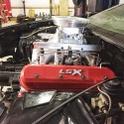
As a start, I have already bought a set of PRC 227's with PAC dual .660" springs, 1.72 roller rockers, 232/234 .600"/.600" 112 LSA cam. FAST 92, NickW throttle body, etc... Lifters and Rods are the last 2 (yea right as if it ever ends) pieces to the puzzle. Have been working slowly on the build over the weekend. Almost completely torn down and ready to start on the upswing.
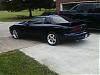
Much like yourself this will be a street car in it's truest form, but still able to smoke some tires in third.
Well, here's a bit more. I finally got a chance to look at that leak on the engine rear, and I found a few different items. Of course, there are pictures, so...
The rear seal was improperly aligned. I didn't bother with a pic of that. you could see the oil trail off the bottom of the rear main seal.
The RTV at the cover corners was hard and crusty. I didn't bother with that picture either - I'm sure you can imagine what that looks like.
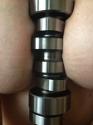
Here's a weird one, though...the barbell had popped out of it's cubby hole:
And, the big finding:
yup, the block was cracked. And I know how and when I did it. Three years ago, when I did my first cam swap, I didn't clean out the head bolt hole in the back good enough. Interesting enough, there was no coolant or oil coming out where it cracked. That was prying against the cover up top, and broke the o-ring seal on the back of the cam:
So, here's the fixes:
I tapped that chip back in and did the best I could to seal it up. it's been like that for three years, so any harm that would have been done is long done. I'll run it for now, but I'm also looking at a lot of blow by, etc, so I'll be int he market for a short block before long, I guess... Here's how the "repair" looks:
I had decided I'd replace the barbell anyway while I was in there, so I put in the Sac City barbell. Really tight fit. Really tight.
Lastly, here's a shot of how this clutch looks after 15,000 miles - just because It's really impressive. Still looks like it did when I installed it:
I like the "fix" 😉. What shortblock set up do you have on your mind?
Lol. Good as new! Likely I'll do LS3. I'm not 100% sure yet. But I won't do a stroker. I'd rather gain cubes with bore and I think GM hit a home run with the 3.62 stroke.
From: Coast of San Mateo County Between Pacifica & HMB
Bore for the Win Baby!
I like that plan Darth, +30" a touch more compression, same cam
and top end, mellow the low speed drive ability and still have the same
Top End RPM!
Lol. Good as new! Likely I'll do LS3. I'm not 100% sure yet. But I won't do a stroker. I'd rather gain cubes with bore and I think GM hit a home run with the 3.62 stroke.
Lol. Good as new! Likely I'll do LS3. I'm not 100% sure yet. But I won't do a stroker. I'd rather gain cubes with bore and I think GM hit a home run with the 3.62 stroke.
I also like stock stroke. My lq4 will go to 4.060 or 4.065 when its time to rebuild. Dart 225 heads to Frankenstein or Mms if he will fool with them so i can get a matching msd intake. Solid roller also to take advantage of rpm with this 8" fti converter.
Edit: also want to do 12 to 1 compression or so with meth injection. Would do e85 but to much pain finding a station
I also like stock stroke. My lq4 will go to 4.060 or 4.065 when its time to rebuild. Dart 225 heads to Frankenstein or Mms if he will fool with them so i can get a matching msd intake. Solid roller also to take advantage of rpm with this 8" fti converter.
Edit: also want to do 12 to 1 compression or so with meth injection. Would do e85 but to much pain finding a station
That'll be a nice build. Keep us posted!
After talking it over with some people, the block is probably fine, so I'll just run it until the rings completely give out and then go from there. There's way more butthurt on the street when they hear its a NA 5.7
Edit - oil pressure up 10-psi after doing all that rear work. Rear main seal is passive, and the chip in the block should be holding. Even if that chip was leaking, it would have been passive given its location. I think the barbell fix was what raised the oil pressure.
Last edited by Darth_V8r; Aug 4, 2017 at 09:54 AM.
Another update. Look what arrived from Chuck BurkhartClause! THe changes are -- Aluminum case vs iron case, wavetrac vs spool (So i can turn in parking lots and neighborhoods without power turning), and 4.30 gear vs 4.11. I'd have it running already, but I didn't have enough RTV to seal the center to the housing, and AZ was closed.
Here is the one I pulled out. The pic doesn't do it justice. The gears were still perfectly shiny and not a scratch on them. If i'd had the flash on, it would have showed better. 5-10k miles on them.
This should be the last thing I have to "undo" on the car to make it a pure pleasure to drive again. I have a friend - LaserLemonTA - who says you go one mod too far and you suddenly have a POS. For me, the spool was just one mod too far. Now people will say it is streetable, and it is. But it took some of the joy of driving away, because of fighting it. I'd much rather deal with cam surge, personally.
Whoever happens to actually get this far reading this thread, be brutally honest with how you intend to use your car before you just do mods for the hell of it. Or before you do a mod on the cheap thinking it'll be OK. Would have been cheaper for me to build it the way I wanted the first time.
I've also got a vacuum pump from GZ that should go in soon *** swell. No pics on that yet. Just want to get the new gears and wavetrac in and see how she drives. I expect the gear to be surprisingly beneficial over the 4.11, even though it isn't that big a change. I feel like the 4.11 was right on the cusp, and the 4.30 will put it over.
Agreed! I mean, what good is a really trick mod if it saps the fun out of driving? Especially when the mods are supposed to make it MORE fun to drive, not less...
7 Most Reliable High-Performance Engines GM Has Ever Built
Slideshow:These GM engines didn't just make huge power, they survived abuse, boost, track days, and six-digit mileage with a reputation for refusing to quit.
6 Common C5 Corvette Failures and What's Involved In Repairing Them
Slideshow: From wobbling harmonic balancers to failed EBCMs, these are the issues that define long-term C5 ownership and what repairs typically involve.
Retro Modern Bandit Pontiac Trans AM Comes With Burt Reynolds' Autograph
Slideshow: A modern Camaro transformed into a retro icon, this limited-run "Bandit" build blends nostalgia with brute force in a way few revivals manage.
Top 10 Greatest Cadillac V Series Performance Models Ever, Ranked
Slideshow: Cadillac didn't just crash the high-performance luxury vehicle party, it showed up loud, supercharged, and occasionally a little unhinged...
Coachbuilt N2A Anteros Is an LS2-Powered C6 Corvette In Italian Clothes
Slideshow: A one-off sports car that looks like a vintage Italian exotic-but hides a C6 Corvette underneath-just sold for the price of a new mid-engine Corvette.