







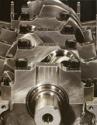



408 Build Thread (New numbers)

Did you check main bearing clearance? Did you mic the crank? I went over mine with a fine tooth comb. I have seen Eagle cranks having problems with machine work. They should always be checked.
Pull the crank out, have it turned .010 and get new bearings. Mic and check main bearing clearance on all the mains. What did the rod bearings look like?
Pull the crank out, have it turned .010 and get new bearings. Mic and check main bearing clearance on all the mains. What did the rod bearings look like?
Also Tony Mamo stresses the importance of clearancing the thrust bearing.
He has seen way too many new stroker motors have bearing failure due to
the thrust bearing (crank end play) being way too tight. IIRC he lightly sands
the thrust surface of the bearing shells on 600 or 1000 grit paper on a super
flat steel or granite plate to acheive .005"-.007" endplay....he's seen most
new cranks start at .001"-.002"....once the bearing material starts flaking
off and wreaking havoc on the rest of the bearings...it's toast.
I thought you mentioned that someone smoothed out your heads ??? I hope
they didn't polish the intake runners..That would make an already large port,
unshrouded valve setup have even worse port speed....in flow bench terms
they call this stalling......really hope you rebound and have some success !!!!
He has seen way too many new stroker motors have bearing failure due to
the thrust bearing (crank end play) being way too tight. IIRC he lightly sands
the thrust surface of the bearing shells on 600 or 1000 grit paper on a super
flat steel or granite plate to acheive .005"-.007" endplay....he's seen most
new cranks start at .001"-.002"....once the bearing material starts flaking
off and wreaking havoc on the rest of the bearings...it's toast.
I thought you mentioned that someone smoothed out your heads ??? I hope
they didn't polish the intake runners..That would make an already large port,
unshrouded valve setup have even worse port speed....in flow bench terms
they call this stalling......really hope you rebound and have some success !!!!
Well got it out and disassembled this morning before work. Main bearings 2 and 4 were worn pretty bad, and 3 wasnt much better. The other 2 were not too bad. It looks to me like they were starved for oil and burnt up. Im not really sure how they would get starved for oil though, and just those 2 in particular. I havent pulled the cam yet to check those bearings, but id imagine they may need replacing as well. Can anyone shed some light on this for me?
Did you check main bearing clearance? Did you mic the crank? I went over mine with a fine tooth comb. I have seen Eagle cranks having problems with machine work. They should always be checked.
Pull the crank out, have it turned .010 and get new bearings. Mic and check main bearing clearance on all the mains. What did the rod bearings look like?
Pull the crank out, have it turned .010 and get new bearings. Mic and check main bearing clearance on all the mains. What did the rod bearings look like?
I thought you mentioned that someone smoothed out your heads ??? I hope
they didn't polish the intake runners..That would make an already large port,
unshrouded valve setup have even worse port speed....in flow bench terms
they call this stalling......really hope you rebound and have some success !!!!
they didn't polish the intake runners..That would make an already large port,
unshrouded valve setup have even worse port speed....in flow bench terms
they call this stalling......really hope you rebound and have some success !!!!
I didnt mic it, but i did check all main bearing clearances with plastigauge. I also had it balanced. He was able to polish the crank, looks like new again. Rod bearings were not too bad, some minor signs of overheating. Im just going to replace them since i have it all apart.
Get a dial bore gauge, mic the crank, zero the dial bore gauge inside your mic, stick the gauge inside the bearing installed and torqued in the block. That will be your bearing clearance.
Also Tony Mamo stresses the importance of clearancing the thrust bearing.
He has seen way too many new stroker motors have bearing failure due to
the thrust bearing (crank end play) being way too tight. IIRC he lightly sands
the thrust surface of the bearing shells on 600 or 1000 grit paper on a super
flat steel or granite plate to acheive .005"-.007" endplay....he's seen most
new cranks start at .001"-.002"....once the bearing material starts flaking
off and wreaking havoc on the rest of the bearings...it's toast.
I thought you mentioned that someone smoothed out your heads ??? I hope
they didn't polish the intake runners..That would make an already large port,
unshrouded valve setup have even worse port speed....in flow bench terms
they call this stalling......really hope you rebound and have some success !!!!
He has seen way too many new stroker motors have bearing failure due to
the thrust bearing (crank end play) being way too tight. IIRC he lightly sands
the thrust surface of the bearing shells on 600 or 1000 grit paper on a super
flat steel or granite plate to acheive .005"-.007" endplay....he's seen most
new cranks start at .001"-.002"....once the bearing material starts flaking
off and wreaking havoc on the rest of the bearings...it's toast.
I thought you mentioned that someone smoothed out your heads ??? I hope
they didn't polish the intake runners..That would make an already large port,
unshrouded valve setup have even worse port speed....in flow bench terms
they call this stalling......really hope you rebound and have some success !!!!
LS1 Tech Stories
The Best V8 Stories One Small Block at Time

6 Common C5 Corvette Failures and What's Involved In Repairing Them
Pouria Savadkouei
Retro Modern Bandit Pontiac Trans AM Comes With Burt Reynolds' Autograph
Verdad Gallardo
Top 10 Greatest Cadillac V Series Performance Models Ever, Ranked
Pouria Savadkouei
Top 10 Most Powerful Chevy Trucks Ever Made!

Hennessey's New Supercharged Silverado ZR2 Has 700 HP
Verdad Gallardo
Coachbuilt N2A Anteros Is an LS2-Powered C6 Corvette In Italian Clothes
Verdad Gallardo
Awesome K5 Blazer Restomod Comes With C7 Corvette Power
Verdad Gallardo
10 Camaros You Should Never Buy

10 LS Engine Myths That Refuse to Die
Verdad Gallardo What about my oiling issue? Its just a high pressure pump, not the high volume one. Also i dont have lifter trays which i heard oil can get hung up on. The only thing i can think of is make sure i have enough clearance for the pick up tube. It should probably be 1/4" of the bottom of the pan correct? any other issues with oiling just on the top end?
You could try the Melling 10296 pump. 18% more volume. Run the lower pressure spring, Blue spring.
When the bypass spring releases in these motors, the extra oil is dumped back into the pickup side of the pump. This makes it harder to starve the engine for oil.
I set my mains to .0021 in an aluminum block, I have 50-55 PSI at hot idle, (I mean really hot heat soaked motor). Its up over 70-75 at WOT. Hard to tell with the stock gauge.
I have the stock LS2 lifter treys as well, no problems.
Car hits the rev limit at 6700 RPM right now.
When the bypass spring releases in these motors, the extra oil is dumped back into the pickup side of the pump. This makes it harder to starve the engine for oil.
I set my mains to .0021 in an aluminum block, I have 50-55 PSI at hot idle, (I mean really hot heat soaked motor). Its up over 70-75 at WOT. Hard to tell with the stock gauge.
I have the stock LS2 lifter treys as well, no problems.
Car hits the rev limit at 6700 RPM right now.
You could try the Melling 10296 pump. 18% more volume. Run the lower pressure spring, Blue spring.
When the bypass spring releases in these motors, the extra oil is dumped back into the pickup side of the pump. This makes it harder to starve the engine for oil.
I set my mains to .0021 in an aluminum block, I have 50-55 PSI at hot idle, (I mean really hot heat soaked motor). Its up over 70-75 at WOT. Hard to tell with the stock gauge.
I have the stock LS2 lifter treys as well, no problems.
Car hits the rev limit at 6700 RPM right now.
When the bypass spring releases in these motors, the extra oil is dumped back into the pickup side of the pump. This makes it harder to starve the engine for oil.
I set my mains to .0021 in an aluminum block, I have 50-55 PSI at hot idle, (I mean really hot heat soaked motor). Its up over 70-75 at WOT. Hard to tell with the stock gauge.
I have the stock LS2 lifter treys as well, no problems.
Car hits the rev limit at 6700 RPM right now.
With his stroker, if he does use the 10296 or M296, I would not use the blue spring and stay with the red. Some of the extra volume will be negated or as you stated bypassed back into the pickup side. The purpose of the high volume is not to soley bypass or make sure there is oil around the pick up. He should be using the extra pressure and volume benefits from the pump to help provide oil through out his motor to key components especilly in a none stock hi performane engine. If not he should just stay with a M295.
Op, this time when you start it up and first 2500 miles, ditch the 10w-30
Use either Conventional oil: Chevron Delo 15W-40 w/ Lucas ZDDP or VR1 20W-50 w/ Lucas ZDDP
Op, this time when you start it up and first 2500 miles, ditch the 10w-30
Use either Conventional oil: Chevron Delo 15W-40 w/ Lucas ZDDP or VR1 20W-50 w/ Lucas ZDDP
When i was first reading up about it i was told that with a stock oil pan the high pressure and high volume pump would suck more oil out of the pan than could return to it. So i just went with the high pressure. My mains were right at .0032 or something near that and i had about 40-45 on a really hot idle, and it could reach near 80 at WOT.
My iron block is set up with about .0025" mains and .0022" rods and sees 40psi hot idle with a 10296 pump and blue spring. I've built three engines that were tighter than yours with 10295 pumps and red springs and the hot idle wasn't anywhere near 40psi, more like 10psi. To have over .003" clearance and 40psi with a 10295 is pretty odd.
With his stroker, if he does use the 10296 or M296, I would not use the blue spring and stay with the red. Some of the extra volume will be negated or as you stated bypassed back into the pickup side. The purpose of the high volume is not to soley bypass or make sure there is oil around the pick up. He should be using the extra pressure and volume benefits from the pump to help provide oil through out his motor to key components especilly in a none stock hi performane engine. If not he should just stay with a M295.
I agree to a certain point.
At idle with the 10296 and red spring, the increased oil pressure readings are usually from the actual increased oil volume from the thicker pump gears. The relief valve is not even coming into play usually. So most people who freak out over this or just worring for nothing. And at cold idle, the thickness and temp of the oil plays a part in the oil pressure readings.
But think about the point when you need the most oil protection especially for a high performance engine. As rpm increases, load increases, this is when you need the most oil protection. The difference between the blue and red spring is that the blue spring will cause the relief valve to open earlier( bypass oil) in the rpm range in realtionship to volume and pressure. The red spring opens the relief valve later allowing more oil and pressure to circulate throught the system and oil pump until it reaches the point where the relief valve spring is activated to release the extra oil(bypass) to the pickup side.
So the red springs does allow more volume and pressure at later rpms vs. the blue spring. How much is the volume difference? I have not measured it myself. But I know how it works and have yet to suck a pan dry as these internet myths preach.
It just does not make sense to get a high volume pump only to use a spring that will bypass the extra volume earlier. At that point you should just use a M295.
You feed the engine what it wants and needs, not what the internet or anybody else says. Look at his motor, bearings, etc, clearly there was an oiling issue or lack of.
At idle with the 10296 and red spring, the increased oil pressure readings are usually from the actual increased oil volume from the thicker pump gears. The relief valve is not even coming into play usually. So most people who freak out over this or just worring for nothing. And at cold idle, the thickness and temp of the oil plays a part in the oil pressure readings.
But think about the point when you need the most oil protection especially for a high performance engine. As rpm increases, load increases, this is when you need the most oil protection. The difference between the blue and red spring is that the blue spring will cause the relief valve to open earlier( bypass oil) in the rpm range in realtionship to volume and pressure. The red spring opens the relief valve later allowing more oil and pressure to circulate throught the system and oil pump until it reaches the point where the relief valve spring is activated to release the extra oil(bypass) to the pickup side.
So the red springs does allow more volume and pressure at later rpms vs. the blue spring. How much is the volume difference? I have not measured it myself. But I know how it works and have yet to suck a pan dry as these internet myths preach.
It just does not make sense to get a high volume pump only to use a spring that will bypass the extra volume earlier. At that point you should just use a M295.
You feed the engine what it wants and needs, not what the internet or anybody else says. Look at his motor, bearings, etc, clearly there was an oiling issue or lack of.
I can’t really see needing any more than 70-75 psi of oil pressure, which is what I have with my current pump setup and the above main clearances and the rods set to .0025 at WOT, 10w 30 Brad Penn synthetic blend.
From what I have read too much pressure is what sucks the pan dry. Or, creates a better chance for it to happen.
What kind of pressure are you getting out of the red spring?
I see the argument here but both of you seem to agree that an m296 would help with my problem?
I talked to the tuner and he said that its very odd that the main bearings wore before the rod bearings. He said normally the rod bearings would go first.
This makes it seem like it was a clearance issue, but i checked all the clearances and the crank turned over beautifully by hand, so it definitely was not too tight.
I just dont know what to do. I hate having a problem, and not really knowing what caused it or how to fix it. I really cant afford to do this again so i need to solve it. Maybe ill order an m296 and run the red spring, and give the pickup a little more clearance. Hopefully thatll solve this
I talked to the tuner and he said that its very odd that the main bearings wore before the rod bearings. He said normally the rod bearings would go first.
This makes it seem like it was a clearance issue, but i checked all the clearances and the crank turned over beautifully by hand, so it definitely was not too tight.
I just dont know what to do. I hate having a problem, and not really knowing what caused it or how to fix it. I really cant afford to do this again so i need to solve it. Maybe ill order an m296 and run the red spring, and give the pickup a little more clearance. Hopefully thatll solve this
52-55 Hot idle... 80-83 WOT Just depends on the oil temp.
Stock motors: M295
Hi Per: M296
IMO
If someone is sucking the pan dry with the M296, they have other issues.
Your clearances, thickness of oil, etc dictates more of your oil pressure than the pump. Case in point, if you have a main bearing problem, oil pressure drops due to the lack of resistance in the system from the opened or increased clearances.
My point is that people are not fully looking into what determines oil pressure. Its more than just deciding whether to use a blue or red spring.
Tighter clearances= higher oil pressure
-Red spring would show higher oil pressure readings before relief valve is opened.
Looser clearances= lower oil pressure
-Red spring would show about normal or slightly higher oil pressure before relief valve is opened.
Stock motors: M295
Hi Per: M296
IMO
If someone is sucking the pan dry with the M296, they have other issues.
Your clearances, thickness of oil, etc dictates more of your oil pressure than the pump. Case in point, if you have a main bearing problem, oil pressure drops due to the lack of resistance in the system from the opened or increased clearances.
My point is that people are not fully looking into what determines oil pressure. Its more than just deciding whether to use a blue or red spring.
Tighter clearances= higher oil pressure
-Red spring would show higher oil pressure readings before relief valve is opened.
Looser clearances= lower oil pressure
-Red spring would show about normal or slightly higher oil pressure before relief valve is opened.
To the OP, I would recommend the 10296 pump. You pick which spring you want to run. I am pretty sure you are running an iron block, so you could go wider on the mains at .0025. The iron blocks do not expand as much as the aluminum blocks do so you will not have as much pressure drop.
Mine were at .0025 on my LS2 402, I bought some .001 under size bearings and just used one half to tighten the mains up.
I think you still had some other issue going on though.
Plastigauge is not very accurate, I would invest in a dial bore gauge. You can get cheap ones through Summit and Jegs.
If you could find one with .0001 accuracy that would be nice
http://www.summitracing.com/parts/sum-900041/overview/
I ordered the melling 10296, i mean it cant hurt right. And im gonna clearance the pickup tube, which should also help. But i still dont know what caused just a few particular main bearings to go and look like it was oil starvation. Also my machine shop has one, i think hed let me borrow it to check my clearances

TECH Addict
Joined: Sep 2009
Posts: 2,481
Likes: 5
From: PA/MD
Did you pull the barbell out and the plugs in the side of the block to look for any debris clogging those ports?
I lost a rod and a set of bearing to a chunk of rtv that got pushed through and laid against the barbell in one of those pirts
I lost a rod and a set of bearing to a chunk of rtv that got pushed through and laid against the barbell in one of those pirts
No i didnt, but i did clean the block very well with hot soapy water, and sprayed the hose through the ports, then used high pressure air to spray all the water out. But ill pop those open and have a look, thanks for the input.
Are you sure about this? I thought the iron blocks expand more thus the reason they have looser clearances, whereas the aluminum will not expand as much and needs tighter clearances.
I ordered the melling 10296, i mean it cant hurt right. And im gonna clearance the pickup tube, which should also help. But i still dont know what caused just a few particular main bearings to go and look like it was oil starvation. Also my machine shop has one, i think hed let me borrow it to check my clearances
I ordered the melling 10296, i mean it cant hurt right. And im gonna clearance the pickup tube, which should also help. But i still dont know what caused just a few particular main bearings to go and look like it was oil starvation. Also my machine shop has one, i think hed let me borrow it to check my clearances
Yes I am sure, aluminum expands way more than iron does. I install press fit bearings in aluminum ford 9 inch pinion supports by heating them up on a hot plate until the bearing races drop in. You cant do that with iron.
Was the block align honed, or at least checked?