



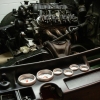


My LS1/T56 swap into '68 Chevy C-10 stepside

Zipped, and in Quicktime format. If you don't want to download and install Quicktime to view it, I highly recommend Quicktime Alternative, which you can download here:
First startup: http://satellitehead.com/stuff/FirstStartup.zip
I kinda haphazardly ran the fuel pump relay, and three fusible links to the PCM and fuel pump in order to fire it up (waiting on my fuse/relay wiring kit from Current Performance). I jacked the car up to be safe and to spin the wheels one time This is the car running with stock '98 Camaro manifolds, stock cats (no exhaust).
Feels good to turn it over, the swap has been 16 months of picking up and losing interest here and there. It's nice to know the engine is good, but there is a lot of work ahead to properly wire this thing up and tuck everything away where it's supposed to be (i.e. safe).
Sad part is I can't drive the damned thing until I get the brakes working, fab up the stupid plate for the hydraulic actuator and install the steering column. You can rest assured at least now I'll have some damned motivation!!
First startup: http://satellitehead.com/stuff/FirstStartup.zip
I kinda haphazardly ran the fuel pump relay, and three fusible links to the PCM and fuel pump in order to fire it up (waiting on my fuse/relay wiring kit from Current Performance). I jacked the car up to be safe and to spin the wheels one time
This is the car running with stock '98 Camaro manifolds, stock cats (no exhaust).Feels good to turn it over, the swap has been 16 months of picking up and losing interest here and there. It's nice to know the engine is good, but there is a lot of work ahead to properly wire this thing up and tuck everything away where it's supposed to be (i.e. safe).
Sad part is I can't drive the damned thing until I get the brakes working, fab up the stupid plate for the hydraulic actuator and install the steering column. You can rest assured at least now I'll have some damned motivation!!
Last edited by shifty`; Apr 19, 2007 at 10:31 AM.
Originally Posted by 68shortstep
dont forget the vid

I know I could post more pictures right now, but I just wanted to post this before I forget:
For anyone else who is using a 5.7L LS1 who also swaps out to use a truck oil pan, windage tray and dipstick like me, I wanted to fill you in: If you fill up the filter like I did before mounting, it takes 5 quarts of oil before you start to register on the dipstick, 5.5 quarts will get you filled up to the middle of the 'operating zone', and I reckon 6 quarts will be on the top of the recommended level.
Just my observation while adding oil. I was pretty surprised after 4 quarts and seeing nothing on the dipstick! Then at 4.5, still nothing, then at 5, showing just a droplet on the dipstick....5.5 seemed to be the sweetspot.
For anyone else who is using a 5.7L LS1 who also swaps out to use a truck oil pan, windage tray and dipstick like me, I wanted to fill you in: If you fill up the filter like I did before mounting, it takes 5 quarts of oil before you start to register on the dipstick, 5.5 quarts will get you filled up to the middle of the 'operating zone', and I reckon 6 quarts will be on the top of the recommended level.
Just my observation while adding oil. I was pretty surprised after 4 quarts and seeing nothing on the dipstick! Then at 4.5, still nothing, then at 5, showing just a droplet on the dipstick....5.5 seemed to be the sweetspot.
man, that's the hardest part
after working and getting all excited, it's hard to post pics after, hate cropping/adjusting/uploading/typing up descriptions/posting at the forum.
keeping up a thread like this is much more work than i thought! when you're on a roll, it's hard to stop and explain/shoot pics.
after working and getting all excited, it's hard to post pics after, hate cropping/adjusting/uploading/typing up descriptions/posting at the forum.
keeping up a thread like this is much more work than i thought! when you're on a roll, it's hard to stop and explain/shoot pics.
Ok, here is my fuel setup, finally took a couple of pics tonight and posting before crashing out.
Supplies and part numbers:
(1) Fuel Pressure gauge, Summit P/N: SUM-800199
(1) Aeroquip adapter P/N: 2242-2-4s (to adapt fuel pressure gauge to fuel rail)
(1) Stock Corvette fuel pressure regulator/filter unit, GM P/N 10299146
(1) 20' spool of -6AN braided steel hose, Summit P/N: SUM-230620 ($74)
(1) Russel Fuel rail adapter 10mm->3/8", Summit P/N: RUS-640850 ($14)
(1) Custom aluminum tank build by board member FuelCellGuy ($625 with pump and sender?)
(-) Tank uses a 'Tanks Inc.' pump setup, Tanks Inc. P/N: PA-2 (note: part no. 'PA-4' will also work).
(-) Tank was coated with Line-X at a local spray shop ($60)
(2) Earl's -6 AN to 1/4 in. NPT 90º swivel adapter, Summit P/N: EAR-829006ERL ($25/ea)
(4) -6 AN hose ends (hose to -6 AN female), Summit P/N: SUM-220690 ($5/ea)
(1) S&P Corvette Fuel Filter adapter 3-piece adapter kit (compression to -6 AN fittings) $100 at www.hotrodlane.cc -> OTHER OPTIONS HERE***
*** NOTE: I was not happy with S&P's fittings and would go with an aftermarket Fuel pressure regulator and separate inline filter next time
Basic diagram of setup from pump to filter:
(Fuel pump) supply -> Earl's swivel -> -6 AN hose end -> -6 AN hose -> -6 AN hose end -> FPR/filter tank supply (S&P fitting)
(Fuel pump) return -> Earl's swivel -> -6 AN hose end -> -6 AN hose -> -6 AN hose end -> FPR/filter tank return (S&P fitting)
Basic setup from FPR/filter to rail:
Filter/FPR -> Filter port to rail (S&P fitting) -> -6 AN hose end -> -6 AN hose -> -6 AN hose end -> Russell fuel rail adapter
That is it in a nutshell.
As you can see in the pictures, I mounted the Vette Filter/FPR to the rear wall of the bed by drilling a hole there and bolting it down. NOTE: the Vette FPR is a joke, and the fitment sucks (stock bracket blows). If I were going to use it again, I would fab up my own bracket, but honestly, it's in your best interest to buy a better aftermarket FPR and use an inline fuel filter between that and the rail.
The S&P fittings are compression and honestly don't fit worth a crap. If you ever need to replace the Filter/FPR, unless you can find a suitable compression ring, you'll be buying new S&P fittings (expensive). Not an ideal situation.
So, long story short, I have two Earl's 90º fittings at the pump taps, Summit fittings attached to those, then a hose up to (and returning from) the Filter/FPR, then the single line out to the rail. All of this was done with exactly 20' of hose, and I will have ~3ft excess after proper routing.
This is ghetto, but because of the lack of sturdiness of the stock GM filter bracket, I had to wire-tie both ends of the filter stems to the rear wall of the bed as you can see. This is to keep movement to a minimum (it works well). The fuel pump power lead and sender lead were both ran along the brake line (down pass side framerail) and into the cab through the hole in the floor where the original stock fuel line went theourh the bottom of the cab.
All fittings were sealed with teflon tape except one (guess what? that fitting is the only one that leaked when testing the pump!! gotta undo it and teflon tape it)
For the fuel rail, I also removed the stock schrader valve from the front of the driver's side fuel rail and installed a fuel pressure gauge there (MORE INFO HERE). Pics of the setup are in the thread I just linked It looks nice.
To test the fuel lines for leaks, I added 5 gallons of fuel to the tank, then properly wired in a relay for the fuel pump - wire diagrams are available here at the forum. DO NOT run your electric fuel pump without at least a couple of gallons of gas in the tank, you'll burn it up (sorry, some people really have no clue about this one, so I gotta say it)
Turn the key to ACC, the fuel pump will run for ~2 seconds to pressurize your lines. Check all fittings for leaks. Check the pressure gauge to make sure you have roughly 50PSI to the rail (pressure will slowly drop off over a few minutes time).
EDIT: Making fuel lines is easy. I was scared to do it because of stories from guys aout shredding their fingers, etc. Here is a simple breakdown of how to do it:
- Get some of the fiberglass packing tape from the store - you know, the transparent tape with white fabric threads running through it. You'll find it at ace hardware.
- Measure your braided line. Mark the hose at the point that the fitting should end.
- Take a the tape, center the tape over the mark you made so that you have equal amounts of tape on either side of the mark - wrap the tape around the hose for one single loop and barely overlapping the ends by 1/4" - pull it tightly together before sticking it.
- Take a dremel or similar cutting wheel (supposedly a sharp chisel will work) and cut the hose in the middle of the tape where your mark would be. The end product will be two taped ends of braided hose. The tape will keep the steel braids from flaring out all over the damn place and cutting you up.
- Take one end of hose, take your hose-end fitting and separate it into two pieces. Remove the tape and quickly push and twist, push and twist, push and twist the hexagonal shaped female end onto the hose end until the hose bottoms out into it. This will take some force - be a man
- With a marker, mark the braided hose where it meets the edge of the fitting. Watch this mark closely as you follow the next step to make sure the fitting doesn't "slip".
- Take the other half of the fitting (tube end) and screw the fitting back together again. This will compress the fitting onto the hose. Result: You are 1/6 of the way through with your hoses if you are using the same setup as me.
Hoses are a piece of cake. I didn't shred my hands once. Be patient, work slowly, never remove the tape until you are prepared to affix the fitting, make sure if the hose end flares, to stuff all the flared pieces into the fitting before you twist it on - and always mark the hose/fitting and look for slippage.
Pics attached of the general setup.
Supplies and part numbers:
(1) Fuel Pressure gauge, Summit P/N: SUM-800199
(1) Aeroquip adapter P/N: 2242-2-4s (to adapt fuel pressure gauge to fuel rail)
(1) Stock Corvette fuel pressure regulator/filter unit, GM P/N 10299146
(1) 20' spool of -6AN braided steel hose, Summit P/N: SUM-230620 ($74)
(1) Russel Fuel rail adapter 10mm->3/8", Summit P/N: RUS-640850 ($14)
(1) Custom aluminum tank build by board member FuelCellGuy ($625 with pump and sender?)
(-) Tank uses a 'Tanks Inc.' pump setup, Tanks Inc. P/N: PA-2 (note: part no. 'PA-4' will also work).
(-) Tank was coated with Line-X at a local spray shop ($60)
(2) Earl's -6 AN to 1/4 in. NPT 90º swivel adapter, Summit P/N: EAR-829006ERL ($25/ea)
(4) -6 AN hose ends (hose to -6 AN female), Summit P/N: SUM-220690 ($5/ea)
(1) S&P Corvette Fuel Filter adapter 3-piece adapter kit (compression to -6 AN fittings) $100 at www.hotrodlane.cc -> OTHER OPTIONS HERE***
*** NOTE: I was not happy with S&P's fittings and would go with an aftermarket Fuel pressure regulator and separate inline filter next time
Basic diagram of setup from pump to filter:
(Fuel pump) supply -> Earl's swivel -> -6 AN hose end -> -6 AN hose -> -6 AN hose end -> FPR/filter tank supply (S&P fitting)
(Fuel pump) return -> Earl's swivel -> -6 AN hose end -> -6 AN hose -> -6 AN hose end -> FPR/filter tank return (S&P fitting)
Basic setup from FPR/filter to rail:
Filter/FPR -> Filter port to rail (S&P fitting) -> -6 AN hose end -> -6 AN hose -> -6 AN hose end -> Russell fuel rail adapter
That is it in a nutshell.
As you can see in the pictures, I mounted the Vette Filter/FPR to the rear wall of the bed by drilling a hole there and bolting it down. NOTE: the Vette FPR is a joke, and the fitment sucks (stock bracket blows). If I were going to use it again, I would fab up my own bracket, but honestly, it's in your best interest to buy a better aftermarket FPR and use an inline fuel filter between that and the rail.
The S&P fittings are compression and honestly don't fit worth a crap. If you ever need to replace the Filter/FPR, unless you can find a suitable compression ring, you'll be buying new S&P fittings (expensive). Not an ideal situation.
So, long story short, I have two Earl's 90º fittings at the pump taps, Summit fittings attached to those, then a hose up to (and returning from) the Filter/FPR, then the single line out to the rail. All of this was done with exactly 20' of hose, and I will have ~3ft excess after proper routing.
This is ghetto, but because of the lack of sturdiness of the stock GM filter bracket, I had to wire-tie both ends of the filter stems to the rear wall of the bed as you can see. This is to keep movement to a minimum (it works well). The fuel pump power lead and sender lead were both ran along the brake line (down pass side framerail) and into the cab through the hole in the floor where the original stock fuel line went theourh the bottom of the cab.
All fittings were sealed with teflon tape except one (guess what? that fitting is the only one that leaked when testing the pump!! gotta undo it and teflon tape it)
For the fuel rail, I also removed the stock schrader valve from the front of the driver's side fuel rail and installed a fuel pressure gauge there (MORE INFO HERE). Pics of the setup are in the thread I just linked
It looks nice.To test the fuel lines for leaks, I added 5 gallons of fuel to the tank, then properly wired in a relay for the fuel pump - wire diagrams are available here at the forum. DO NOT run your electric fuel pump without at least a couple of gallons of gas in the tank, you'll burn it up (sorry, some people really have no clue about this one, so I gotta say it)
Turn the key to ACC, the fuel pump will run for ~2 seconds to pressurize your lines. Check all fittings for leaks. Check the pressure gauge to make sure you have roughly 50PSI to the rail (pressure will slowly drop off over a few minutes time).
EDIT: Making fuel lines is easy. I was scared to do it because of stories from guys aout shredding their fingers, etc. Here is a simple breakdown of how to do it:
- Get some of the fiberglass packing tape from the store - you know, the transparent tape with white fabric threads running through it. You'll find it at ace hardware.
- Measure your braided line. Mark the hose at the point that the fitting should end.
- Take a the tape, center the tape over the mark you made so that you have equal amounts of tape on either side of the mark - wrap the tape around the hose for one single loop and barely overlapping the ends by 1/4" - pull it tightly together before sticking it.
- Take a dremel or similar cutting wheel (supposedly a sharp chisel will work) and cut the hose in the middle of the tape where your mark would be. The end product will be two taped ends of braided hose. The tape will keep the steel braids from flaring out all over the damn place and cutting you up.
- Take one end of hose, take your hose-end fitting and separate it into two pieces. Remove the tape and quickly push and twist, push and twist, push and twist the hexagonal shaped female end onto the hose end until the hose bottoms out into it. This will take some force - be a man
- With a marker, mark the braided hose where it meets the edge of the fitting. Watch this mark closely as you follow the next step to make sure the fitting doesn't "slip".
- Take the other half of the fitting (tube end) and screw the fitting back together again. This will compress the fitting onto the hose. Result: You are 1/6 of the way through with your hoses if you are using the same setup as me.
Hoses are a piece of cake. I didn't shred my hands once. Be patient, work slowly, never remove the tape until you are prepared to affix the fitting, make sure if the hose end flares, to stuff all the flared pieces into the fitting before you twist it on - and always mark the hose/fitting and look for slippage.
Pics attached of the general setup.
Last edited by shifty`; May 4, 2007 at 11:21 AM.
LS1 Tech Stories
The Best V8 Stories One Small Block at Time

Gas Monkey Built a 6-Wheel Ferrari Testarossa With a Corvette LT4 Engine
Verdad Gallardo
7 Most Reliable High-Performance Engines GM Has Ever Built
Verdad Gallardo
Amazing '71 Camaro Restomod Is Modern Muscle Car Under the Skin
Verdad Gallardo
6 Common C5 Corvette Failures and What's Involved In Repairing Them
Pouria Savadkouei
Retro Modern Bandit Pontiac Trans AM Comes With Burt Reynolds' Autograph
Verdad Gallardo
Top 10 Greatest Cadillac V Series Performance Models Ever, Ranked
Pouria Savadkouei
Top 10 Most Powerful Chevy Trucks Ever Made!

Hennessey's New Supercharged Silverado ZR2 Has 700 HP
Verdad Gallardo
Coachbuilt N2A Anteros Is an LS2-Powered C6 Corvette In Italian Clothes
Verdad Gallardo PS - just a point of note: I have over $1,000 in my fuel system and I didn't even go ballzout or anything.
Next time someone posts to ask, "how much does a swap like this cost?", direct them to this post and maybe they'll recognize how much the small stuff REALLY bites you in the *** throughout the swap.
If someone would have told me I'd spend $1k on fuel system alone at the beginning of this swap, I would have laughed at them.
Haha!!
Next time someone posts to ask, "how much does a swap like this cost?", direct them to this post and maybe they'll recognize how much the small stuff REALLY bites you in the *** throughout the swap.
If someone would have told me I'd spend $1k on fuel system alone at the beginning of this swap, I would have laughed at them.
Haha!!

Originally Posted by shifty`
If someone would have told me I'd spend $1k on fuel system alone at the beginning of this swap, I would have laughed at them.
Haha!!
Haha!!
Great Job BTW!!

Fuel system looks great, very nice job and the writeup for assembly is sure to be helpful for others. One note on installing AN hose ends, when you twis you go counterclockwise to get the fitting on. I figured this out after doing many the other way and it takes alot less effort. Keep up the good work on the build.
thanks, the truck is running at this point, i am going to buy the new gauges today (Autometer Steetrod Designer 5" speedo, 5" 4-way multi, 3-5/8 tach).
I started gutting the stock wiring last night and taking out unnecessary wires, also removed the factory bulkhead (will shave the hole). I am using wiring kit SA-1000 from Current Performance and integrating it into both my interior wiring and the hacked harness from Wait4Me. The SA-1000 has just enough circuits to properly wire almost everything in my truck, I just need to figure out a way to integrate a horn relay, hazard flasher relay and turn signal relay nicely into it all.
I am also having stupid problems with the battery - I need to move the batt to the driver side of the truck - they make a stock auxillary batt tray for this, but apparently it only fits '69 and up trucks and I can't easily use a '69-72 core support, so ... I may drill the existing core and tap it to make it work. I'm not sure yet.
Either way - if I get wired up this weekend (lots of time to work on it, I hope), then all that's left is dropping the tranny to remove the slave cylinder and adapt the quick connect to a -3AN using that Russell fitting and I think I can drive it (ok, needs column and brake MC to be hooked up but ...)
I started gutting the stock wiring last night and taking out unnecessary wires, also removed the factory bulkhead (will shave the hole). I am using wiring kit SA-1000 from Current Performance and integrating it into both my interior wiring and the hacked harness from Wait4Me. The SA-1000 has just enough circuits to properly wire almost everything in my truck, I just need to figure out a way to integrate a horn relay, hazard flasher relay and turn signal relay nicely into it all.
I am also having stupid problems with the battery - I need to move the batt to the driver side of the truck - they make a stock auxillary batt tray for this, but apparently it only fits '69 and up trucks
and I can't easily use a '69-72 core support, so ... I may drill the existing core and tap it to make it work. I'm not sure yet.Either way - if I get wired up this weekend (lots of time to work on it, I hope), then all that's left is dropping the tranny to remove the slave cylinder and adapt the quick connect to a -3AN using that Russell fitting and I think I can drive it (ok, needs column and brake MC to be hooked up but ...
) Last edited by shifty`; May 4, 2007 at 11:37 AM.
Teching In
Joined: Mar 2007
Posts: 44
Likes: 0
From: Arkansas
[QUOTE=shifty`]PS - just a point of note: I have over $1,000 in my fuel system and I didn't even go ballzout or anything.
This is the exact reason why I always use the stock GM fuel pump assembly. No offense to anyone but it is crazy to spend this kind of money on a fuel system. I had a friend of mine who happens to be a fabricator make me a 20 gal fuel tank that he made to work with the GM assembly. He also sanded primered and painted it for me to match my frame. I have $250.00 in mine including the fuel pump and sender assembly and I bet it works and looks just as good as the $1,000 setup. So dont lead everyone to believe that they will have to spend crazy money on the fuel system because it can be done right on a budget.
http://s174.photobucket.com/albums/w110/1sick66/
This is the exact reason why I always use the stock GM fuel pump assembly. No offense to anyone but it is crazy to spend this kind of money on a fuel system. I had a friend of mine who happens to be a fabricator make me a 20 gal fuel tank that he made to work with the GM assembly. He also sanded primered and painted it for me to match my frame. I have $250.00 in mine including the fuel pump and sender assembly and I bet it works and looks just as good as the $1,000 setup. So dont lead everyone to believe that they will have to spend crazy money on the fuel system because it can be done right on a budget.
http://s174.photobucket.com/albums/w110/1sick66/
[QUOTE=66 chevy truck man] Even using stock parts, I would have spent $300 on my setup between the stock pump, filter and fittings. Add another $100-300 for lines, and $300 for tank (not everyone has cool friends like you!!) and ... i'm back in the $800-1000 range. My tank has $100 in aluminum in it alone, so ... again - kudos to you.
If I really wanted to, I could have maintained the stock tank...but the reality is, it's old, it's in the cab, and it's a ****-poor solution. Sure, I could have done it and only spent $200...but my life, my comfort and my style is more important.
I could have done things more expensive - ECE's stainless steel tank is $800. That would have been ballzout, especially if I used an aftermarket FPR and an aftermarket inline filter. Would have had over $1800 in my setup at that point. So ... you spent $200, I spent a thousand, could have spent $1800....that puts me in the middle.
For the record, I've openly stated several times that, had I more fabrication skills and cool buddies like you do, I'd have spent a lot less. The reality is, most people don't. Consider yourself lucky. You have "doing things right", and "doing things on a budget", but the two rarely mix. It sounds like you made them mix, and for that you get big kudos from me.
Originally Posted by shifty`
I have $250.00 in mine including the fuel pump and sender assembly and I bet it works and looks just as good as the $1,000 setup. So dont lead everyone to believe that they will have to spend crazy money on the fuel system because it can be done right on a budget.
If I really wanted to, I could have maintained the stock tank...but the reality is, it's old, it's in the cab, and it's a ****-poor solution. Sure, I could have done it and only spent $200...but my life, my comfort and my style is more important.
I could have done things more expensive - ECE's stainless steel tank is $800. That would have been ballzout, especially if I used an aftermarket FPR and an aftermarket inline filter. Would have had over $1800 in my setup at that point. So ... you spent $200, I spent a thousand, could have spent $1800....that puts me in the middle.
For the record, I've openly stated several times that, had I more fabrication skills and cool buddies like you do, I'd have spent a lot less. The reality is, most people don't. Consider yourself lucky. You have "doing things right", and "doing things on a budget", but the two rarely mix. It sounds like you made them mix, and for that you get big kudos from me.
Teching In
Joined: Mar 2007
Posts: 44
Likes: 0
From: Arkansas
Just so you know Shifty the only reason I posted what I did is so that someone who is trying to do a conversion on a budget dosent say oh crap I cant afford to spend a $1,000 bucks on a fuel system and so they get scared and never do the project. I am not dising you for spending what you did hell that is your business I just want to let people know that you can do things to make it affordable. I am only 26 and dont have the budget that alot of you guys do so I have had to learn to be thrifty. Had it not been for using the factory fuel pump assembly and making my tank from plain steel instead of stainless or aluminum I dont know what I would have done. I also was able to use the lines from the salvage truck my motor came out of so that is how I did it for $250.00. Like I said just wanted to let guys like myself know that they dont have to spend $1,000 bucks to get it going. And for the record I couldnt agree with you more about getting the tank out from behind the seat. To me using the stock tank is and really never should be an option. I sure dont like the idea of being strapped to a bomb!
Good luck with the truck man.
http://s174.photobucket.com/albums/w110/1sick66/
Good luck with the truck man.
http://s174.photobucket.com/albums/w110/1sick66/
Shifty,
I think you did pretty good spending only $1K! We have almost $1700 into our fuel system alone. Of course this car will eventually be her showing car, so the stainless becomes easier to justify at that point.
Truckman,
It isn't crazy to spend a few ducats on the fuel system. It is a failry important part of this swap. A nice, baffled tank should be considered a must have item with fuel injection. Unlike a carb, fuel injection cannot tolerate any interuption in the fuel supply. If you plan on doing anything more than idling at the curb, you will want to consider a baffled tank. For some swaps, an existing tank from an OEM setup may work, some people are really good welders (not us), and the rest of us pay good money for a custom solution. It is great that an OEM solution worked out for you, but it won't work for everyone. It depends on the volume available, and what the vehicle will be used for.
I think you did pretty good spending only $1K! We have almost $1700 into our fuel system alone. Of course this car will eventually be her showing car, so the stainless becomes easier to justify at that point.
Truckman,
It isn't crazy to spend a few ducats on the fuel system. It is a failry important part of this swap. A nice, baffled tank should be considered a must have item with fuel injection. Unlike a carb, fuel injection cannot tolerate any interuption in the fuel supply. If you plan on doing anything more than idling at the curb, you will want to consider a baffled tank. For some swaps, an existing tank from an OEM setup may work, some people are really good welders (not us), and the rest of us pay good money for a custom solution. It is great that an OEM solution worked out for you, but it won't work for everyone. It depends on the volume available, and what the vehicle will be used for.
Teching In
Joined: Mar 2007
Posts: 44
Likes: 0
From: Arkansas
Just so you know 67rsss GM does not baffle the full size size truck tanks. My family has done 3 swaps like this all pulling the fuel pump assembly from various 2000-2005 trucks and tahoes and not one of those tanks was baffled. I still have the 05 tank from the truck my 5.3 came out of in the attic and guess what, not one dang baffle. Apparently the guys at GM have figured out how to design the pumps to not require using baffles or im sure they would be. So since the engineers at GM are smarter than me I would say that a baffled tank is not a "must have with fuel injection". I have run my truck several times to the E mark with my non-baffled custom tank and have never had any symptoms of fuel starvation so no offense but I think the whole baffle or no baffle debate is a bunch of B.S. at least when you are using the stock fuel pump assembly. I cant speak for any aftermarket set ups only my own.
http://s174.photobucket.com/albums/w110/1sick66/
http://s174.photobucket.com/albums/w110/1sick66/
not to fuel the fire (i think you have a very good looking truck 66) but GM tanks arnt baffled because the pump has a houseing around it to retain fuel, and this is the baffle to keep the pump submerged... so GM designed this type of baffleing system to keep the fuel from sloshing and cavitating the pump... so the baffleing is a very important part of keeping the pump running properly.

Has any on ever heard of an in-cab tank blowing up? IMO there safe, I just don't like the way they smell. I've ran mine ever since high school and the lack of space behind the seat and the smell is the only complants that I have. I'm finding out that the more I costomize the longer everything takes. Then again I'm do'n a frame off so I shouldn't complane about how long it's taking.
Teching In
Joined: Mar 2007
Posts: 44
Likes: 0
From: Arkansas
Like I said 68 the GM pumps are designed NOT to need baffles IN the tank. This is why I stated that it is not needed when you are using the stock assembly. And thanks for the complements on the truck I really appreciate it. What you said about the pump absoulutley proves my point that with the GM setup a high dollar baffled tank is not needed thus a guy on a budget will save a ton of money by avoiding this step and going with the stock setup.
Hey nitsudls there actually have been reports over the years of our trucks blowing up when there has been a severe collision. I myself have a 20 month old daugther and have taken many steps to make the truck as safe as possible including childseat teathers (dont now if I spelled that right) and removing the fuel tank from behind the seat. I just dont like what ifs. You are probably correct that the chances of this happening are slim to none but I dont think one can be to safe. Thanks again.
Hey nitsudls there actually have been reports over the years of our trucks blowing up when there has been a severe collision. I myself have a 20 month old daugther and have taken many steps to make the truck as safe as possible including childseat teathers (dont now if I spelled that right) and removing the fuel tank from behind the seat. I just dont like what ifs. You are probably correct that the chances of this happening are slim to none but I dont think one can be to safe. Thanks again.