


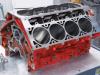
magnesium block

I do not know which is heavier, but I know titanium is stronger and very light. The SR71 Black bird is made from it. I know titanium rods are lighter, but that is probably because they are stronger and need less material to do the job. Don't they make valves out of it too? It is very expensive though, and for the weight reduction you would have in a block it is probably not worth the money. It would be cool to say I have a titanum block. As for magnesium, I had an intake for my old Honda motorcycle that was made out of it and it cracked. i had no idea it was magnesium until I had it welded up. The shop did not realize it was magnisum. It caught fire, and burned at a very high rate. It was blinding how bright the burn was. It finaly burnt out and wow what a mess! I think the real problem was mentioned before is the fact it is a lessor metal, so it will eat away due to electolises in the cooling system. It is used off shore to protect the platforms and ships from corrosion, and it is sometimes placed in large industial engine to protect the liners from corrosion due to electolises. Aluminam does the same thing, it is a lessor metal as compared to cast iron, hince the reason for the different colored coolant with special inhibitors in it to protect the aluminum componets. I do not know what the inhibiters are but I bet magnesum is in there.
And you have to emer land right after take off without being able to dump fuel.

Wish you had those Brembos now huh???
Thread Starter
TECH Addict
iTrader: (8)
Joined: Oct 2008
Posts: 2,047
Likes: 2
From: toronto ontario canada
yea the sr71 used to leak fuel when it was on the ground, because the metal expanded when it was in the air. i think the whole plain was a foot longer in the air then on the ground. but it was probably not made of the same am-sc1 alloy.
This is off topic but I have touched a SR71 once. They have one on the parade ground at the Air Force Boot Camp in San Antonio TX. The **** pit was painted over and the engines were removed but it was there. Bad **** plane. And how would you like to be the poor guy who had to crawl outside and messure that thing at mac million?
 Sorry I just had to get some comedy in.
Sorry I just had to get some comedy in. Thread Starter
TECH Addict
iTrader: (8)
Joined: Oct 2008
Posts: 2,047
Likes: 2
From: toronto ontario canada
This is off topic but I have touched a SR71 once. They have one on the parade ground at the Air Force Boot Camp in San Antonio TX. The **** pit was painted over and the engines were removed but it was there. Bad **** plane. And how would you like to be the poor guy who had to crawl outside and messure that thing at mac million?
Sorry I just had to get some comedy in.
Sorry I just had to get some comedy in. Thread Starter
TECH Addict
iTrader: (8)
Joined: Oct 2008
Posts: 2,047
Likes: 2
From: toronto ontario canada
also i forgot to mention that Nissan's vh45de motor was recast in magnesium for racing in group c in japan. they called the motor VRH35Z , it also had smaller displacement at 3.5 liters. but after sometime they made the same motor out of aluminum alloy called the VRH35L. wonder why ?
here are some figures
The VRH35Z produces 800 ps @7600 rpm and weighs 408 lb (185 kg).
The VRH35L produces 650 ps @6800 rpm and weighs 375 lb (170 kg).
how did the manage to make the magnesium block heavier then aluminum alloy i honestly don't know, but that is probably why the decided to stick with aluminum alloy, then magnesium alloy for their racing motors
here are some figures
The VRH35Z produces 800 ps @7600 rpm and weighs 408 lb (185 kg).
The VRH35L produces 650 ps @6800 rpm and weighs 375 lb (170 kg).
how did the manage to make the magnesium block heavier then aluminum alloy i honestly don't know, but that is probably why the decided to stick with aluminum alloy, then magnesium alloy for their racing motors
Have we covered that Mag might require more tooling cost through increased machining time and wear on the tool heads?
Does it require more expensive casting techniques or more limited in how you can cast it?
Does it require more expensive casting techniques or more limited in how you can cast it?
LS1 Tech Stories
The Best V8 Stories One Small Block at Time

Gas Monkey Built a 6-Wheel Ferrari Testarossa With a Corvette LT4 Engine
Verdad Gallardo
7 Most Reliable High-Performance Engines GM Has Ever Built
Verdad Gallardo
Amazing '71 Camaro Restomod Is Modern Muscle Car Under the Skin
Verdad Gallardo
6 Common C5 Corvette Failures and What's Involved In Repairing Them
Pouria Savadkouei
Retro Modern Bandit Pontiac Trans AM Comes With Burt Reynolds' Autograph
Verdad Gallardo
Top 10 Greatest Cadillac V Series Performance Models Ever, Ranked
Pouria Savadkouei
Top 10 Most Powerful Chevy Trucks Ever Made!

Hennessey's New Supercharged Silverado ZR2 Has 700 HP
Verdad Gallardo
Coachbuilt N2A Anteros Is an LS2-Powered C6 Corvette In Italian Clothes
Verdad Gallardo
The turbine engines my father and I rebuild are made out of magnesium, we'll at least the gearbox is.

I saw the last SR-71 takeoff, it was at Beale AFB near Yuba City. That thing was badass! It was March 6, 1990. I'll never forget that, my dad came and took me out of school to watch that thing fly. I was in first grade. 
I also had dinner with Brian Shul who was one of the SR-71 pilots, really a nice guy. You should have heard some of his stories. Unbelievable **** went down with those SR-71s!
This is off topic but I have touched a SR71 once. They have one on the parade ground at the Air Force Boot Camp in San Antonio TX. The **** pit was painted over and the engines were removed but it was there. Bad **** plane. And how would you like to be the poor guy who had to crawl outside and measure that thing at mac million?
Sorry I just had to get some comedy in.
Sorry I just had to get some comedy in.I also had dinner with Brian Shul who was one of the SR-71 pilots, really a nice guy. You should have heard some of his stories. Unbelievable **** went down with those SR-71s!
I would love to hear some of those stories! I thought they gave a couple to NASA and maybe another scientific resurch center for High altitude research. I also thought I read somewere that they put one or two temperarly back in service for one of the Iraqi conflicts due to the fact the Iraqis knew when the satalites would pass over. Maybe it was the U-2 that was being used at the time. Either way that would be very impresive to see one flying.
As far as magnisium, dont they use it on the shuttle? Saw the one go up yesterday, I have to see one go up in person some day, talk about realy power and big wevos to ride one!!!!
As far as magnisium, dont they use it on the shuttle? Saw the one go up yesterday, I have to see one go up in person some day, talk about realy power and big wevos to ride one!!!!


Yep, all the air-cooled VW's had AS21 or AS41 mag alloy blocks. In a prior life, those little jewels were all I messed with. Usually, the engine fires were caused by the brass fuel line fitting in either the carb or the fuel pump coming out and spraying gas everywhere. Out of the hundreds of those I personally worked on, I never saw a block that had ignited. Most could be salvaged by replacing all the melted aluminum and pot metal parts. The long block would be fine. The shavings from various VW block machining operations in the floor around my mill, that is another story. I learned the hard way that they can and will ignite easily.

The aircraft I work on have magnesium main transmissions and they regularly get replaced due to severe internal corrosion. They are painted but any chip in the paint means it has very little service life left. I can't see this being efficient for consumer vehicles. It is used because aluminum could not handle the stresses placed on it, but most other metals are too heavy.

Only the outside case of the BMW engines are magnesium. It doesn't touch oil or coolant, I believe. The head gasket has an external flange so that fluid cannot touch the aluminum head and magnesium block at the same time, otherwise it would lead to a good amount of corrosion. Magnesium's expansion rate is almost identical to aluminum's, btw.

TECH Resident
Joined: Jul 2009
Posts: 772
Likes: 0
From: Bahrain
I wonder if we could make ceramic blocks? Or maybe not. Rolls Royce went that route and it cost them so much in R&D that they ended up having to sell the automotive division.


On The Tree

Joined: Jan 2008
Posts: 109
Likes: 6
From: Where you least expect me
My experience with Magnesium blocks stems from a v12 engine we worked on at CJ Batten's back in the 90's. The block moved HORRIBLY when you measured at room temperature then at 200 degrees of water temperature. Round holes (cylinders and mains) weren't even close to round any more. Not good for blowby, cylinder sleeve retension, or bearing life.
I don't know the specifics of the BMW blocks, but consider the relationship of iron and aluminum in the LS1. That's the same relationship shared by aluminum and magnesium in the BMW. Aluminum is used for the high load/high wear points, while magnesium is used to make sure you can't see through it.
However, BMW only uses the magnesium blocks in the N/A engines. The turbo engines have fully aluminum blocks for strength.
In mass production, magnesium is actually a very cheap material, partly because it's actually very easy to work with, thanks to a low melting point. I think the C6 engine/suspension cradle is cast magnesium. While magnesium itself isn't as strong as aluminum, it's enough lighter that you can add material to get the strength back and the final part can still save weight vs aluminum. Since it's not that expensive in bulk, the choice is easy.
Titanium is lighter than iron, heavier than aluminum, but as strong as the highest strength steels. The wing box (where the wing spars tie into the fuselage) on the F-22 is cast titanium.
There was a buy a while back for magnesium Cadillac 500 intake manifolds. The producer already had a low volume of sales for aluminum manifolds. He put out feelers to gauge interest in magnesium, which wasn't very high. The cost increase was only about $50 (mostly due to magnesium being an oddball for that foundry), but the weight savings was a few pounds.
TECH Regular
Joined: Sep 2008
Posts: 425
Likes: 1
From: Scottsdale, Arizona
old school VW's were mag cases. Since they are all air cooled, I don't think that heat is that much of an issue since they are air cooled. I drove VW's pretty much in my younger years, drag racing them and even had a 10 second bug.