


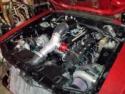


How the MAF really works

Does anybody know the specific heat of humid air and dry air? Or the specific heat of water vapor vs dry air? People have said humid air cools better, others say it cools worse but i haven't seen any numbers to back it up.
Well I found the specific heat of air is about 1.06 kJ/kg K and it's 1.84 kJ/kg K for water vapor. So it takes more heat to raise the temperature of humid air, which should make it cool better right?

TECH Addict

Joined: Mar 2004
Posts: 2,336
Likes: 0
From: Fat Chance Hotel
Originally Posted by P Mack
So it takes more heat to raise the temperature of humid air, which should make it cool better right?
The question would remain...how much?
 late night thinking
 Great thread guys! I'm just getting started in tuning and trying to wrap my head around the whole issue here. Let me throw out some recaps and a couple of theories and let me know what you think.
Given these assumptions:
-flow through the MAF sensor is non-compressible (otherwise stated as compressibility affects are negligible, flow is subsonic)
-reversion affects are negligible (maybe a better way to put it would be changes in reversion affects due to system modifications are negligible)
-geometry of the MAF sensor has not been altered
-changes upstream of the MAF are not causing non-uniform velocity profiles
-mass flow increases (or decreases) do not go "off scale" of the MAF
WHY DOES THE MAF NEED RECALIBRATED AFTER SYSTEM CHANGES THAT AFFECT AIRFLOW?
Thermometer analogy - just because I move to a hotter climate (my engine flows more), doesn't mean my thermometer is invalid (the MAF can't read the flow accurately).
So in a pure sense, it seems intuitive; my MAF calibration should still be valid even though I've changed the system on both sides of it (again, with the given assumptions).
But in practice, we've seen the need to adjust the MAF calibration. Why?
Theory:
We are incorrectly assuming a "DC" type flow. That is, flow at a given TP is steady. In actuality, we are dealing with pulses of air with frequency and amplitude. 1000-6000 RPM = 66-400Hz - intake pulses. MAF is "inherently calibrated" (meaning, I know they are actually calibrated with real flow numbers vs. electrical freq input) to the flow pulses of a given engine - for given a frequency, engine "A" has X amplitude of air pulse. When we modify our engines, we are changing that amplitude of air pulse per given frequency. Which is messing with this inherent calibration. hmmm, having a hard time wording this... maybe some more thinking is needed.
I don't know - it's late and my head is spinning . Maybe I'll wake up tomorrow and wish I hadn't posted this. Well at least it will be good for a laugh!
I think I'm gonna put a carb on my car.

Given these assumptions:
-flow through the MAF sensor is non-compressible (otherwise stated as compressibility affects are negligible, flow is subsonic)
-reversion affects are negligible (maybe a better way to put it would be changes in reversion affects due to system modifications are negligible)
-geometry of the MAF sensor has not been altered
-changes upstream of the MAF are not causing non-uniform velocity profiles
-mass flow increases (or decreases) do not go "off scale" of the MAF
WHY DOES THE MAF NEED RECALIBRATED AFTER SYSTEM CHANGES THAT AFFECT AIRFLOW?
Thermometer analogy - just because I move to a hotter climate (my engine flows more), doesn't mean my thermometer is invalid (the MAF can't read the flow accurately).
So in a pure sense, it seems intuitive; my MAF calibration should still be valid even though I've changed the system on both sides of it (again, with the given assumptions).
But in practice, we've seen the need to adjust the MAF calibration. Why?
Theory:
We are incorrectly assuming a "DC" type flow. That is, flow at a given TP is steady. In actuality, we are dealing with pulses of air with frequency and amplitude. 1000-6000 RPM = 66-400Hz - intake pulses. MAF is "inherently calibrated" (meaning, I know they are actually calibrated with real flow numbers vs. electrical freq input) to the flow pulses of a given engine - for given a frequency, engine "A" has X amplitude of air pulse. When we modify our engines, we are changing that amplitude of air pulse per given frequency. Which is messing with this inherent calibration. hmmm, having a hard time wording this... maybe some more thinking is needed.
I don't know - it's late and my head is spinning
. Maybe I'll wake up tomorrow and wish I hadn't posted this. Well at least it will be good for a laugh!I think I'm gonna put a carb on my car.
that makes a lot of sens to me...but then again...I understand when you use terms liek Amplitude...because I'm an audio guy.
I think you said one phrase that makes perfect sense..
Its been calibrated to the Stock LS1 as it sits unmodified.
and any modification changes airflow.
an increase in airflow changes the way that it crosses the MAF
alos when you change the size of teh hole(i.e. Porting/descreening) you also change the airflow.
IF you change the Pressure at which the air is moving through it then you are changing the speed at which air is moving through it also as teh size of teh hole remains constant...
so now we have an incorrect reading due to the pressure change.
which is why it needs to be recalibrated for any mod
I think you said one phrase that makes perfect sense..
I know they are actually calibrated with real flow numbers vs. electrical freq input) to the flow pulses of a given engine - for given a frequency
and any modification changes airflow.
an increase in airflow changes the way that it crosses the MAF
alos when you change the size of teh hole(i.e. Porting/descreening) you also change the airflow.
IF you change the Pressure at which the air is moving through it then you are changing the speed at which air is moving through it also as teh size of teh hole remains constant...
so now we have an incorrect reading due to the pressure change.
which is why it needs to be recalibrated for any mod

FormerVendor
Joined: Jan 2003
Posts: 525
Likes: 0
From: Melbourne, Australia
i think you guys are recovering issues answered in earlier posts to this thread.
MAF is only accurate for unidirectional, laminar, non-turbulent flow. The MAF has been calibrated as best it could be given the conditions available at calibration time. Any modification that affect the conditions under which the MAF was calculated will change its readings. Especially mods that remove things that are designed to promote non-turbulent, laminar flow (such as the screen) etc.
Think of the physical process as a guy standing in the middle of a busy hallway trying to estimate the number of people that are walking past him by the number that bump into him. If anything other than a marching band in perfect formation goes by he is bound to get it wrong, now imagine it is a large kindergarten and someone just hit the fire alarm...
MAF is only accurate for unidirectional, laminar, non-turbulent flow. The MAF has been calibrated as best it could be given the conditions available at calibration time. Any modification that affect the conditions under which the MAF was calculated will change its readings. Especially mods that remove things that are designed to promote non-turbulent, laminar flow (such as the screen) etc.
Think of the physical process as a guy standing in the middle of a busy hallway trying to estimate the number of people that are walking past him by the number that bump into him. If anything other than a marching band in perfect formation goes by he is bound to get it wrong, now imagine it is a large kindergarten and someone just hit the fire alarm...
i wouldn't say that reversion is ignorable. there are few big setups (forged stroker/big intake/big head/cam suitable for even a bigger stroker) that i worked on where the car would work fine in SD, but i could (and did!) spend hours on trying to get it to run in MAF an the car just wouldn't have it. instant stalling while pulling out of the driveway, BAD bucking at cruise speeds, etc. pull the maf and car drives normal.
i traveled from chicago to california in SD, and i have a lot of data on how trims react to altitude/gradients/temperatures etc. I've been trying to get in there and chew through the data, but i've been busy setting up a new life in CA. short preview though: VE is voilitile, fickle, and can change quite a bit fairly quickly.
more on that later, motivate me
i traveled from chicago to california in SD, and i have a lot of data on how trims react to altitude/gradients/temperatures etc. I've been trying to get in there and chew through the data, but i've been busy setting up a new life in CA. short preview though: VE is voilitile, fickle, and can change quite a bit fairly quickly.
more on that later, motivate me
LS1 Tech Stories
The Best V8 Stories One Small Block at Time

Gas Monkey Built a 6-Wheel Ferrari Testarossa With a Corvette LT4 Engine
Verdad Gallardo
7 Most Reliable High-Performance Engines GM Has Ever Built
Verdad Gallardo
Amazing '71 Camaro Restomod Is Modern Muscle Car Under the Skin
Verdad Gallardo
6 Common C5 Corvette Failures and What's Involved In Repairing Them
Pouria Savadkouei
Retro Modern Bandit Pontiac Trans AM Comes With Burt Reynolds' Autograph
Verdad Gallardo
Top 10 Greatest Cadillac V Series Performance Models Ever, Ranked
Pouria Savadkouei
Top 10 Most Powerful Chevy Trucks Ever Made!

Hennessey's New Supercharged Silverado ZR2 Has 700 HP
Verdad Gallardo
Coachbuilt N2A Anteros Is an LS2-Powered C6 Corvette In Italian Clothes
Verdad Gallardo
Originally Posted by soundengineer
IF you change the Pressure at which the air is moving through it then you are changing the speed at which air is moving through it also as teh size of teh hole remains constant...
so now we have an incorrect reading due to the pressure change.
which is why it needs to be recalibrated for any mod
so now we have an incorrect reading due to the pressure change.
which is why it needs to be recalibrated for any mod
From another thread, here's a very great explanation on how the MAF works:
Originally Posted by John_D.
Discusses voltage based and frequency based.
Has a lot of tables, charts, and formulas.
http://delphi.com/pdf/techpapers/2000-01-0546.pdf
Interesting stuff, but a little deep for me once I got past the first 4-5 pages...
Has a lot of tables, charts, and formulas.
http://delphi.com/pdf/techpapers/2000-01-0546.pdf
Interesting stuff, but a little deep for me once I got past the first 4-5 pages...
