







How do YOU explain "area under the curve" ?

TECH Veteran
Joined: Mar 2004
Posts: 4,662
Likes: 0
From: Sun Diego

Assuming the term has origins in mathematics, where area is expressed in square units (square inches, square miles, etc.), my guess is that 'area under the curve' is meant to describe those components that add power everywhere, not just at the top end, thereby giving you the most area 'under the curve' of a dyno graph. This is how I have always used the term, and how I have read articles that use the term.

TECH Enthusiast
Joined: May 2005
Posts: 555
Likes: 0
From: Blairsville, GA
Picture a dyno graph... it has nice curvy lines on it to show where you make power. I'd consider the area at any rpm less than redline to be under the curve.
As for power under the curve, I agree with TBSS. You wouldn't want 1000 hp at ONLY 5900rpm(Supra syndrome), would you??? Power under the curve means having more average power, as in power at any rpm, and that'll frustrate the hell out of guys with much more PEAK hp and nothing anywhere else in the rpm range.
Little joke... What do a 1000-hp Supra and a 400-hp T/A have in common?
They both run high 11s
As for power under the curve, I agree with TBSS. You wouldn't want 1000 hp at ONLY 5900rpm(Supra syndrome), would you??? Power under the curve means having more average power, as in power at any rpm, and that'll frustrate the hell out of guys with much more PEAK hp and nothing anywhere else in the rpm range.
Little joke... What do a 1000-hp Supra and a 400-hp T/A have in common?
They both run high 11s
As far as drag racing goes here's how i've tried to go about it. First pick the highest rpms you wanna spin your motor. This can be detrermined by your vale train, rotating assembly, estimated rpm band, or oiling methods (my limitation). Now estimate or find out your raceweight. Estimate the power you expect from your combination. Then find yourself a calculator and plug these values in to give you the proper gear choice and estimated e.t. and all that (in general you wanna cross the traps at your horse power peak rpm). I use richmond gears although it is relatively simple it'll get you in the ball park it seems.
After that is all said and done find out what your rpms drops are between shifts from your maximum rpm (need trans and rear end ratios to find this). Now you know the "area under the curve" you should be concerned with.
Most chassis dynoes don't seem to give you an "area under the curve" value but you can divy it off into rpms points, add them up, and then divide by how many points, to get an average or area under the curve.
Engine master's competition scores are actually a sum of the average torque and average horsepower from 2500-6500 rpm, hmm, wonder why they do that, he he.
After that is all said and done find out what your rpms drops are between shifts from your maximum rpm (need trans and rear end ratios to find this). Now you know the "area under the curve" you should be concerned with.
Most chassis dynoes don't seem to give you an "area under the curve" value but you can divy it off into rpms points, add them up, and then divide by how many points, to get an average or area under the curve.
Engine master's competition scores are actually a sum of the average torque and average horsepower from 2500-6500 rpm, hmm, wonder why they do that, he he.
Last edited by DAPSUPRSLO; Apr 22, 2006 at 09:30 AM.
Normally I take a dyno graph, plot its position in coordinates about the X and Y planes on the graph, (substituting the high numbers for lower decimal/fractional values) and take the integral of the function.
Integral of the line Y=MX+B basically about the interval from A to B, A being starting RPMs and B being ending RPMs.
Integral of the line Y=MX+B basically about the interval from A to B, A being starting RPMs and B being ending RPMs.
Trending Topics
LS1 Tech Stories
The Best V8 Stories One Small Block at Time

Topdon ONE vs. Artidiag 800 BT2: Which is the Diagnostic Tablet For You?
Pouria Savadkouei
Gas Monkey Built a 6-Wheel Ferrari Testarossa With a Corvette LT4 Engine
Verdad Gallardo
7 Most Reliable High-Performance Engines GM Has Ever Built
Verdad Gallardo
Amazing '71 Camaro Restomod Is Modern Muscle Car Under the Skin
Verdad Gallardo
6 Common C5 Corvette Failures and What's Involved In Repairing Them
Pouria Savadkouei
Retro Modern Bandit Pontiac Trans AM Comes With Burt Reynolds' Autograph
Verdad Gallardo
Top 10 Greatest Cadillac V Series Performance Models Ever, Ranked
Pouria Savadkouei
Top 10 Most Powerful Chevy Trucks Ever Made!

Hennessey's New Supercharged Silverado ZR2 Has 700 HP
Verdad Gallardo
under the curve is exactly what it says...your hp and torque have a curve. now..the joke with the supra..a 1000 hp supra may make 1000+ hp from 8-9k rpms...thats not a very big curve...so there is less power under the curve. Now with a 400hp t/a...it probably makes 350+ from 3000-6500rpms...making a lot more power under the curve. I think under the curve is more about the usable power band.

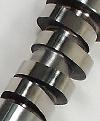
One of the best ways to maximize the area under the curve is by utilizing parts that compliment each other. Too often, racers on this board design their motors without regard to all of the pieces of the puzzle, most notably, the intake manifold. The great thing about the LSX intake is that it gives a nice broad power and torque curve. The downside is that the runner length of the LS1/LS6/FAST and port cross sectional area tend to force a torque peak around 4800 rpm and a power peak around 6300 rpm.
The intake valve closing point is the biggest determiner as to where the motor makes peak power, but the intake manifold will always try to force the 6300 rpm power peak. Sure you can force a later power peak by closing the intake valve later, but experience has shown that the gains up high will not offset the losses in the mid-range. Basically the area under the curve gets worse.
For a stock displacement 346, there are diminishing returns in power once you exceed an intake valve closing point of 46 degrees ABDC at .050" when running an LSX intake manifold. General Motors knows this better than anyone. Just look at their factory race cams:
ASA Cam: 226/236 110LSA (IVC of 43 degrees ABDC)
Grand Cup Cam: 239/251 106LSA (IVC of 45.5 degrees ABDC)
These cams make excellent power under the curve. Why? Because they pump up dynamic compression and close the intake valve within the window that the LSX intake manifold likes.
There are many cams that make good peak power, but are pretty weak in the low and mid range. Almost without exception, they are large duration cams with wide LSAs.
Take this cam for example: 237/242 113LSA +0. This is a popular cam that is known for making good peak numbers, but what is left out is how weak the area under the curve is. Why? Because the intake valve closing point is 52.5 degrees. That's more than 6 degrees past what the LSX intake manifold is tuned for. The small gains up top are not worth the large losses down low. The dynamic compression is a cam-only arrangement is below 8:1. Not good!
So in a nutshell, when running an LSX manifold, we need to keep our valve events in line with the rpm range the intake manifold was designed for if we are interested in maximizing the area under the curve. GM knows this and many on this board know this. Sadly, many of our sponsors are promoting cams to the street/strip crowd that are poor candidates for maximizing the torque curve.
The intake valve closing point is the biggest determiner as to where the motor makes peak power, but the intake manifold will always try to force the 6300 rpm power peak. Sure you can force a later power peak by closing the intake valve later, but experience has shown that the gains up high will not offset the losses in the mid-range. Basically the area under the curve gets worse.
For a stock displacement 346, there are diminishing returns in power once you exceed an intake valve closing point of 46 degrees ABDC at .050" when running an LSX intake manifold. General Motors knows this better than anyone. Just look at their factory race cams:
ASA Cam: 226/236 110LSA (IVC of 43 degrees ABDC)
Grand Cup Cam: 239/251 106LSA (IVC of 45.5 degrees ABDC)
These cams make excellent power under the curve. Why? Because they pump up dynamic compression and close the intake valve within the window that the LSX intake manifold likes.
There are many cams that make good peak power, but are pretty weak in the low and mid range. Almost without exception, they are large duration cams with wide LSAs.
Take this cam for example: 237/242 113LSA +0. This is a popular cam that is known for making good peak numbers, but what is left out is how weak the area under the curve is. Why? Because the intake valve closing point is 52.5 degrees. That's more than 6 degrees past what the LSX intake manifold is tuned for. The small gains up top are not worth the large losses down low. The dynamic compression is a cam-only arrangement is below 8:1. Not good!
So in a nutshell, when running an LSX manifold, we need to keep our valve events in line with the rpm range the intake manifold was designed for if we are interested in maximizing the area under the curve. GM knows this and many on this board know this. Sadly, many of our sponsors are promoting cams to the street/strip crowd that are poor candidates for maximizing the torque curve.
__________________
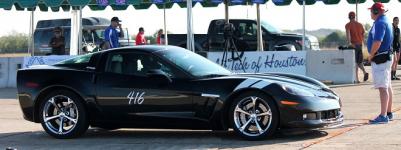
2013 Corvette Grand Sport A6 LME forged 416, Greg Good ported TFS 255 LS3 heads, 222/242 .629"/.604" 121LSA Pat G blower cam, ARH 1 7/8" headers, ESC Novi 1500 Supercharger w/8 rib direct drive conversion, 747rwhp/709rwtq on 93 octane, 801rwhp/735rwtq on race fuel, 10.1 @ 147.25mph 1/4 mile, 174.7mph Half Mile.
2016 Corvette Z51 M7 Magnuson Heartbeat 2300 supercharger, TSP LT headers, Pat G tuned, 667rwhp, 662rwtq, 191mph TX Mile.
2009.5 Pontiac G8 GT 6.0L, A6, AFR 230v2 heads. 506rwhp/442rwtq. 11.413 @ 121.29mph 1/4 mile, 168.7mph TX Mile
2000 Pewter Ram Air Trans Am M6 heads/cam 508 rwhp/445 rwtq SAE, 183.092 TX Mile
2022 Cadillac Escalade 6.2L A10 S&B CAI, Corsa catback.
2023 Corvette 3LT Z51 soon to be modified.
Custom LSX tuning in person or via email press here.
2013 Corvette Grand Sport A6 LME forged 416, Greg Good ported TFS 255 LS3 heads, 222/242 .629"/.604" 121LSA Pat G blower cam, ARH 1 7/8" headers, ESC Novi 1500 Supercharger w/8 rib direct drive conversion, 747rwhp/709rwtq on 93 octane, 801rwhp/735rwtq on race fuel, 10.1 @ 147.25mph 1/4 mile, 174.7mph Half Mile.
2016 Corvette Z51 M7 Magnuson Heartbeat 2300 supercharger, TSP LT headers, Pat G tuned, 667rwhp, 662rwtq, 191mph TX Mile.
2009.5 Pontiac G8 GT 6.0L, A6, AFR 230v2 heads. 506rwhp/442rwtq. 11.413 @ 121.29mph 1/4 mile, 168.7mph TX Mile
2000 Pewter Ram Air Trans Am M6 heads/cam 508 rwhp/445 rwtq SAE, 183.092 TX Mile
2022 Cadillac Escalade 6.2L A10 S&B CAI, Corsa catback.
2023 Corvette 3LT Z51 soon to be modified.
Custom LSX tuning in person or via email press here.

TECH Fanatic
Joined: Sep 2004
Posts: 1,124
Likes: 1
From: Las Vegas
The area between the curve defined by a positive function f and the x axis between two specific values of y is called the definite integral of f between those values. Starting with the fact that the area of a rectangle is the product of its side lengths, we can give a formal definition of the area under a general curve. The method of doing this used is generalized to define a wide variety of integrals that do not describe area. These include integration on a path in the complex plane, along a path in any Euclidean space, over an area in the plane, over a surface in three dimensional space and over volume.
The definite integral can be used to find the area between a graph curve and the ‘x’ axis, between two given ‘x’ values. This area is called the ‘area under the curve’ regardless of whether it is above or below the ‘x’ axis.
Another linky:
http://www.teacherschoice.com.au/Mat...er_a_curve.htm
The definite integral can be used to find the area between a graph curve and the ‘x’ axis, between two given ‘x’ values. This area is called the ‘area under the curve’ regardless of whether it is above or below the ‘x’ axis.
Another linky:
http://www.teacherschoice.com.au/Mat...er_a_curve.htm

The area under the curve is technically the horsepower and/or torque from idle to redline. This has absolutely no bearing on how fast a car is. It is all about the area under the horsepower curve in a range that you will use. So for most of the cars here, 3000rpm-6000rpm. For mine, 4500-7500. Anything below that simply doesn't matter. And if your car is set up to where it does, then you need either better gearing, better tires, or a higher stall converter. There is simply no reason to be in the lower RPMs (torque range) in a drag race (Assuming your car doesn't redline at 3000 of course).
For example, the guy a few posts up said "supra syndrome." Now correct me if I'm wrong, but the Supra can reliably take 600whp on the STOCK bottom end, out of just 3.0 liters. And there are literally hundreds of them pushing 1000+hp (Enough to beat most of the cars on this board). They are quite peaky, and power doesn't come on until 5000rpm (Holding to 8000), but when you have the gearing to take advantage of this 3000rpm spread, what does it matter? The only time spent below 5000rpm with a decent setup is right off the line, but even then if you have enough money to spend on a Supra, then the parts to get it to 1000hp, I doubt a higher stall converter is very expensive, or new rear end gears for a stick. So the Supra may be very on/off around town and daily driving, but when it's time to go fast, all he has to do is put it in the right gear and hold on.
For example, the guy a few posts up said "supra syndrome." Now correct me if I'm wrong, but the Supra can reliably take 600whp on the STOCK bottom end, out of just 3.0 liters. And there are literally hundreds of them pushing 1000+hp (Enough to beat most of the cars on this board). They are quite peaky, and power doesn't come on until 5000rpm (Holding to 8000), but when you have the gearing to take advantage of this 3000rpm spread, what does it matter? The only time spent below 5000rpm with a decent setup is right off the line, but even then if you have enough money to spend on a Supra, then the parts to get it to 1000hp, I doubt a higher stall converter is very expensive, or new rear end gears for a stick. So the Supra may be very on/off around town and daily driving, but when it's time to go fast, all he has to do is put it in the right gear and hold on.
Originally Posted by FieroZ34
The area under the curve is technically the horsepower and/or torque from idle to redline. This has absolutely no bearing on how fast a car is. It is all about the area under the horsepower curve in a range that you will use. So for most of the cars here, 3000rpm-6000rpm. For mine, 4500-7500. Anything below that simply doesn't matter. And if your car is set up to where it does, then you need either better gearing, better tires, or a higher stall converter. There is simply no reason to be in the lower RPMs (torque range) in a drag race (Assuming your car doesn't redline at 3000 of course).
For example, the guy a few posts up said "supra syndrome." Now correct me if I'm wrong, but the Supra can reliably take 600whp on the STOCK bottom end, out of just 3.0 liters. And there are literally hundreds of them pushing 1000+hp (Enough to beat most of the cars on this board). They are quite peaky, and power doesn't come on until 5000rpm (Holding to 8000), but when you have the gearing to take advantage of this 3000rpm spread, what does it matter? The only time spent below 5000rpm with a decent setup is right off the line, but even then if you have enough money to spend on a Supra, then the parts to get it to 1000hp, I doubt a higher stall converter is very expensive, or new rear end gears for a stick. So the Supra may be very on/off around town and daily driving, but when it's time to go fast, all he has to do is put it in the right gear and hold on.
For example, the guy a few posts up said "supra syndrome." Now correct me if I'm wrong, but the Supra can reliably take 600whp on the STOCK bottom end, out of just 3.0 liters. And there are literally hundreds of them pushing 1000+hp (Enough to beat most of the cars on this board). They are quite peaky, and power doesn't come on until 5000rpm (Holding to 8000), but when you have the gearing to take advantage of this 3000rpm spread, what does it matter? The only time spent below 5000rpm with a decent setup is right off the line, but even then if you have enough money to spend on a Supra, then the parts to get it to 1000hp, I doubt a higher stall converter is very expensive, or new rear end gears for a stick. So the Supra may be very on/off around town and daily driving, but when it's time to go fast, all he has to do is put it in the right gear and hold on.
You're right, partially. For an automatic this is irrelevent, but for a stickshift you do lose boost when the thorttle snaps closed. However, so long as you shift into the RPM in which the turbo is timed for, let's say 5000rpm in a 8k redline Supra, the turbo will spool in the next egar near instantaneously, especially with the advancements in blow off valves and ball bearing turbochargers. But it is going to lose boost and have to spool up all over again, and in a 1000hp Supra, the turbo is going to be big enough to where it will lag for a split second, even when your engine is at an RPM that the exhaust gasses can spin the turbo fast enough.

TECH Senior Member


Joined: Apr 2002
Posts: 6,080
Likes: 17
From: So.Cal.
What would the TQ/HP curves look like for a 1000HP Supra and a 1000HP LS1...?
Which one would you rather have...?
Having a large area under the torque curve makes for a very responsive street car (95% of time spent below 4000RPM).
Which one would you rather have...?
Having a large area under the torque curve makes for a very responsive street car (95% of time spent below 4000RPM).

 The above people are correct with their calculus-based explanations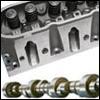
Well, I'm going to stray just a bit from the full race car approach, and avoid the complicated mathmatics as well.
For those of us with a street car, the area under the curve that we should be concerned with starts off-idle and ranges on up to about 3500 rpm. Anything you can do to improve upon that area (under peak torque and horsepower, but where 95% of your driving is done) will net you a better driving, more responsive car. If you can get a torque curve that stays above say 300-350 ft-lbs from 1500 rpms in your daily driver, you'll find that it is much easier to live with than a car that makes something like 250 because it is overcammed, uses high volume ports, valves and exhaust components.
So without going into a hugh mathematical discussion, if you are honest with yourself about what area of the curve you are going to use most, and gear your mods for that, you be much happier with the end results.
For those of us with a street car, the area under the curve that we should be concerned with starts off-idle and ranges on up to about 3500 rpm. Anything you can do to improve upon that area (under peak torque and horsepower, but where 95% of your driving is done) will net you a better driving, more responsive car. If you can get a torque curve that stays above say 300-350 ft-lbs from 1500 rpms in your daily driver, you'll find that it is much easier to live with than a car that makes something like 250 because it is overcammed, uses high volume ports, valves and exhaust components.
So without going into a hugh mathematical discussion, if you are honest with yourself about what area of the curve you are going to use most, and gear your mods for that, you be much happier with the end results.
For a dual-purpose street/strip car, a good benchmark is for the car to be putting down its cubic inch displacement in torque by 3000 rpm and make at least 1.25X its displacement in peak torque.
For a stock displacement LS1, that would mean 346 rwtq by 3000 rpm and a torque peak of 433 rwtq.
Similarly, a 408 would make 408 rwtq by 3000 rpm and 510 rwtq at its peak. Sadly, too many motors on this board (intended for dual-purpose) don't come anywhere close to these mid-range torque numbers and as a result, make poor area under the curve.
For a stock displacement LS1, that would mean 346 rwtq by 3000 rpm and a torque peak of 433 rwtq.
Similarly, a 408 would make 408 rwtq by 3000 rpm and 510 rwtq at its peak. Sadly, too many motors on this board (intended for dual-purpose) don't come anywhere close to these mid-range torque numbers and as a result, make poor area under the curve.