


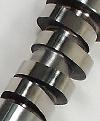



Valve Events

Thread Starter
12 Second Club
iTrader: (1)
Joined: Apr 2004
Posts: 1,369
Likes: 0
From: Clarksville, TN
 Valve Events
 Ok, so I've read through every single post in every single cam tech thread and my head is spinning. I need some help from some of the guys that know what they're talking about, haha
This isn't a 'which cam is better' post, but I will throw some cams up for comparison. It's just come to my attention that the events in my current cam (228/232 112+0, XE-R) are less than ideal. I asked Patrick G what he thought about a new type of set-up and he was more than awesome in giving me some new specs (227/235 110+2, LSK). I've also tuned a cam that was very similar to mine but made tons more power (228/230 114+0, XE-R).
Patrick mentioned that less than 46* IVC is best for our tuned intakes, got that. Also that overlap should be biased towards the intake side. That makes sense to me because that's how we make power at the top end, by letting the motor breathe.
But how do I read these events? I'm at a loss! I have no doubt that Patrick G's recommendation will make lots of power, I just want to know why and how to read cams and valve events so that I can make an educated decision and be more knowlegeable in the future. Thanks for the help!
Here's the specs:

This isn't a 'which cam is better' post, but I will throw some cams up for comparison. It's just come to my attention that the events in my current cam (228/232 112+0, XE-R) are less than ideal. I asked Patrick G what he thought about a new type of set-up and he was more than awesome in giving me some new specs (227/235 110+2, LSK). I've also tuned a cam that was very similar to mine but made tons more power (228/230 114+0, XE-R).
Patrick mentioned that less than 46* IVC is best for our tuned intakes, got that. Also that overlap should be biased towards the intake side. That makes sense to me because that's how we make power at the top end, by letting the motor breathe.
But how do I read these events? I'm at a loss! I have no doubt that Patrick G's recommendation will make lots of power, I just want to know why and how to read cams and valve events so that I can make an educated decision and be more knowlegeable in the future. Thanks for the help!
Here's the specs:
Change your screen shot if Brian's cam is Brian from TFS. Brian Tooley's cam is 228/230 112LSA +4.
__________________

2013 Corvette Grand Sport A6 LME forged 416, Greg Good ported TFS 255 LS3 heads, 222/242 .629"/.604" 121LSA Pat G blower cam, ARH 1 7/8" headers, ESC Novi 1500 Supercharger w/8 rib direct drive conversion, 747rwhp/709rwtq on 93 octane, 801rwhp/735rwtq on race fuel, 10.1 @ 147.25mph 1/4 mile, 174.7mph Half Mile.
2016 Corvette Z51 M7 Magnuson Heartbeat 2300 supercharger, TSP LT headers, Pat G tuned, 667rwhp, 662rwtq, 191mph TX Mile.
2009.5 Pontiac G8 GT 6.0L, A6, AFR 230v2 heads. 506rwhp/442rwtq. 11.413 @ 121.29mph 1/4 mile, 168.7mph TX Mile
2000 Pewter Ram Air Trans Am M6 heads/cam 508 rwhp/445 rwtq SAE, 183.092 TX Mile
2022 Cadillac Escalade 6.2L A10 S&B CAI, Corsa catback.
2023 Corvette 3LT Z51 soon to be modified.
Custom LSX tuning in person or via email press here.
2013 Corvette Grand Sport A6 LME forged 416, Greg Good ported TFS 255 LS3 heads, 222/242 .629"/.604" 121LSA Pat G blower cam, ARH 1 7/8" headers, ESC Novi 1500 Supercharger w/8 rib direct drive conversion, 747rwhp/709rwtq on 93 octane, 801rwhp/735rwtq on race fuel, 10.1 @ 147.25mph 1/4 mile, 174.7mph Half Mile.
2016 Corvette Z51 M7 Magnuson Heartbeat 2300 supercharger, TSP LT headers, Pat G tuned, 667rwhp, 662rwtq, 191mph TX Mile.
2009.5 Pontiac G8 GT 6.0L, A6, AFR 230v2 heads. 506rwhp/442rwtq. 11.413 @ 121.29mph 1/4 mile, 168.7mph TX Mile
2000 Pewter Ram Air Trans Am M6 heads/cam 508 rwhp/445 rwtq SAE, 183.092 TX Mile
2022 Cadillac Escalade 6.2L A10 S&B CAI, Corsa catback.
2023 Corvette 3LT Z51 soon to be modified.
Custom LSX tuning in person or via email press here.

Banned
Joined: Aug 2006
Posts: 326
Likes: 0
From: North Bay, CA
Thread Starter
12 Second Club
iTrader: (1)
Joined: Apr 2004
Posts: 1,369
Likes: 0
From: Clarksville, TN
Ok, so that really helped me visualize what was going on, but I still need some help with what the 'recipe' for power is. I know there's no stead-fast and hard rules, because otherwise we'd all be running the same cam, but I'm having issues visualizing 'what makes power' if that makes any sense.
Maybe I'm looking at the valve events in the wrong duration figure...
Here's what I've got so far (those degree marks should be pretty accurate, too)
Maybe I'm looking at the valve events in the wrong duration figure...
Here's what I've got so far (those degree marks should be pretty accurate, too)
Trending Topics

TECH Resident
Joined: Dec 2004
Posts: 845
Likes: 0
From: K-W, Ontario
I still need some help with what the 'recipe' for power is.
I don't fully understand what you're after, but I do know you also need to
consider what's happening at the valves instead of at the cam lobe.
When picking the camshaft, the rocker ratio, pre-load/lash and thermal expansion
are three big players in what will determine the effective overlap and duration.
Comparing the exact setup, by only changing pre-load by a few thousandths
can make a difference in the dyno numbers and peak RPM.
LS1 Tech Stories
The Best V8 Stories One Small Block at Time

Top 10 Greatest Cadillac V Series Performance Models Ever, Ranked
Pouria Savadkouei
Top 10 Most Powerful Chevy Trucks Ever Made!

Hennessey's New Supercharged Silverado ZR2 Has 700 HP
Verdad Gallardo
Coachbuilt N2A Anteros Is an LS2-Powered C6 Corvette In Italian Clothes
Verdad Gallardo
Awesome K5 Blazer Restomod Comes With C7 Corvette Power
Verdad Gallardo
10 Camaros You Should Never Buy

10 LS Engine Myths That Refuse to Die
Verdad Gallardo
Five Reasons the Camaro Was the Most Pivotal Player in the Pony Car Wars 2.0
Brett Foote
10 Reasons the LS7 Is GM's Most Extreme Naturally Aspirated V8 Engine Ever
Verdad Gallardo Thread Starter
12 Second Club
iTrader: (1)
Joined: Apr 2004
Posts: 1,369
Likes: 0
From: Clarksville, TN
I'm assuming 1.7 stocker rockers and 22ftlbs of preload...
basically I'm trying to pick the brains of the experts and get them to show me (us) what types of events are better geared for what range of power, whether overlap should always be biased towards the intake side, and if it is, why it's not on a lot of popular cams....
Just kinda wanting to know... you know... everything! Or at least as much as they're willing to share, haha
basically I'm trying to pick the brains of the experts and get them to show me (us) what types of events are better geared for what range of power, whether overlap should always be biased towards the intake side, and if it is, why it's not on a lot of popular cams....
Just kinda wanting to know... you know... everything! Or at least as much as they're willing to share, haha

TECH Fanatic
Joined: Jun 2002
Posts: 1,979
Likes: 3
From: Upstate NY
Originally Posted by CamTom12
I still need some help with what the 'recipe' for power is.
Not everyone has a good grasp of what works and what doesn't. That may be because changing one variable in the package can change the others, and few of us can juggle 5 or 10 or 20 variables in our heads at one time.
If you define what you want, like max acceleration in the 1/4 mile, or a stealthy daily driver that hauls butt and passes a sniffer, or a top speed only car, etc. an engine designer can then design an engine that will accomplish your goals, or if you already have the engine, the (cam) designer can spec a valvetrain that gets as much as possible out of what you have (hardware) and what you want, and how much you are willing to spend.
IMO opinion, many folks get lost in the cam details (LSA, overlap, "splits", etc) without a good understanding of the valve events that a specific engine/vehicle combination wants, and perhaps more importantly, why it wants them. One, two or three cams don't fit all combinations, but within a range of engine/vehicle combinations, you can come pretty close with a few different cams. That's why head/cam packages can be tailored fairly well for a few specific uses.
How does one determine that his/her current cam is less than ideal? If the engine/vehicle combination isn't doing what you want (assuming all the parts are working together correctly), the valve events might be one of the problems, but they are only part of the package. A "good" cam can't save a bad combination, but a "bad" cam can certainly ruin a good combination.
Sharing information is only as good as the ability the "sharee" to understand it. No offense intended to anyone reading this, but it is obvious that many folks who post on forums like this don't have enough understanding of how engines really work to discuss valve event selection. Many have spent years or a career learning, and still learn something helpful almost daily. I do. No one person has all the answers nor even all the information.
If I personally wanted/needed a different cam, I'd first spend a lot of time on my favorite engine simulator and vehicle performance simulator trying many different combinations (hundreds, perhaps) and then I'd go to an engine designer I trusted, have him spec a cam for me and discuss our different/similar results. Of course if one were just throwing numbers into Desktop Dyno, I'd advise just going to the engine designer. I recently saw an engine that was farily well designed with the exception of the cam. DD had been used to spec the cam which had at least 20 degrees too much duration.
Sometime check out the percentage of threads on this (or similar) forums which deal specifically with cams. IMO, it's way more than it should be. Perhaps that's because "cam design" seems like a black art or because folks think of the cam as a "magic bullet" which will solve all of their wants/needs/problems. It's neither.
My highly opinionated $.02.
Thread Starter
12 Second Club
iTrader: (1)
Joined: Apr 2004
Posts: 1,369
Likes: 0
From: Clarksville, TN
Originally Posted by Old SStroker
IMO opinion, many folks get lost in the cam details (LSA, overlap, "splits", etc) without a good understanding of the valve events that a specific engine/vehicle combination wants, and perhaps more importantly, why it wants them.
This is EXACTLY what I was trying to ask! You nailed it on the head, Old SStroker!
I wanted to give motor specs for people to reference but at the same time I really want to shy away from giving my motor specs. I'm not asking this to have someone spec me a cam for free, I'm asking because I want someone with the experience of what works to share as much of that as they can/are willing to share.
I realize that there are many variables that go into VE selection, my main questions tend to run along the lines of why. Why people choose to place overlap centered over where for what purpose, why they choose the IVC where they put it, etc.
I probably should invest in a copy of desktop dyno too, but with saving for a new cam and intake that might be a while off, haha... This damn expensive obsession

I'm surprised CamKing isin't in here trying to teach all of us something.....
Old SStroker has that name for a reason ;-)
Please just leave the DD alone, that motor he mentioned in question with the cam far off is a SBF thats in a car i'm working on. (It NEEDS A LS2 instead) The cam is just so far off the thing is a pig and even if it did hook the thing wouldn't do well, the sad thing is that you can look up a engine article off of AFR's site or a number of other places with this combination and get a cam that is dam close, the guy who built the motor didn't beleive that real world stuff and used a bad simulator program because it said it would make all sorts of power. Guess what it doesn't.
Bret
Old SStroker has that name for a reason ;-)
Please just leave the DD alone, that motor he mentioned in question with the cam far off is a SBF thats in a car i'm working on. (It NEEDS A LS2 instead) The cam is just so far off the thing is a pig and even if it did hook the thing wouldn't do well, the sad thing is that you can look up a engine article off of AFR's site or a number of other places with this combination and get a cam that is dam close, the guy who built the motor didn't beleive that real world stuff and used a bad simulator program because it said it would make all sorts of power. Guess what it doesn't.
Bret


11 Second Club
iTrader: (20)
Joined: Sep 2002
Posts: 2,684
Likes: 3
From: Albuquerque NM - The Land of 8000ft DA
Originally Posted by Old SStroker
There is no specific "recipe" for power. Valve event timing needs to be chosen based upon all the engine specs (displacement, SCR, head intake and exhaust lengths and flow, among lots of other things) as well as vehicle specs like transmission/converter, final drive ratio, traction availiable, and what the owner/driver wants from the complete vehicle/engine package. If that sounds like a lot of variables to consider...it certainly is.
Not everyone has a good grasp of what works and what doesn't. That may be because changing one variable in the package can change the others, and few of us can juggle 5 or 10 or 20 variables in our heads at one time.
If you define what you want, like max acceleration in the 1/4 mile, or a stealthy daily driver that hauls butt and passes a sniffer, or a top speed only car, etc. an engine designer can then design an engine that will accomplish your goals, or if you already have the engine, the (cam) designer can spec a valvetrain that gets as much as possible out of what you have (hardware) and what you want, and how much you are willing to spend.
IMO opinion, many folks get lost in the cam details (LSA, overlap, "splits", etc) without a good understanding of the valve events that a specific engine/vehicle combination wants, and perhaps more importantly, why it wants them. One, two or three cams don't fit all combinations, but within a range of engine/vehicle combinations, you can come pretty close with a few different cams. That's why head/cam packages can be tailored fairly well for a few specific uses.
How does one determine that his/her current cam is less than ideal? If the engine/vehicle combination isn't doing what you want (assuming all the parts are working together correctly), the valve events might be one of the problems, but they are only part of the package. A "good" cam can't save a bad combination, but a "bad" cam can certainly ruin a good combination.
Sharing information is only as good as the ability the "sharee" to understand it. No offense intended to anyone reading this, but it is obvious that many folks who post on forums like this don't have enough understanding of how engines really work to discuss valve event selection. Many have spent years or a career learning, and still learn something helpful almost daily. I do. No one person has all the answers nor even all the information.
If I personally wanted/needed a different cam, I'd first spend a lot of time on my favorite engine simulator and vehicle performance simulator trying many different combinations (hundreds, perhaps) and then I'd go to an engine designer I trusted, have him spec a cam for me and discuss our different/similar results. Of course if one were just throwing numbers into Desktop Dyno, I'd advise just going to the engine designer. I recently saw an engine that was farily well designed with the exception of the cam. DD had been used to spec the cam which had at least 20 degrees too much duration.
Sometime check out the percentage of threads on this (or similar) forums which deal specifically with cams. IMO, it's way more than it should be. Perhaps that's because "cam design" seems like a black art or because folks think of the cam as a "magic bullet" which will solve all of their wants/needs/problems. It's neither.
My highly opinionated $.02.
Not everyone has a good grasp of what works and what doesn't. That may be because changing one variable in the package can change the others, and few of us can juggle 5 or 10 or 20 variables in our heads at one time.
If you define what you want, like max acceleration in the 1/4 mile, or a stealthy daily driver that hauls butt and passes a sniffer, or a top speed only car, etc. an engine designer can then design an engine that will accomplish your goals, or if you already have the engine, the (cam) designer can spec a valvetrain that gets as much as possible out of what you have (hardware) and what you want, and how much you are willing to spend.
IMO opinion, many folks get lost in the cam details (LSA, overlap, "splits", etc) without a good understanding of the valve events that a specific engine/vehicle combination wants, and perhaps more importantly, why it wants them. One, two or three cams don't fit all combinations, but within a range of engine/vehicle combinations, you can come pretty close with a few different cams. That's why head/cam packages can be tailored fairly well for a few specific uses.
How does one determine that his/her current cam is less than ideal? If the engine/vehicle combination isn't doing what you want (assuming all the parts are working together correctly), the valve events might be one of the problems, but they are only part of the package. A "good" cam can't save a bad combination, but a "bad" cam can certainly ruin a good combination.
Sharing information is only as good as the ability the "sharee" to understand it. No offense intended to anyone reading this, but it is obvious that many folks who post on forums like this don't have enough understanding of how engines really work to discuss valve event selection. Many have spent years or a career learning, and still learn something helpful almost daily. I do. No one person has all the answers nor even all the information.
If I personally wanted/needed a different cam, I'd first spend a lot of time on my favorite engine simulator and vehicle performance simulator trying many different combinations (hundreds, perhaps) and then I'd go to an engine designer I trusted, have him spec a cam for me and discuss our different/similar results. Of course if one were just throwing numbers into Desktop Dyno, I'd advise just going to the engine designer. I recently saw an engine that was farily well designed with the exception of the cam. DD had been used to spec the cam which had at least 20 degrees too much duration.
Sometime check out the percentage of threads on this (or similar) forums which deal specifically with cams. IMO, it's way more than it should be. Perhaps that's because "cam design" seems like a black art or because folks think of the cam as a "magic bullet" which will solve all of their wants/needs/problems. It's neither.
My highly opinionated $.02.
but that's not in my speadsheet calculator!!(not directed towards camtom12 btw)

Great info....as always.
Thread Starter
12 Second Club
iTrader: (1)
Joined: Apr 2004
Posts: 1,369
Likes: 0
From: Clarksville, TN
Old SStroker et al... What I want to understand is why the practical application works. Given a fixed combo (I can post mine up, but I really don't want this to turn into a "what cam should I go with" thread), why would you move the VE's where to make power at the top, why would you move them where to make power down low, what have you seen work on these motors and what appearingly sound theories have you seen disproved, etc.
I deal with much more complicated things than the Otto Cycle and wave dynamics on a daily basis, I just was hoping to draw some of the 'experience' out of our most experienced members
I deal with much more complicated things than the Otto Cycle and wave dynamics on a daily basis, I just was hoping to draw some of the 'experience' out of our most experienced members

TECH Addict

Joined: Jul 2002
Posts: 2,261
Likes: 0
Originally Posted by Old SStroker
There is no specific "recipe" for power. Valve event timing needs to be chosen based upon all the engine specs (displacement, SCR, head intake and exhaust lengths and flow, among lots of other things) as well as vehicle specs like transmission/converter, final drive ratio, traction availiable, and what the owner/driver wants from the complete vehicle/engine package. If that sounds like a lot of variables to consider...it certainly is.
Not everyone has a good grasp of what works and what doesn't. That may be because changing one variable in the package can change the others, and few of us can juggle 5 or 10 or 20 variables in our heads at one time.
If you define what you want, like max acceleration in the 1/4 mile, or a stealthy daily driver that hauls butt and passes a sniffer, or a top speed only car, etc. an engine designer can then design an engine that will accomplish your goals, or if you already have the engine, the (cam) designer can spec a valvetrain that gets as much as possible out of what you have (hardware) and what you want, and how much you are willing to spend.
IMO opinion, many folks get lost in the cam details (LSA, overlap, "splits", etc) without a good understanding of the valve events that a specific engine/vehicle combination wants, and perhaps more importantly, why it wants them. One, two or three cams don't fit all combinations, but within a range of engine/vehicle combinations, you can come pretty close with a few different cams. That's why head/cam packages can be tailored fairly well for a few specific uses.
How does one determine that his/her current cam is less than ideal? If the engine/vehicle combination isn't doing what you want (assuming all the parts are working together correctly), the valve events might be one of the problems, but they are only part of the package. A "good" cam can't save a bad combination, but a "bad" cam can certainly ruin a good combination.
Sharing information is only as good as the ability the "sharee" to understand it. No offense intended to anyone reading this, but it is obvious that many folks who post on forums like this don't have enough understanding of how engines really work to discuss valve event selection. Many have spent years or a career learning, and still learn something helpful almost daily. I do. No one person has all the answers nor even all the information.
If I personally wanted/needed a different cam, I'd first spend a lot of time on my favorite engine simulator and vehicle performance simulator trying many different combinations (hundreds, perhaps) and then I'd go to an engine designer I trusted, have him spec a cam for me and discuss our different/similar results. Of course if one were just throwing numbers into Desktop Dyno, I'd advise just going to the engine designer. I recently saw an engine that was farily well designed with the exception of the cam. DD had been used to spec the cam which had at least 20 degrees too much duration.
Sometime check out the percentage of threads on this (or similar) forums which deal specifically with cams. IMO, it's way more than it should be. Perhaps that's because "cam design" seems like a black art or because folks think of the cam as a "magic bullet" which will solve all of their wants/needs/problems. It's neither.
My highly opinionated $.02.
Not everyone has a good grasp of what works and what doesn't. That may be because changing one variable in the package can change the others, and few of us can juggle 5 or 10 or 20 variables in our heads at one time.
If you define what you want, like max acceleration in the 1/4 mile, or a stealthy daily driver that hauls butt and passes a sniffer, or a top speed only car, etc. an engine designer can then design an engine that will accomplish your goals, or if you already have the engine, the (cam) designer can spec a valvetrain that gets as much as possible out of what you have (hardware) and what you want, and how much you are willing to spend.
IMO opinion, many folks get lost in the cam details (LSA, overlap, "splits", etc) without a good understanding of the valve events that a specific engine/vehicle combination wants, and perhaps more importantly, why it wants them. One, two or three cams don't fit all combinations, but within a range of engine/vehicle combinations, you can come pretty close with a few different cams. That's why head/cam packages can be tailored fairly well for a few specific uses.
How does one determine that his/her current cam is less than ideal? If the engine/vehicle combination isn't doing what you want (assuming all the parts are working together correctly), the valve events might be one of the problems, but they are only part of the package. A "good" cam can't save a bad combination, but a "bad" cam can certainly ruin a good combination.
Sharing information is only as good as the ability the "sharee" to understand it. No offense intended to anyone reading this, but it is obvious that many folks who post on forums like this don't have enough understanding of how engines really work to discuss valve event selection. Many have spent years or a career learning, and still learn something helpful almost daily. I do. No one person has all the answers nor even all the information.
If I personally wanted/needed a different cam, I'd first spend a lot of time on my favorite engine simulator and vehicle performance simulator trying many different combinations (hundreds, perhaps) and then I'd go to an engine designer I trusted, have him spec a cam for me and discuss our different/similar results. Of course if one were just throwing numbers into Desktop Dyno, I'd advise just going to the engine designer. I recently saw an engine that was farily well designed with the exception of the cam. DD had been used to spec the cam which had at least 20 degrees too much duration.
Sometime check out the percentage of threads on this (or similar) forums which deal specifically with cams. IMO, it's way more than it should be. Perhaps that's because "cam design" seems like a black art or because folks think of the cam as a "magic bullet" which will solve all of their wants/needs/problems. It's neither.
My highly opinionated $.02.

Part of the Old mans post isin't as much about how to make TQ at higher or lower RPM, but more in a RPM range average and maximixing what's in there. Usually the best way to make the most there is not what people think.
Bret
Bret

Teching In
Joined: Aug 2012
Posts: 17
Likes: 0
From: Texas
Old SStroker et al... What I want to understand is why the practical application works. Given a fixed combo (I can post mine up, but I really don't want this to turn into a "what cam should I go with" thread), why would you move the VE's where to make power at the top, why would you move them where to make power down low, what have you seen work on these motors and what appearingly sound theories have you seen disproved, etc.
I deal with much more complicated things than the Otto Cycle and wave dynamics on a daily basis, I just was hoping to draw some of the 'experience' out of our most experienced members
I deal with much more complicated things than the Otto Cycle and wave dynamics on a daily basis, I just was hoping to draw some of the 'experience' out of our most experienced members
I attribute this response to two scenarios:
1) they don't have the understanding themselves, but only an experience of what has and has not worked for them or
2) they don't want to divulge knowledge for intellectual property reasons or business reasons.

TECH Resident
Joined: Dec 2004
Posts: 845
Likes: 0
From: K-W, Ontario
The dreaded email notification appeared...I thought this thread was dead, and gone.
There are a couple potential problems with trying to learn complex systems on a web forum:
- nobody wants to re-type the 1000's of pages of scientific data they own in hard cover books written by qualified individuals.
- certain members who reply with their best intentions don't understand the subject, and
how the cam deals with intake systems, exhaust systems, atmospheric conditions, engine component properties, displacement, piston velocity, air mass & momentum, pressure changes in the system, etc.
If you're that serious about learning, you should seek the answers via published texts.
There are a couple potential problems with trying to learn complex systems on a web forum:
- nobody wants to re-type the 1000's of pages of scientific data they own in hard cover books written by qualified individuals.
- certain members who reply with their best intentions don't understand the subject, and
how the cam deals with intake systems, exhaust systems, atmospheric conditions, engine component properties, displacement, piston velocity, air mass & momentum, pressure changes in the system, etc.
If you're that serious about learning, you should seek the answers via published texts.


