


How does cam timing work?




 How does cam timing work?
 I know that if a cam's timing is high, it will have better low-range power. If it's degreed lower, it will have better high range power...
...But how does this work? I mean, what is physically happening that causes the powerband to change? A friend and I were discussing this and I couldn't see what would cause it change where the power was made. If anyone knows, please share. I hope I'm not the only guy thinking this, so hopefully this will answer a question many people may have.
Thanks!
...But how does this work? I mean, what is physically happening that causes the powerband to change? A friend and I were discussing this and I couldn't see what would cause it change where the power was made. If anyone knows, please share. I hope I'm not the only guy thinking this, so hopefully this will answer a question many people may have.
Thanks!

TECH Enthusiast
Joined: Jul 2006
Posts: 638
Likes: 0
From: San Diego
Originally Posted by Cerebrex
I know that if a cam's timing is high, it will have better low-range power. If it's degreed lower, it will have better high range power...
...But how does this work? I mean, what is physically happening that causes the powerband to change? A friend and I were discussing this and I couldn't see what would cause it change where the power was made. If anyone knows, please share. I hope I'm not the only guy thinking this, so hopefully this will answer a question many people may have.
Thanks!
...But how does this work? I mean, what is physically happening that causes the powerband to change? A friend and I were discussing this and I couldn't see what would cause it change where the power was made. If anyone knows, please share. I hope I'm not the only guy thinking this, so hopefully this will answer a question many people may have.
Thanks!

TECH Fanatic
Joined: May 2005
Posts: 1,135
Likes: 1
From: The 'Burgh, PA
I will attempt to explain my understanding of this topic. Please feel free to correct me on any or all of this:
The LS1 is a pushrod V8 with only one camshaft. The relationship between the intake and exhaust valve timing, duration, and lift is fixed by the grind of the camshaft. The cam timing is adjusted by advancing or retarding the relation of the camshaft to the position of the crankshaft. Because there is only one cam, the exhaust timing will follow the intake timing as cam adjustments are made. The internal combustion engine is basically just a large air pump, and changing the cam timing is really just maximizing the volumetric efficiency of the engine in the desired RPM range. I will use the opening of the intake valve as a reference point and attempt to explain. By advancing the cam you are advancing the timing at which the intake valve begins to open in the cycle (The intake valve begins to open sooner in the cycle). This tends to improve the intake charge and escaping exhaust at low RPM and shifts the power lower in the RPM band. By retarding the cam you are retarding the timing at which the intake valve begins to open in the cycle (The intake valve begins to open later in the cycle). This tends to improve the intake charge and escaping exhaust higher in the RPM band. The reasons for this are complicated, and would involve a discussion in fluid dynamics and the timing of the fluid charges that go into and out of your engine at various engine speeds. The wide variety of camshaft designs can make this process a bit confusing for a number of reasons. For example; Factors like valve overlap must be taken into consideration-the intake and exhaust valves can be open at the same time for too long of a period with an advanced cam and then some of the intake charge can escape out of the exhaust valve. This is why different camshaft designs will respond differently to adjustments in cam timing. This is just my overview of the process, as a more detailed explanation could easily fill up dozens of pages. I’m sure that the guru’s on this site can offer plenty more info. Just when I think I have a decent grasp on this topic there always seems to be someone that gets me thinking again.
The LS1 is a pushrod V8 with only one camshaft. The relationship between the intake and exhaust valve timing, duration, and lift is fixed by the grind of the camshaft. The cam timing is adjusted by advancing or retarding the relation of the camshaft to the position of the crankshaft. Because there is only one cam, the exhaust timing will follow the intake timing as cam adjustments are made. The internal combustion engine is basically just a large air pump, and changing the cam timing is really just maximizing the volumetric efficiency of the engine in the desired RPM range. I will use the opening of the intake valve as a reference point and attempt to explain. By advancing the cam you are advancing the timing at which the intake valve begins to open in the cycle (The intake valve begins to open sooner in the cycle). This tends to improve the intake charge and escaping exhaust at low RPM and shifts the power lower in the RPM band. By retarding the cam you are retarding the timing at which the intake valve begins to open in the cycle (The intake valve begins to open later in the cycle). This tends to improve the intake charge and escaping exhaust higher in the RPM band. The reasons for this are complicated, and would involve a discussion in fluid dynamics and the timing of the fluid charges that go into and out of your engine at various engine speeds. The wide variety of camshaft designs can make this process a bit confusing for a number of reasons. For example; Factors like valve overlap must be taken into consideration-the intake and exhaust valves can be open at the same time for too long of a period with an advanced cam and then some of the intake charge can escape out of the exhaust valve. This is why different camshaft designs will respond differently to adjustments in cam timing. This is just my overview of the process, as a more detailed explanation could easily fill up dozens of pages. I’m sure that the guru’s on this site can offer plenty more info. Just when I think I have a decent grasp on this topic there always seems to be someone that gets me thinking again.
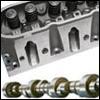
First off, let me say that JohnnyC did an excellent job giving a primer on some cam basics. He and GOaT Cheese are correct, there is a lot that goes into designing a good performing camshaft.
To be honest, I'm not sure I understand what you mean by "a cam's timing is high" and "if it's degreed lower". Are you strictly speaking in terms of advance and retard, or are you asking about durations? Moving the IVC of a given cam does alter its power characteristics somewhat, but changing the durations and overlap is where you really see a big difference.
Originally Posted by Cerebrex
I know that if a cam's timing is high, it will have better low-range power. If it's degreed lower, it will have better high range power...
...But how does this work? I mean, what is physically happening that causes the powerband to change? A friend and I were discussing this and I couldn't see what would cause it change where the power was made. If anyone knows, please share. I hope I'm not the only guy thinking this, so hopefully this will answer a question many people may have.
Thanks!
...But how does this work? I mean, what is physically happening that causes the powerband to change? A friend and I were discussing this and I couldn't see what would cause it change where the power was made. If anyone knows, please share. I hope I'm not the only guy thinking this, so hopefully this will answer a question many people may have.
Thanks!









