When you click on links to various merchants on this site and make a purchase, this can result in this site earning a commission. Affiliate programs and affiliations include, but are not limited to, the eBay Partner Network.
4l60e manifold pressure switch cleaning and testing?
1.) Is there a safe solution to use for cleaning the manifold pressure switch? Currently I just submerge it in clean ATF and scrub with a small brush. It works, but it's messy and cumbersome. I'm looking for a more efficient method. School me please.
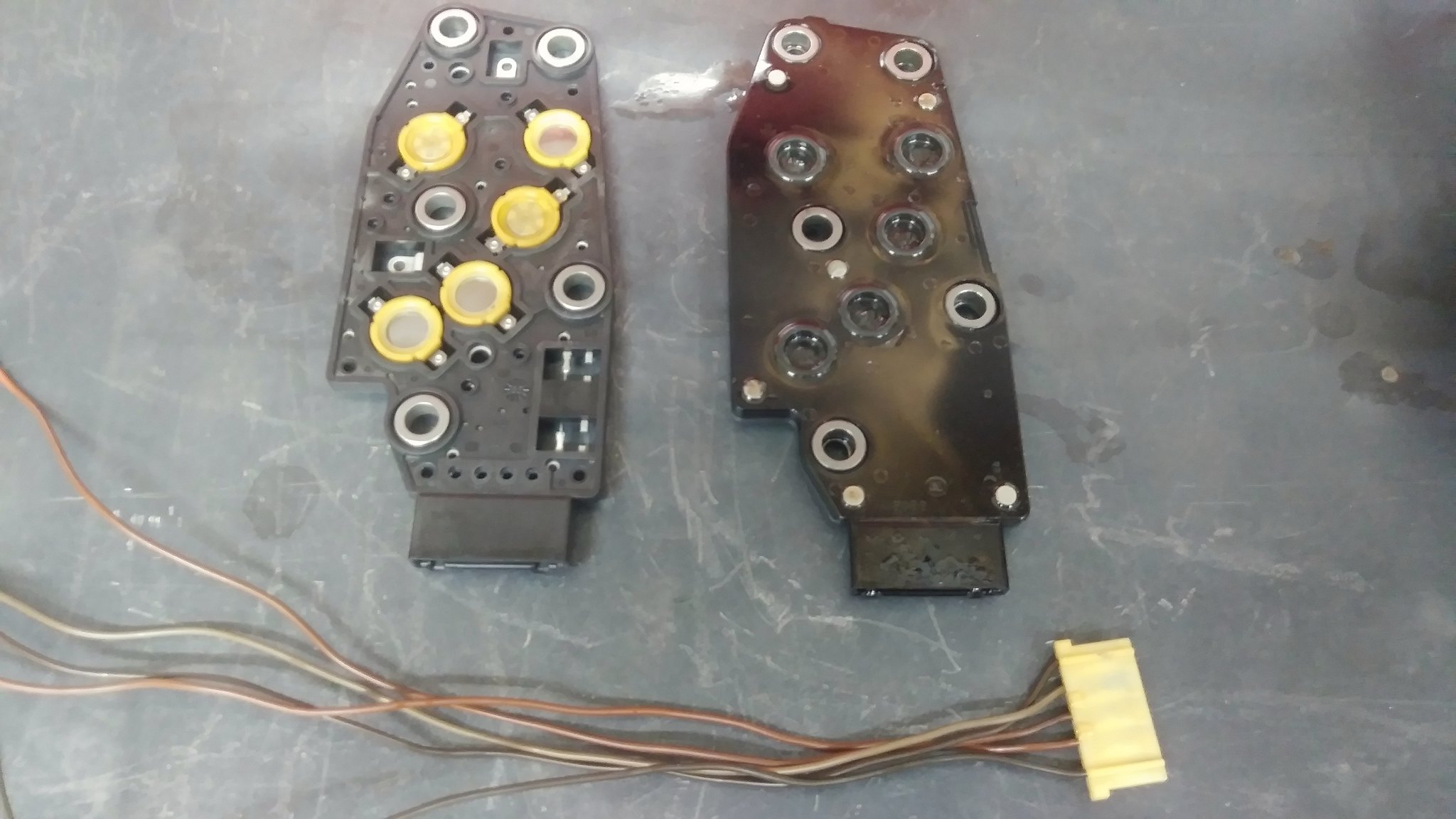
2.) How do you continuity test (what I will call) an "enclosed" switch? It's pretty obvious how to test the "exposed" switch (seen on the left). Just probe the terminals and press the button. Beep or no beep. Simple. However, the terminals on the enclosed switch (on the right) are well... enclosed. I can't get to them. No probing there. I do have a pigtail I can plug in to make things easier, but I can't for the life of me figure out the sequence of what wire goes with what switch to test continuity. Does anybody have a guide, video or schematic? I would be eternally grateful.
You can use prettymuch any solvent on these. Brake cleaner works fine too. they aren't sensitive.
there are 5 pins on the switch...the two not marked in this picture are for the fluid temp sensor.
You can use pretty much any solvent on these. Brake cleaner works fine too. they aren't sensitive.
Great! I remember seeing in a Youtube video a guy saying you shouldn't use any kind of solvent on them. Guess he was just paranoid. I have a parts washer that should do the trick.
Edit: Mineral spirits. Not water based solvent.
there are 5 pins on the switch...the two not marked in this picture are for the fluid temp sensor.
Thank you! That schematic should be what I need. I'm not super good with electrical symbols, but I ought to be able to figure out the circuits for testing.
FWIW, I'm building a vacuum tester using your write up. Thanks for that also!
Originally Posted by grasshopper645
I would just buy a new one, they arent particularly expensive.
Fair point, and I thought about addressing this in the original post. You are correct. $20 extra on a full build isn't much in the grand scheme of things. I just can't see replacing something with such a low failure rate repeatedly. Especially if I can fully test it.






 4l60e manifold pressure switch cleaning and testing?