





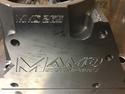



Heater core bypass block

You asked a very good question. The LSs run the 4 port bypass and even the marine versions run a simple bypass hose rather than block the heater ports off. I suspect there is a reason, but I've got lots of miles on my Classic Auto Air and Vintage Air LS swaps with conventional HCVs, no issues.
But there are plenty of OEM vacuum, electric, and manual HCVs with 4 ports and a bypass.

TECH Addict

Joined: Oct 2016
Posts: 2,513
Likes: 480
From: PDX-OR-USA
If your running a car that has the stock heater sheetmetal under the dash,, and it has a flap to block the heater core and allows the chilled air to bypass it (Most 80's and up cars) , then typically the system runs coolant all the time. If your running an old school box, like a early nova or mustang that didn't have the heat diversion flapper in the box they had a valve in the line. In between there were a fair number of cars that ran a on-off diverter valve, when they shut the coolant off to the core it diverted back to the return.
From the engines I've touched, most modern engines have some sort of bypass port in the water pump/thermostat housing that bleeds a small amount of coolant around the stat so that it gets enough flow to open on time..
When I delete the heater loop, I add a 1/4 inch bypass around the thermostat to handle this. Usually you can creatively drill the thermostat housing to make this happen.
Or if you have a engine with the heater inlet and outlet hoses next to each other on the block, you can sometimes drill a bleed hole, then screw plugs in to cap the original heater hose locations.
If the coolant doesn't move in the system, then the water temps can get too high in the heads before enough heat bleeds in the system to open the stat up, cold weather can make this fatal. Almost like the radiator is froze up.
YMMV
From the engines I've touched, most modern engines have some sort of bypass port in the water pump/thermostat housing that bleeds a small amount of coolant around the stat so that it gets enough flow to open on time..
When I delete the heater loop, I add a 1/4 inch bypass around the thermostat to handle this. Usually you can creatively drill the thermostat housing to make this happen.
Or if you have a engine with the heater inlet and outlet hoses next to each other on the block, you can sometimes drill a bleed hole, then screw plugs in to cap the original heater hose locations.
If the coolant doesn't move in the system, then the water temps can get too high in the heads before enough heat bleeds in the system to open the stat up, cold weather can make this fatal. Almost like the radiator is froze up.
YMMV

Teching In
Joined: Oct 2019
Posts: 10
Likes: 3
Hi Everyone.
I have read many threads and have yet to see anyone explain the heater bypass issue. I will. But first, the simplest solution is buying to T connectors for your heater hose, connect them and install it between your engine and AC heater valve. If you are worried about getting enough flow to your heater core, use a 5/8 x 1/2 x 5/8 adapter. it will create a pressure build up passing into the 1/2 inch fitting ensuring when the heater valve is open, the water will take the path of least resistance into the heater core. less than 10 bucks.
The problem is one of GM's own making. They relocated the thermostat from the top of the engine to the water pump creating a disparity between the engine coolant temperature and the water temperature at the thermostat when it is closed. You can test it with a heat gun if you like. The temperature difference is a good 20 degrees. So if you have a 200 degree thermostat, it is not going to open until the engine is 220 degrees.
To fix that, they machined the water pump to flow the waste water from the heater system back over the thermostat housing in a continuous loop with water constantly coming out of the pump into the heater system from the engine. THEN they created this elaborate hose system full of check valves and bypass valves to keep it out of the heater core while the ac is off. AND THEN engineered a overflow container to accept the continuous flow of water coming from the water pump. To help justify that, they routed the stem vents from the heads into it as well instead of routing it into a heater hose or something a lot simpler. That is why you have so many water hoses and a overflow container that looks like it supplies a ship instead of a car. That is why you need the bypass. They should have left it on top of the engine or used an electronic valve controlled by the computer which could be put anywhere and get rid of the thermostat all together. But they didn't. So you have to deal with it. the end.
What will happen if you don't? Your engine is going to run at or above 220 degrees with a 200 degree thermostat. In colder climates where the water pump itself is exposed to cool air, the disparity will be greater. Less during the summer.
I have read many threads and have yet to see anyone explain the heater bypass issue. I will. But first, the simplest solution is buying to T connectors for your heater hose, connect them and install it between your engine and AC heater valve. If you are worried about getting enough flow to your heater core, use a 5/8 x 1/2 x 5/8 adapter. it will create a pressure build up passing into the 1/2 inch fitting ensuring when the heater valve is open, the water will take the path of least resistance into the heater core. less than 10 bucks.
The problem is one of GM's own making. They relocated the thermostat from the top of the engine to the water pump creating a disparity between the engine coolant temperature and the water temperature at the thermostat when it is closed. You can test it with a heat gun if you like. The temperature difference is a good 20 degrees. So if you have a 200 degree thermostat, it is not going to open until the engine is 220 degrees.
To fix that, they machined the water pump to flow the waste water from the heater system back over the thermostat housing in a continuous loop with water constantly coming out of the pump into the heater system from the engine. THEN they created this elaborate hose system full of check valves and bypass valves to keep it out of the heater core while the ac is off. AND THEN engineered a overflow container to accept the continuous flow of water coming from the water pump. To help justify that, they routed the stem vents from the heads into it as well instead of routing it into a heater hose or something a lot simpler. That is why you have so many water hoses and a overflow container that looks like it supplies a ship instead of a car. That is why you need the bypass. They should have left it on top of the engine or used an electronic valve controlled by the computer which could be put anywhere and get rid of the thermostat all together. But they didn't. So you have to deal with it. the end.
What will happen if you don't? Your engine is going to run at or above 220 degrees with a 200 degree thermostat. In colder climates where the water pump itself is exposed to cool air, the disparity will be greater. Less during the summer.
“So if you have a 200 degree thermostat, it is not going to open until the engine is 220 degrees.”
Not quite. If you have a 200F t’stat, it will open at - wait for it - 200F. It’s simply that with 200F coolant at the INLET of the engine where the t’stat is, it’ll pick up heat as it travels through the motor and result in 220F coolant at the OUTLET.
Mine has OEM 187F t’stat on inlet. Engine operates at 195F-197F - so I’m only seeing about a 10F delta. Same operating temp as the previous Ford motor did with a 195F t’stat on the outlet.
Not quite. If you have a 200F t’stat, it will open at - wait for it - 200F. It’s simply that with 200F coolant at the INLET of the engine where the t’stat is, it’ll pick up heat as it travels through the motor and result in 220F coolant at the OUTLET.
Mine has OEM 187F t’stat on inlet. Engine operates at 195F-197F - so I’m only seeing about a 10F delta. Same operating temp as the previous Ford motor did with a 195F t’stat on the outlet.
Teching In
Joined: Oct 2019
Posts: 10
Likes: 3
You are not getting it. When the thermostat is closed, closed, the coolant in the to end of the motor is hotter than the coolant where the thermostat is sitting. On an aluminum water pump. A good 2 to 3 inches away from the block. So your 200 degree thermostat will open in fact when the coolant at the thermostat is 200 degrees, but by the time the coolant there is 200 degrees, the coolant at the top of the engine will be 220 or over. When it opens, it is all good.
Old school - 197F t'stat = 197F operating temp provided air flow is sufficient. New school - 187F t'stat = 197F operating temp. No problem.
LS1 Tech Stories
The Best V8 Stories One Small Block at Time

6 Common C5 Corvette Failures and What's Involved In Repairing Them
Pouria Savadkouei
Retro Modern Bandit Pontiac Trans AM Comes With Burt Reynolds' Autograph
Verdad Gallardo
Top 10 Greatest Cadillac V Series Performance Models Ever, Ranked
Pouria Savadkouei
Top 10 Most Powerful Chevy Trucks Ever Made!

Hennessey's New Supercharged Silverado ZR2 Has 700 HP
Verdad Gallardo
Coachbuilt N2A Anteros Is an LS2-Powered C6 Corvette In Italian Clothes
Verdad Gallardo
Awesome K5 Blazer Restomod Comes With C7 Corvette Power
Verdad Gallardo
10 Camaros You Should Never Buy

10 LS Engine Myths That Refuse to Die
Verdad Gallardo
I've ran the same engine blocked and unblocked in my 2000 S-10 and have swapped into cars that didn't have a bypass only a valve to open and close the flow to the heater core and the difference is 3* measured at the head and it's only momentary. Below is a video someone posted on another thread a while back that shows the exact same situation and same results as I keep seeing.
I also read somewhere that the reason GM designed the system the way they did was with two things in mind. Get temperature in the engine as quickly as possible (Reduced Emissions/Reduced Wear) and to get heat into the heater core as quickly as possible (Comfort).
I also read somewhere that the reason GM designed the system the way they did was with two things in mind. Get temperature in the engine as quickly as possible (Reduced Emissions/Reduced Wear) and to get heat into the heater core as quickly as possible (Comfort).
We might've read the same piece - re: warm up/emissions and heater core for quick heat. I also read that they experienced fewer problems with trapped air while filling the system with coolant (and ability to fill it more quickly on the ***'y line) moving the t'stat to the inlet side combined with the steam ports allowing air to easily leave the high points of the engine during filling.
Teching In
Joined: Oct 2019
Posts: 10
Likes: 3
We ran into a problem with a 5.3 build in a 70 c-10. No problem at idle in the shop. But on the highway at speed in Feb, it would climb to 220 and higher. We replaced the thermostat. No change. And it was always starting out on a trip from a cold start. After it was warmed up and then hitting the highway, no problems. It always ran kind of high, over 210, but never any higher. We punched out the thermostat and no more problem.
With the bypass on another engine, solid at 190. Idle, highway, didn't matter, all day long. I doubt fan two ever kicks in. Fan one comes on when the ac is on regardless.
To the above poster, old school vs new school, your thermostat was located on the top of the engine. Where the hottest water is. Not down at the bottom on an aluminium mount sticking a good 2 to 3 inches away from the block. When it is closed without a bypass, there is no top end water flowing over it. for those of you in cold weather, it could get to a point with 10 degree air blowing on the front of the engine at highway speed, it may never open even if the top end starts to over heat.
Do what you like. It is your engine. But the above is why GM created a bypass system in the first place. If there was no problem, they would not have wasted time and money in creating such an elaborate system. The fix is simple for swaps. No reason not to do it. I am sure many people have and feel the need to justify their decision. To them, 10 bucks for two T fittings and 6 hose clamps. Try it and see what happens.
I only wrote this here because there was always an argument on do it or not without an explanation as to why it needed to be done or not. Now you know. There is the same argument over closing off the steam vents or not. No explanation as to why it is there in the first place. They bleed off trapped air at the highest part of the system and send it to the overfill container. Minor, yes, but that is how concerned GM was with maintaining temperature control and eliminating air from every part of the system to prevent hot spots and premature heat related failure to the number 1 and 2 cylinders.
Another easy fix. buy a radiator hose connector for 4 bucks, 2 hose clamps, a 1/4 brass fitting and a length of small fuel line. Drill out a hole for the fitting in the hose connector, epoxy it in, and run the vent tube back into the upper radiator hose. What? Doesn't get rid of the air say the nay sayers? Removes it from the top of the engine as intended and eventually gets pushed into the over flow container in the end. Just takes longer and you do not have to modify an overflow container with a lot of hoses like GM did. In fact, do both and you can use a factory overflow container and radiator from your old school car. You save even more money and time on your build. yea.
With the bypass on another engine, solid at 190. Idle, highway, didn't matter, all day long. I doubt fan two ever kicks in. Fan one comes on when the ac is on regardless.
To the above poster, old school vs new school, your thermostat was located on the top of the engine. Where the hottest water is. Not down at the bottom on an aluminium mount sticking a good 2 to 3 inches away from the block. When it is closed without a bypass, there is no top end water flowing over it. for those of you in cold weather, it could get to a point with 10 degree air blowing on the front of the engine at highway speed, it may never open even if the top end starts to over heat.
Do what you like. It is your engine. But the above is why GM created a bypass system in the first place. If there was no problem, they would not have wasted time and money in creating such an elaborate system. The fix is simple for swaps. No reason not to do it. I am sure many people have and feel the need to justify their decision. To them, 10 bucks for two T fittings and 6 hose clamps. Try it and see what happens.
I only wrote this here because there was always an argument on do it or not without an explanation as to why it needed to be done or not. Now you know. There is the same argument over closing off the steam vents or not. No explanation as to why it is there in the first place. They bleed off trapped air at the highest part of the system and send it to the overfill container. Minor, yes, but that is how concerned GM was with maintaining temperature control and eliminating air from every part of the system to prevent hot spots and premature heat related failure to the number 1 and 2 cylinders.
Another easy fix. buy a radiator hose connector for 4 bucks, 2 hose clamps, a 1/4 brass fitting and a length of small fuel line. Drill out a hole for the fitting in the hose connector, epoxy it in, and run the vent tube back into the upper radiator hose. What? Doesn't get rid of the air say the nay sayers? Removes it from the top of the engine as intended and eventually gets pushed into the over flow container in the end. Just takes longer and you do not have to modify an overflow container with a lot of hoses like GM did. In fact, do both and you can use a factory overflow container and radiator from your old school car. You save even more money and time on your build. yea.
You are not getting it. When the thermostat is closed, closed, the coolant in the to end of the motor is hotter than the coolant where the thermostat is sitting. On an aluminum water pump. A good 2 to 3 inches away from the block. So your 200 degree thermostat will open in fact when the coolant at the thermostat is 200 degrees, but by the time the coolant there is 200 degrees, the coolant at the top of the engine will be 220 or over. When it opens, it is all good.
Edit: I'm running a pump now that I pulled the heater core tubes out and put threaded plugs in it's place and put in a 190* thermostat and it runs 190* all day long and never runs any hotter, According to the post above you were overheating at highway speed even after the thermostat opened and you still had a problem lol
I don't know if you referring to me as the "above poster"??
My swaps are LS engine into old and newer vehicles that never had them and the results I see are a couple degree swing as logged in using Holley EFI from blocked heater core ports to bypassed ports just as the person who posted the LS3 video above. In the summer I start my vehicles and let them run for a half a minute or so, I don't sit and let them idle until they reach 200* and like I said...no 20* swing ever in any of the swaps I've done.
Last edited by LLLosingit; Oct 31, 2019 at 02:29 PM.
We ran into a problem with a 5.3 build in a 70 c-10. No problem at idle in the shop. But on the highway at speed in Feb, it would climb to 220 and higher. We replaced the thermostat. No change. And it was always starting out on a trip from a cold start. After it was warmed up and then hitting the highway, no problems. It always ran kind of high, over 210, but never any higher. We punched out the thermostat and no more problem.
Rosco - if you go back to the thread start you’ll see that it began as a discussion about alternative ways to provide for the bypass without having coolant go through the htr core. The OP and I proposed solutions in the first two posts.
As for trapped air, I connected the steam ports to the “overflow” line that connects my pressurized reservoir (high point of my system) to the top of the rad. Filling mine is as simple as dumping coolant into the reservoir as fast as it will take it. Never any trapped air. No need to top up after driving the first time post-refill.
As for trapped air, I connected the steam ports to the “overflow” line that connects my pressurized reservoir (high point of my system) to the top of the rad. Filling mine is as simple as dumping coolant into the reservoir as fast as it will take it. Never any trapped air. No need to top up after driving the first time post-refill.
Last edited by Michael Yount; Nov 3, 2019 at 05:48 AM.