When you click on links to various merchants on this site and make a purchase, this can result in this site earning a commission. Affiliate programs and affiliations include, but are not limited to, the eBay Partner Network.
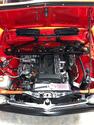
My setup: 2004 Avalanche engine, trans into a 1978 Caprice.
Just finished up with my swap and got the final tune. I drove the car into work today for the first time (about 20 miles) which includes stop and go traffic as well as city and highway speeds. It was 20 degrees F this morning, so it was very cold. I have Dakota Digital gauges in the car that are setup to read data from the OBD port. As I neared the end of my trip the coolant temps at one point approached or reached 220, and then the high speed fans kicked on and brought the temps back to around 210, and they fluctuate between over 200 and 215.
I have read that it is (arguably) normal for LS engines to run between 220 and 230, but my concern is the outside temps. Should driving in 20 degree outside temps with no AC on (no defroster) cause the engine to run that hot? I would be concerned if this were a 90+ degree day with high humidity and the AC on, but I’m a bit concerned given how cold it was outside and the car is still running at those temps. Maybe it would run at those temps whether it was hot or cold? I can rule out the radiator as an issue as it’s anew and a Griffin LS radiator which is more than enough to cool my stock setup and a new water pump.
IF the fans are set so they don't come on until 220F and that set point is above the t'stat temp (as it should be), then the engine will continue to heat up until the fans come on during low speed driving. If you were under cruise at 30mph or higher for any significant period of time -- I wouldn't have thought the fans would come on at all. 20F ambient and free flow of air across the rad should've kept the operating temp closer to what it should be if the t'stat is controlling temp. While operating in the 210F-220F range is nothing to worry about -- with that low of an ambient temp, I'd have expected it to run a bit cooler. New radiator?
Mine has a 187F t'stat in the coolant INLET which results in head coolant temps (leaving the motor) in the 195F-197F range. My fans are set to control to 202F. The other morning I made the 22 mile round trip to cars&coffee in 40F weather. Never over 50mph. My cooling fans NEVER came on. Oil temps got up to 210F.
I have been working through some issues on mine and found I have a 195 degree thermostat. I threw it in a pot of boiling water to verify. If you have a 195, then your 220 isn't that much higher than the set point.
I don't want my temps up that high, so I picked up a 160.
With a 195F on inlet you’d see 202-205F leaving the head. You wouldn’t want fans set to turn off at any less than 210F to be sure the fans and the T’stat don’t start fighting with each other.
Sounds like you might have some air trapped. I've run both 160 and 180 stats in couple different LS swaps with big Griffin radiators and if it's below 50 degrees they struggle to get up to the stats temps even in traffic. In my 68 C10 LS1 my fan is controlled by the ecm to come on at 205 degrees and off at 195 degrees. My 98 Wrangler with a LS6 swap has a 197 degree stat only because it's my plow Jeep in the winter and I want a bit more heat in the cab when I plow snow with it..
The best way I've found to get all air out is bring the engine up to temp and then loosen up the temp sensor on the left head and let some coolant drain out. Be careful its hot.
Thanks for the responses. With the big Griffin radiator and these temps I also though that the fans probably shouldn't even come on, but on low speed at the most. Given the somewhat spurratic nature of when the fans seem to need to come on I have suspected possible air trapped in the system. An example, I parked in a driveway on the way home tonight and the car sat idling for about 10 minutes and the high fans came on. Later tonight I had to stop somewhere and the car idled and the high fans never came on. I'll try bleeding the system further.
I found the easiest place to purge air is to loosen the steam line hose and let the air water mix flow into a catch bowl. This hose is at the top front of the engine and is the exit to the steam tubes on top of the valley cover. Air naturally rises to the top of this tube.
I found the easiest place to purge air is to loosen the steam line hose and let the air water mix flow into a catch bowl. This hose is at the top front of the engine and is the exit to the steam tubes on top of the valley cover. Air naturally rises to the top of this tube.
Apologies to the OP, don't mean to derail your thread but I am curious. My engine has the steam vent tubes which are routed to the reservoir. I was thinking that the system was essentially "self bleeding" in that the air would naturally rise and make its way up to the reservoir. Is that not the case?
Apologies to the OP, don't mean to derail your thread but I am curious. My engine has the steam vent tubes which are routed to the reservoir. I was thinking that the system was essentially "self bleeding" in that the air would naturally rise and make its way up to the reservoir. Is that not the case?
Not everyone uses a reservoir that's the high point of the system. Suspect your 944 is set up that way; my 242 is. My steam line ties into vent line that runs between the top of the rad and the top of the reservoir. As you fill the system through the reservoir (my radiator has no "cap"), all air comes out through the steam system and vents to atmosphere through the reservoir. So filling the system is as simple as, well, pouring coolant into the reservoir until it's at the "cold fill" line. And you're done. Never any air trapped. With swaps, lots of folks tie the steam line in down at the water pump to a fitting they've installed. Pretty easy to trap air with set ups like that. If the steam line is tied in to the top of the system, air gets out pretty easily.
Apologies to the OP, don't mean to derail your thread but I am curious. My engine has the steam vent tubes which are routed to the reservoir. I was thinking that the system was essentially "self bleeding" in that the air would naturally rise and make its way up to the reservoir. Is that not the case?
If your reservoir is pressurized and part of your cooling system then your setup is fine. If it's just a reservoir to catch overflow from the radiator cap then your setup will not work.
Thanks for the confirmation guys. Michael, sounds like my setup is exactly like yours. Not the best pic, but you can see a brass T above the plug wires and the line running up to the back of the reservoir.
I suspect air in the system as well. I've had really good luck with backfilling the system through the steam vent tube. Do this when the engine is cold. It's a little slow, but not hard using a long hose and small funnel. With the cold ambient temperature, I wouldn't expect your fans to come on much, if at all, while driving.
Couldn’t one just disconnect the steam hose; raise it up in the air so it’s the highest point of the system; fill through as normal and let air vent out of the steam hose? Once you have fluid in the hose you should be full.
Couldn’t one just disconnect the steam hose; raise it up in the air so it’s the highest point of the system; fill through as normal and let air vent out of the steam hose? Once you have fluid in the hose you should be full.
You beat me to it! I thought exactly the same thing. As long as there is an escape for the air.
This may be an exaggeration, but raise all 4 steam hoses so there would be no chance of an air pocket.
I have a couple vehicles that have air trap issues, I finally just installed a T and a valve that dumps to the overflow tank or the top of the radiator, so I can just get it to temp and crack the valve.. The valve is deliberately the highest point in the system. No coolant lost..
Here's my setup. I used the stock reservoir (or overflow) from the '78 Caprice into the radiator. The Griffin radiator has a port for the steam vent. I tied the original steam vent hose from the engine directly into the radiator (tied to the back of the upper radiator hose). When I filled the engine when it was bone dry I filled the upper radiator hose until it was full and I also filled the radiator until it was full. Where I'm curious is shouldn't the steam-hose lines purge all of the air out of the system on its own? Also, could I jack the front of the car up to allow the air out. The steam vent is so small, how would I fill any amount of fluid through the small hose?
Did I understand correctly that I can remove the steam vent hose, hold it up and fill it with coolant. Wouldn't there need to be a way for the trapped air to escape, so I would need to drain some coolant somewhere as the coolant went into the steam hose?
Gas Monkey Built a 6-Wheel Ferrari Testarossa With a Corvette LT4 Engine
Slideshow: The controversial Ferrari F6 swaps its original flat-12 for a Corvette Z06-derived LT4 V8 and sends power to four rear wheels through a custom-built drivetrain.
7 Most Reliable High-Performance Engines GM Has Ever Built
Slideshow:These GM engines didn't just make huge power, they survived abuse, boost, track days, and six-digit mileage with a reputation for refusing to quit.
6 Common C5 Corvette Failures and What's Involved In Repairing Them
Slideshow: From wobbling harmonic balancers to failed EBCMs, these are the issues that define long-term C5 ownership and what repairs typically involve.
Retro Modern Bandit Pontiac Trans AM Comes With Burt Reynolds' Autograph
Slideshow: A modern Camaro transformed into a retro icon, this limited-run "Bandit" build blends nostalgia with brute force in a way few revivals manage.
Top 10 Greatest Cadillac V Series Performance Models Ever, Ranked
Slideshow: Cadillac didn't just crash the high-performance luxury vehicle party, it showed up loud, supercharged, and occasionally a little unhinged...
Coachbuilt N2A Anteros Is an LS2-Powered C6 Corvette In Italian Clothes
Slideshow: A one-off sports car that looks like a vintage Italian exotic-but hides a C6 Corvette underneath-just sold for the price of a new mid-engine Corvette.







 Engine Temps on New LS Swap (in cold weather)