When you click on links to various merchants on this site and make a purchase, this can result in this site earning a commission. Affiliate programs and affiliations include, but are not limited to, the eBay Partner Network.
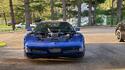
Hey guys! I was able to dyno my LS7 swapped FD yesterday. I'm shocked by the results. I'll have to Dragy this thing to see how legit they are. Seat of the pants I can tell you it is blazingly fast for something that also stops and handles. The car weighs about 2850 and is on road race slicks on the street. I have a lot of seat time in this car making 512whp SAE on a hub dyno with my 402 and it was fast before, but this is another level. Going into the dyno day I'd be happy enough with 550whp, and felt I'd be lucky to reach 570, so when the first baseline pull printed out 605whp I thought we were on another planet lol.
More or less the TL;DR:
615whp @ ~7000 rpm, 552 ft lb @ ~5300 rpm
> 600whp from ~6200rpm to 7500rpm, and pulls to 7800
>500whp from ~3500 rpm to 6500 rpm
LS7 SBE 427, 11.4:1 Comp low shock lobes 234/247, .665/.658" lift (1.82 ratio), 116+2 Stock ls7 heads w/ Ti intakes, Ferrea exhausts 4.150 .040" cometic gaskets Johnson 2116SLR slow leakdown .093" travel PAC 1207x .700" lift springs TSP roller tip 1.82 rockers Melling 10296 high volume/high pressure Improved Racing Fbody pan trap door Meziere EWP
Holley Sniper Low Pro ATI damper no underdrive Tilton 246 twin disk organic clutch w/ sprung hub and strapped floaters 1 7/8" headers into dual 2.5" xpipe
Holley HP EFI with Flex Fuel
I will do my best to try and backup the numbers someday, but my primary goal was the driving experience over total power, and for that - mission accomplished. I think this is secretly one of the best performing intake manifolds out there that Big Hammer put me onto years ago with his 388 results. It's like packaging a super victor intake in a front facing low profile package.
Dyno was a Dynocom dyno. The shop owner is a friend that competes pro-am drifting in his rotary FD rx7 making 650whp on his dyno, and on a local dynojet made 655whp. I also had him drive my car at the end of the day and he was extremely impressed with the acceleration.
I went into the day with the calibration commanding 12.5 AFR, and a timing curve going from 18 to 20 degrees of timing. We bumped it to 22 degrees and it gained a solid amount, like 20+ whp. Going to 24 degrees on 91 the peak power rpm dropped, and it made the same power - so it did not like the extra timing at all. I backed it back down to 22, drained the tank and put e85 in it.
Letting the fuel mix, E85 blend came out to E65.
We ran it exactly the same AFR and timing, and the numbers dropped across the board, 10-15 horsepower. This is consistent with what I've seen before, despite everyone thinking that E85 immediately gains 20 hp on an NA combination.
Put 4 degrees in it, and the power came back about 6-7.
Tried 28 degrees total, and it didn't like it - made less power.
Went back to 26 degrees and tried more fuel, and it also didn't like it.
Leaned it out to 12.9-13.2 and we picked up everything it "lost" by going to E85 nearly printing the two curves on top of each other. The one thing is, the air temp went up quite a bit since the first run of the day. If we were able to back to back in the same conditions, maybe E85 would be worth another 5-10 hp, but it is not knock limited on 91 octane.
So, I wound up putting in my tables a timing adder of 4 degrees, and it leans out the mixture a half an AFR on E85.
This Dynocom dyno is just like a dynojet - just an intertia drum. We calibrated the engine RPM to the drum speed approximately, but did not have an inductive pick-up. Horsepower is measured by how quickly you spin the drum. Torque is back calculated from the RPM value. We compared the datalog with the dyno RPM and the dyno was reporting not quite 200 rpm less than the engine at 7500 rpm. In my opinion, the torque number is inflated by about 15 ft lb, but the horsepower number is accurate. the RPM displayed is about 200 rpm lower than actual.
This thing LOVES to rev, and screams all the way to 7500 making amazing power for how small the camshaft is. It is only 8.5 degrees of overlap at .050", idles like a kitten and drives very smooth.
Last edited by spanks13; Jul 15, 2025 at 09:09 PM.
I did some more digging on the numbers, and it makes a lot of sense. I calculated the SAE corrected numbers back to uncorrected values. I then used the baro and air temperature values from my datalog to recalculate SAE corrected numbers.
First of all, super thrilled with the uncorrected numbers at ~1200 ft of elevation. Second, it makes more sense to us now why it wouldn't make any more power on E85.
91 octane pulls:
594whp uncorrected
610whp SAE
E85 pulls -
586 whp uncorrected
620whp SAE
His baro read ~28.3, and my baro reported 28.67 in hg, or 97kPA.
On my best 91 octane pull, IAT was a chilly 73* at the start of the pull all the way up to redline.
My E85 pulls, the engine was ingesting some hot air from the radiator back into the intake during the pull because the cooling fans were not coming on since the fuel cools the engine down so much. I'm working on a redesigned filter/intake duct and I think I will incorporate a shield to block the radiator/fans from interfering with the air intake.
On E85 the pull started at 83 degrees, and it ended at 101 degrees at redline.
So in reality in equal air temp it ought to make ~10whp more on E85 with 26* timing and a leaner mixture. We were down a solid 15 whp on E85 to start, and I was able to get it back within 4whp on E85, but now we know it was sucking in 100 degree air temps.
Love that you were after the torque curve the whole build and then found the right parts to support that. You have a fun car, that is for sure!
The short runner intakes actually need the early IVC event (which usually means less duration). But it still made more torque than i would have expected, which is cool to see


 SBE LS7 in '94 FD RX7