





Twin BW S366 on 427LSX?

Well that honestly depends on the amount of boost planned as well as the purpose of the vehicle. It sounds like it is more of a straight drag set up. Surprisingly enough, backpressure will be an issue towards redline depending on the amount of boost run. It is not horrible with the .91 but at the same time if he plans too run a ton of boost it might benefit from a larger ar turbine housing. As stated above, rrunning 17 psi at 7000 rpms it will be closing in on 30 psi of backpressure. Will it work? Sure. Is it optimal? Not really.
Actually you can calculate a good guestimate. I spoke with one of the engineers at Full Race who works closely with the Borg Warner engineers and he said from their findings it has been very close to reality. Did you look at the link I put up or just throwing out a blanket statement?
What about a pair of 6768 CEA Precision turbos? Instant spool and more than enough to make the 1200whp you are looking for.. With room to turn it up a little.. I am no turbo expert though. The BW's look just as good.
Actually if you look at macthbot most of that is taken into account. But the bottom line is you will still have to flow x amount of air through a y sized turbine no matter the compression, valve events or or post turbine exhaust. I never clamed it was exact, but it has been pretty darn accurate in the vehicles I have played with.
Housing size has little to no effect on the actual maximum drive pressure created. Turbine wheel size does. Changing the housing's aspect ratio serves to change the rpm in which that maximum drive pressure number is reached. Basically in simple terms, it "shapes" the curve.
For a given turbine wheel size, changing to a tighter AR housing will create more low end torque, quicker spool and overall more under the curve power. Changing to a looser AR housing will create less low end, slower spooling and generally less under the curve power.
The turbine wheel is the choke point. Thus it is what dictates maximum back pressure. This is why I always like to run the largest turbine wheel needed for a given engine size and the tightest ar housing possible. What this does is it lowers maximum drive pressure(also known as back pressure), but keeps spool time down to a minimum. If you can generate your maximum drive pressure as soon as possible in the rpm range, but it's at a low enough boost pressure to drive pressure ratio to remain at the turbo's highest efficiency you've got a winner.
Combine this with a camshaft that takes into account all of these specifics and also boosts drive pressure at a low RPM to achieve the fastest spool time possible without adding to maximum drive pressure as to not choke the turbine and you've nailed the perfect turbo set-up.
Hope this helps!
Case in point....here is a dyno graph that shows what I am talking about. This dyno graph is from a local X275 car with a BWS588 which is a 112mm turbine wheel. This is on a 358 cubic inch SBF engine.
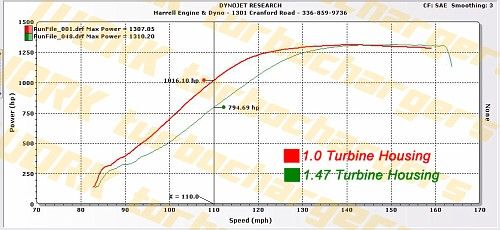
As you can see the looser AR housing did nothing for top end. All it did was kill under the curve power. IMO the only reason you'd ever do something like this is if you just couldn't keep a car from going on the bumper at the track, a high profile roll racing car that needs to always hook on the street or if you cannot get down the track due to the turbo's creating drive pressure so fast that it blows the tires off.
As far as the OP's question, I think your turbo selection is fine although I would of liked to of seen you go with a S400 frame for a larger turbine wheel and tighter AR housing selection, but you'll have no issues at all lighting those turbo's with the engine you have.
I would also be happy to specify a camshaft for you if you do not already have one in mind or ground.
For a given turbine wheel size, changing to a tighter AR housing will create more low end torque, quicker spool and overall more under the curve power. Changing to a looser AR housing will create less low end, slower spooling and generally less under the curve power.
The turbine wheel is the choke point. Thus it is what dictates maximum back pressure. This is why I always like to run the largest turbine wheel needed for a given engine size and the tightest ar housing possible. What this does is it lowers maximum drive pressure(also known as back pressure), but keeps spool time down to a minimum. If you can generate your maximum drive pressure as soon as possible in the rpm range, but it's at a low enough boost pressure to drive pressure ratio to remain at the turbo's highest efficiency you've got a winner.
Combine this with a camshaft that takes into account all of these specifics and also boosts drive pressure at a low RPM to achieve the fastest spool time possible without adding to maximum drive pressure as to not choke the turbine and you've nailed the perfect turbo set-up.
Hope this helps!
Case in point....here is a dyno graph that shows what I am talking about. This dyno graph is from a local X275 car with a BWS588 which is a 112mm turbine wheel. This is on a 358 cubic inch SBF engine.

As you can see the looser AR housing did nothing for top end. All it did was kill under the curve power. IMO the only reason you'd ever do something like this is if you just couldn't keep a car from going on the bumper at the track, a high profile roll racing car that needs to always hook on the street or if you cannot get down the track due to the turbo's creating drive pressure so fast that it blows the tires off.
As far as the OP's question, I think your turbo selection is fine although I would of liked to of seen you go with a S400 frame for a larger turbine wheel and tighter AR housing selection, but you'll have no issues at all lighting those turbo's with the engine you have.
I would also be happy to specify a camshaft for you if you do not already have one in mind or ground.
LS1 Tech Stories
The Best V8 Stories One Small Block at Time

Gas Monkey Built a 6-Wheel Ferrari Testarossa With a Corvette LT4 Engine
Verdad Gallardo
7 Most Reliable High-Performance Engines GM Has Ever Built
Verdad Gallardo
Amazing '71 Camaro Restomod Is Modern Muscle Car Under the Skin
Verdad Gallardo
6 Common C5 Corvette Failures and What's Involved In Repairing Them
Pouria Savadkouei
Retro Modern Bandit Pontiac Trans AM Comes With Burt Reynolds' Autograph
Verdad Gallardo
Top 10 Greatest Cadillac V Series Performance Models Ever, Ranked
Pouria Savadkouei
Top 10 Most Powerful Chevy Trucks Ever Made!

Hennessey's New Supercharged Silverado ZR2 Has 700 HP
Verdad Gallardo
Coachbuilt N2A Anteros Is an LS2-Powered C6 Corvette In Italian Clothes
Verdad Gallardo
TECH Regular
Joined: Oct 2012
Posts: 476
Likes: 2
Damn. Not only did you put up a thread questioning my turbo selection for you on the bullet.... you put one up here too....
Starting to think you dont have any faith in me Jason.....
Martin.... dont you have some Na cam to design somewhere instead of trying to steal my guys?? Jesus... lol
Starting to think you dont have any faith in me Jason.....
Martin.... dont you have some Na cam to design somewhere instead of trying to steal my guys?? Jesus... lol

I've seen 6262's make 1200 rwhp on a 427. Some people act like you need 200 lb/min of air to make 1000 rwhp lol. Those lambos are making 1500 + rwhp with twin 6766's. Some of these billet 66mm turbos will flow 94lbs of air a piece!
Here is a dyno graph from a badass 427 build from National Speed. 2010 Camaro, 6262's, 4l80e pump gas tune up. Here is the build thread https://ls1tech.com/forums/forced-in...0-1-200hp.html
Here is a dyno graph from a badass 427 build from National Speed. 2010 Camaro, 6262's, 4l80e pump gas tune up. Here is the build thread https://ls1tech.com/forums/forced-in...0-1-200hp.html
Hey guys, apologies for the delay in updates and responses over the past month or so. Life at the shop became extremely hectic with this car running over on scheduled time, and it needing to get wrapped up and to Eric. Things are starting to get back to a stabilized level, and the NZ1200 has left on the truck en route to Kansas City.
A few pictures of the completed vehicle with Eric Berry's vehicle and wheel stripes, cleaned up and heading home;
The final Level-IV power setting dyno graph. 17psi, low ignition timing (15degrees), 11.5:1 air:fuel ratio across the loaded board, tuned for 91octane...
(between 1,290-1,300hp and 1,190-1,200ftlbs at the engine. So NZ1200 is a little underrated)

A few pictures of the completed vehicle with Eric Berry's vehicle and wheel stripes, cleaned up and heading home;
The final Level-IV power setting dyno graph. 17psi, low ignition timing (15degrees), 11.5:1 air:fuel ratio across the loaded board, tuned for 91octane...
(between 1,290-1,300hp and 1,190-1,200ftlbs at the engine. So NZ1200 is a little underrated)
Last edited by Nitroused383; May 24, 2013 at 05:43 AM.
Damn. Not only did you put up a thread questioning my turbo selection for you on the bullet.... you put one up here too....
Starting to think you dont have any faith in me Jason.....
Martin.... dont you have some Na cam to design somewhere instead of trying to steal my guys?? Jesus... lol
Starting to think you dont have any faith in me Jason.....
Martin.... dont you have some Na cam to design somewhere instead of trying to steal my guys?? Jesus... lol




Thread Starter
Teching In
Joined: Apr 2008
Posts: 32
Likes: 0
Starting to think you dont have any faith in me Jason.....

I posted them both before I spoke with you.... They just looked so small when I got them....all I could think was that you thought I was putting them on this
instead of this...


TECH Regular
Joined: Oct 2012
Posts: 476
Likes: 2
Bahahahahahaha thats hilarious.
Nah i remember what that are going on.... amd i remember how concerned we are about packaging.
If you end up maxing those out...we have the billet wheels too..
You also gotta remember the "73"mm turbine is an 82/73 wheel...
Thats the same size wheel as the smallest wheel thats available in the 400 chassis...
Make 1600 horsepower at the crank with those.... then we will talk about bigger units.
Nah i remember what that are going on.... amd i remember how concerned we are about packaging.
If you end up maxing those out...we have the billet wheels too..
You also gotta remember the "73"mm turbine is an 82/73 wheel...
Thats the same size wheel as the smallest wheel thats available in the 400 chassis...
Make 1600 horsepower at the crank with those.... then we will talk about bigger units.



Just remember it is very dependent on the combination and the turbine of the turbo that is on the motor. If smaller was always better they would only make small ar housings, lol. The above is on a LARGE turbine and a not so large motor. If you have smallish turbines, sometimes the larger turbine housing can help out a bunch.
As Martin stated the turbine housing is used to shift where maximum drive pressure is reached. It needs to be used as such. If you have smallish turbine wheels, sometimes moving the curve out will help. However with a monster turbine wheel on a not so monster motor such as the one in the dyno graph, I can't really imagine why they would have put a 1.47 ar turbine housing on it in the first place unless it was the only one available.
Now this can also go the other way. If you have a smallish turbine wheel on a larger motor, you need every advantage you can get to shift it out. I have at times gone to a larger housing and lost very little under the curve and gained a good bit of top end if the housing was choking the motor. This is just another tool, but Martin is correct in saying to use the smallest AR that works. Figuring out which turbine housing that is for each combination is the key Ultimately sizing the turbo to the motor is the most important step. Turbine AND turbine housing need to be sized accordingly.
As Martin stated the turbine housing is used to shift where maximum drive pressure is reached. It needs to be used as such. If you have smallish turbine wheels, sometimes moving the curve out will help. However with a monster turbine wheel on a not so monster motor such as the one in the dyno graph, I can't really imagine why they would have put a 1.47 ar turbine housing on it in the first place unless it was the only one available.
Now this can also go the other way. If you have a smallish turbine wheel on a larger motor, you need every advantage you can get to shift it out. I have at times gone to a larger housing and lost very little under the curve and gained a good bit of top end if the housing was choking the motor. This is just another tool, but Martin is correct in saying to use the smallest AR that works. Figuring out which turbine housing that is for each combination is the key
Ultimately sizing the turbo to the motor is the most important step. Turbine AND turbine housing need to be sized accordingly. Just remember it is very dependent on the combination and the turbine of the turbo that is on the motor. If smaller was always better they would only make small ar housings, lol. The above is on a LARGE turbine and a not so large motor. If you have smallish turbines, sometimes the larger turbine housing can help out a bunch.
As Martin stated the turbine housing is used to shift where maximum drive pressure is reached. It needs to be used as such. If you have smallish turbine wheels, sometimes moving the curve out will help. However with a monster turbine wheel on a not so monster motor such as the one in the dyno graph, I can't really imagine why they would have put a 1.47 ar turbine housing on it in the first place unless it was the only one available.
Now this can also go the other way. If you have a smallish turbine wheel on a larger motor, you need every advantage you can get to shift it out. I have at times gone to a larger housing and lost very little under the curve and gained a good bit of top end if the housing was choking the motor. This is just another tool, but Martin is correct in saying to use the smallest AR that works. Figuring out which turbine housing that is for each combination is the key Ultimately sizing the turbo to the motor is the most important step. Turbine AND turbine housing need to be sized accordingly.
As Martin stated the turbine housing is used to shift where maximum drive pressure is reached. It needs to be used as such. If you have smallish turbine wheels, sometimes moving the curve out will help. However with a monster turbine wheel on a not so monster motor such as the one in the dyno graph, I can't really imagine why they would have put a 1.47 ar turbine housing on it in the first place unless it was the only one available.
Now this can also go the other way. If you have a smallish turbine wheel on a larger motor, you need every advantage you can get to shift it out. I have at times gone to a larger housing and lost very little under the curve and gained a good bit of top end if the housing was choking the motor. This is just another tool, but Martin is correct in saying to use the smallest AR that works. Figuring out which turbine housing that is for each combination is the key
Ultimately sizing the turbo to the motor is the most important step. Turbine AND turbine housing need to be sized accordingly.Valve overlap also influences drive pressure and I use it to my advantage in all turbo combinations.
As has probably been pointed out by you and others countless times, everything has to work together or you will just end up with a pile of parts that you are unhappy with....sometimes expensive parts! Cam, turbo, turbine, housing, everything is one big system!