




Air Filter size important on Turbo engine? Yes!

I was assuming they tested 1 sq ft of each media type. When they say super specific things like provides "good protection from particulate". I have my doubts too. Has to be better than a screen IMO. And was about the same cost as my AFE.
http://www.r2cperformance.com/black-...l-filters.aspx
http://www.r2cperformance.com/black-...l-filters.aspx

9 Second Club
iTrader: (10)
Joined: Apr 2009
Posts: 1,230
Likes: 3
From: Joliet,IL and Las Vegas 50/50
I've always used the largest K&N filter I could find after having a shorty filter crush in on itself and haven't had a problem since. I've never removed it while at the track either.
That’s great if you have the room to run a massive filter. Many setups like mine do not. So the idea of a smaller filter that flows 4x as much per SQ FT of media as the standard filters is appealing.
9 Second Club
iTrader: (10)
Joined: Apr 2009
Posts: 1,230
Likes: 3
From: Joliet,IL and Las Vegas 50/50
Yeah I definitely agree. I'm lucky enough that the position of my turbo I can 90* straight down with an aluminum elbow and pop a big *** filter on it. Otherwise i'd be in that position to find a max flow small filter.
LS1 Tech Stories
The Best V8 Stories One Small Block at Time

Gas Monkey Built a 6-Wheel Ferrari Testarossa With a Corvette LT4 Engine
Verdad Gallardo
7 Most Reliable High-Performance Engines GM Has Ever Built
Verdad Gallardo
Amazing '71 Camaro Restomod Is Modern Muscle Car Under the Skin
Verdad Gallardo
6 Common C5 Corvette Failures and What's Involved In Repairing Them
Pouria Savadkouei
Retro Modern Bandit Pontiac Trans AM Comes With Burt Reynolds' Autograph
Verdad Gallardo
Top 10 Greatest Cadillac V Series Performance Models Ever, Ranked
Pouria Savadkouei
Top 10 Most Powerful Chevy Trucks Ever Made!

Hennessey's New Supercharged Silverado ZR2 Has 700 HP
Verdad Gallardo
Coachbuilt N2A Anteros Is an LS2-Powered C6 Corvette In Italian Clothes
Verdad Gallardo

these filters allowed Camaro Andreas's car to go 6.3 at over 220mph. Says he tried without the filters and it made no difference.
So I'd find it very hard...in fact impossible to believe changing an air filter caused 2 full AFR points difference at idle, considering how relatively little air the engine would be consuming at idle.
Unless previously you had the most ridiculous piece of **** air filter possible. Pictures would speak a thousand words as to what you had before and have now though
By all means use the biggest and best quality filter you can, that's just common sense. But unless it's very bad to start with, I cant see it making a huge difference. And if there was a difference, it would mostly only be when the restriction is there. ie at high loads.
"Black Hex" Filter showed up today. The inlet was a little shy of 5", but with a slight trim and heat gun I squeezed it over my intake pipe. The HEX around the filter makes it much stronger. I had to bear down on it really hard to get it on my intake pipe. Seems very sturdy at least.
Here it is next to the old AFE filter. Wish the new one had the additional filter cone on top.
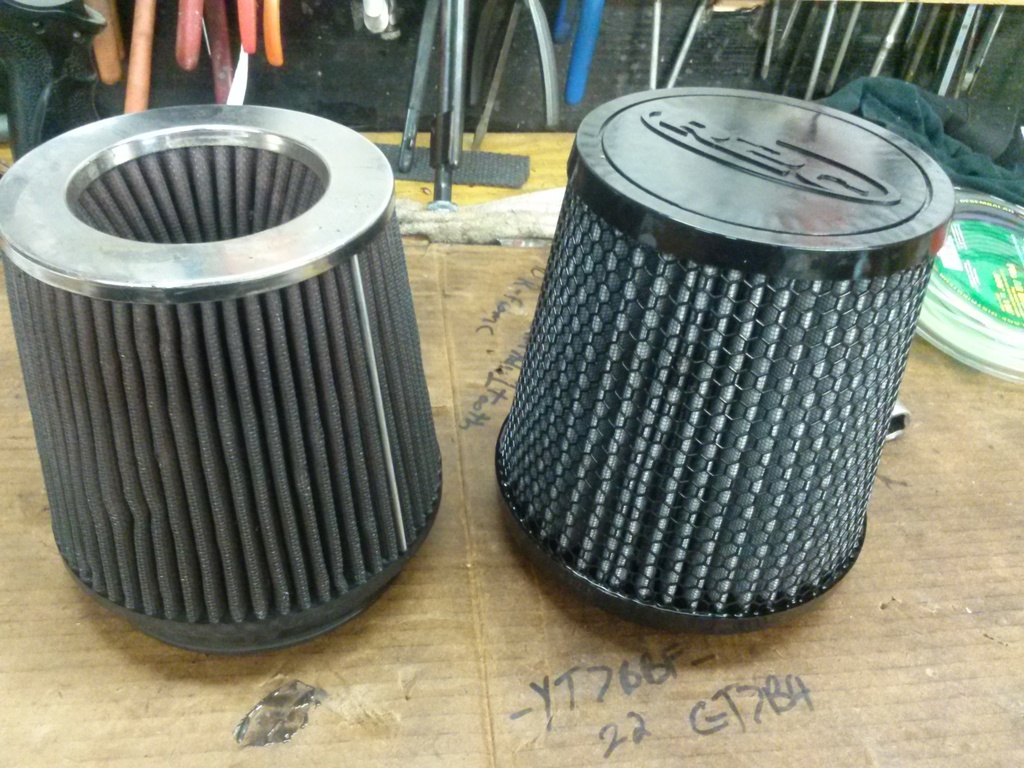

Here it is next to the old AFE filter. Wish the new one had the additional filter cone on top.

Forcefed86, did you try that filter out yet to see if you gained anything as far as air flow and does it look to be a good street/strip filter?
Last edited by Monte4ever; Oct 13, 2015 at 02:27 AM.

You all realize that you can actually measure the pressure between the filter and intake manifold, using a gauge that reads in inches of water for very high accuracy? That will take the guess work out of "will I gain anything without my filter" and "is this filter a restriction on my engine?". You simply compare atmospheric pressure to the pressure after the filter. A couple of inches of water is normal there. If you are serious about this, you will also log the pressure (as you would any other sensor) and compare it later at home on your laptop with RPM and TPS and vehicle speed to see what the pressures are while you were driving. Furthermore this could also model filter flow decline due as it becomes more filthy.
You can grab the gauge for like $20 shipped.
http://www.ebay.com/itm/Filter-Minder-Dash-Panel-Gauge-168501-00225-Air-Filter-Restriction-Monitoring-/321870077347?hash=item4af0f39da3&vxp=mtr
Hope to get back to the track this weekend.
http://www.ebay.com/itm/Filter-Minder-Dash-Panel-Gauge-168501-00225-Air-Filter-Restriction-Monitoring-/321870077347?hash=item4af0f39da3&vxp=mtr
Hope to get back to the track this weekend.

9 Second Club
Joined: Nov 2003
Posts: 13,616
Likes: 185
From: Norn Iron
You all realize that you can actually measure the pressure between the filter and intake manifold, using a gauge that reads in inches of water for very high accuracy? That will take the guess work out of "will I gain anything without my filter" and "is this filter a restriction on my engine?". You simply compare atmospheric pressure to the pressure after the filter. A couple of inches of water is normal there. If you are serious about this, you will also log the pressure (as you would any other sensor) and compare it later at home on your laptop with RPM and TPS and vehicle speed to see what the pressures are while you were driving. Furthermore this could also model filter flow decline due as it becomes more filthy.
Something like this would be ok. No need to use fancy names for gauges.
It can tell you if there is a pressure drop, which is to say, there is a slight restriction. If we decrease air filter size gradually, there will be more and more pressure drop (restriction) after the filter, until a full laboratory vacuum is established and there is no net movement of air molecules. Naturally, if we go the other direction, by increasing the size of the filter, the pressure will increase until it hits atmospheric, and then stabilizing around there, as it will tend to fluctuate on a running engine and even in the ambient air. Achieving this state is to say that the filter is "non-existent" or therefore "as if it was not there" which would be an nearly ideal situation, since it is as far opposite of the full vacuum, zero flow situation I have just had the honor of mentioning you are able to attain without exotic means at atmospheric pressure.
In other words, you would be able to establish and record any improvement, or gains as you put it, with this method, which is also to say that you are incorrect in your reasoning; you seem to be dismissing the difference between negligible "gains" (it is common for inlet plumbing to present a vacuum for the sake of PCV and the factory indeed adjusts the pressure in this location for this very reason using carefully planned restriction fittings) and whether there has been any improvement whatsoever.
Last edited by kingtal0n; Oct 13, 2015 at 08:25 PM.
9 Second Club
Joined: Nov 2003
Posts: 13,616
Likes: 185
From: Norn Iron
Miljoco LP2507L240 Pressure Gauge 0 to 60H2O 2 1 2in 1 4in | eBay
Something like this would be ok. No need to use fancy names for gauges.
It can tell you if there is a pressure drop, which is to say, there is a slight restriction. If we decrease air filter size gradually, there will be more and more pressure drop (restriction) after the filter, until a full laboratory vacuum is established and there is no net movement of air molecules. Naturally, if we go the other direction, by increasing the size of the filter, the pressure will increase until it hits atmospheric, and then stabilizing around there, as it will tend to fluctuate on a running engine and even in the ambient air. Achieving this state is to say that the filter is "non-existent" or therefore "as if it was not there" which would be an nearly ideal situation, since it is as far opposite of the full vacuum, zero flow situation I have just had the honor of mentioning you are able to attain without exotic means at atmospheric pressure.
In other words, you would be able to establish and record any improvement, or gains as you put it, with this method, which is also to say that you are incorrect in your reasoning; you seem to be dismissing the difference between negligible "gains" (it is common for inlet plumbing to present a vacuum for the sake of PCV and the factory indeed adjusts the pressure in this location for this very reason using carefully planned restriction fittings) and whether there has been any improvement whatsoever.
Something like this would be ok. No need to use fancy names for gauges.
It can tell you if there is a pressure drop, which is to say, there is a slight restriction. If we decrease air filter size gradually, there will be more and more pressure drop (restriction) after the filter, until a full laboratory vacuum is established and there is no net movement of air molecules. Naturally, if we go the other direction, by increasing the size of the filter, the pressure will increase until it hits atmospheric, and then stabilizing around there, as it will tend to fluctuate on a running engine and even in the ambient air. Achieving this state is to say that the filter is "non-existent" or therefore "as if it was not there" which would be an nearly ideal situation, since it is as far opposite of the full vacuum, zero flow situation I have just had the honor of mentioning you are able to attain without exotic means at atmospheric pressure.
In other words, you would be able to establish and record any improvement, or gains as you put it, with this method, which is also to say that you are incorrect in your reasoning; you seem to be dismissing the difference between negligible "gains" (it is common for inlet plumbing to present a vacuum for the sake of PCV and the factory indeed adjusts the pressure in this location for this very reason using carefully planned restriction fittings) and whether there has been any improvement whatsoever.
A straight edged intake from say a turbo or supercharger inlet with no filter my represent zero restriction. However if you then add a properly designed bellmouth/velocity stack, you could see improvements in power. Yet pressure difference has not changed.
Smooth airflow will always work better here than turbulent airflow, and often a filter can help to smooth airflow. So it would be preferable to have a good filter with perhaps a very small restriction in terms of water pressure measurement vs no filter, no restriction but highly turbulent airflow.
And as for negligible gains, until you're into the realms of 20, 50, 100hp etc...anything sub that level is negligible especially when we're talking mostly about boosted builds probably in the region of 800+ HP
If you had say 1000hp and there was an indicated gain of even 20hp...that really is negligible and could simply be any number of dyno variations.
Of course the manometer would be a useful tool in monitoring the health of any filter or intake setup to alert the driver of any issues which is perhaps a better use of such a thing here.
"Modern engines universally have tuned intake tract volumes and associated resonance frequencies, designed to provide higher than atmospheric intake air pressure while the intake valves are open"
-https://en.wikipedia.org/wiki/Velocity_stack
Smooth airflow will always work better here than turbulent airflow, and often a filter can help to smooth airflow. So it would be preferable to have a good filter with perhaps a very small restriction in terms of water pressure measurement vs no filter, no restriction but highly turbulent airflow.
And as for negligible gains, until you're into the realms of 20, 50, 100hp etc...anything sub that level is negligible especially when we're talking mostly about boosted builds probably in the region of 800+ HP
If you had say 1000hp and there was an indicated gain of even 20hp...that really is negligible and could simply be any number of dyno variations.
If you had say 1000hp and there was an indicated gain of even 20hp...that really is negligible and could simply be any number of dyno variations.
Of course the manometer would be a useful tool in monitoring the health of any filter or intake setup to alert the driver of any issues which is perhaps a better use of such a thing here.
