


Electronic boost gauge from MAP sensor


 Electronic boost gauge from MAP sensor
 I have searched but am unable to find anything.
Has anyone run a boost gauge (not electronic controller, simply boost readout) that converted the 0-5v MAP signal (2 or 3 bar MAP sensor) to read boost? An electronic voltmeter could be used, but then you would have to do the numbers in your head! [5v = 14.7 psi or 29.4 psi, depending on 2 or 3 bar].
Seems like this should be doable at a reasonable cost, but I can't find one.
Thanks for the help!
Has anyone run a boost gauge (not electronic controller, simply boost readout) that converted the 0-5v MAP signal (2 or 3 bar MAP sensor) to read boost? An electronic voltmeter could be used, but then you would have to do the numbers in your head! [5v = 14.7 psi or 29.4 psi, depending on 2 or 3 bar].
Seems like this should be doable at a reasonable cost, but I can't find one.
Thanks for the help!
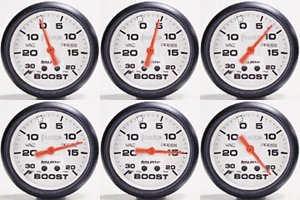

the autometer one does use a standard 2 or 3 bar map sensor but they also use it as a baro sensor to calibrate the gauge everyime on startup - its a nice gauge but pricey. It is nice to have the max recall though. I use a 2 bar map sensor going through the a/c pressure sensor to log boost with efilive. I calibrated it with a mityvac against my normal boost gauge and it works pretty well.
Let me clarify: I would like to have a gauge that would simply read off of an already installed MAP sensor, not buying an extra one. The autometers are ~$200 and include the sensor.
Looking at a plot of manifold pressure vs voltage, if one had a gauge that read 0-5 v through an arc [of the needle] of 270 deg or so, a custom overlay could be created w/ the numbers, reading from vacuum to 14.7 or 29.4 psi. The peak hold is nice, but I just don't quite get the cost of these.
In one sense, calibrating it to barometric pressure isn't really as important as absolute pressure is. If you go to an altitude where atmospheric pressure is 13.7psi, you could actually run 1 psi higher boost to end up 'shoving' the same amount of air into the engine...
Looking at a plot of manifold pressure vs voltage, if one had a gauge that read 0-5 v through an arc [of the needle] of 270 deg or so, a custom overlay could be created w/ the numbers, reading from vacuum to 14.7 or 29.4 psi. The peak hold is nice, but I just don't quite get the cost of these.
In one sense, calibrating it to barometric pressure isn't really as important as absolute pressure is. If you go to an altitude where atmospheric pressure is 13.7psi, you could actually run 1 psi higher boost to end up 'shoving' the same amount of air into the engine...


