


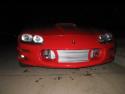
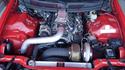



How much boost is lost over the FMIC??
 How much boost is lost over the FMIC??
 Specifically, how much will I lose on the STS kit plus the FMIC. STS claims a loss of 1/2 psi through just the piping. Now, compound that loss on top of the FMIC and I'm thinking the turbo is going to have to push 10+psi just so my intake sees 7.5psi.
Verses running a long *** vacuum line up to the engine, I'm just going to use a boost controller to adjust as needed, referencing the psi for the wastegate at the compressor housing.
Any thoughts on this?
Verses running a long *** vacuum line up to the engine, I'm just going to use a boost controller to adjust as needed, referencing the psi for the wastegate at the compressor housing.
Any thoughts on this?

If you pull boost signal from your manifold, you will still make what ever boost pressure you were making before but the turbo will have to work a little harder to get the air through the induction track. The only change you will notice however is some more power from your system for the same boost level.

Teching In
Joined: Jun 2005
Posts: 22
Likes: 0
From: Houston TX
Originally Posted by pdanrichey
Specifically, how much will I lose on the STS kit plus the FMIC. STS claims a loss of 1/2 psi through just the piping. Now, compound that loss on top of the FMIC and I'm thinking the turbo is going to have to push 10+psi just so my intake sees 7.5psi.
Verses running a long *** vacuum line up to the engine, I'm just going to use a boost controller to adjust as needed, referencing the psi for the wastegate at the compressor housing.
Any thoughts on this?
Verses running a long *** vacuum line up to the engine, I'm just going to use a boost controller to adjust as needed, referencing the psi for the wastegate at the compressor housing.
Any thoughts on this?
At least two factors are present, total system volume and restriction of flow.
Volume is total including all common space from the compressor to the intake valve(s). The smaller the volume the higher the pressure for any given increase in airflow.
Restriction of flow is how transparent the FMIC is to the mass flow. As the charge goes through the core and cools it reduces pressure. This pressure reduction is functionally just like adding system volume and means the compressor must work harder to maintain a given amount of pressure (boost). A free flowing FMIC will allow the pressure to balance between the inlet and outlet hence the limited boost reading reduction.
That said it is mostly the MASS FLOW that determines power output. On a supercharged application the lower pressure that an intercooler creates does not mean less mass flow. In fact the supercharger will take less energy to turn and add to the gains. On a turbo as mentioned if you source your WG signal from the intake manifold it will self correct. Either way your compressor will work harder and your MF should go up and with it power. Unless you are maxing out your compressor already.
I have to run a long *** vacuum line up to the engine bay. I was going to do that last night but I went to Autozone and they want $4 a foot for vacuum line!!! I was like...screw that, I need 15 feet of that stuff!! I figure with a boost controller, at least it will be easy to change the boost level to get the right amount at the intake. There is a 5psi spring in the wastegate and the controller lets me go up to 5psi over that. So, if I only lose 1 through the FMIC and .5 through the piping, I'll just run the controller at 9psi and call it a day to get my 7.5psi goal, etc...
Trending Topics
LS1 Tech Stories
The Best V8 Stories One Small Block at Time

Topdon ONE vs. Artidiag 800 BT2: Which is the Diagnostic Tablet For You?
Pouria Savadkouei
Gas Monkey Built a 6-Wheel Ferrari Testarossa With a Corvette LT4 Engine
Verdad Gallardo
7 Most Reliable High-Performance Engines GM Has Ever Built
Verdad Gallardo
Amazing '71 Camaro Restomod Is Modern Muscle Car Under the Skin
Verdad Gallardo
6 Common C5 Corvette Failures and What's Involved In Repairing Them
Pouria Savadkouei
Retro Modern Bandit Pontiac Trans AM Comes With Burt Reynolds' Autograph
Verdad Gallardo
Top 10 Greatest Cadillac V Series Performance Models Ever, Ranked
Pouria Savadkouei
Top 10 Most Powerful Chevy Trucks Ever Made!

Hennessey's New Supercharged Silverado ZR2 Has 700 HP
Verdad Gallardo
Originally Posted by pdanrichey
I have to run a long *** vacuum line up to the engine bay. I was going to do that last night but I went to Autozone and they want $4 a foot for vacuum line!!! I was like...screw that, I need 15 feet of that stuff!! I figure with a boost controller, at least it will be easy to change the boost level to get the right amount at the intake. There is a 5psi spring in the wastegate and the controller lets me go up to 5psi over that. So, if I only lose 1 through the FMIC and .5 through the piping, I'll just run the controller at 9psi and call it a day to get my 7.5psi goal, etc...

Joined: Jun 2004
Posts: 1,501
Likes: 7
From: Ft. Irwin, California (But Virginia is home)
Originally Posted by trtturbo
They priced you the wrong line. Should be less than $1./ ft.


