



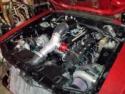


ported & polished Throttlebody vs 80mm ??

On The Tree
Joined: Feb 2004
Posts: 112
Likes: 0

Originally Posted by Jason 98 TA
We are finishing up our bigger blade ported stock housing throttle bodies that should be ready in about another week! Pricing will be $179 with the larger blade!
Originally Posted by Larry
How would an 80mm throttle body improve flow with only the stock 66.2 mm equivalent diameter mass air body?
I've read posts saying the factory mass air is big enough to support 500 hp. If this is true then the factory throttle body is larger than a factory mass air body eliminating it as a restriction.
I've read posts saying the factory mass air is big enough to support 500 hp. If this is true then the factory throttle body is larger than a factory mass air body eliminating it as a restriction.

Oh and my Bauer piece is a work of art, and I can feel the pull away from stock at upper RPMs and I've only started to mod. Besides Stellar customer service.
I know that air velocity is really more important than the whole amount of air going in....
I think of it like this....
lots of water through a big pipe...or thru a smaller pipe...
same amount of water...just more pressure.....so it will flow better with more pressure(put your thumbslightly over the end of a garden hose and see how much more distance you get.....) but the question is where does that benefit change to not enough..... if I go too big...then the lack of velocity causes me to lose power...but I dont know where that point is...and thats what I am trying to figure out.... I think??
I think of it like this....
lots of water through a big pipe...or thru a smaller pipe...
same amount of water...just more pressure.....so it will flow better with more pressure(put your thumbslightly over the end of a garden hose and see how much more distance you get.....) but the question is where does that benefit change to not enough..... if I go too big...then the lack of velocity causes me to lose power...but I dont know where that point is...and thats what I am trying to figure out.... I think??

TECH Senior Member
Joined: Mar 2004
Posts: 14,620
Likes: 17
From: BFE
I know what u mean! the thing is as a maketing tool I found it weird (Tricky) that FAST made a 78mm and a 90mm but no 80mm to monopolyse the TB sales.
BBK has a 80mm intake but it is Alum. and we all know about heat soak.
I still have my stock TB and I'm thinking of porting it then doing a back to back BBK VS ported TB dynos and put this whole question to rest OAFA.
BBK has a 80mm intake but it is Alum. and we all know about heat soak.
I still have my stock TB and I'm thinking of porting it then doing a back to back BBK VS ported TB dynos and put this whole question to rest OAFA.

TECH Fanatic
Joined: Jun 2002
Posts: 1,979
Likes: 3
From: Upstate NY
Originally Posted by soundengineer
I know that air velocity is really more important than the whole amount of air going in....
I think of it like this....
lots of water through a big pipe...or thru a smaller pipe...
same amount of water...just more pressure.....so it will flow better with more pressure(put your thumbslightly over the end of a garden hose and see how much more distance you get.....) but the question is where does that benefit change to not enough..... if I go too big...then the lack of velocity causes me to lose power...but I dont know where that point is...and thats what I am trying to figure out....
I think??
I think of it like this....
lots of water through a big pipe...or thru a smaller pipe...
same amount of water...just more pressure.....so it will flow better with more pressure(put your thumbslightly over the end of a garden hose and see how much more distance you get.....) but the question is where does that benefit change to not enough..... if I go too big...then the lack of velocity causes me to lose power...but I dont know where that point is...and thats what I am trying to figure out....
I think??
I think you have that reversed. Power comes from pumping more air thru the engine (and adding the correct amount of fuel to make it interesting).
Water flowing thru a hose under many psi of pressure isn't too similar to an engine operating at a very slight vacuum (at WOT). Holding your thumb partly over the hose end will increase the time it takes to fill a pail with water even with the higher velocity water because it causes a flow restrictioin. The analogy says the engines will also get less air in the same amount of time, so less power.

On The Tree
Joined: Dec 2003
Posts: 104
Likes: 0
From: McAllen, TX
Originally Posted by Old SStroker
I think you have that reversed. Power comes from pumping more air thru the engine (and adding the correct amount of fuel to make it interesting).
Water flowing thru a hose under many psi of pressure isn't too similar to an engine operating at a very slight vacuum (at WOT). Holding your thumb partly over the hose end will increase the time it takes to fill a pail with water even with the higher velocity water because it causes a flow restrictioin. The analogy says the engines will also get less air in the same amount of time, so less power.
Water flowing thru a hose under many psi of pressure isn't too similar to an engine operating at a very slight vacuum (at WOT). Holding your thumb partly over the hose end will increase the time it takes to fill a pail with water even with the higher velocity water because it causes a flow restrictioin. The analogy says the engines will also get less air in the same amount of time, so less power.
On The Tree
Joined: Feb 2004
Posts: 112
Likes: 0
Originally Posted by Old SStroker
Water flowing thru a hose under many psi of pressure isn't too similar to an engine operating at a very slight vacuum (at WOT). Holding your thumb partly over the hose end will increase the time it takes to fill a pail with water even with the higher velocity water because it causes a flow restrictioin. The analogy says the engines will also get less air in the same amount of time, so less power.
1) consevation of mass -- even blocking the end of the hose, the mass flow rate in is equal to the mass flow rate out. changing the size of one of the openings increases its velocity to maintain this. (rho)AV = (rho)AV rho is the density and stays constant. the velocity increases to make up for the decreased velocity.
2) i have done an experiment on the flow loss of a system based on the shape of the exit. comment 1 assumes ideal conditions (frictionless flow, etc, etc). the part that matters in filling the bucket (from the experiment i did) is the shape of the nozzle, not the size. we changed the shape of the nozzle from flat to a smaller end that was tappered and the smaller/tappered end flowed faster and more efficiently. size is not everything.
So I hit the nail on the head???
If I increase velocity...then I am better than if I just make the hole bigger and lose velocity possibly???
and my thumb on the hose was not a total blockage...just a slight to get pressure and velocity......
so I understand more about this stuff than I thought I knew....Its just simple physics???
If I increase velocity...then I am better than if I just make the hole bigger and lose velocity possibly???
and my thumb on the hose was not a total blockage...just a slight to get pressure and velocity......
so I understand more about this stuff than I thought I knew....Its just simple physics???
LS1 Tech Stories
The Best V8 Stories One Small Block at Time

Gas Monkey Built a 6-Wheel Ferrari Testarossa With a Corvette LT4 Engine
Verdad Gallardo
7 Most Reliable High-Performance Engines GM Has Ever Built
Verdad Gallardo
Amazing '71 Camaro Restomod Is Modern Muscle Car Under the Skin
Verdad Gallardo
6 Common C5 Corvette Failures and What's Involved In Repairing Them
Pouria Savadkouei
Retro Modern Bandit Pontiac Trans AM Comes With Burt Reynolds' Autograph
Verdad Gallardo
Top 10 Greatest Cadillac V Series Performance Models Ever, Ranked
Pouria Savadkouei
Top 10 Most Powerful Chevy Trucks Ever Made!

Hennessey's New Supercharged Silverado ZR2 Has 700 HP
Verdad Gallardo
Coachbuilt N2A Anteros Is an LS2-Powered C6 Corvette In Italian Clothes
Verdad Gallardo TECH Fanatic
Joined: Jun 2002
Posts: 1,979
Likes: 3
From: Upstate NY
Originally Posted by raceguy333
several comments:
1) consevation of mass -- even blocking the end of the hose, the mass flow rate in is equal to the mass flow rate out. changing the size of one of the openings increases its velocity to maintain this. (rho)AV = (rho)AV rho is the density and stays constant. the velocity increases to make up for the decreased velocity.
2) i have done an experiment on the flow loss of a system based on the shape of the exit. comment 1 assumes ideal conditions (frictionless flow, etc, etc). the part that matters in filling the bucket (from the experiment i did) is the shape of the nozzle, not the size. we changed the shape of the nozzle from flat to a smaller end that was tappered and the smaller/tappered end flowed faster and more efficiently. size is not everything.
1) consevation of mass -- even blocking the end of the hose, the mass flow rate in is equal to the mass flow rate out. changing the size of one of the openings increases its velocity to maintain this. (rho)AV = (rho)AV rho is the density and stays constant. the velocity increases to make up for the decreased velocity.
2) i have done an experiment on the flow loss of a system based on the shape of the exit. comment 1 assumes ideal conditions (frictionless flow, etc, etc). the part that matters in filling the bucket (from the experiment i did) is the shape of the nozzle, not the size. we changed the shape of the nozzle from flat to a smaller end that was tappered and the smaller/tappered end flowed faster and more efficiently. size is not everything.
Of course, using incompressible flow (water) analogies for compressible flow (air) isn't a very good idea, is it?
2) I always liked working with frictionless flow. It has so many real applications in the internal combustion engine and vehicle aerodynamics.

Cup "plate engine" guys find quite a few things orifice or nozzle shape can do to modify flow.
3) Size may not be everything, but sometimes it's the easiest way to the "prize". displacement, restrictor plate opening, throttle body or carb bore, depth of pockets, and the other obvious ones.
Last edited by Old SStroker; Apr 29, 2004 at 09:24 PM.
TECH Fanatic
Joined: Jun 2002
Posts: 1,979
Likes: 3
From: Upstate NY
Originally Posted by soundengineer
So I hit the nail on the head???
If I increase velocity...then I am better than if I just make the hole bigger and lose velocity possibly???
and my thumb on the hose was not a total blockage...just a slight to get pressure and velocity......
so I understand more about this stuff than I thought I knew....Its just simple physics???
If I increase velocity...then I am better than if I just make the hole bigger and lose velocity possibly???
and my thumb on the hose was not a total blockage...just a slight to get pressure and velocity......
so I understand more about this stuff than I thought I knew....Its just simple physics???
The engine will "suck harder" at wide open throttle (WOT), and intake manifold vacuum will be higher, velocity throught the smallest cross-section of the intake, the TB will be higher, but total air flow, and therefore power will be down. If that is your goal, by all means 'un-port' your throttle body. Actually, GM did a similar thing on 4.3L V6 engine. They used a larger (V8) TB and put a "tumor" on the back side of the blade which limits the effective area when the blade is wide open. It flows about 75% of the air a tumorless TB flows. Of course it's only feeding 75% of the displacement of a 350 V8.
On The Tree
Joined: Feb 2004
Posts: 112
Likes: 0
Originally Posted by Old SStroker
1)So if you press your thumb firmly enough on the end of the water hose to completely stop the flow, mass flow out is zero, and mass flow into the hose is approximately zero (hose may expand slightly). How does that fill the bucket?
2) I always liked working with frictionless flow. It has so many real applications in the internal combustion engine and vehicle aerodynamics.
2) I always liked working with frictionless flow. It has so many real applications in the internal combustion engine and vehicle aerodynamics.

2) the nozzle experiment does not assume frictionless... it was done in real-world conditions.. and the affects of a nozzle are due to friction and flow-loss coefficients...
On The Tree
Joined: Dec 2003
Posts: 104
Likes: 0
From: McAllen, TX
You can try and use physics and conduct experiments all you want. The bottom line is.... porting the throttle body to a larger opening to MATCH the intake manifold opening is the best way to go. Don't go over with a 80mm TB because there is an uneven flow. But then don't restrict it too much with the stock TB. IMO porting the stock TB to match the intake manifold is the best way to get better results...that is what I did. Like i stated earlier...I went from a 13.59 to a 13.15 ET with a ported throttle body and TB bypass. This was my experiment with my LS1, NOT A WATERHOSE!!!!!!
thats all and well...but I'mtalking about a modded motor...and how can you say a ported stock is better when you have not doe the 80mm and compared on the dyno and the track???
and FYI...
The waterhose was used because in an engine...air acts more like fluid dynamics than it does like air.... and is matching it?? or going larger to fit the pressure idea???
its really all about velocity...
and I'm trying to find out where that fine line is between volume and velocity is...for my engine...
and now I'm starting to consider the 90mm and fast stlye intakes...
and FYI...
The waterhose was used because in an engine...air acts more like fluid dynamics than it does like air.... and is matching it?? or going larger to fit the pressure idea???
its really all about velocity...
and I'm trying to find out where that fine line is between volume and velocity is...for my engine...
and now I'm starting to consider the 90mm and fast stlye intakes...

Originally Posted by TRAGIC
You can try and use physics and conduct experiments all you want. The bottom line is.... porting the throttle body to a larger opening to MATCH the intake manifold opening is the best way to go. Don't go over with a 80mm TB because there is an uneven flow. But then don't restrict it too much with the stock TB. IMO porting the stock TB to match the intake manifold is the best way to get better results...that is what I did. Like i stated earlier...I went from a 13.59 to a 13.15 ET with a ported throttle body and TB bypass. This was my experiment with my LS1, NOT A WATERHOSE!!!!!!

On The Tree
Joined: Dec 2003
Posts: 104
Likes: 0
From: McAllen, TX
Originally Posted by Dear John
Who ported your TB? It seems like that stocker was really holding you back. 4 tenths is unheard of. Way to go.
TECH Senior Member
Joined: Mar 2004
Posts: 14,620
Likes: 17
From: BFE
THe 80 MM BBk has a spacer before the intake. So the blades can open fully (As the intake is 75mm). The whole idea of porting is to increase the CFM draw capacity of the TB. IMO a ported TB with equal CFM capacity as a BBK will work as well. BBK doesn't achieve it's full potential with the LS1/LS6 manifold.
BBK has an 80mm intake but it is alum.

BBK has an 80mm intake but it is alum.
