





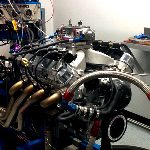




Is the torquer 2 big enough for a 408?

TECH Senior Member
Joined: Feb 2009
Posts: 5,445
Likes: 4

what would your static compression be using the 5.3 heads on the 408 ?that would determine the cam to get the right dynamic compression.a 6.0 used short block would be a cheaper swap,but I don't understand budgets or cheap.do what your heart tells you.l92 or ls3 heads would be killer on a 4" bore or bigger cylinder.
Martin, I would think that size motor with those heads would favor a wider LSA. With that many cubes the tight LSA is not needed to boost the midrange intake signal and would just waste some of the intake charge out the exhaust.
While I have not had personal experience testing LS strokers vs stock cubers, on the small block Chevys, the 400 always preferred the wider LSA than the 350. It was an important consideration when camming a 400.
Also, the wider LSA would also benefit the OPs desired street manners.
While I have not had personal experience testing LS strokers vs stock cubers, on the small block Chevys, the 400 always preferred the wider LSA than the 350. It was an important consideration when camming a 400.
Also, the wider LSA would also benefit the OPs desired street manners.
I can make a cam with a wide lsa still have more overlap than is necessary. I can also do the same thing with a tight lsa and have less overlap than is needed.
What makes you think a tight lsa can't be utilized? Remember stop thinking in terms of duration and lsa.
Tigger stop thinking in terms of duration and lsa and think in terms of events and duration at different points of the lift curve.
I can make a cam with a wide lsa still have more overlap than is necessary. I can also do the same thing with a tight lsa and have less overlap than is needed.
What makes you think a tight lsa can't be utilized? Remember stop thinking in terms of duration and lsa.
I can make a cam with a wide lsa still have more overlap than is necessary. I can also do the same thing with a tight lsa and have less overlap than is needed.
What makes you think a tight lsa can't be utilized? Remember stop thinking in terms of duration and lsa.
That is like when you talk to somebody who can't understand plain English unless they restate it in their own words.
Stating a cam profile in terms of IVO/IVC and EVO/EVC means absolutely the same to me as duration on a centerline and exhaust duration stated in relation to the intake. In the end it all means the same ****. Are there people who really can't correlate the two? It is just a matter of what you are familiar with.
It is pretty obvious that a much larger cam that has a 2 degree wider LSA will have more overlap than a small cam on a tighter LSA. It is just basic math.
As for a cam on a tighter LSA. I already explained why I thought a wider LSA might do better. It was due to some engine dyno testing I witnessed and the customers feedback on how the cars performed on the track when they got the motor back. Also, what I did not mention was that over two decades of drag racing, cam manufacturers would typically recommend tighter LSAs for smaller, shorter stroke motor and wider LSAs for larger, longer stroke motors. In general, I will say that larger, longer stroke motors can gain more by smoothing and broadening the torque curve and extending the RPM range. This is what wider LSAs generally do. Smaller shorter stroke engines typically benefited from a tighter LSA to improve the midrange torque.
A lot of people like to theorize stuff first. I tend to prefer comparing results of existing combos and applying what was learned. With that being said, the "why" it works conclusion we came to is this: We felt that the overlap cycle scavenging on the tighter LSA cams was creating a stonger intake pulse which helps fill the cylinders better in the midrange of the small motors, but is wasteful in the bigger motors as their larger displacement was providing a stronger signal by its size.
In that way it is similar to using wider LSAs on a supercharged motor. Since the air is being forced in, using overlap to increase the intake signal is not needed and wasteful. And like a supercharged engine, the larger displacement engines benefit by the increased "blow down" time provided by the earlier EVO that occurs in a wider LSA.
A lot of people like to theorize stuff first. I tend to prefer comparing results of existing combos and applying what was learned. With that being said, the "why" it works conclusion we came to is this: We felt that the overlap cycle scavenging on the tighter LSA cams was creating a stonger intake pulse which helps fill the cylinders better in the midrange of the small motors, but is wasteful in the bigger motors as their larger displacement was providing a stronger signal by its size.
In that way it is similar to using wider LSAs on a supercharged motor. Since the air is being forced in, using overlap to increase the intake signal is not needed and wasteful. And like a supercharged engine, the larger displacement engines benefit by the increased "blow down" time provided by the earlier EVO that occurs in a wider LSA.
Hey Tigger, some spirited cam discussion here...I do see your point and have
had similar results to the theories you are describing regarding larger airpumps
I think what Martin is trying to explain is that the lifter jerk or the rate of the
rise over the run does not always have to be constant. Lobe flanks can be
faster earlier then smooth out around the nose, drop fast and still set down
slowly so as not to bounce. When you look at any manufacturers cam lobes
be it Comp, Isky, Ultradyne, or Lunati you can compare lobes advertised dur.
, dur. @ .050/ @ .200/ and @ .300 to get a clearer picture of what the lifter
and ultimately the valve is actually seeing. I'm not saying either of you is
more right or wrong but rather that there are hundreds of aspects to consider
when putting an intake and exhaust lobe together in order to maximize the
efficiency of a particular combination............out..........JIM
had similar results to the theories you are describing regarding larger airpumps
I think what Martin is trying to explain is that the lifter jerk or the rate of the
rise over the run does not always have to be constant. Lobe flanks can be
faster earlier then smooth out around the nose, drop fast and still set down
slowly so as not to bounce. When you look at any manufacturers cam lobes
be it Comp, Isky, Ultradyne, or Lunati you can compare lobes advertised dur.
, dur. @ .050/ @ .200/ and @ .300 to get a clearer picture of what the lifter
and ultimately the valve is actually seeing. I'm not saying either of you is
more right or wrong but rather that there are hundreds of aspects to consider
when putting an intake and exhaust lobe together in order to maximize the
efficiency of a particular combination............out..........JIM
Semantics. Several people were talking all that crap on the bullet. Like saying it that way is the only "proper" way to describe valve events.
That is like when you talk to somebody who can't understand plain English unless they restate it in their own words.
Stating a cam profile in terms of IVO/IVC and EVO/EVC means absolutely the same to me as duration on a centerline and exhaust duration stated in relation to the intake. In the end it all means the same ****. Are there people who really can't correlate the two? It is just a matter of what you are familiar with.
It is pretty obvious that a much larger cam that has a 2 degree wider LSA will have more overlap than a small cam on a tighter LSA. It is just basic math.
That is like when you talk to somebody who can't understand plain English unless they restate it in their own words.
Stating a cam profile in terms of IVO/IVC and EVO/EVC means absolutely the same to me as duration on a centerline and exhaust duration stated in relation to the intake. In the end it all means the same ****. Are there people who really can't correlate the two? It is just a matter of what you are familiar with.
It is pretty obvious that a much larger cam that has a 2 degree wider LSA will have more overlap than a small cam on a tighter LSA. It is just basic math.
As for a cam on a tighter LSA. I already explained why I thought a wider LSA might do better. It was due to some engine dyno testing I witnessed and the customers feedback on how the cars performed on the track when they got the motor back. Also, what I did not mention was that over two decades of drag racing, cam manufacturers would typically recommend tighter LSAs for smaller, shorter stroke motor and wider LSAs for larger, longer stroke motors. In general, I will say that larger, longer stroke motors can gain more by smoothing and broadening the torque curve and extending the RPM range. This is what wider LSAs generally do. Smaller shorter stroke engines typically benefited from a tighter LSA to improve the midrange torque.
A lot of people like to theorize stuff first. I tend to prefer comparing results of existing combos and applying what was learned. With that being said, the "why" it works conclusion we came to is this: We felt that the overlap cycle scavenging on the tighter LSA cams was creating a stonger intake pulse which helps fill the cylinders better in the midrange of the small motors, but is wasteful in the bigger motors as their larger displacement was providing a stronger signal by its size.
In that way it is similar to using wider LSAs on a supercharged motor. Since the air is being forced in, using overlap to increase the intake signal is not needed and wasteful. And like a supercharged engine, the larger displacement engines benefit by the increased "blow down" time provided by the earlier EVO that occurs in a wider LSA.
A lot of people like to theorize stuff first. I tend to prefer comparing results of existing combos and applying what was learned. With that being said, the "why" it works conclusion we came to is this: We felt that the overlap cycle scavenging on the tighter LSA cams was creating a stonger intake pulse which helps fill the cylinders better in the midrange of the small motors, but is wasteful in the bigger motors as their larger displacement was providing a stronger signal by its size.
In that way it is similar to using wider LSAs on a supercharged motor. Since the air is being forced in, using overlap to increase the intake signal is not needed and wasteful. And like a supercharged engine, the larger displacement engines benefit by the increased "blow down" time provided by the earlier EVO that occurs in a wider LSA.
I do nearly 90 LS cams a month I know what works with what and what doesn't pretty well, but I will say I haven't been doing it for 20 years. You're jumping down my throat here, when all I was saying was to quit thinking in terms of generalization.
Last edited by Sales@Tick; Dec 24, 2012 at 01:38 AM.
You're still speaking terms of duration and LSA, at what duration? @.050", @.006", @.0200"???....................................Agai n, you're still speaking in terms of wide and tight, what one might generalize as "wide" might be 113-115 where as another might think it's 116-118. That means nothing to me, but what the cams lsa needs to end up on versus intake and exhaust centerline.
You may prefer talking about IVO/IVC and EVO/EVC at whatever lift you want if that is how you best visualize what is happening inside of an engine. I have no problem with that.
I can visualize it either way. If I can, I am sure some others can too. The Russians and the Americans both created successful space programs but in different languages. The NASA did not convert to speaking Russian after Sputnik.
All semantics aside, this is the fundamental difference in what we are thinking. Now you can easily restate this in valve events and that is fine. But in the end, it is all the same.
I am irritated by the thought process that intelligent people cannot visualize what is going on inside of a motor unless they use the new trendy language. I also used to laugh at my daughters elementary school teachers when they told me that the way we learned math was wrong because they teach it different now. As if the answers to 2+2 is different with the new math. :
 I am annoyed by the semantics. Nothing else. This is not directed at you, so please do not be angry. But when I first saw this discussion on the bullet it reminded of something my Dad used to say: If you can't dazzle them with brilliance baffle them with bullshit. That is how it struck me.
One last thing and I will be throw the soap box on the shelf for the day. You can take the biggest and best cam gurus and have them spec a cam for a motor with all of the information about the combo they think they need. And, unless it is is a combo that they have a lot of experience with, there is a fairly good chance that when you put it on the dyno, you can pick up some horsepower by advancing it or retarding it a few degrees. So, there goes their theoretical ideal IVC event and so on.
Now if it is a common popular combo like the hundreds of people who have an LS1 with 243 heads fast intake blah blah blah, then the cam expert will know from experience what has worked in the past on that combo and nail it most of the time. Computer cam programs and philosophical discussion are great and have value, but I will take real world comparative data every time.
LS1 Tech Stories
The Best V8 Stories One Small Block at Time

Topdon ONE vs. Artidiag 800 BT2: Which is the Diagnostic Tablet For You?
Pouria Savadkouei
Gas Monkey Built a 6-Wheel Ferrari Testarossa With a Corvette LT4 Engine
Verdad Gallardo
7 Most Reliable High-Performance Engines GM Has Ever Built
Verdad Gallardo
Amazing '71 Camaro Restomod Is Modern Muscle Car Under the Skin
Verdad Gallardo
6 Common C5 Corvette Failures and What's Involved In Repairing Them
Pouria Savadkouei
Retro Modern Bandit Pontiac Trans AM Comes With Burt Reynolds' Autograph
Verdad Gallardo
Top 10 Greatest Cadillac V Series Performance Models Ever, Ranked
Pouria Savadkouei
Top 10 Most Powerful Chevy Trucks Ever Made!

Hennessey's New Supercharged Silverado ZR2 Has 700 HP
Verdad Gallardo Hey Tigger, some spirited cam discussion here...I do see your point and have
had similar results to the theories you are describing regarding larger airpumps
I think what Martin is trying to explain is that the lifter jerk or the rate of the
rise over the run does not always have to be constant. Lobe flanks can be
faster earlier then smooth out around the nose, drop fast and still set down
slowly so as not to bounce. When you look at any manufacturers cam lobes
be it Comp, Isky, Ultradyne, or Lunati you can compare lobes advertised dur.
, dur. @ .050/ @ .200/ and @ .300 to get a clearer picture of what the lifter
and ultimately the valve is actually seeing. I'm not saying either of you is
more right or wrong but rather that there are hundreds of aspects to consider
when putting an intake and exhaust lobe together in order to maximize the
efficiency of a particular combination............out..........JIM
had similar results to the theories you are describing regarding larger airpumps
I think what Martin is trying to explain is that the lifter jerk or the rate of the
rise over the run does not always have to be constant. Lobe flanks can be
faster earlier then smooth out around the nose, drop fast and still set down
slowly so as not to bounce. When you look at any manufacturers cam lobes
be it Comp, Isky, Ultradyne, or Lunati you can compare lobes advertised dur.
, dur. @ .050/ @ .200/ and @ .300 to get a clearer picture of what the lifter
and ultimately the valve is actually seeing. I'm not saying either of you is
more right or wrong but rather that there are hundreds of aspects to consider
when putting an intake and exhaust lobe together in order to maximize the
efficiency of a particular combination............out..........JIM
I don't think any off shore boat racer is going to say: "Hey throw that super aggressive lobe on the intake sides of my boat cam because it has the .200 duration I want but still achieves my ideal lift." That is just not practical. Instead he is going to say: "give me as much lobe as you can that will not break during the race". If a cam guru decides he wants the intake valve to be at a certain place at x amount of crank degrees, he is still going to do it with the lobe that makes the most sense for the application stability and longevity wise.
I say lobe choice is more often a practical decision than an idealism thing.

Thread Starter
11 Second Club
Joined: Feb 2002
Posts: 955
Likes: 4
From: Silver Spring, Md.
Wow, there is some very interesting information being shared in this thread. Now let me throw something else in the pot. I'm trying to get a better understanding on how the cam events affect the performance of the motor, so I apologize if some of my questions seem a bit silly by your standards. If I choose down the road to change to a better set of heads, would a cam that's optimized for the 5.3 heads not work for a set ported aftermarket heads with a bigger intake port? My guess is I'll be leaving power on the table but how will the performance suffer?
Wow, there is some very interesting information being shared in this thread. Now let me throw something else in the pot. I'm trying to get a better understanding on how the cam events affect the performance of the motor, so I apologize if some of my questions seem a bit silly by your standards. If I choose down the road to change to a better set of heads, would a cam that's optimized for the 5.3 heads not work for a set ported aftermarket heads with a bigger intake port? My guess is I'll be leaving power on the table but how will the performance suffer?
So, if you are sure of the heads you want and you are pretty sure the head swap is going to happen, then you might get the optimum cam for that combo now. On the flip side, used roller cams are typically pretty easy to sell, so you can always re-cam with the new heads and recoup some of your money selling your old cam.
Thread Starter
11 Second Club
Joined: Feb 2002
Posts: 955
Likes: 4
From: Silver Spring, Md.
Actually this question gets asked on here a lot. I would say it is a sacrifice for sure. The two scenarios will definitely want some slightly different specs. I doubt it will be a huge difference, but I would certainly spec the cam for the most likely scenario.
So, if you are sure of the heads you want and you are pretty sure the head swap is going to happen, then you might get the optimum cam for that combo now. On the flip side, used roller cams are typically pretty easy to sell, so you can always re-cam with the new heads and recoup some of your money selling your old cam.
So, if you are sure of the heads you want and you are pretty sure the head swap is going to happen, then you might get the optimum cam for that combo now. On the flip side, used roller cams are typically pretty easy to sell, so you can always re-cam with the new heads and recoup some of your money selling your old cam.
Actually, I can speak in either terms because to me they mean EXACTLY the same thing. You can measure something in millimeters or inches. It does not change how big it is.
You may prefer talking about IVO/IVC and EVO/EVC at whatever lift you want if that is how you best visualize what is happening inside of an engine. I have no problem with that.
I can visualize it either way. If I can, I am sure some others can too. The Russians and the Americans both created successful space programs but in different languages. The NASA did not convert to speaking Russian after Sputnik.
Now this is the meat and potatoes for me. This is where my experience and yours a truly differ. I am saying that the smaller head on a big motor is going to want a wider LSA and the bigger head may prefer a tighter LSA in general. And, I am not suggesting you look at LSA in a vacuum, but LSA gives a good visualization for discussion of overlap for a given duration split.
All semantics aside, this is the fundamental difference in what we are thinking. Now you can easily restate this in valve events and that is fine. But in the end, it is all the same.
Absolutely NOT jumping down your throat. I am a big fan of your tech advice and your dedicated contribution to this community is extraordinary and much appreciated. I have no doubt that your LS specific knowledge far surpasses mine. And I will still ask you your opinion on all kinds of things I may be contemplating or discussing because I value it.
I am irritated by the thought process that intelligent people cannot visualize what is going on inside of a motor unless they use the new trendy language. I also used to laugh at my daughters elementary school teachers when they told me that the way we learned math was wrong because they teach it different now. As if the answers to 2+2 is different with the new math. : I am annoyed by the semantics. Nothing else. This is not directed at you, so please do not be angry. But when I first saw this discussion on the bullet it reminded of something my Dad used to say: If you can't dazzle them with brilliance baffle them with bullshit. That is how it struck me.
One last thing and I will be throw the soap box on the shelf for the day. You can take the biggest and best cam gurus and have them spec a cam for a motor with all of the information about the combo they think they need. And, unless it is is a combo that they have a lot of experience with, there is a fairly good chance that when you put it on the dyno, you can pick up some horsepower by advancing it or retarding it a few degrees. So, there goes their theoretical ideal IVC event and so on.
Now if it is a common popular combo like the hundreds of people who have an LS1 with 243 heads fast intake blah blah blah, then the cam expert will know from experience what has worked in the past on that combo and nail it most of the time. Computer cam programs and philosophical discussion are great and have value, but I will take real world comparative data every time.
You may prefer talking about IVO/IVC and EVO/EVC at whatever lift you want if that is how you best visualize what is happening inside of an engine. I have no problem with that.
I can visualize it either way. If I can, I am sure some others can too. The Russians and the Americans both created successful space programs but in different languages. The NASA did not convert to speaking Russian after Sputnik.
Now this is the meat and potatoes for me. This is where my experience and yours a truly differ. I am saying that the smaller head on a big motor is going to want a wider LSA and the bigger head may prefer a tighter LSA in general. And, I am not suggesting you look at LSA in a vacuum, but LSA gives a good visualization for discussion of overlap for a given duration split.
All semantics aside, this is the fundamental difference in what we are thinking. Now you can easily restate this in valve events and that is fine. But in the end, it is all the same.
Absolutely NOT jumping down your throat. I am a big fan of your tech advice and your dedicated contribution to this community is extraordinary and much appreciated. I have no doubt that your LS specific knowledge far surpasses mine. And I will still ask you your opinion on all kinds of things I may be contemplating or discussing because I value it.
I am irritated by the thought process that intelligent people cannot visualize what is going on inside of a motor unless they use the new trendy language. I also used to laugh at my daughters elementary school teachers when they told me that the way we learned math was wrong because they teach it different now. As if the answers to 2+2 is different with the new math. :
I am annoyed by the semantics. Nothing else. This is not directed at you, so please do not be angry. But when I first saw this discussion on the bullet it reminded of something my Dad used to say: If you can't dazzle them with brilliance baffle them with bullshit. That is how it struck me.One last thing and I will be throw the soap box on the shelf for the day. You can take the biggest and best cam gurus and have them spec a cam for a motor with all of the information about the combo they think they need. And, unless it is is a combo that they have a lot of experience with, there is a fairly good chance that when you put it on the dyno, you can pick up some horsepower by advancing it or retarding it a few degrees. So, there goes their theoretical ideal IVC event and so on.
Now if it is a common popular combo like the hundreds of people who have an LS1 with 243 heads fast intake blah blah blah, then the cam expert will know from experience what has worked in the past on that combo and nail it most of the time. Computer cam programs and philosophical discussion are great and have value, but I will take real world comparative data every time.
My gripe with what you were saying wasn't even about this engine needing a tight or a wide lsa and I wasn't disagreeing with you at all that it would need a "wider" lsa(at least I don't think I did?) I was just pointing out that "wide" and "tight" can be taken in many different contexts like Jim saying, "Sally is tight as hell!", then Frank says, "man that thing is wider than a B52 hangar!"
Depending on the weight of the vehicle and where the customer wants to turn his engine, I 9/10 will use a LSA in between 112-114 on an engine like this. I hate speaking in these terms, because there are so many variables, but that's usually where they end up.
I'm glad you're a fan of mine, I try to share as much knowledge as I can with others so that they may truly learn how their set-up/combination works and that when they buy a cam or a H/C/I package from me they feel like they know how their set-up works best and that they didn't just pay someone to do it all for them. I like to involve my customers in the thought process that goes behind specing their cam, and I do the same with those that aren't my customers.
I don't think speaking in terms of events are trendy or something new that is just being tossed around as every cam guy I've ever known speaks in these terms, it's more-so the general public that speaks in terms of duration. I honestly don't use any computer software to determine my valve events or lobe intensity. I do it based off experience and as you said, using the most aggressive lobe I can while still keeping stablility and longevity depending on the intended application and mileage driven per year.
At first I thought you were trying to say that I didn't have enough experience and that all larger engines regardless of port volume, cross sectional area, valve diameter and type of intake manifold needed a wide lsa no matter what and that a tighter lsa was wrong. I understand what you're trying to say, and again I never said that what you were getting at about using a wider lsa or a tighter lsa was wrong either. I wanted to hear your thoughts and experiences on this as I know you're a lot older than I am with more experience in general than I. I also wasn't trying to say you were wrong for using terms of duration and LSA, I was mainly trying to say that making generalities and painting with a wide brush can get you into trouble sometimes.
Lmfao.... poor Frank is only working with a 3/4 cam on a 55mm journal while Jim has got the full race cam on a 60mm big block journal.



LOL.
T2 is too small. But you could run it on a 115+0. That changes the VEs to better match the 408. It will also drive really smooth.
If you look at the 600rwhp Cathedral port 427+cid motors, all of them have massive overlap but extremely wide LSAs. 250/260 115 type cams. Why? Broaden the torque curve across the massive engine's RPM range.
Even on heads like AFR, Mamo and Curtis and others all agree that you don't need to use overlap as a crutch for the intake charge. If heads have 85% I/E efficiency, you can go with enough duration and set the ICL where you want to get optimal VEs that don't rely on the cam to create cylinder pressure. You rely on compression and head efficiency (both I/E ratio and especially velocity relative to a given CSA) to make power with a given set of VEs.
T2 is too small. But you could run it on a 115+0. That changes the VEs to better match the 408. It will also drive really smooth.
If you look at the 600rwhp Cathedral port 427+cid motors, all of them have massive overlap but extremely wide LSAs. 250/260 115 type cams. Why? Broaden the torque curve across the massive engine's RPM range.
Even on heads like AFR, Mamo and Curtis and others all agree that you don't need to use overlap as a crutch for the intake charge. If heads have 85% I/E efficiency, you can go with enough duration and set the ICL where you want to get optimal VEs that don't rely on the cam to create cylinder pressure. You rely on compression and head efficiency (both I/E ratio and especially velocity relative to a given CSA) to make power with a given set of VEs.


Thread Starter
11 Second Club
Joined: Feb 2002
Posts: 955
Likes: 4
From: Silver Spring, Md.
So, I'm not asking for exact specs, but given that I'll be using the 5.3 heads, what size cam can I get away with in a 408 that would give me the driveability of a t2 in a stock cubed motor? Judging from what I'm gathering from what you guys have been talking about...would I need something in the 230-240 range on the intake side, and 240+ on the exhaust side, on a 115 lsa? What kind of lift would I be looking at assuming my piston has 8cc valve reliefs?
Last edited by big dave; Jan 10, 2013 at 05:22 PM.

Staging Lane
Joined: Feb 2012
Posts: 82
Likes: 0
From: El Paso Texas