



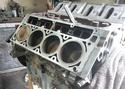



ticking/tapping sound coming from engine

push rods, stock ones are weak and bend i bent 7 all intake side. drove it ticking for way to long and smashed a lifter into the cam and ruined everything 
its pretty simple to take the valve covers off, un bolt the rockers and pull out and check for bent push rods. find one of those and then you need to worry about lifters
its pretty simple to take the valve covers off, un bolt the rockers and pull out and check for bent push rods. find one of those and then you need to worry about lifters
yeah, i'm gonna go ahead & pull the valve covers this weekend and see if there's anything to see in there first....i think that would actually take me less time to do than pulling the exhaust to check those gaskets, too...i don't have access to a lift, and removing the exhaust on the ground is not fun, even with Rhino Ramps....
well, i didn't get a chance this weekend to pull the valve covers...but this morning on the way to work, the temperature gauge went to the red a couple times. oil pressure is steady, though.
could this be a popped head gasket?
could this be a popped head gasket?
OK, so i found out that it is likely to be at least a blown head gasket. hopefully it's just the head gasket(s) that are hosed...if so, i will be a very happy camper.
after the overheating occurred, i let the car cool down and checked the water level, and it was low. i refilled it with water, and ran it for a few minutes sitting still, and it didn't overheat anymore. so then i checked the oil level again, the level is fine, and oil pressure is still holding strong, but when i pulled the stick out to check it, i saw a very little bit of smoke/steam coming out the tube. i also saw a slow trickle of smoke/steam coming out the tailpipes.
oil didn't seem milky, though, so i'm not 100% certain...could it be a slow enough leak of water into the cylinder(s) that it's evaporating before it has a chance to mix with the oil?
i went ahead & ordered intake, head, exhaust manifold & exhaust flange gaskets anyway, cause all that is gonna come off and be inspected this week & weekend. all together it was only around $150, so that's not bad at all. gonna get some new head bolts tomorrow or thursday after i get paid again. any other parts or special tools (apart from torque wrenches, which i have) that i may need while i'm getting them? i will be towing my car out to my mom's place out of town, and i'd rather not have to run back into town to pick up more parts if i don't have to. i already have some new spark plugs, which are going to go in while the heads are out....may as well take advantage of the extra clearance while i can...i was putting off doing the spark plugs for a while now because of how difficult they are to get to.
also, how do i check for damage to other stuff like the lifters, valves, springs & rocker arms? pushrods are pretty evident, just take them out & roll them on a flat surface & check the ends for excessive wear...and make sure they're not clogged up in the center.
to check for a collapsed lifter, i know you can press/lift the rocker arms and check for play there, but don't you have to rotate the crank to a certain point and check each pair of rockers individually?
and obviously, i know to check for piston/valve contact, which should be pretty evident, but how do i check the stems & the valve springs?
after the overheating occurred, i let the car cool down and checked the water level, and it was low. i refilled it with water, and ran it for a few minutes sitting still, and it didn't overheat anymore. so then i checked the oil level again, the level is fine, and oil pressure is still holding strong, but when i pulled the stick out to check it, i saw a very little bit of smoke/steam coming out the tube. i also saw a slow trickle of smoke/steam coming out the tailpipes.
oil didn't seem milky, though, so i'm not 100% certain...could it be a slow enough leak of water into the cylinder(s) that it's evaporating before it has a chance to mix with the oil?
i went ahead & ordered intake, head, exhaust manifold & exhaust flange gaskets anyway, cause all that is gonna come off and be inspected this week & weekend. all together it was only around $150, so that's not bad at all. gonna get some new head bolts tomorrow or thursday after i get paid again. any other parts or special tools (apart from torque wrenches, which i have) that i may need while i'm getting them? i will be towing my car out to my mom's place out of town, and i'd rather not have to run back into town to pick up more parts if i don't have to. i already have some new spark plugs, which are going to go in while the heads are out....may as well take advantage of the extra clearance while i can...i was putting off doing the spark plugs for a while now because of how difficult they are to get to.
also, how do i check for damage to other stuff like the lifters, valves, springs & rocker arms? pushrods are pretty evident, just take them out & roll them on a flat surface & check the ends for excessive wear...and make sure they're not clogged up in the center.
to check for a collapsed lifter, i know you can press/lift the rocker arms and check for play there, but don't you have to rotate the crank to a certain point and check each pair of rockers individually?
and obviously, i know to check for piston/valve contact, which should be pretty evident, but how do i check the stems & the valve springs?
also, how do i check for damage to other stuff like the lifters, valves, springs & rocker arms? pushrods are pretty evident, just take them out & roll them on a flat surface & check the ends for excessive wear...and make sure they're not clogged up in the center.
to check for a collapsed lifter, i know you can press/lift the rocker arms and check for play there, but don't you have to rotate the crank to a certain point and check each pair of rockers individually?
and obviously, i know to check for piston/valve contact, which should be pretty evident, but how do i check the stems & the valve springs?
to check for a collapsed lifter, i know you can press/lift the rocker arms and check for play there, but don't you have to rotate the crank to a certain point and check each pair of rockers individually?
and obviously, i know to check for piston/valve contact, which should be pretty evident, but how do i check the stems & the valve springs?
by plunger, i'm guessing you're referring to the lifters? sorry, haven't dealt with OHV setups before
LS1 Tech Stories
The Best V8 Stories One Small Block at Time

Topdon ONE vs. Artidiag 800 BT2: Which is the Diagnostic Tablet For You?
Pouria Savadkouei
Gas Monkey Built a 6-Wheel Ferrari Testarossa With a Corvette LT4 Engine
Verdad Gallardo
7 Most Reliable High-Performance Engines GM Has Ever Built
Verdad Gallardo
Amazing '71 Camaro Restomod Is Modern Muscle Car Under the Skin
Verdad Gallardo
6 Common C5 Corvette Failures and What's Involved In Repairing Them
Pouria Savadkouei
Retro Modern Bandit Pontiac Trans AM Comes With Burt Reynolds' Autograph
Verdad Gallardo
Top 10 Greatest Cadillac V Series Performance Models Ever, Ranked
Pouria Savadkouei
Top 10 Most Powerful Chevy Trucks Ever Made!

Hennessey's New Supercharged Silverado ZR2 Has 700 HP
Verdad Gallardo
push rods, stock ones are weak and bend i bent 7 all intake side. drove it ticking for way to long and smashed a lifter into the cam and ruined everything
its pretty simple to take the valve covers off, un bolt the rockers and pull out and check for bent push rods. find one of those and then you need to worry about lifters
its pretty simple to take the valve covers off, un bolt the rockers and pull out and check for bent push rods. find one of those and then you need to worry about lifters
well, i finally had some time to get into the heads, and although it kinda sounds strange, i've never been more disappointed that i don't have collapsed lifters or bent pushrods...... 
gonna wait until tomorrow to pull the heads off, so we'll see if there are any PTV clearance issues then.....
gonna wait until tomorrow to pull the heads off, so we'll see if there are any PTV clearance issues then.....
so the heads are off now, and i'm thinking there actually is a problem with some of the lifters.....on 8 of them, i can push the plunger in by hand (using a pushrod), and the other 8 are solid, they don't budge at all by hand. this is after thoroughly soaking/cleaning them in gasoline to get any gunk out of them, and blowing compressed air through the pushrod seat to blow out everything out the feeder hole in the side of the lifter.
so is it bad if you can compress the plunger by hand like that, just using one finger on a pushrod to compress it?
so is it bad if you can compress the plunger by hand like that, just using one finger on a pushrod to compress it?

Teching In
Joined: Apr 2013
Posts: 39
Likes: 0
From: Wisconsin
check exhaust manifold studs. It is common for them to snap mine did and sounded like that. If those are fine probably bent push rod somewhere. Is check engine light on? When I bent my push rods it ran like **** but was getting check engine codes!
i know i have a blown head gasket....when i pulled the valve covers, there was murky/milky gunk all over them....so the heads were gonna have to come off anyway.
i don't remember seeing the check engine light come on before i started taking everything apart. the pushrods were all perfectly straight, there's no issues there, and i could not see any PTV contact points anywhere.
on cylinder 7, though (driver's side closest to the firewall), there was evidence of what i believe to be an issue with a lifter having gone bad...the exhaust valve there was blacker/sootier than all the rest of them, and there was the same milky water/oil mixture in that cylinder, but none in any of the other cylinders...so i think what happened is that the lifter on the exhaust side of that cylinder collapsed and kept that valve from being able to open all the way (or at all), which caused too much pressure in that cylinder, which caused the head gasket to blow out and get water/oil in that cylinder. that would also explain the noise, because the collapsed lifter would not be able to keep the pushrod pushed up tight against the rocker arm, leaving a bit of a gap where the pushrod would just bounce between the rocker & the lifter, causing the tapping sound.
i did also find out that on the driver's side exhaust manifold, there were only 5 of the 6 bolts in there. it didn't break off or anything, there were no remains of the bolt in the hole once the heads were off, it just simply wasn't there. i suspect that the previous owner either had LT's on the car and pulled them back off before trading it in, or had taken the manifolds off for some reason, and just didn't bother (or forgot) to put the last bolt back in. i know this was not the issue causing the sound, though...the manifold was rusty where the bolt would have been, and there was dirt/dust, etc. in the hole where the bolt should have been....it had been that way since i bought the car.
i'm going to be taking the heads to a local engine/machine shop here tomorrow to have them checked out for warping/cracks/bent valves, etc., due to the overheating that occurred from the loss of water from the blown head gasket.
my main concern now is how do i tell whether or not i need to buy a new set of lifters? is there some way to "bench test" lifters to see whether or not they are bad?
i really need to know soon, so i can get parts ordered & shipped in before this next weekend & start getting the engine back together. this is my daily driver, and it's already been a couple weeks, and i can't work on it during the week at all because it's out of town at my folks' place.
i don't remember seeing the check engine light come on before i started taking everything apart. the pushrods were all perfectly straight, there's no issues there, and i could not see any PTV contact points anywhere.
on cylinder 7, though (driver's side closest to the firewall), there was evidence of what i believe to be an issue with a lifter having gone bad...the exhaust valve there was blacker/sootier than all the rest of them, and there was the same milky water/oil mixture in that cylinder, but none in any of the other cylinders...so i think what happened is that the lifter on the exhaust side of that cylinder collapsed and kept that valve from being able to open all the way (or at all), which caused too much pressure in that cylinder, which caused the head gasket to blow out and get water/oil in that cylinder. that would also explain the noise, because the collapsed lifter would not be able to keep the pushrod pushed up tight against the rocker arm, leaving a bit of a gap where the pushrod would just bounce between the rocker & the lifter, causing the tapping sound.
i did also find out that on the driver's side exhaust manifold, there were only 5 of the 6 bolts in there. it didn't break off or anything, there were no remains of the bolt in the hole once the heads were off, it just simply wasn't there. i suspect that the previous owner either had LT's on the car and pulled them back off before trading it in, or had taken the manifolds off for some reason, and just didn't bother (or forgot) to put the last bolt back in. i know this was not the issue causing the sound, though...the manifold was rusty where the bolt would have been, and there was dirt/dust, etc. in the hole where the bolt should have been....it had been that way since i bought the car.
i'm going to be taking the heads to a local engine/machine shop here tomorrow to have them checked out for warping/cracks/bent valves, etc., due to the overheating that occurred from the loss of water from the blown head gasket.
my main concern now is how do i tell whether or not i need to buy a new set of lifters? is there some way to "bench test" lifters to see whether or not they are bad?
i really need to know soon, so i can get parts ordered & shipped in before this next weekend & start getting the engine back together. this is my daily driver, and it's already been a couple weeks, and i can't work on it during the week at all because it's out of town at my folks' place.
Teching In
Joined: Apr 2013
Posts: 39
Likes: 0
From: Wisconsin
Sorry didnt see you already pulled heads. the lifters should not be that easy to compress they will compress but not that easy. I know how it goes trying to save money on only getting what you need but its all apart get the new lifters as well as nice gasket set! hope you get her going again! ps sounds like good idea on what happened on # 7
well, i got the engine all back together and went to fire it up...and there is still a tapping sound in it.... 
i had the heads repaired, there was 1 exhaust valve that needed to be replaced, new valve seals all around, everything else is stock (pushrods, rockers, springs)...stock lifters were replaced with LS7's & new lifter trays. everything was put together with liberal amounts of Lucas assembly lube. heads were milled .004", basically just to clean the mating surface...otherwise, they were fine as far as warping or whatever.
i swapped over to the LS6 PCV valley cover (the NEW 2004+ style with PCV integrated), all new Fel-Pro gaskets everywhere.
any ideas?
i had the heads repaired, there was 1 exhaust valve that needed to be replaced, new valve seals all around, everything else is stock (pushrods, rockers, springs)...stock lifters were replaced with LS7's & new lifter trays. everything was put together with liberal amounts of Lucas assembly lube. heads were milled .004", basically just to clean the mating surface...otherwise, they were fine as far as warping or whatever.
i swapped over to the LS6 PCV valley cover (the NEW 2004+ style with PCV integrated), all new Fel-Pro gaskets everywhere.
any ideas?
well, i have an update...i took the car out to 510 Race Engineernig in Tomball, and they took a look/listened to it after i unloaded it off the trailer and they said it sounded like something in the bottom end. they pulled the dipstick and there was water in the oil again...apparently the head gasket blew again right after i started it for the first time, which was the cause of the whole car shifting/kicking over real hard when i first fired it up....
so i left it there and they started working on pulling everything on thursday/friday...after pulling the engine & tearing it down, they said that cylinder 7's wall (not the sleeve) & its piston are both cracked.
in a way, i actually feel OK about that, because until i found that out, i was worried that i had done something wrong that caused it to pop again, but i guess the crack was already there from before, i just couldn't see it with the engine in the car.
i just don't see how the cylinder wall & piston would be cracked like that, it was a bone-stock engine that has never seen nitrous since i've owned it...it only had 11,706 miles on it when i bought it, and it's a little over 80k now, so i doubt there would have been damage from the previous owner spraying it that would take 70k-ish miles to surface. only thing i can think is maybe a minor defect in the casting that got worse over time and finally popped after many, many heat/cool cycles?
so i left it there and they started working on pulling everything on thursday/friday...after pulling the engine & tearing it down, they said that cylinder 7's wall (not the sleeve) & its piston are both cracked.
in a way, i actually feel OK about that, because until i found that out, i was worried that i had done something wrong that caused it to pop again, but i guess the crack was already there from before, i just couldn't see it with the engine in the car.
i just don't see how the cylinder wall & piston would be cracked like that, it was a bone-stock engine that has never seen nitrous since i've owned it...it only had 11,706 miles on it when i bought it, and it's a little over 80k now, so i doubt there would have been damage from the previous owner spraying it that would take 70k-ish miles to surface. only thing i can think is maybe a minor defect in the casting that got worse over time and finally popped after many, many heat/cool cycles?
