





Crankcase Pressure Issues

TECH Addict
Joined: Mar 2013
Posts: 2,628
Likes: 30

Registered User
Joined: Nov 2014
Posts: 38
Likes: 0
From: Arizona

Very little even when it blows out the rear Main it looks bad but I've never had to add oil. When I swapped to the Ls30 last week I had 2000miles with catch can and mabe there was a tablespoon of oil inside
TECH Addict
Joined: Mar 2013
Posts: 2,628
Likes: 30
Hmmm I have to agree its very odd. What happens if you rev the engine to 2500 with the oil cap off? Does it blow air out? Pull off the cap and hold it at 2500 and try putting your hand over it slowly to see how much pressure it builds. Be sure your PCV is hooked up properly before doing this.
This does not seem like a blow by issue to me. Sure a torque plate is better however I doubt the bore distorts as much in the top inch like a gen one SBC since the head bolts pull from the bottom of the cylinder barrels on a LS.
During early testing; GM had to use iron blocks since they kept exploding the aluminum ones on the dyno. This led to the bay to bay casting vents in order to allow the crankcase to breath. The better the hone job equals a quality ring seal. This makes more power, however there is still the same number of cubic inches under the pistons as on top of them.
A quality air pump is worth power. Period.
Any dyno will show that although they take roughly 12-17 HP to turn @ high rpms, they usually return anywhere from 20-50 horsepower in drag applications. Similar to the way a dry sump oiling system creates crankcase vaccum, the power comes from dramatically increased ring seal. Less ring flutter (no lower pressure working against) means the compression rings continue to press against the cylinder wall for a greater number of crankshaft degrees (rotation) past TDC.
Getting your crankcase pressure in check is the key as the piston to wall clearance in a forged motor is nearly three times that of a factory hyper piston.
During early testing; GM had to use iron blocks since they kept exploding the aluminum ones on the dyno. This led to the bay to bay casting vents in order to allow the crankcase to breath. The better the hone job equals a quality ring seal. This makes more power, however there is still the same number of cubic inches under the pistons as on top of them.
A quality air pump is worth power. Period.
Any dyno will show that although they take roughly 12-17 HP to turn @ high rpms, they usually return anywhere from 20-50 horsepower in drag applications. Similar to the way a dry sump oiling system creates crankcase vaccum, the power comes from dramatically increased ring seal. Less ring flutter (no lower pressure working against) means the compression rings continue to press against the cylinder wall for a greater number of crankshaft degrees (rotation) past TDC.
Getting your crankcase pressure in check is the key as the piston to wall clearance in a forged motor is nearly three times that of a factory hyper piston.
LS1 Tech Stories
The Best V8 Stories One Small Block at Time

Topdon ONE vs. Artidiag 800 BT2: Which is the Diagnostic Tablet For You?
Pouria Savadkouei
Gas Monkey Built a 6-Wheel Ferrari Testarossa With a Corvette LT4 Engine
Verdad Gallardo
7 Most Reliable High-Performance Engines GM Has Ever Built
Verdad Gallardo
Amazing '71 Camaro Restomod Is Modern Muscle Car Under the Skin
Verdad Gallardo
6 Common C5 Corvette Failures and What's Involved In Repairing Them
Pouria Savadkouei
Retro Modern Bandit Pontiac Trans AM Comes With Burt Reynolds' Autograph
Verdad Gallardo
Top 10 Greatest Cadillac V Series Performance Models Ever, Ranked
Pouria Savadkouei
Top 10 Most Powerful Chevy Trucks Ever Made!

Hennessey's New Supercharged Silverado ZR2 Has 700 HP
Verdad Gallardo
This does not seem like a blow by issue to me. Sure a torque plate is better however I doubt the bore distorts as much in the top inch like a gen one SBC since the head bolts pull from the bottom of the cylinder barrels on a LS.
During early testing; GM had to use iron blocks since they kept exploding the aluminum ones on the dyno. This led to the bay to bay casting vents in order to allow the crankcase to breath. The better the hone job equals a quality ring seal. This makes more power, however there is still the same number of cubic inches under the pistons as on top of them.
A quality air pump is worth power. Period.
Any dyno will show that although they take roughly 12-17 HP to turn @ high rpms, they usually return anywhere from 20-50 horsepower in drag applications. Similar to the way a dry sump oiling system creates crankcase vaccum, the power comes from dramatically increased ring seal. Less ring flutter (no lower pressure working against) means the compression rings continue to press against the cylinder wall for a greater number of crankshaft degrees (rotation) past TDC.
Getting your crankcase pressure in check is the key as the piston to wall clearance in a forged motor is nearly three times that of a factory hyper piston.
During early testing; GM had to use iron blocks since they kept exploding the aluminum ones on the dyno. This led to the bay to bay casting vents in order to allow the crankcase to breath. The better the hone job equals a quality ring seal. This makes more power, however there is still the same number of cubic inches under the pistons as on top of them.
A quality air pump is worth power. Period.
Any dyno will show that although they take roughly 12-17 HP to turn @ high rpms, they usually return anywhere from 20-50 horsepower in drag applications. Similar to the way a dry sump oiling system creates crankcase vaccum, the power comes from dramatically increased ring seal. Less ring flutter (no lower pressure working against) means the compression rings continue to press against the cylinder wall for a greater number of crankshaft degrees (rotation) past TDC.
Getting your crankcase pressure in check is the key as the piston to wall clearance in a forged motor is nearly three times that of a factory hyper piston.
Registered User
Joined: Nov 2014
Posts: 38
Likes: 0
From: Arizona
This does not seem like a blow by issue to me. Sure a torque plate is better however I doubt the bore distorts as much in the top inch like a gen one SBC since the head bolts pull from the bottom of the cylinder barrels on a LS.
During early testing; GM had to use iron blocks since they kept exploding the aluminum ones on the dyno. This led to the bay to bay casting vents in order to allow the crankcase to breath. The better the hone job equals a quality ring seal. This makes more power, however there is still the same number of cubic inches under the pistons as on top of them.
A quality air pump is worth power. Period.
Any dyno will show that although they take roughly 12-17 HP to turn @ high rpms, they usually return anywhere from 20-50 horsepower in drag applications. Similar to the way a dry sump oiling system creates crankcase vaccum, the power comes from dramatically increased ring seal. Less ring flutter (no lower pressure working against) means the compression rings continue to press against the cylinder wall for a greater number of crankshaft degrees (rotation) past TDC.
Getting your crankcase pressure in check is the key as the piston to wall clearance in a forged motor is nearly three times that of a factory hyper piston.
During early testing; GM had to use iron blocks since they kept exploding the aluminum ones on the dyno. This led to the bay to bay casting vents in order to allow the crankcase to breath. The better the hone job equals a quality ring seal. This makes more power, however there is still the same number of cubic inches under the pistons as on top of them.
A quality air pump is worth power. Period.
Any dyno will show that although they take roughly 12-17 HP to turn @ high rpms, they usually return anywhere from 20-50 horsepower in drag applications. Similar to the way a dry sump oiling system creates crankcase vaccum, the power comes from dramatically increased ring seal. Less ring flutter (no lower pressure working against) means the compression rings continue to press against the cylinder wall for a greater number of crankshaft degrees (rotation) past TDC.
Getting your crankcase pressure in check is the key as the piston to wall clearance in a forged motor is nearly three times that of a factory hyper piston.
Aerospace, GZ, and Moroso all make nice kits.
Friend on mine has the Aerospace kit on his TSP 416 in his 2012 GS vette. He road races for half hour sessions at Road America and has had no oil leaks what so ever. IIRC he's in the neighborhood of 570 rear wheel.
Friend on mine has the Aerospace kit on his TSP 416 in his 2012 GS vette. He road races for half hour sessions at Road America and has had no oil leaks what so ever. IIRC he's in the neighborhood of 570 rear wheel.
Baffles in the valve covers? The passenger side point is only for fresh air INTO the crankcase so it shouldn't have impact one way or the other.. The gases come out of the crankcase from the valley cover nipple below and slightly in back of the TB. That then goes to the nipple on the manifold behind the TB. Unless that nipple is blocked off you have vacuum there at part throttle. There is no vacuum really anywhere at WOT but the gases should still flow under pressure to there (and possibly up the inlet side hose to the air intake). If those tubes can't handle the flow you have bad rings, period.
Here's a rough diagram although it also has a oil catch can which if you don't have will just be a solid piece of hose.
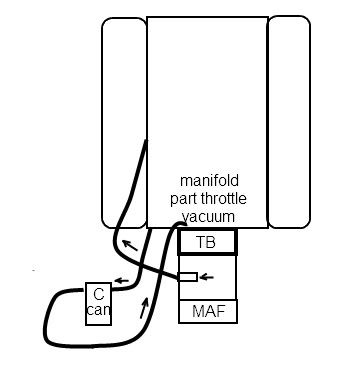
Here's a rough diagram although it also has a oil catch can which if you don't have will just be a solid piece of hose.
Registered User
Joined: Nov 2014
Posts: 38
Likes: 0
From: Arizona
Baffles in the valve covers? The passenger side point is only for fresh air INTO the crankcase so it shouldn't have impact one way or the other.. The gases come out of the crankcase from the valley cover nipple below and slightly in back of the TB. That then goes to the nipple on the manifold behind the TB. Unless that nipple is blocked off you have vacuum there at part throttle. There is no vacuum really anywhere at WOT but the gases should still flow under pressure to there (and possibly up the inlet side hose to the air intake). If those tubes can't handle the flow you have bad rings, period.
Here's a rough diagram although it also has a oil catch can which if you don't have will just be a solid piece of hose.
Here's a rough diagram although it also has a oil catch can which if you don't have will just be a solid piece of hose.
Diagram matches my set up.. Catch can and all.
Registered User
Joined: Nov 2014
Posts: 38
Likes: 0
From: Arizona
Mine pulls 12psi
Stock pulls 20psi
Built pulls 17psi
There still has to be something wrong with your PCV setup or you have massive blow-by. When you have had your blow-outs you were at WOT right? At WOT when blow-by is the highest there isn't hardly any vacuum on any car. The vacuum point is right behind the open throttle blade and the manifold will be near atmospheric pressure.
All vapors can usually be handled by the 3/8" tubing and use the small pressure in the crankcase to push it into the manifold like it normally does under part-throttle/manifold vacuum or it can go backwards up the "in" tube to in between the MAF and TB. You're saying that there is so much pressure it can't escape the 3/8th tube fast enough.
Run a 3/8 tube from your crankcase into the cabin and have someone see if they can feel gases pushing out at WOT. If you have a lot of blow-by you'll feel a strong breeze.
BTW to prevent reverse flow bypassing my catch can I don't use the MAF-TB to passenger valve cover tube but instead use a breather on that cover. My path is valve cover breather to crankcase to valley cover nipple to catch can to behind the TB. I guess if it was massive enough the pressure would vent back out the breather.
You can see the breather and also the hose from the catch can (CC) to the vacuum point behind the TB. My CC is under the front fender so you can't see it. You also can't see the hose from the crankcase (valley cover nipple) to the CC.
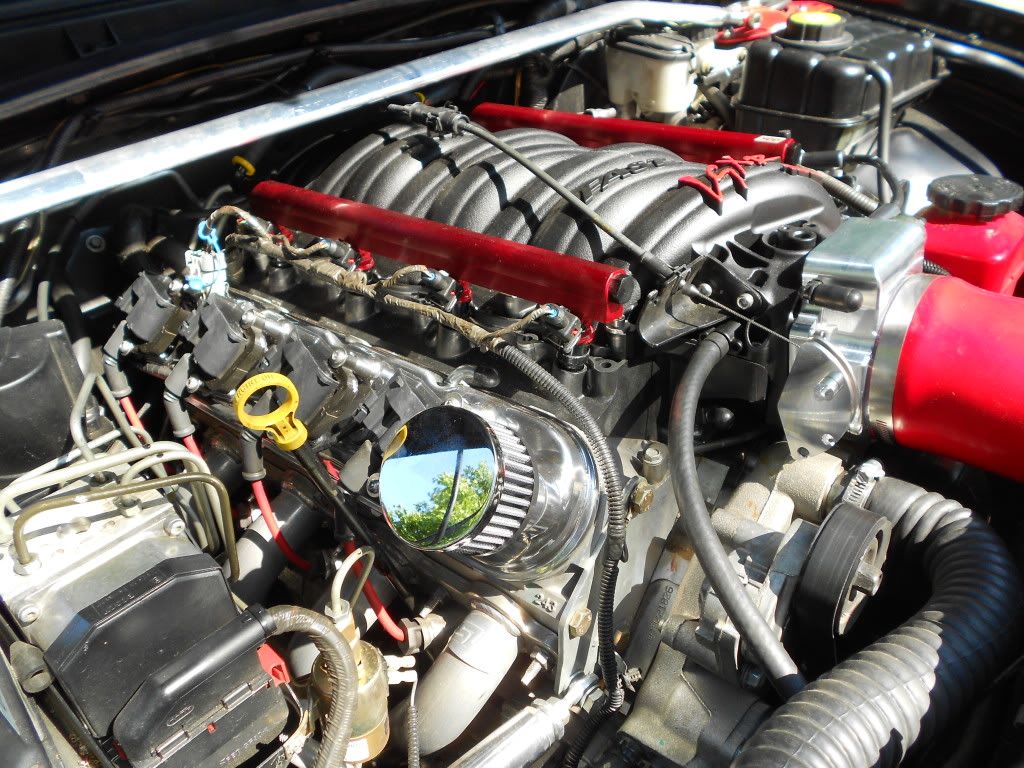
All vapors can usually be handled by the 3/8" tubing and use the small pressure in the crankcase to push it into the manifold like it normally does under part-throttle/manifold vacuum or it can go backwards up the "in" tube to in between the MAF and TB. You're saying that there is so much pressure it can't escape the 3/8th tube fast enough.
Run a 3/8 tube from your crankcase into the cabin and have someone see if they can feel gases pushing out at WOT. If you have a lot of blow-by you'll feel a strong breeze.
BTW to prevent reverse flow bypassing my catch can I don't use the MAF-TB to passenger valve cover tube but instead use a breather on that cover. My path is valve cover breather to crankcase to valley cover nipple to catch can to behind the TB. I guess if it was massive enough the pressure would vent back out the breather.
You can see the breather and also the hose from the catch can (CC) to the vacuum point behind the TB. My CC is under the front fender so you can't see it. You also can't see the hose from the crankcase (valley cover nipple) to the CC.
Last edited by svede1212; Nov 16, 2014 at 08:02 PM.
Registered User
Joined: Nov 2014
Posts: 38
Likes: 0
From: Arizona
There still has to be something wrong with your PCV setup or you have massive blow-by. When you have had your blow-outs you were at WOT right? At WOT when blow-by is the highest there isn't hardly any vacuum on any car. The vacuum point is right behind the open throttle blade and the manifold will be near atmospheric pressure.
All vapors can usually be handled by the 3/8" tubing and use the small pressure in the crankcase to push it into the manifold like it normally does under part-throttle/manifold vacuum or it can go backwards up the "in" tube to in between the MAF and TB. You're saying that there is so much pressure it can't escape the 3/8th tube fast enough.
Run a 3/8 tube from your crankcase into the cabin and have someone see if they can feel gases pushing out at WOT. If you have a lot of blow-by you'll feel a strong breeze.
BTW to prevent reverse flow bypassing my catch can I don't use the MAF-TB to passenger valve cover tube but instead use a breather on that cover. My path is valve cover breather to crankcase to valley cover nipple to catch can to behind the TB. I guess if it was massive enough the pressure would vent back out the breather.
You can see the breather and also the hose from the catch can (CC) to the vacuum point behind the TB. My CC is under the front fender so you can't see it. You also can't see the hose from the crankcase (valley cover nipple) to the CC.
All vapors can usually be handled by the 3/8" tubing and use the small pressure in the crankcase to push it into the manifold like it normally does under part-throttle/manifold vacuum or it can go backwards up the "in" tube to in between the MAF and TB. You're saying that there is so much pressure it can't escape the 3/8th tube fast enough.
Run a 3/8 tube from your crankcase into the cabin and have someone see if they can feel gases pushing out at WOT. If you have a lot of blow-by you'll feel a strong breeze.
BTW to prevent reverse flow bypassing my catch can I don't use the MAF-TB to passenger valve cover tube but instead use a breather on that cover. My path is valve cover breather to crankcase to valley cover nipple to catch can to behind the TB. I guess if it was massive enough the pressure would vent back out the breather.
You can see the breather and also the hose from the catch can (CC) to the vacuum point behind the TB. My CC is under the front fender so you can't see it. You also can't see the hose from the crankcase (valley cover nipple) to the CC.



I have never seen anything like this. It seems to me if it had excessive blowby, it would be smoking at all times? I've seen a few engines with a lot of blowby and this one seems tight and clean.