When you click on links to various merchants on this site and make a purchase, this can result in this site earning a commission. Affiliate programs and affiliations include, but are not limited to, the eBay Partner Network.
Seen some good names mentioned, but wanted to follow up with some more information that relates to the original question.
Who builds the best shortblock?
Like others have mentioned there is not necessarily a "right" answer to that question. There are individuals and companies that do good work out there, so saying there is just one company or person is not really possible. However, we feel pretty strongly that we build a great engine here at Livernois. There are a lot of companies that build engines, and yes, in many cases those engines are adequate and get the job done. Like anything though, there are varying levels to any kind of product that has a lot of labor involved in it. We feel like the way we design, machine and build an engine produces about the best value for the dollar you can get.
What makes us different though?
Well, there are a couple of areas that stand out. The components that go into our engine are a good starting point. Again, not to put down anyone's product or offerings, off the shelf pistons, rods, cranks, etc will do an adequate job in many cases. But at a certain point, like anything else, there is going to be a point where the off the shelf parts don't scale up when the engine is making more power, or being used for an application outside of the standard. This is one of the areas that we invest a lot of time, the development of the components and parts that go into our combinations. Time spent developing the piston package, skirt profiles, ringland thicknesses, crown shape, pin boss struts, etc. etc. All of these things come into play and are handled on the design end. We strive to build complete packages, where the piston, the rod and crankshaft all work together and fit together as one package. Sometimes off the shelf parts work and cover a wide range of applications, and if they do, that's great. But if we see the need to make changes or design something to fit that works better than we often do that.
The machine work is another area where standard machine work gets the job done. No question about it. But when you start talking higher performance, street/track usage, or racing environments, that's where all the little things really come into play. For example, honing a block is a pretty straightforward operation. Most standard practices will suffice and get the job done. But when you want that extra performance and durability for your application it takes a lot of little things to make that happen. Ring finish is both a science and an art. We spent considerable time testing out different ring finishes with different rings. Yes, a standard honing protocol would work, but it would leave some performance on the table. The science portion of this comes from using a measurement tool called a profilometer. This is a fairly expensive piece of equipment that is capable of taking very exact measurement of the surface of something and outputting all the different metrics used in finish measurement. We use this tool extensively in designing our cylinder honing procedure for the finish. This machine measures the surface of the bore and outputs various different results in the form of RA, RVK, RK, RPK, RMAX and many more. All of these numbers correspond to the surface of the bore, and we can use these numbers to hone in on the exact finish needed to match the rings. In the end this ensures better ring seal, better ring, piston and cylinder wall life, andl better oil control.
So the short answer is, yes anyone with a cylinder honing machine can hone a hole, and it will probably work well enough. But if you really want to pursue things like finding that perfect finish you have to employ a lot of research and development time and use sophisticated tools and methodology to produce a superior finish.
This is just one aspect of the engine, but this is the level of detail that goes into just one of those aspects. Beyond that we have cylinder dimensions under load, bore deformation, piston load, skirt design, etc. etc. Every aspect of the engines we design and build are approached with this same methodology. We focus on each and every area of the engine design and build to the nth degree in order to try and produce the best product for the application. This is why we feel that our product offering is such a good value. We're not building or producing engines with the intent to produce generic one size fits all engines. We build engines as unique products designed purposefully to meet and exceed the needs of the application.
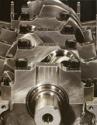
Attached are a couple of pictures of the profilometer we use in action measuring bore finishes. Also attached are some pics of a block in our CNC block machine center. This is another advanced tool that lets us hold very tight tolerances and machine blocks to OEM blueprints as they were meant to be, as opposed to how they come machined from the factory. You can be assured we at Livernois spend more time and care on one engine than most shops spend on several.
Thank you for the bump FRY and HCI2000SS, We appreciate the good words.
I remember reading a couple of threads where your were bending over backwards trying to make idiot customers happy by paying all shipping and repair cost even though there engine failures were very likely there fault and not yours. You can't beat that kind of service and hope to have you build me a short block or 2 some day.
Seen some good names mentioned, but wanted to follow up with some more information that relates to the original question.
Who builds the best shortblock?
Like others have mentioned there is not necessarily a "right" answer to that question. There are individuals and companies that do good work out there, so saying there is just one company or person is not really possible. However, we feel pretty strongly that we build a great engine here at Livernois. There are a lot of companies that build engines, and yes, in many cases those engines are adequate and get the job done. Like anything though, there are varying levels to any kind of product that has a lot of labor involved in it. We feel like the way we design, machine and build an engine produces about the best value for the dollar you can get.
What makes us different though?
Well, there are a couple of areas that stand out. The components that go into our engine are a good starting point. Again, not to put down anyone's product or offerings, off the shelf pistons, rods, cranks, etc will do an adequate job in many cases. But at a certain point, like anything else, there is going to be a point where the off the shelf parts don't scale up when the engine is making more power, or being used for an application outside of the standard. This is one of the areas that we invest a lot of time, the development of the components and parts that go into our combinations. Time spent developing the piston package, skirt profiles, ringland thicknesses, crown shape, pin boss struts, etc. etc. All of these things come into play and are handled on the design end. We strive to build complete packages, where the piston, the rod and crankshaft all work together and fit together as one package. Sometimes off the shelf parts work and cover a wide range of applications, and if they do, that's great. But if we see the need to make changes or design something to fit that works better than we often do that.
The machine work is another area where standard machine work gets the job done. No question about it. But when you start talking higher performance, street/track usage, or racing environments, that's where all the little things really come into play. For example, honing a block is a pretty straightforward operation. Most standard practices will suffice and get the job done. But when you want that extra performance and durability for your application it takes a lot of little things to make that happen. Ring finish is both a science and an art. We spent considerable time testing out different ring finishes with different rings. Yes, a standard honing protocol would work, but it would leave some performance on the table. The science portion of this comes from using a measurement tool called a profilometer. This is a fairly expensive piece of equipment that is capable of taking very exact measurement of the surface of something and outputting all the different metrics used in finish measurement. We use this tool extensively in designing our cylinder honing procedure for the finish. This machine measures the surface of the bore and outputs various different results in the form of RA, RVK, RK, RPK, RMAX and many more. All of these numbers correspond to the surface of the bore, and we can use these numbers to hone in on the exact finish needed to match the rings. In the end this ensures better ring seal, better ring, piston and cylinder wall life, andl better oil control.
So the short answer is, yes anyone with a cylinder honing machine can hone a hole, and it will probably work well enough. But if you really want to pursue things like finding that perfect finish you have to employ a lot of research and development time and use sophisticated tools and methodology to produce a superior finish.
This is just one aspect of the engine, but this is the level of detail that goes into just one of those aspects. Beyond that we have cylinder dimensions under load, bore deformation, piston load, skirt design, etc. etc. Every aspect of the engines we design and build are approached with this same methodology. We focus on each and every area of the engine design and build to the nth degree in order to try and produce the best product for the application. This is why we feel that our product offering is such a good value. We're not building or producing engines with the intent to produce generic one size fits all engines. We build engines as unique products designed purposefully to meet and exceed the needs of the application.
Attached are a couple of pictures of the profilometer we use in action measuring bore finishes. Also attached are some pics of a block in our CNC block machine center. This is another advanced tool that lets us hold very tight tolerances and machine blocks to OEM blueprints as they were meant to be, as opposed to how they come machined from the factory. You can be assured we at Livernois spend more time and care on one engine than most shops spend on several.
This is just one aspect of the engine, but this is the level of detail that goes into just one of those aspects. Beyond that we have cylinder dimensions under load, bore deformation, piston load, skirt design, etc. etc.
Interesting read! What kind of torque plates do you use during honing?
Livernois seems to be overlooked sometimes. They have been around forever and you rarely, if ever hear anything bad about them. I wish I still lived down the road from them.
These guys know what they are doing, their hat needs to be thrown in the ring when considering a short block/long block.
Myself, I had some local guy do my machine work, and I know he's not nearly as good at the LS stuff as the guys in this thread. Sometimes questioning the engine at the power level I'm looking at. Pick your builder wisely or just run a stock short block!
Interesting read! What kind of torque plates do you use during honing?
Follow up in regards to the torque plates
It depends on the block and build. In a lot of cases we use aluminum plates that we make ourselves. We've got a range of bore sizes on the plates that let us match up best to what head will be on the engine. Usually we try and match the plate thickness to the cylinder head bolt boss thickness to try and mimic the distance the load and clamping will be from the deck surface.
If the head or block requires it we will build up plates that more exactly mimic the contours of the head and thickness of the head. This allows us to more exactingly replicate the loads that the bore will see when clamping the head down.
Every block is different depending on the design of the bolt holes and other factors. The position in relation to the bore, the water jacket, the bore thickness, the bolt hole depth, etc. All of these things are factored in when planning out a torque plate and procedure that will be used for cylinder honing.
LMFAO. It is crazy how many builders are out there now that can build you a motor for about the same as you can get the parts for. I have always built my own motors and got the machine work done locally but that will likely change if I ever get rich enough to build another car.......shortcoming still LMFAO













 to Livernois