







timing chain ?
 timing chain ?
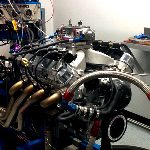
 I am building 6.0lq9 for drag racing. I had it line bored. now my timing chain has too much slop in it. I called cloyes today. they told me only timing chain that they sell any shorter for my application was a double roller they also said a double roller timing chain would not fit under a stock timing chain cover. is this true? if so does any one else sell a shorter timing chain set up?
thanks
thanks
Did you try katech? Don't know if they sell one but with the LS work they do they might be able to help. Lingenfelter would be another place to call but Katech would be my first call after speaking with Cloyes.
Did you speak to someone knowledgeable or a 1-800 line catalog reader?
I know in some other applications Cloyes makes a slightly oversized crank gear to take up chain slack. I have no idea if they do for the LS but if you talked to a simple catalog reader it would be good to go back and ask about a gear. If you spoke to a knowledgeable person they would have volunteered that info if it was available. Much of the time though phone line folks are clueless entry level.
I know in some other applications Cloyes makes a slightly oversized crank gear to take up chain slack. I have no idea if they do for the LS but if you talked to a simple catalog reader it would be good to go back and ask about a gear. If you spoke to a knowledgeable person they would have volunteered that info if it was available. Much of the time though phone line folks are clueless entry level.
If you had it lined bored and the timing chain is loose, your machine shop screwed up. They moved the crank shaft center line up in the block, closer to the cam shaft center line. They've also changed the deck height, piston angles, and rod angles.
For street cruising, you could make it work. But it's a custom non-standard build. You'll need to check (and maybe change) everything - piston to valve clearance, piston height gasket thickness, etc.
Also, be sure and check rod and crank clearances at the bottom of the cylinder. Probably not an issue, but certainly worth checking.
For drag racing, it's a boat anchor.
For street cruising, you could make it work. But it's a custom non-standard build. You'll need to check (and maybe change) everything - piston to valve clearance, piston height gasket thickness, etc.
Also, be sure and check rod and crank clearances at the bottom of the cylinder. Probably not an issue, but certainly worth checking.
For drag racing, it's a boat anchor.
I am building 6.0lq9 for drag racing. I had it line bored. now my timing chain has too much slop in it. I called cloyes today. they told me only timing chain that they sell any shorter for my application was a double roller they also said a double roller timing chain would not fit under a stock timing chain cover. is this true? if so does any one else sell a shorter timing chain set up?
thanks
thanks
If you had it lined bored and the timing chain is loose, your machine shop screwed up. They moved the crank shaft center line up in the block, closer to the cam shaft center line. They've also changed the deck height, piston angles, and rod angles.
For street cruising, you could make it work. But it's a custom non-standard build. You'll need to check (and maybe change) everything - piston to valve clearance, piston height gasket thickness, etc.
Also, be sure and check rod and crank clearances at the bottom of the cylinder. Probably not an issue, but certainly worth checking.
For drag racing, it's a boat anchor.
For street cruising, you could make it work. But it's a custom non-standard build. You'll need to check (and maybe change) everything - piston to valve clearance, piston height gasket thickness, etc.
Also, be sure and check rod and crank clearances at the bottom of the cylinder. Probably not an issue, but certainly worth checking.
For drag racing, it's a boat anchor.
Far as rod angles and PTV etc we are talking a few thousandths, not half an inch.
Trending Topics
Old - yes. Wise - sometimes 
Yes, it is common to move the centerline up in the block after a line bore. And for a street performance engine it's not that big of a deal. It can be done and still maintain the correct position, but it's more difficult and uses more expensive machinery.
It does change the relationship of the moving parts - more than just the timing chain. So you do have to check and adjust things like head gasket thickness (quench), PTV clearance, etc. If a block needs to be line bored, it usually needs to be decked, as well. It's all part of the blue printing process.
Simple geometry tells you that there will be changes in the relationship of the bores to the crank, rods, and pistons. I doubt it will be enough of a change to affect much, but I'd check it anyway.
But the OP is building a drag racing engine, and not a street engine. Drag racing places huge loads on an engine. It all needs to be perfect if it's going to survive; and this is not.
"Many engines can handle a few thousandths variation in the position of the crankshaft centerline but others cannot because of changes it causes in other critical dimensions such as the deck height of the pistons when the crank is at top dead center (which affects compression, piston-to-head clearance and valve-to-piston clearance). Performance engines and diesels are much more sensitive to centerline changes than light duty passenger car engines."
http://www.enginebuildermag.com/2006...oring-subject/
Yes, it is common to move the centerline up in the block after a line bore. And for a street performance engine it's not that big of a deal. It can be done and still maintain the correct position, but it's more difficult and uses more expensive machinery.
It does change the relationship of the moving parts - more than just the timing chain. So you do have to check and adjust things like head gasket thickness (quench), PTV clearance, etc. If a block needs to be line bored, it usually needs to be decked, as well. It's all part of the blue printing process.
Simple geometry tells you that there will be changes in the relationship of the bores to the crank, rods, and pistons. I doubt it will be enough of a change to affect much, but I'd check it anyway.
But the OP is building a drag racing engine, and not a street engine. Drag racing places huge loads on an engine. It all needs to be perfect if it's going to survive; and this is not.
"Many engines can handle a few thousandths variation in the position of the crankshaft centerline but others cannot because of changes it causes in other critical dimensions such as the deck height of the pistons when the crank is at top dead center (which affects compression, piston-to-head clearance and valve-to-piston clearance). Performance engines and diesels are much more sensitive to centerline changes than light duty passenger car engines."
http://www.enginebuildermag.com/2006...oring-subject/
LS1 Tech Stories
The Best V8 Stories One Small Block at Time

Topdon ONE vs. Artidiag 800 BT2: Which is the Diagnostic Tablet For You?
Pouria Savadkouei
Gas Monkey Built a 6-Wheel Ferrari Testarossa With a Corvette LT4 Engine
Verdad Gallardo
7 Most Reliable High-Performance Engines GM Has Ever Built
Verdad Gallardo
Amazing '71 Camaro Restomod Is Modern Muscle Car Under the Skin
Verdad Gallardo
6 Common C5 Corvette Failures and What's Involved In Repairing Them
Pouria Savadkouei
Retro Modern Bandit Pontiac Trans AM Comes With Burt Reynolds' Autograph
Verdad Gallardo
Top 10 Greatest Cadillac V Series Performance Models Ever, Ranked
Pouria Savadkouei
Top 10 Most Powerful Chevy Trucks Ever Made!

Hennessey's New Supercharged Silverado ZR2 Has 700 HP
Verdad Gallardo


I run a double-roller. I have a Synergy Oil Pump and Rick grinds it in several areas for double-roller clearance (which is actually the bigger issue, having the chain grind off the pump and putting shavings everywhere). I also used the spacers. I didn't have to do anything to my front cover. But I used a tool for front cover alignment and while tight, everything went together no problem.
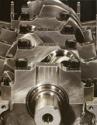
Now as far as a line bore is concerned, that's a different process. It's similar to boring the cylinders, where a hone is still required afterwards and depending on the machine used to bore it, you could be able to move the centerline so a shorter chain won't be required.
For what it's worth, I've seen plenty of engines go together with some slack in the timing chain and not really cause any problems, but as Speedtigger said, a double roller can be used under the stock timing cover. The oil pump will need be spaced out further away from the chain and the cover will need to be clearanced for the oil pump. It's a simple but tedious process, but it would work fine.
I missed it where in that article does it specifically state that the LS variants can't tolerate a few thousandths higher crank centerline?
Why don't you calculate the rod angle with the crank stock, vs. raised .005, then do so again with the common rod length variations?
I am no math PHD but off the top of my head the switch from stock rods to aftermarket 6.125"(with appropriate pistons) probably changes the rod angle more. If not then let's compare the 4.8L stock vs. the ever common 408ci motors people build.
On another forum someone who used to get too caught up in theory and built some real turds based on it finally learned something useful and put a quote in his signature along the lines of.
Why don't you calculate the rod angle with the crank stock, vs. raised .005, then do so again with the common rod length variations?
I am no math PHD but off the top of my head the switch from stock rods to aftermarket 6.125"(with appropriate pistons) probably changes the rod angle more. If not then let's compare the 4.8L stock vs. the ever common 408ci motors people build.
On another forum someone who used to get too caught up in theory and built some real turds based on it finally learned something useful and put a quote in his signature along the lines of.
It works in REALITY but does it work in theory?