


Let's take a moment to talk about Lift


Thread Starter
TECH Fanatic


Joined: Jan 2017
Posts: 1,758
Likes: 442
 Let's take a moment to talk about Lift
 In the market for a Cam as tax season is coming up. I have been learning a lot about cam theories, valve events, pressure waves and such, but one thing that has been unclear to me is lift. Now, it seems that the common belief is that more lift is good, as long as your heads can keep flowing enough air at said lift. Well okay, then why does every aftermarket LS cam not have .6"/.6" lift?(Lets just say peak flow was here) Why does Cam A have lift .595/.589 and Cam B will have lift .612/.598? What determines such precise numbers anyhow? I would say to a degree, most Heads, especially ported, flow at different rates at all inches of lift. I already know about valve springs and how Spring A is good up to .625" and spring B can handle .7" and harmonics and such so different Lifts can be used in synergy with certain springs.
Before you tell me to Google it, I ask here only because I like to receive insight from those who have hands on experience, and different kinds of experience with different circumstances. Discussions bring lots of ideas to the table and more importantly, new theories. That and I am sure I am not the only one with this question. Thanks in advance.
Before you tell me to Google it, I ask here only because I like to receive insight from those who have hands on experience, and different kinds of experience with different circumstances. Discussions bring lots of ideas to the table and more importantly, new theories. That and I am sure I am not the only one with this question. Thanks in advance.

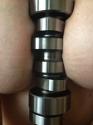


Just because peak flow is at 600 on a given cam doesn't mean that there is no benefit to higher lift. Increasing lift to 650 for example greatly increases the curtain time at 600 lift and also area under the curtain.
What I'm about to say I learned from Martin Smallwood. The shape of the lobe is important for valve control. If you go up rapidly off the seat to a relative short plateau, the natural movement of the valve is likely to be to continue lifting, resulting in valve loft. By the opposite condition if you try to come gently off the seat and then suddenly and severely ramp up to a higher lift, you're very likely to flex a pushrod which will then throw the valve at or near peak lift and the valve will come slamming home. Obviously not a good arrangement for the lifter vs lobe contact.
So the lift on a lobe is generally determined by a combination of durations at various lifts and the most natural path for the valve to follow, which will give you the best control. If you look at a lobe list you can generally see that within a lobe family, longer durations almost always make for higher lifts.
When Martin speced my cam he specified 006, 020, 050, 200 lift durations, and then said, "that'll put lift right at 653". So in a sense, lift was the last metric determined. And it was primarily based on the optimal valve path. He also told me in that conversation if he went with less lift it'd have less valve control.
Hope that helps a little. I only have a very rudimentary grasp on how valve lift is determined.
What I'm about to say I learned from Martin Smallwood. The shape of the lobe is important for valve control. If you go up rapidly off the seat to a relative short plateau, the natural movement of the valve is likely to be to continue lifting, resulting in valve loft. By the opposite condition if you try to come gently off the seat and then suddenly and severely ramp up to a higher lift, you're very likely to flex a pushrod which will then throw the valve at or near peak lift and the valve will come slamming home. Obviously not a good arrangement for the lifter vs lobe contact.
So the lift on a lobe is generally determined by a combination of durations at various lifts and the most natural path for the valve to follow, which will give you the best control. If you look at a lobe list you can generally see that within a lobe family, longer durations almost always make for higher lifts.
When Martin speced my cam he specified 006, 020, 050, 200 lift durations, and then said, "that'll put lift right at 653". So in a sense, lift was the last metric determined. And it was primarily based on the optimal valve path. He also told me in that conversation if he went with less lift it'd have less valve control.
Hope that helps a little. I only have a very rudimentary grasp on how valve lift is determined.
Thread Starter
TECH Fanatic
Joined: Jan 2017
Posts: 1,758
Likes: 442
Just because peak flow is at 600 on a given cam doesn't mean that there is no benefit to higher lift. Increasing lift to 650 for example greatly increases the curtain time at 600 lift and also area under the curtain.
What I'm about to say I learned from Martin Smallwood. The shape of the lobe is important for valve control. If you go up rapidly off the seat to a relative short plateau, the natural movement of the valve is likely to be to continue lifting, resulting in valve loft. By the opposite condition if you try to come gently off the seat and then suddenly and severely ramp up to a higher lift, you're very likely to flex a pushrod which will then throw the valve at or near peak lift and the valve will come slamming home. Obviously not a good arrangement for the lifter vs lobe contact.
So the lift on a lobe is generally determined by a combination of durations at various lifts and the most natural path for the valve to follow, which will give you the best control. If you look at a lobe list you can generally see that within a lobe family, longer durations almost always make for higher lifts.
When Martin speced my cam he specified 006, 020, 050, 200 lift durations, and then said, "that'll put lift right at 653". So in a sense, lift was the last metric determined. And it was primarily based on the optimal valve path. He also told me in that conversation if he went with less lift it'd have less valve control.
Hope that helps a little. I only have a very rudimentary grasp on how valve lift is determined.
What I'm about to say I learned from Martin Smallwood. The shape of the lobe is important for valve control. If you go up rapidly off the seat to a relative short plateau, the natural movement of the valve is likely to be to continue lifting, resulting in valve loft. By the opposite condition if you try to come gently off the seat and then suddenly and severely ramp up to a higher lift, you're very likely to flex a pushrod which will then throw the valve at or near peak lift and the valve will come slamming home. Obviously not a good arrangement for the lifter vs lobe contact.
So the lift on a lobe is generally determined by a combination of durations at various lifts and the most natural path for the valve to follow, which will give you the best control. If you look at a lobe list you can generally see that within a lobe family, longer durations almost always make for higher lifts.
When Martin speced my cam he specified 006, 020, 050, 200 lift durations, and then said, "that'll put lift right at 653". So in a sense, lift was the last metric determined. And it was primarily based on the optimal valve path. He also told me in that conversation if he went with less lift it'd have less valve control.
Hope that helps a little. I only have a very rudimentary grasp on how valve lift is determined.

Look up a guy named Gordon Blair.
Thread Starter
TECH Fanatic
Joined: Jan 2017
Posts: 1,758
Likes: 442
Originally Posted by KCS
What formula? Something like that would probably need to be calculated with some sort of software due to the complexity of the problem.
Look up a guy named Gordon Blair.
Look up a guy named Gordon Blair.
Trending Topics
Thread Starter
TECH Fanatic
Joined: Jan 2017
Posts: 1,758
Likes: 442
Indeed it is far too complex to do on paper. Not that you cant but the room for error is null and a computer using specific software with its own language is required. Apparently lobe surfaces have to be extremely smooth (more than 1 micron of deviation can rob lots of power) this is why they are often polished after the steel, hardended to 64-65 rockwell, is lubricated. To eliminate surface imperfections. Most of us dont have access to this software so Ill leave it for the cam designers to determine. What this does tell me is that buying from a quality manufacturer with USA steel made in USA factories would be worth the extra money. Perhaps some companies charge the extra 50 for a reason...if anything its piece of mind.