



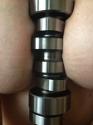







396hp ls1 !!! JakeFusion

@Srt8,
Short answer -- the intake ports in most Heads outflow the exhaust ports. By a large margin. The longer exhaust duration helps make up the difference. You can only inhale as much you exhale.
You do see reverse split (intake>exhaust) cams out there, and they seem to do great for midrange power, but do not generally carry up top as well as the traditional split counterparts.
Short answer -- the intake ports in most Heads outflow the exhaust ports. By a large margin. The longer exhaust duration helps make up the difference. You can only inhale as much you exhale.
You do see reverse split (intake>exhaust) cams out there, and they seem to do great for midrange power, but do not generally carry up top as well as the traditional split counterparts.

Joined: Mar 2007
Posts: 1,148
Likes: 53
From: Saskatchewan, Canada - where arguing "DA" is for the slow and weak...
Same here. PRC Stage 1 243/799, Cam Motion 228/234 .627"/.612" 112+3, ported TBSS intake, Warr 92mm TB, 4L80E w/FTI 3800 triple disc, and S60 w/3.73s turning 345/40R17s - drives great. Targeting peak HP figures is for ******** BSing at Cars and Coffee... want to impress me? Show me a timeslip worth looking at.
LOL @ The S.O. swingers. It's a damn TV show. Who gives a F if they say street car or street raced car. No one should give a **** if you know them. Sadly though, they do. It's no wonder stupid *** shows like the reality trend promote do so well.
My car has 6 degrees of split and carries from 6100 peak to the 6600 shift point very cleanly...too much exhaust creates too much heat and trades bottom/mid torque for top end power. For street cars, the mid range torque would be more desirable provided you can hook. And this creates less overlap for a more stable idle quality. Perhaps if you need that much exh duration on an NA motor you really needed more intake duration to begin with...
 . Would likely make similar power with much more TQ.
I notice a lot of puzzling suggestions being made lately to get cars more "streetable"(objective as that is), and people are looking in unorthodox places and taking private individuals advice over giant companies that have dyno'd potentially thousands of combos in the name of finding some super-secret special magical cam. Not calling anyone out, since we all can learn something from everyone else and everything posted in this thread has had some merit. Just want people to keep in mind that SBCs have been around over 60+ years - there is NO SUCH THING as a magic, special grind. When building my race motor I had an idea of what I thought I wanted but gave my complete vehicle specs (MUCH more than you usually see in a forum - intake style, cubes, ECU RPM capability, valvetrain, head CFM up to .750, vehicle raceweight, stall speed...heck, even gears and tire diameter) to four different big name companies and guess what? All four suggested very similar grinds. That is not a coincidence.
Many are starting to pass off weak low end as intentional in the name of being streetable, and a lot of cams are going back to the old style grinds with huge duration splits to keep intake duration lower. This is contrary to people and companies with huge R&D budgets like Lingenfelter and Isky which are/were huge fans of single pattern or narrow split cams with massive TQ that may dyno a bit less but be much more fun on the street and quicker overall with higher average power. Those old giant split duration cams were not popular in the past because of streetability concerns, but because exhaust port tech SUCKED and you needed massive exh duration to make power. Modern heads intake flow is still stronger on the intake port of course, and they DO benefit from a split pattern cam in most cases, but the ratio is not nearly as terrible. Old school SBC heads can have an exhaust port that flows 40% less than the intake port. On a factory LS1 head that difference is less than 20%.
The duration split of a cam should be determined by the intake manifold style(single plane, ITB, dual plane, sheetmetal, etc) and the cylinder head characteristics being used, along with how restrictive the exhaust being used is to get the desired performance through the whole RPM range, not just peak dyno number. Definitely not to adjust as a bandaid for streetability issues since everyone wants the illusive 600hp car that drives like stock.
To put it bluntly, A higher exhaust duration will always sacrifice tq vs a the same cam with a lower exhaust duration.
Don't shoot the messenger, I do not expect everyone to agree with me. Just sharing some extra info for those new to the game before they grab a Thumpr from the bottom of a Summit catalogue and get mad when their build has zero low end and gets pulled on by cars with properly spec'd custom cams. There is a reason why the majority of NA custom cams from the pros have small ~6* duration splits.
Last edited by Puck; May 27, 2018 at 07:03 PM. Reason: clarified for NA use
@Puck - without quoting your post and typing from a phone -- I agree with most of what you said. There's a reason truck cams keep that exhaust valve closed longer. But I do find that with increased compression, one can open that exhaust valve earlier and lose less vs a low compression engine. Its one big reason I like to run compression up is to open that EV earlier with less sacrifices made.
And to add to the split discussion, the ls3 heads have a bigger I/E flow bias vs Ls1 heads, so you do see many 12 degree splits on ls3 vs 4-8 on cathedral ports.
And to add to the split discussion, the ls3 heads have a bigger I/E flow bias vs Ls1 heads, so you do see many 12 degree splits on ls3 vs 4-8 on cathedral ports.
My BTR Stage 2 cam pulls better at 1500 rpm than stock, even with the 3.42 gears and holds it's peak from 6200-6500.
My BTR Stage 2 with TSP 243 Stage 1 heads vs a BTR stage 3 with stock 241 heads produced 50 more hp at peak and had more torque down low and a flat torque curve. With ported heads the Stage 3 might produce 8-10 hp more but with less low end torque where it's used on the street.
My BTR Stage 2 with TSP 243 Stage 1 heads vs a BTR stage 3 with stock 241 heads produced 50 more hp at peak and had more torque down low and a flat torque curve. With ported heads the Stage 3 might produce 8-10 hp more but with less low end torque where it's used on the street.
Last edited by wannafbody; May 28, 2018 at 09:21 AM.
LS1 Tech Stories
The Best V8 Stories One Small Block at Time

6 Common C5 Corvette Failures and What's Involved In Repairing Them
Pouria Savadkouei
Retro Modern Bandit Pontiac Trans AM Comes With Burt Reynolds' Autograph
Verdad Gallardo
Top 10 Greatest Cadillac V Series Performance Models Ever, Ranked
Pouria Savadkouei
Top 10 Most Powerful Chevy Trucks Ever Made!

Hennessey's New Supercharged Silverado ZR2 Has 700 HP
Verdad Gallardo
Coachbuilt N2A Anteros Is an LS2-Powered C6 Corvette In Italian Clothes
Verdad Gallardo
Awesome K5 Blazer Restomod Comes With C7 Corvette Power
Verdad Gallardo
10 Camaros You Should Never Buy

10 LS Engine Myths That Refuse to Die
Verdad Gallardo @Puck - without quoting your post and typing from a phone -- I agree with most of what you said. There's a reason truck cams keep that exhaust valve closed longer. But I do find that with increased compression, one can open that exhaust valve earlier and lose less vs a low compression engine. Its one big reason I like to run compression up is to open that EV earlier with less sacrifices made.
And to add to the split discussion, the ls3 heads have a bigger I/E flow bias vs Ls1 heads, so you do see many 12 degree splits on ls3 vs 4-8 on cathedral ports.
And to add to the split discussion, the ls3 heads have a bigger I/E flow bias vs Ls1 heads, so you do see many 12 degree splits on ls3 vs 4-8 on cathedral ports.
Another totally different benefit to playing with the exhaust valve timing events is that you can squeeze more duration in there without hitting PTV contact, which seems to be an issue with LS3s. Their heads are amazing but unlike most stock shortblocks they will hit PTV issues before being considered overcammed by most people. IMO that is also a bandaid vs flycutting or new pistons and running the actual cam specs proper for your combo...but if it works, it works
 .
.