


Camshaft core alloy



TECH Senior Member


Joined: Jun 2016
Posts: 22,301
Likes: 3,625
From: Central Cal.

I asked them about that a while back on one of these forums. They said that honestly, the cheapest one they have will easily get the job done for the majority of users. BUT having said that, you might call them with your requirements
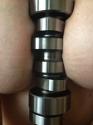

5150 is fine for most street stuff. When you stay getting into 50%+ more power than stock, I'd step up. 8620 is the least likely to have pieces flake off and take out the bottom end
 Copper Cams
 Hi 8 Lug, I fit a Copper cam with Solid Roller Lifters. (8620)
I fit a Copper cam with HIGH Spring Nose Pressure and use Timken bearings instead of Babbitt bearings.
I fit a Copper cam when the core lobe position is incorrect for a TIGHT Lobe Center cam design.
I fit a Copper cam AND Timkens to increase oil pressure/reduce oil windage.
I fit a Copper cam with SOME AL blocks that have poor cam tunnel design AND then use Timkens.
I fit a Copper cam when Lobe Lift is greater than the core can support.
Lance
I fit a Copper cam with HIGH Spring Nose Pressure and use Timken bearings instead of Babbitt bearings.
I fit a Copper cam when the core lobe position is incorrect for a TIGHT Lobe Center cam design.
I fit a Copper cam AND Timkens to increase oil pressure/reduce oil windage.
I fit a Copper cam with SOME AL blocks that have poor cam tunnel design AND then use Timkens.
I fit a Copper cam when Lobe Lift is greater than the core can support.
Lance

Personally, when you consider the amount of money and labor to swap a cam I would go with the better material myself. As a percentage of cost of the cam swap, the difference is really in the noise.
I found this post by Kip Fabre of Cam Motion, where he was answering a similar question:
Roller Camshaft Materials
There is a fairly broad spectrum of materials and heat treating methods used in the production of roller camshafts. There are more than three suppliers now as many companies continue to outsource internationally making it harder to verify material and heat treating specifications. First, gray cast iron is not used. For most FLAT tappet camshafts, the cores are made from cast iron, but a special cast iron. I am not addressing here the materials for flat tappet cores. The commonly available steel for roller cams are 1050, 1060, 1080, 4150, 5150, 5160, 8650 and 8660. All of these steels are available in different qualities or grades. All of these are high carbon steels and have higher carbon content in the steel for surface hardness created in the heat treating process. 1050 has .5 per cent carbon 1060 has .6 per cent carbon. To manufacture a camshaft blank from these steels the process is much simpler than for the 8620 or 9310 steels. The high carbon steels are “spooled out” meaning they are grooved to space the lobes /bearings / gears to the correct linear position and diameter. After that they are “lobe milled”. That refers to the process that creates the lobe shape and position which determines what lift, duration, lobe separation and cylinder firing order that blank will make as a finished cam. Next is the heat treatment process to produce the case hardness on the lobes. This is done with an electrical induction coil that goes around one lobe at a time. The lobe is heated up to a specific given temperature and time depending on the material ( it will be red hot). Then it is “quenched” or cooled by either spraying down or dunking into a water/polymer quench. That is all there is to the heat treat process. The lobes are now hard.
The 8620 steel has a lower (.2 per cent) carbon which requires the cam core go through a different heat treating process because of the lower carbon content. The lower carbon content produces a stronger part, not a harder part. They first have to be spooled like the other material cores, but after that they must be copper plated. The copper plating is a masking agent for the sections of the cam that you do not want to get hardened. After the plating the copper is removed from the O.D. of the cam, leaving the plating only on the shaft in between the lobes. Next is the lobe milling which is just like the induction a hardened camshaft. After they have been lobe milled they are sent to heat treat. The heat treatment process for 8620 and 9310 is referred to as carburization. The common cycle for 8620 or 9310 is to put in a carburizing oven at 1750 degrees for 36 hours, then it is cooled to 1475 degrees for one hour, then oil quenched, then tempered to 300 degrees for 3 hours, then air cooled. The 9310 material requires a deep freezing process at this point. After that process it is media blasted clean and jet wash cleaned. We then straighten on a 25 ton hydraulic press. After straightening they are ready for the grinding of the bearing surfaces. At this point the core is ready to be ground to a finished camshaft.
Which is the best? I think 8620 is the best. It has been proven over the years.
The 5160 steel from what I know from talking to people in the industry is 5150 made in China. We use it on some of our cores we buy. I think it all come from the same place. The differences in the finished cams could be in the heat treat process but mainly it is in the finishing and final detailing process.
I found this post by Kip Fabre of Cam Motion, where he was answering a similar question:
Roller Camshaft Materials
There is a fairly broad spectrum of materials and heat treating methods used in the production of roller camshafts. There are more than three suppliers now as many companies continue to outsource internationally making it harder to verify material and heat treating specifications. First, gray cast iron is not used. For most FLAT tappet camshafts, the cores are made from cast iron, but a special cast iron. I am not addressing here the materials for flat tappet cores. The commonly available steel for roller cams are 1050, 1060, 1080, 4150, 5150, 5160, 8650 and 8660. All of these steels are available in different qualities or grades. All of these are high carbon steels and have higher carbon content in the steel for surface hardness created in the heat treating process. 1050 has .5 per cent carbon 1060 has .6 per cent carbon. To manufacture a camshaft blank from these steels the process is much simpler than for the 8620 or 9310 steels. The high carbon steels are “spooled out” meaning they are grooved to space the lobes /bearings / gears to the correct linear position and diameter. After that they are “lobe milled”. That refers to the process that creates the lobe shape and position which determines what lift, duration, lobe separation and cylinder firing order that blank will make as a finished cam. Next is the heat treatment process to produce the case hardness on the lobes. This is done with an electrical induction coil that goes around one lobe at a time. The lobe is heated up to a specific given temperature and time depending on the material ( it will be red hot). Then it is “quenched” or cooled by either spraying down or dunking into a water/polymer quench. That is all there is to the heat treat process. The lobes are now hard.
The 8620 steel has a lower (.2 per cent) carbon which requires the cam core go through a different heat treating process because of the lower carbon content. The lower carbon content produces a stronger part, not a harder part. They first have to be spooled like the other material cores, but after that they must be copper plated. The copper plating is a masking agent for the sections of the cam that you do not want to get hardened. After the plating the copper is removed from the O.D. of the cam, leaving the plating only on the shaft in between the lobes. Next is the lobe milling which is just like the induction a hardened camshaft. After they have been lobe milled they are sent to heat treat. The heat treatment process for 8620 and 9310 is referred to as carburization. The common cycle for 8620 or 9310 is to put in a carburizing oven at 1750 degrees for 36 hours, then it is cooled to 1475 degrees for one hour, then oil quenched, then tempered to 300 degrees for 3 hours, then air cooled. The 9310 material requires a deep freezing process at this point. After that process it is media blasted clean and jet wash cleaned. We then straighten on a 25 ton hydraulic press. After straightening they are ready for the grinding of the bearing surfaces. At this point the core is ready to be ground to a finished camshaft.
Which is the best? I think 8620 is the best. It has been proven over the years.
The 5160 steel from what I know from talking to people in the industry is 5150 made in China. We use it on some of our cores we buy. I think it all come from the same place. The differences in the finished cams could be in the heat treat process but mainly it is in the finishing and final detailing process.
5150 is good old fashioned spring steel. Materials have sort of moved past that now, but back in the day, 5150 rounds and flats were very commonly used for coil and leaf springs. It doesn't mean it's bad steel, but when it goes, it GOES.
8620 is a lot tougher, meaning it can absorb impact a lot better without breaking, cracking, pieces coming off, etc. if you're planning to beat the crap out of your engine, 8620 is the way to go. If you're going to do a fairly simple street engine, cam only or maybe ported heads to go with it and go trolling for Br0s, then the 5150 core is fine.
8620 is a lot tougher, meaning it can absorb impact a lot better without breaking, cracking, pieces coming off, etc. if you're planning to beat the crap out of your engine, 8620 is the way to go. If you're going to do a fairly simple street engine, cam only or maybe ported heads to go with it and go trolling for Br0s, then the 5150 core is fine.









