



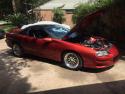



Potential head gasket issue

Thread Starter
Teching In
Joined: Nov 2016
Posts: 5
Likes: 0
 Potential head gasket issue
 Hello all. I'm the original owner of a '99 Z28 (LS1) with 150,xxx miles. It's a bit of a long story, but I recently discovered my thermostat was bad (stuck closed), despite the car not really overheating (temp was a bit higher than normal when not in motion and idling), but it never moved completely past the center line of the gauge. After changing the stat and while I was bleeding the system of any air pockets, I noticed the dreaded steam coming from the tailpipes (not much steam, but noticeable). I smelled it, and sure enough, sweet smelling. So with that, I am assuming I have a leaking head gasket. Not sure when it happened, since the car was never even close to the danger area on the gauge. Maybe being 20 years old contributed to its failure?
I am going to pick up one of those test kits that determines whether or not exhaust gases are present in the radiator. I'll post the results of that test when I have them.
Assuming it is a faulty head gasket, I am leaning towards doing the replacement myself, even though it is a bit intimidating. I normally do all my own basic maintenance on the car (all fluids, filters, brakes, spark plugs (which are fun on this car), basic suspension, etc), but I have never been as far as the heads. I am in a good position to tackle this, however, since the car is not currently my daily driver and I have a garage I can park it in and work on it indefinitely, while taking my time.
Any advice should I decide to tackle this? I have a service manual and a Haynes manual. I'm still looking around for any online write-ups or youtube videos to supplement the guides I have - the more information I have beforehand, the better. I can just picture myself missing a simple, critical detail and only finding out when everything is back together. Any common pitfalls or things I need to look out for during this job?
Thanks for any input.
I am going to pick up one of those test kits that determines whether or not exhaust gases are present in the radiator. I'll post the results of that test when I have them.
Assuming it is a faulty head gasket, I am leaning towards doing the replacement myself, even though it is a bit intimidating. I normally do all my own basic maintenance on the car (all fluids, filters, brakes, spark plugs (which are fun on this car), basic suspension, etc), but I have never been as far as the heads. I am in a good position to tackle this, however, since the car is not currently my daily driver and I have a garage I can park it in and work on it indefinitely, while taking my time.
Any advice should I decide to tackle this? I have a service manual and a Haynes manual. I'm still looking around for any online write-ups or youtube videos to supplement the guides I have - the more information I have beforehand, the better. I can just picture myself missing a simple, critical detail and only finding out when everything is back together. Any common pitfalls or things I need to look out for during this job?
Thanks for any input.
Hello all. I'm the original owner of a '99 Z28 (LS1) with 150,xxx miles. It's a bit of a long story, but I recently discovered my thermostat was bad (stuck closed), despite the car not really overheating (temp was a bit higher than normal when not in motion and idling), but it never moved completely past the center line of the gauge. After changing the stat and while I was bleeding the system of any air pockets, I noticed the dreaded steam coming from the tailpipes (not much steam, but noticeable). I smelled it, and sure enough, sweet smelling. So with that, I am assuming I have a leaking head gasket. Not sure when it happened, since the car was never even close to the danger area on the gauge. Maybe being 20 years old contributed to its failure?
I am going to pick up one of those test kits that determines whether or not exhaust gases are present in the radiator. I'll post the results of that test when I have them.
Assuming it is a faulty head gasket, I am leaning towards doing the replacement myself, even though it is a bit intimidating. I normally do all my own basic maintenance on the car (all fluids, filters, brakes, spark plugs (which are fun on this car), basic suspension, etc), but I have never been as far as the heads. I am in a good position to tackle this, however, since the car is not currently my daily driver and I have a garage I can park it in and work on it indefinitely, while taking my time.
Any advice should I decide to tackle this? I have a service manual and a Haynes manual. I'm still looking around for any online write-ups or youtube videos to supplement the guides I have - the more information I have beforehand, the better. I can just picture myself missing a simple, critical detail and only finding out when everything is back together. Any common pitfalls or things I need to look out for during this job?
Thanks for any input.
I am going to pick up one of those test kits that determines whether or not exhaust gases are present in the radiator. I'll post the results of that test when I have them.
Assuming it is a faulty head gasket, I am leaning towards doing the replacement myself, even though it is a bit intimidating. I normally do all my own basic maintenance on the car (all fluids, filters, brakes, spark plugs (which are fun on this car), basic suspension, etc), but I have never been as far as the heads. I am in a good position to tackle this, however, since the car is not currently my daily driver and I have a garage I can park it in and work on it indefinitely, while taking my time.
Any advice should I decide to tackle this? I have a service manual and a Haynes manual. I'm still looking around for any online write-ups or youtube videos to supplement the guides I have - the more information I have beforehand, the better. I can just picture myself missing a simple, critical detail and only finding out when everything is back together. Any common pitfalls or things I need to look out for during this job?
Thanks for any input.
Do process in reverse to complete .

TECH Senior Member


Joined: Jun 2016
Posts: 22,308
Likes: 3,625
From: Central Cal.
He'd gaskets are actually pretty easy in car I can knock out a set in about 6 hours by myself. Just remember to take your time. Pull intake (lid) , intake manifold, valve covers, rocket arms, push rods. Then pull Headers/manifolds off, front accessories, need a (powresteering pulley puller) for driver head, then pull the 3 grounds from behind the driver side head (15mm open ended wrench) . Then pull the steam vent cross over tube, then 10mm head bolts, then 15mm head bolts and BAM heads are off .
Do process in reverse to complete .
Do process in reverse to complete .

TECH Resident
Joined: Apr 2014
Posts: 985
Likes: 12
Be cautious of the few sensors, and vacuum nipples on the back of the intake, and in that area, sometimes they get broken. Take a few pictures of how the hoses and brackets are routed and mounted.
Make sure you clean out the head bolt holes, meaning coolant and debris that will fall down in there upon removal.
Spray the crap out of your exhaust manifold bolts with liquid wrench or your favorite penetrating lube a day or so before you
try to remove them, sometimes they like to break, instead of just trying to man handling them out, be easy and go a little forward and a little backwards all the way out
if they feel like they want to be difficult, sometimes that helps, or just break them off and remove them on the bench.
But yeah any monkey can do heads on an LS1 so don't let it intimidate you.
Make sure you clean out the head bolt holes, meaning coolant and debris that will fall down in there upon removal.
Spray the crap out of your exhaust manifold bolts with liquid wrench or your favorite penetrating lube a day or so before you
try to remove them, sometimes they like to break, instead of just trying to man handling them out, be easy and go a little forward and a little backwards all the way out
if they feel like they want to be difficult, sometimes that helps, or just break them off and remove them on the bench.
But yeah any monkey can do heads on an LS1 so don't let it intimidate you.

TECH Fanatic
Joined: Dec 2017
Posts: 1,476
Likes: 271
From: Bossier City, Louisiana
Somebody please correct me but I believe your head bolts are "one time use only" torque to yield bolts. In other words, you need to buy an all new set of head bolts. Your current set is used up and can't be re-used.
Rick
Rick
Thread Starter
Teching In
Joined: Nov 2016
Posts: 5
Likes: 0
Thanks everyone for the suggestions. I picked up the block tester kit yesterday, but haven't had the chance to do the test yet.
@Mavn That is good stuff to know. I had read about the steam vent tube in my Haynes manual I think, but that's the first I've heard of the 3 grounds back there.
@B52bombardier1 @G Atsma Regarding the bolts, I did read somewhere that the head bolts are not re-usable. ARP bolts are the gold standard for this application? I'm not planning on going in here again for the life of the car, so the replacement bolts being reusable is not high on my list - but good, top quality parts is high on my list.
So, while I'm in here, is there anything else I need to replace? I know a lot of you would take the chance to put new heads in, new cam, etc. Maybe 15 years ago, I would have too. But at this stage of my life, I think it's more important for me to just get it back to stock and running properly. With that said, I don't mind spending the money now on something that will make it more reliable in the long run. I plan on keeping this car til I die, much to my wife's dismay.
ARP bolts were mentioned. Any other suggestions on what to buy as far as bolts and the gaskets? Should I just pick up gaskets from the dealer? Or would it be better to source them from an aftermarket shop? How about checking the head for warping - am I good enough just putting a straight edge on it, or should I do a more comprehensive check?
Last question for now - and this is probably a stupid question, and I'm probably getting ahead of myself, but how does coolant get back in the engine before the first start-up? Assuming every last bit of coolant was drained out of not only the radiator, but also the engine area, before/during this procedure. When everything is back together, I fill up the radiator, but the thermostat is still closed. So how does coolant get to the engine area on that first start-up? Seems to me like it would run "dry" until the thermostat opens? What am i missing? Hoping an expert can educate me on that process.
@Mavn That is good stuff to know. I had read about the steam vent tube in my Haynes manual I think, but that's the first I've heard of the 3 grounds back there.
@B52bombardier1 @G Atsma Regarding the bolts, I did read somewhere that the head bolts are not re-usable. ARP bolts are the gold standard for this application? I'm not planning on going in here again for the life of the car, so the replacement bolts being reusable is not high on my list - but good, top quality parts is high on my list.
So, while I'm in here, is there anything else I need to replace? I know a lot of you would take the chance to put new heads in, new cam, etc. Maybe 15 years ago, I would have too. But at this stage of my life, I think it's more important for me to just get it back to stock and running properly. With that said, I don't mind spending the money now on something that will make it more reliable in the long run. I plan on keeping this car til I die, much to my wife's dismay.
ARP bolts were mentioned. Any other suggestions on what to buy as far as bolts and the gaskets? Should I just pick up gaskets from the dealer? Or would it be better to source them from an aftermarket shop? How about checking the head for warping - am I good enough just putting a straight edge on it, or should I do a more comprehensive check?
Last question for now - and this is probably a stupid question, and I'm probably getting ahead of myself, but how does coolant get back in the engine before the first start-up? Assuming every last bit of coolant was drained out of not only the radiator, but also the engine area, before/during this procedure. When everything is back together, I fill up the radiator, but the thermostat is still closed. So how does coolant get to the engine area on that first start-up? Seems to me like it would run "dry" until the thermostat opens? What am i missing? Hoping an expert can educate me on that process.
Last edited by camaro322hp; Oct 23, 2019 at 08:40 AM.
Trending Topics
TECH Fanatic
Joined: Dec 2017
Posts: 1,476
Likes: 271
From: Bossier City, Louisiana
I undo the top radiator hose at the radiator connection and pour a gallon or more of water / coolant mix down the open radiator hose. My thermostat has a small hole that seems to let this fluid past and then on down past the water pump and into the engine. Once satisfied there and into the actual radiator fully topped off, I undo the rubber hose on the steam vent line and allow air to purge out as the engine heats up. Don't be surprised at how much air can still be trapped inside. You will need to top off once or twice. Also run the heater on full blast to let water into that core and the air out.
Rick
Rick
LS1 Tech Stories
The Best V8 Stories One Small Block at Time

Topdon ONE vs. Artidiag 800 BT2: Which is the Diagnostic Tablet For You?
Pouria Savadkouei
Gas Monkey Built a 6-Wheel Ferrari Testarossa With a Corvette LT4 Engine
Verdad Gallardo
7 Most Reliable High-Performance Engines GM Has Ever Built
Verdad Gallardo
Amazing '71 Camaro Restomod Is Modern Muscle Car Under the Skin
Verdad Gallardo
6 Common C5 Corvette Failures and What's Involved In Repairing Them
Pouria Savadkouei
Retro Modern Bandit Pontiac Trans AM Comes With Burt Reynolds' Autograph
Verdad Gallardo
Top 10 Greatest Cadillac V Series Performance Models Ever, Ranked
Pouria Savadkouei
Top 10 Most Powerful Chevy Trucks Ever Made!

Hennessey's New Supercharged Silverado ZR2 Has 700 HP
Verdad Gallardo

TECH Resident
Joined: Apr 2010
Posts: 926
Likes: 18
From: Central Texas
You can't get it too clean!! A thread chaser would be a good investment. The use of the ARP head BOLTS not studs is alot cheaper than studs plus they use torque value vs the turn of the nut method necessitating a special wrench whereas most folks have a torque wrench available to them.You might look into using the LS9 head gaskets by GM, pricey but very good quality. By the way REMOVE the oil pressure sending unit first! Easily broken while removing the intake and PITA to fix if you break it plus it's like 55 bucks..

Teching In
Joined: Nov 2017
Posts: 30
Likes: 5
I undo the top radiator hose at the radiator connection and pour a gallon or more of water / coolant mix down the open radiator hose. My thermostat has a small hole that seems to let this fluid past and then on down past the water pump and into the engine. Once satisfied there and into the actual radiator fully topped off, I undo the rubber hose on the steam vent line and allow air to purge out as the engine heats up. Don't be surprised at how much air can still be trapped inside. You will need to top off once or twice. Also run the heater on full blast to let water into that core and the air out.
Rick
Rick
Very important to get all the air out of the coolingsystem
Thread Starter
Teching In
Joined: Nov 2016
Posts: 5
Likes: 0
I added a comment yesterday, but I guess it's still awaiting moderation because I included a picture (of the block test result).
I did the block test and it came back negative - no exhaust gases in the radiator. So I guess that means I may not have a bad head gasket? All other signs look good - no deposits under the oil filler cap, oil looks fine (not milky), no air bubbles in the radiator while engine is running. Maybe I just panicked when I noticed the tailpipe steam, which wasn't really excessive - maybe it was normal for a 50 degree Oregon day? The sweet smell may have been from all the coolant that spilled during the bleeding process. Now it doesn't smell as sweet as I remember.
I guess I'll cautiously drive it for a while and keep a close eye on the coolant level.
Thanks again everybody for the guidance here. If I don't need it today, I'll need it someday down the road. It's good to see there is still a vibrant LS1 community here - I'll try to stop by more often.
I did the block test and it came back negative - no exhaust gases in the radiator. So I guess that means I may not have a bad head gasket? All other signs look good - no deposits under the oil filler cap, oil looks fine (not milky), no air bubbles in the radiator while engine is running. Maybe I just panicked when I noticed the tailpipe steam, which wasn't really excessive - maybe it was normal for a 50 degree Oregon day? The sweet smell may have been from all the coolant that spilled during the bleeding process. Now it doesn't smell as sweet as I remember.
I guess I'll cautiously drive it for a while and keep a close eye on the coolant level.
Thanks again everybody for the guidance here. If I don't need it today, I'll need it someday down the road. It's good to see there is still a vibrant LS1 community here - I'll try to stop by more often.
Last edited by camaro322hp; Oct 25, 2019 at 08:17 AM.