



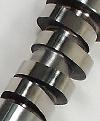


Reverse split X1 vs standard split R1

Thread Starter
Banned
Joined: Mar 2003
Posts: 603
Likes: 0
From: L.I. NY
 Reverse split X1 vs standard split R1
 I'm seeing guys run some great times (Wilwaxu, JaSSon and others) with the MTI X1 cam. Yet I don't see too many guys running the R1. Why are guys running the reverse split cam more? What are the benefits that made them choose these cams?
Back before the ported FAST 90mm intakes came on the scene, reverse split cams were an excellent way to balance the right blend of intake and exhaust duration. The X1 uses the faster COMP XE-R lobes while the R1 uses slower ramp rate lobes. bottom line, the X1 make close to the same power as the R1, but with lots better street manners.
__________________

2013 Corvette Grand Sport A6 LME forged 416, Greg Good ported TFS 255 LS3 heads, 222/242 .629"/.604" 121LSA Pat G blower cam, ARH 1 7/8" headers, ESC Novi 1500 Supercharger w/8 rib direct drive conversion, 747rwhp/709rwtq on 93 octane, 801rwhp/735rwtq on race fuel, 10.1 @ 147.25mph 1/4 mile, 174.7mph Half Mile.
2016 Corvette Z51 M7 Magnuson Heartbeat 2300 supercharger, TSP LT headers, Pat G tuned, 667rwhp, 662rwtq, 191mph TX Mile.
2009.5 Pontiac G8 GT 6.0L, A6, AFR 230v2 heads. 506rwhp/442rwtq. 11.413 @ 121.29mph 1/4 mile, 168.7mph TX Mile
2000 Pewter Ram Air Trans Am M6 heads/cam 508 rwhp/445 rwtq SAE, 183.092 TX Mile
2022 Cadillac Escalade 6.2L A10 S&B CAI, Corsa catback.
2023 Corvette 3LT Z51 soon to be modified.
Custom LSX tuning in person or via email press here.
2013 Corvette Grand Sport A6 LME forged 416, Greg Good ported TFS 255 LS3 heads, 222/242 .629"/.604" 121LSA Pat G blower cam, ARH 1 7/8" headers, ESC Novi 1500 Supercharger w/8 rib direct drive conversion, 747rwhp/709rwtq on 93 octane, 801rwhp/735rwtq on race fuel, 10.1 @ 147.25mph 1/4 mile, 174.7mph Half Mile.
2016 Corvette Z51 M7 Magnuson Heartbeat 2300 supercharger, TSP LT headers, Pat G tuned, 667rwhp, 662rwtq, 191mph TX Mile.
2009.5 Pontiac G8 GT 6.0L, A6, AFR 230v2 heads. 506rwhp/442rwtq. 11.413 @ 121.29mph 1/4 mile, 168.7mph TX Mile
2000 Pewter Ram Air Trans Am M6 heads/cam 508 rwhp/445 rwtq SAE, 183.092 TX Mile
2022 Cadillac Escalade 6.2L A10 S&B CAI, Corsa catback.
2023 Corvette 3LT Z51 soon to be modified.
Custom LSX tuning in person or via email press here.

!LS1 11 Second Club
Joined: Apr 2003
Posts: 7,133
Likes: 2
From: Miami
Originally Posted by SilverSurfer
I don't know bro, these guys are running in line with cars that have bigger traditional split cams. What gives?

My former car is running around right now with 480rwhp on my old setup.

Trending Topics
LS1 Tech Stories
The Best V8 Stories One Small Block at Time

6 Gifts Neither Your Dad Nor Grad Will Shove Into the 'Trinket Drawer'
Brett Foote
Topdon ONE vs. Artidiag 800 BT2: Which is the Diagnostic Tablet For You?
Pouria Savadkouei
Gas Monkey Built a 6-Wheel Ferrari Testarossa With a Corvette LT4 Engine
Verdad Gallardo
7 Most Reliable High-Performance Engines GM Has Ever Built
Verdad Gallardo
Amazing '71 Camaro Restomod Is Modern Muscle Car Under the Skin
Verdad Gallardo
6 Common C5 Corvette Failures and What's Involved In Repairing Them
Pouria Savadkouei
Retro Modern Bandit Pontiac Trans AM Comes With Burt Reynolds' Autograph
Verdad Gallardo
Top 10 Greatest Cadillac V Series Performance Models Ever, Ranked
Pouria Savadkouei
Top 10 Most Powerful Chevy Trucks Ever Made!

I don't plan on changing my setup from the stock TB and stock LS6 intake so that's why I asked...car does have a lid and Pacesetter Longtubes into an X w/Bullets.
The sound clips i've heard of the TR230/224 cam are awesome and it would have the powerband i'm looking for I believe...wouldn't have to rev it to the moon to see good "peak" numbers and would have a great curve too. Unless I find something that better fits the bill I will probably go with this one, though likely on a different LSA than the 111.
The sound clips i've heard of the TR230/224 cam are awesome and it would have the powerband i'm looking for I believe...wouldn't have to rev it to the moon to see good "peak" numbers and would have a great curve too. Unless I find something that better fits the bill I will probably go with this one, though likely on a different LSA than the 111.
!LS1 11 Second Club
Joined: Apr 2003
Posts: 7,133
Likes: 2
From: Miami
From JRP's sticky on the top of this forum:
C. Lobe Separation Angle (LSA)
- LSA is defined as spread in camshaft degrees between the intake centerline and the exhaust centerline.
- Overlap is the number of crankshaft degrees that both the intake and exhaust valves are open as the cylinder transitions through the end of the exhaust stroke and into the intake stroke
- LSA is ground into the cam and cannot be changed without grinding a new cam
- Bigger duration cams will have more overlap then a smaller duration cam even if both are on the same LSA.
- The key to making overlap work is maximizing the power in the rpm band where you want it.
- Long overlap periods work best for high-rpm power. For the street, a long overlap period combined with long-duration profiles combine to kill low-speed torque
- Reducing overlap on a long-duration cam will often increase midrange torque at the expense of peak power, but if the average torque improves, that’s probably a change worth making.
- Many enthusiasts purchase a camshaft strictly on the basis of how it sounds. A cam with generous overlap creates that distinctive choppy idle that just sounds cool.
- While doing my research on the T1 I cam across this dyno in which if I recall Tony (Nineball) stated that the blue graph was a T1 (112 lsa) and the other 2 where a B1 (114) lsa. 112 vs. 114
- What really affects where the cam makes the most power is the intake timing events. What affects drivability most is the exhaust-closing event.
D. Advance and Retard:
- When you see cams specs like 224/224 .563/.563 112+4; the +4 denotes that the cam has 4 degrees of advance ground in.
- Most off the shelf cams have 2 or 4 degrees of advance ground in. This lowers the power band slightly and offers more low end and midrange at the sacrifice of a bit more top end power
- For cams used primarily on the street the advance is best appreciated. For a strip or racing setup 2 or 0 degrees advance will net you more peak power in the upper ranges of the power band
- To find out if you cam has advance ground in you can check on the cam card. Besides the +2, +4, you can determine the number by looking at the intake center line (ICL). Referring back to the T1 cam card you’ll see that it states that those are the specs when installed on a 108 ICL.
- Subtracting the ICL from the LSA will give you the advance: 112 – 108 = 4 using the T1. Or 113 – 109 = 4 using the G5X2.
- Retarding the cam does the opposite of advancing it, it pushes the power band up slightly and gives more top end power.
- With an adjustable timing chain or degreeing the cam you can install the cam at different ICL’s.
- Keep in mind as stated; most cams already have advance ground into them so if you buy an adjustable timing chain and advance 2 degrees you’ll increase the overall advance to 6 degree’s if the cam has 4 degree’s ground in.
- Also with big cams and/or milled heads piston to valve clearances starts becoming an issue. If in doubt always clay the heads and find out your PtV clearance before installing/advancing especially if your cam has a big intake duration as advancing starts the intake valve events sooner.
- Degreeing or installing dot to dot at the said ICL is the best bet.
- LSA is defined as spread in camshaft degrees between the intake centerline and the exhaust centerline.
- Overlap is the number of crankshaft degrees that both the intake and exhaust valves are open as the cylinder transitions through the end of the exhaust stroke and into the intake stroke
- LSA is ground into the cam and cannot be changed without grinding a new cam
- Bigger duration cams will have more overlap then a smaller duration cam even if both are on the same LSA.
- The key to making overlap work is maximizing the power in the rpm band where you want it.
- Long overlap periods work best for high-rpm power. For the street, a long overlap period combined with long-duration profiles combine to kill low-speed torque
- Reducing overlap on a long-duration cam will often increase midrange torque at the expense of peak power, but if the average torque improves, that’s probably a change worth making.
- Many enthusiasts purchase a camshaft strictly on the basis of how it sounds. A cam with generous overlap creates that distinctive choppy idle that just sounds cool.
- While doing my research on the T1 I cam across this dyno in which if I recall Tony (Nineball) stated that the blue graph was a T1 (112 lsa) and the other 2 where a B1 (114) lsa. 112 vs. 114
- What really affects where the cam makes the most power is the intake timing events. What affects drivability most is the exhaust-closing event.
D. Advance and Retard:
- When you see cams specs like 224/224 .563/.563 112+4; the +4 denotes that the cam has 4 degrees of advance ground in.
- Most off the shelf cams have 2 or 4 degrees of advance ground in. This lowers the power band slightly and offers more low end and midrange at the sacrifice of a bit more top end power
- For cams used primarily on the street the advance is best appreciated. For a strip or racing setup 2 or 0 degrees advance will net you more peak power in the upper ranges of the power band
- To find out if you cam has advance ground in you can check on the cam card. Besides the +2, +4, you can determine the number by looking at the intake center line (ICL). Referring back to the T1 cam card you’ll see that it states that those are the specs when installed on a 108 ICL.
- Subtracting the ICL from the LSA will give you the advance: 112 – 108 = 4 using the T1. Or 113 – 109 = 4 using the G5X2.
- Retarding the cam does the opposite of advancing it, it pushes the power band up slightly and gives more top end power.
- With an adjustable timing chain or degreeing the cam you can install the cam at different ICL’s.
- Keep in mind as stated; most cams already have advance ground into them so if you buy an adjustable timing chain and advance 2 degrees you’ll increase the overall advance to 6 degree’s if the cam has 4 degree’s ground in.
- Also with big cams and/or milled heads piston to valve clearances starts becoming an issue. If in doubt always clay the heads and find out your PtV clearance before installing/advancing especially if your cam has a big intake duration as advancing starts the intake valve events sooner.
- Degreeing or installing dot to dot at the said ICL is the best bet.

Originally Posted by SouthFL.02.SS
Both Patrick and I have had stock cube 460+rwhp setups on traditional splits.
My former car is running around right now with 480rwhp on my old setup.
My former car is running around right now with 480rwhp on my old setup.
!LS1 11 Second Club
Joined: Apr 2003
Posts: 7,133
Likes: 2
From: Miami
^
All grannyshifting:
When my setup was @ 425rwhp (no FAST, no QTP HVM), it ran 11.8@119 in the high heat of a dog sweat summer sizzling afternoon, full weight, daily driven tire, rear end giving it's last breath before dying.
When it was cam-only (390rwhp), it ran 12.1 @ 118mph, full weight, daily driven, stock suspension in good air.
It would be safe to say that in its current form, 125mph is attainable in decent air.
In its current form, 10's would be easily attainable on slicks and skinnies.
I wish I would have run it with 460 at the wheels, but I was selling it and didn't want to break more stuff .
.
All grannyshifting:
When my setup was @ 425rwhp (no FAST, no QTP HVM), it ran 11.8@119 in the high heat of a dog sweat summer sizzling afternoon, full weight, daily driven tire, rear end giving it's last breath before dying.
When it was cam-only (390rwhp), it ran 12.1 @ 118mph, full weight, daily driven, stock suspension in good air.
It would be safe to say that in its current form, 125mph is attainable in decent air.
In its current form, 10's would be easily attainable on slicks and skinnies.
I wish I would have run it with 460 at the wheels, but I was selling it and didn't want to break more stuff
.