








View Poll Results: Have you had this happen?
2000 LS6


0
0%
2002 LS6


0
0%
Multiple Choice Poll. Voters: 28. You may not vote on this poll
Broken/Cracked Ringlands on stock pistons???

Thread Starter
12 Second Club
Joined: Jul 2004
Posts: 2,923
Likes: 0
From: Lynnwood, WA
 Broken/Cracked Ringlands on stock pistons???
 Have you had it? If so what year car? Model? mods?
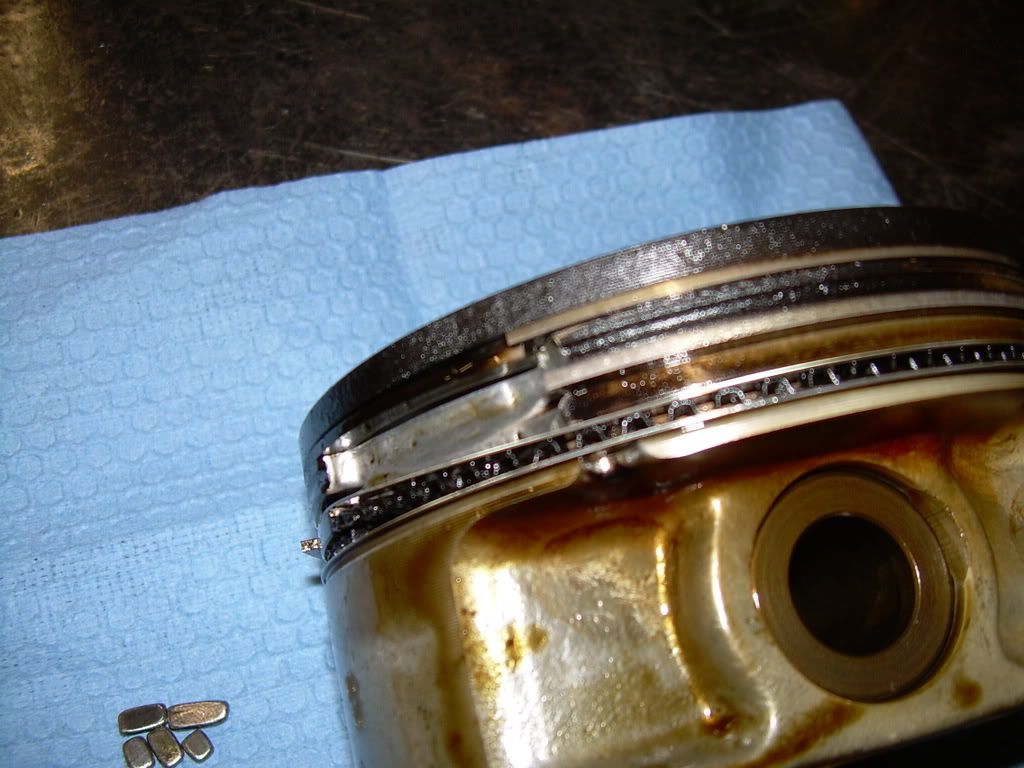

Courtesy EPP website:

These are out of two different cars, different owners, one pretty much stock, one cam (GMPP ASA) and bolt ons. Same year, same model car (2001 Trans Am's (1 ws6 1 firehawk). Both cyl-5. Both decently under 100k (mine was at 72k) and taken care of.
I'm just curious to see how many other people have seen this or had this happen. I saw the 3rd picture on EPP's website on one of their builds where they posted a picture with a piston that had almost identical damage as an example. Kinda frustrating to see this happen when they're supposed to be good pistons.
And they look to be LS6 pistons (the one out of my car is an LS6 piston as we had gone to replace it with a stock LS1 piston and they were definately different in appearance on the skirts and ring lands, plus the area where the pin is)
Courtesy EPP website:
These are out of two different cars, different owners, one pretty much stock, one cam (GMPP ASA) and bolt ons. Same year, same model car (2001 Trans Am's (1 ws6 1 firehawk). Both cyl-5. Both decently under 100k (mine was at 72k) and taken care of.
I'm just curious to see how many other people have seen this or had this happen. I saw the 3rd picture on EPP's website on one of their builds where they posted a picture with a piston that had almost identical damage as an example. Kinda frustrating to see this happen when they're supposed to be good pistons.
And they look to be LS6 pistons (the one out of my car is an LS6 piston as we had gone to replace it with a stock LS1 piston and they were definately different in appearance on the skirts and ring lands, plus the area where the pin is)
Last edited by HitmanLSX; Jun 1, 2008 at 09:42 PM.
They are Hyper correct? If you heat them up good without a ring gap adjustment that happens often enough. Maybe the factory was a little tight to start with but don't know if anyone spec'd a low mileage motor. I helped my shop blueprint a ZZ4 motor for a warranty claim and #7 was tight.
Why blueprint a stock motor? And you have to have rings left to spec it after the fact 
Pic #1 looks very familiar Look how rounded the bits o' ring got? Motor had about 46k on it and I'm guessing that happened around 30k (a bit of knock but nothing major seemed out of the ordinary until it grew much worse much later).
Pic #1 looks very familiar
Look how rounded the bits o' ring got? Motor had about 46k on it and I'm guessing that happened around 30k (a bit of knock but nothing major seemed out of the ordinary until it grew much worse much later). Thread Starter
12 Second Club
Joined: Jul 2004
Posts: 2,923
Likes: 0
From: Lynnwood, WA
Yeah mine was pretty much the same then started missing a lot and I couldn't figure out for the life of me what was wrong. Then noticed that fuel was getting into the oil and parked it until I could afford to tear down the motor and rebuild it and that's what we found.
Thread Starter
12 Second Club
Joined: Jul 2004
Posts: 2,923
Likes: 0
From: Lynnwood, WA
This was hardly noticable until it was done? How can you prevent something if it doesn't show up as a problem? Only thing you could hear maybe was a little piston slap when it was cold and that's it until everything went to hell.
Trending Topics
LS1 Tech Stories
The Best V8 Stories One Small Block at Time

Gas Monkey Built a 6-Wheel Ferrari Testarossa With a Corvette LT4 Engine
Verdad Gallardo
7 Most Reliable High-Performance Engines GM Has Ever Built
Verdad Gallardo
Amazing '71 Camaro Restomod Is Modern Muscle Car Under the Skin
Verdad Gallardo
6 Common C5 Corvette Failures and What's Involved In Repairing Them
Pouria Savadkouei
Retro Modern Bandit Pontiac Trans AM Comes With Burt Reynolds' Autograph
Verdad Gallardo
Top 10 Greatest Cadillac V Series Performance Models Ever, Ranked
Pouria Savadkouei
Top 10 Most Powerful Chevy Trucks Ever Made!

Hennessey's New Supercharged Silverado ZR2 Has 700 HP
Verdad Gallardo
Coachbuilt N2A Anteros Is an LS2-Powered C6 Corvette In Italian Clothes
Verdad Gallardo

TECH Senior Member
Joined: Jan 2004
Posts: 5,798
Likes: 16
From: St.Charles MO
Have you had it? If so what year car? Model? mods?
These are out of two different cars, different owners, one pretty much stock, one cam (GMPP ASA) and bolt ons. Same year, same model car (2001 Trans Am's (1 ws6 1 firehawk). Both cyl-5. Both decently under 100k (mine was at 72k) and taken care of.
These are out of two different cars, different owners, one pretty much stock, one cam (GMPP ASA) and bolt ons. Same year, same model car (2001 Trans Am's (1 ws6 1 firehawk). Both cyl-5. Both decently under 100k (mine was at 72k) and taken care of.
2001 LS1 74K miles, typical bolt ons, very well taken care of with the same damage, cylinder 5. Weird it let go at the same miles as yours above.
Just randomly started having a missfire under normal driving, after doing a compression test #5 was only holding 30psi, so it was tear down time...




Stock ring lands and skirts are notoriously known for breaking. Get's even worse with boost. Read plugs read plugs read plugs, this will let you know if it is detonating before they actually let go.
The number 7's typically go as a result of being the hottest running cylinder due to coolant flow path. I also don't see supporting pics of the number 7's noted, that have failed. So, we don't know where on the piston the failure has occurred.
In the pics, the number 5 cylinder failures always happen in the same location on the piston. Only repeatable condition I can think of is the location of where the regulator sends fuel to the rail on that side, as noted earlier.
Maybe number 5 doesn't run lean all the time. For this reason, perhaps it's hard to note from reading the plug. Could be that it happens only after the fuel pump ages & gets a bit weaker; then the combination of the connection point on the fuel rail in conjunction w/ a weaker pump creates the condition? I don't know. Am trying to note possibilities that could explain this.
Would be good to know if anyone using aftermarket fuel rails w/ regulator properly connected on fuel exit, has had this exact number 5 failure.
In the pics, the number 5 cylinder failures always happen in the same location on the piston. Only repeatable condition I can think of is the location of where the regulator sends fuel to the rail on that side, as noted earlier.
Maybe number 5 doesn't run lean all the time. For this reason, perhaps it's hard to note from reading the plug. Could be that it happens only after the fuel pump ages & gets a bit weaker; then the combination of the connection point on the fuel rail in conjunction w/ a weaker pump creates the condition? I don't know. Am trying to note possibilities that could explain this.
Would be good to know if anyone using aftermarket fuel rails w/ regulator properly connected on fuel exit, has had this exact number 5 failure.


I had my number #7 do the same thing in my 98 shortblock ,but i did beat on it for 5 yrs and then added a maggie on it for about 6 months.Took it off and then 4 months later had a small hessitation and crusing speed didnt know what it was till i did a leak down .Replaced rod & piston with another stock piston/rod and car ran just as fast as it did and still going strong.

 1998 H/C/I 107K car making 438/400

