4.8L crank in LS2

[QUOTE=KCS;12538375]Well, if you don't even want ~35 more cubic inches, then I guess this is a moot point anyhow.
However, one thing to note is that cramming the same amount of air, into a smaller space, will typically increase cylinder pressure and put you closer to the detonation threshold, requiring a higher grade of fuel for the same amount of power. The question here is, could the expense of higher octane fuel, or a water/methanol injection setup, negate the supposed fuel economy of a smaller engine? Is there better fuel economy in a smaller supercharged engine, making the same power as a bigger supercharged engine?
Also, what you are doing does not require a "high dollar" bottom end, although I wouldn't attempt it with stock pistons. You can use any stock crank, stock connecting rod combo, so why not enjoy ~35 more cubic inches? It's not a reliability issue, I assure you that. The stock LS2 crank and rod will last as long as you want. The tune and the quality of the machine work will have exponentially greater influence on the reliability of the engine than this rod ratio.[/QUOTE
I have a turbo charged truck, an mp122 blown truck (in signature), and a TVS 2300 blown vette. All run on 93 octane fuel. I factored 93 octane fuel in from the beginning. Every smaller engine I've ever been associated with went farther on a gallon of fuel vs a bigger one.
The beauty of a good f/i setup is that the power is available, but it doesn't cost you anything if you don't use it. If you can get by with a smaller engine (size wise), you can realize some savings. That's what I'm looking for. I think a 500+ rwhp rig is doable that still sips fuel.
However, one thing to note is that cramming the same amount of air, into a smaller space, will typically increase cylinder pressure and put you closer to the detonation threshold, requiring a higher grade of fuel for the same amount of power. The question here is, could the expense of higher octane fuel, or a water/methanol injection setup, negate the supposed fuel economy of a smaller engine? Is there better fuel economy in a smaller supercharged engine, making the same power as a bigger supercharged engine?
Also, what you are doing does not require a "high dollar" bottom end, although I wouldn't attempt it with stock pistons. You can use any stock crank, stock connecting rod combo, so why not enjoy ~35 more cubic inches? It's not a reliability issue, I assure you that. The stock LS2 crank and rod will last as long as you want. The tune and the quality of the machine work will have exponentially greater influence on the reliability of the engine than this rod ratio.[/QUOTE
I have a turbo charged truck, an mp122 blown truck (in signature), and a TVS 2300 blown vette. All run on 93 octane fuel. I factored 93 octane fuel in from the beginning. Every smaller engine I've ever been associated with went farther on a gallon of fuel vs a bigger one.
The beauty of a good f/i setup is that the power is available, but it doesn't cost you anything if you don't use it. If you can get by with a smaller engine (size wise), you can realize some savings. That's what I'm looking for. I think a 500+ rwhp rig is doable that still sips fuel.
Because you aren't looking for huge torque, and probably can't use it as you mentioned, I like the idea of the budget 329. If it makes peak power at say 6000, 550 fwhp is about 210 psi BMEP, very doable with the huffer. With some very well modified 243 heads, 550 hp is doable NA on a 329, albeit at a higher rpm and a lot less dirveabilty.
The bottom end, with upgraded rod bolts, is plenty strong. Obviously, the engine should be designed as a complete package: heads, cam valvetrain blower and octane you want to use. OEM lifters and rocker arms are also good. This helps kep the cost reasonable and allows you more of your available budget for headwork. The better the head the less cam and boost you need with a blower. That's heresy to many folks, but not to the engine.
Hans was correct about how GM Racing/Katech got he original 5.7 L CTS racing engine. It also would spin to near 8000 with hydraulic lifters.
Good luck with your project.
Jon
The bottom end, with upgraded rod bolts, is plenty strong. Obviously, the engine should be designed as a complete package: heads, cam valvetrain blower and octane you want to use. OEM lifters and rocker arms are also good. This helps kep the cost reasonable and allows you more of your available budget for headwork. The better the head the less cam and boost you need with a blower. That's heresy to many folks, but not to the engine.
Hans was correct about how GM Racing/Katech got he original 5.7 L CTS racing engine. It also would spin to near 8000 with hydraulic lifters.
Good luck with your project.
Jon
if you do it my understanding is that the deck height and piston height are not the same on the 4.8. You can use the crank, but the rods are not right to get the piston to the top of the bore. I believe they are longer or something. You can't just stab it together. I thought of this years ago, but never followed through with it. Your looking at custom length rods and custom pistons at the very least. other than that everything else should come together. I don't think you'll make the hp your thinking though. Good luck.
Last edited by old motorhead; Nov 24, 2009 at 07:50 PM.

TECH Fanatic
Joined: Jun 2002
Posts: 1,979
Likes: 3
From: Upstate NY
I always thought about doing this, but in the end I couldn't find any real advantages. If you want the cool factor of having the short stroke setup it may be worth it, but cool factor is really the only advantage. Less cubes will not equal better mileage. You won't be able to rev it higher, as the valvetrain is the limit rather than the bottom end. You will strain the bottom end more to make the power with less cubic inches. I think in the fuel economy area it's moot and it won't make much difference. As far as engine life goes, if it is set up well it will last, but the full displacement setup is probably safer than the same power on the smaller displacement setup.
If this is a setup for the truck in your sig, I honestly think you would be stepping down from what you currently have. I'm not a "more cubes is always batter!" kind of guy either, as I have considered something like this myself. I just do not believe the de-stroking option is advantageous for this situation.
If this is a setup for the truck in your sig, I honestly think you would be stepping down from what you currently have. I'm not a "more cubes is always batter!" kind of guy either, as I have considered something like this myself. I just do not believe the de-stroking option is advantageous for this situation.
Thoughts (no offense intended)
Hydraulic valvetrain with stock lifters and rockers, the correct springs, pushrods and cam lobes won't be a problem unless old motorhead plans rpm way north of 7000, which I highly doubt.
Each cylinder will be producing the same power no matter what the size. The shorter stroke crank with the same size rod and main journals will have more "overlap" which makes it stronger.
If one just wanted an LS this size, sure pickup a 5.3 and go for it. If the parts are cheaply available and the cool factor is a driver for you, I think the 329 will work.
I don't think cruising fuel economy will be much different. It takes a given amount of power to cruise a given vehicle at a given speed. Unless you aim for cruising at a more efficient portion of the part-throttle low-boost portion of the torque curve you probably would need OEM equipment to find the difference.
Shorter strokes, with the resultant lower piston speed do consume less friction hp than longer strokes, but in this case it's not a whole lot.
I like the idea mainly because it would be a reasonable cheap thing to try, and would have a high cool factor.
old mentioned this was for a 3500 lb. vehicle.
Jon
I did the math on this because I wanted to use the 4.8 flat tops in a budget 5.3 I was planning. It worked out where the 4.8 has a piston to deck height that is 2 thousandths higher than the 5.3. The 4.8 crank/rod combo will work with the 6.0 pistons, they may just come out of the hole a tad more.

TECH Fanatic

Joined: Jul 2005
Posts: 1,685
Likes: 7
From: Beebe, Arkansas
I did the math on this because I wanted to use the 4.8 flat tops in a budget 5.3 I was planning. It worked out where the 4.8 has a piston to deck height that is 2 thousandths higher than the 5.3. The 4.8 crank/rod combo will work with the 6.0 pistons, they may just come out of the hole a tad more.
Running a 4.8l crank and rod and a 6.0l flat top will boost CR. I would use a LQ4 dished piston, that will lower the CR a bit since its going to be used with a SC.
I say do it!

LS1 Tech Stories
The Best V8 Stories One Small Block at Time

Gas Monkey Built a 6-Wheel Ferrari Testarossa With a Corvette LT4 Engine
Verdad Gallardo
7 Most Reliable High-Performance Engines GM Has Ever Built
Verdad Gallardo
Amazing '71 Camaro Restomod Is Modern Muscle Car Under the Skin
Verdad Gallardo
6 Common C5 Corvette Failures and What's Involved In Repairing Them
Pouria Savadkouei
Retro Modern Bandit Pontiac Trans AM Comes With Burt Reynolds' Autograph
Verdad Gallardo
Top 10 Greatest Cadillac V Series Performance Models Ever, Ranked
Pouria Savadkouei
Top 10 Most Powerful Chevy Trucks Ever Made!

Hennessey's New Supercharged Silverado ZR2 Has 700 HP
Verdad Gallardo
Coachbuilt N2A Anteros Is an LS2-Powered C6 Corvette In Italian Clothes
Verdad Gallardo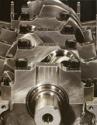
Well, if you don't even want ~35 more cubic inches, then I guess this is a moot point anyhow.
However, one thing to note is that cramming the same amount of air, into a smaller space, will typically increase cylinder pressure and put you closer to the detonation threshold, requiring a higher grade of fuel for the same amount of power. The question here is, could the expense of higher octane fuel, or a water/methanol injection setup, negate the supposed fuel economy of a smaller engine? Is there better fuel economy in a smaller supercharged engine, making the same power as a bigger supercharged engine?
Also, what you are doing does not require a "high dollar" bottom end, although I wouldn't attempt it with stock pistons. You can use any stock crank, stock connecting rod combo, so why not enjoy ~35 more cubic inches? It's not a reliability issue, I assure you that. The stock LS2 crank and rod will last as long as you want. The tune and the quality of the machine work will have exponentially greater influence on the reliability of the engine than this rod ratio.
However, one thing to note is that cramming the same amount of air, into a smaller space, will typically increase cylinder pressure and put you closer to the detonation threshold, requiring a higher grade of fuel for the same amount of power. The question here is, could the expense of higher octane fuel, or a water/methanol injection setup, negate the supposed fuel economy of a smaller engine? Is there better fuel economy in a smaller supercharged engine, making the same power as a bigger supercharged engine?
Also, what you are doing does not require a "high dollar" bottom end, although I wouldn't attempt it with stock pistons. You can use any stock crank, stock connecting rod combo, so why not enjoy ~35 more cubic inches? It's not a reliability issue, I assure you that. The stock LS2 crank and rod will last as long as you want. The tune and the quality of the machine work will have exponentially greater influence on the reliability of the engine than this rod ratio.
The beauty of a good f/i setup is that the power is available, but it doesn't cost you anything if you don't use it. If you can get by with a smaller engine (size wise), you can realize some savings. That's what I'm looking for. I think a 500+ rwhp rig is doable that still sips fuel.
The smaller engine just may get better fuel mileage, but my point is that it will most likely require 93, and as hot and humid as it gets here in Texas, it may not even be enough then. The extra displacement gives you a larger margin of safety, and may even allow a lower octane to be used, depending on other variables. The ability to run the lower octane, ie cheaper, fuel in the larger engine may make the economic difference in the two neglibible.
Thoughts (no offense intended)
If one just wanted an LS this size, sure pickup a 5.3 and go for it. If the parts are cheaply available and the cool factor is a driver for you, I think the 329 will work.
I don't think cruising fuel economy will be much different. It takes a given amount of power to cruise a given vehicle at a given speed. Unless you aim for cruising at a more efficient portion of the part-throttle low-boost portion of the torque curve you probably would need OEM equipment to find the difference.
Shorter strokes, with the resultant lower piston speed do consume less friction hp than longer strokes, but in this case it's not a whole lot.
I like the idea mainly because it would be a reasonable cheap thing to try, and would have a high cool factor.
old mentioned this was for a 3500 lb. vehicle.
Jon
If one just wanted an LS this size, sure pickup a 5.3 and go for it. If the parts are cheaply available and the cool factor is a driver for you, I think the 329 will work.
I don't think cruising fuel economy will be much different. It takes a given amount of power to cruise a given vehicle at a given speed. Unless you aim for cruising at a more efficient portion of the part-throttle low-boost portion of the torque curve you probably would need OEM equipment to find the difference.
Shorter strokes, with the resultant lower piston speed do consume less friction hp than longer strokes, but in this case it's not a whole lot.
I like the idea mainly because it would be a reasonable cheap thing to try, and would have a high cool factor.
old mentioned this was for a 3500 lb. vehicle.
Jon
I think you may be discounting the value of the smaller motor fuel eco wise. My sons have 4.8L and 5.3L half ton trucks. I have a 6.0L in my half ton. As you would expect, the smaller motor gets the best fuel eco by a fairly large margin. I think that would hold true as long as the small motor wasn't overloaded and lugged. That won't be the case here.
The 4.8l has flat top pistons. The 5.3 had dished pistons. Later GM used the 4.8l flattops in the 5.3L to boost CR to get more HP out of the 5.3L. All the 5.3l are now 4.8l pistons they are the same part numbers.
Running a 4.8l crank and rod and a 6.0l flat top will boost CR. I would use a LQ4 dished piston, that will lower the CR a bit since its going to be used with a SC.
I say do it!
Running a 4.8l crank and rod and a 6.0l flat top will boost CR. I would use a LQ4 dished piston, that will lower the CR a bit since its going to be used with a SC.
I say do it!
Running a 4.8 crank in a 6.0 will not boost compression, it will actually lower it. Decreasing cubic inches also decreases the amount of air compressed in each stroke, thus reducing compression. A flat top 6.0 has a 10:1 CR with a 3.622 crank and swapping to a 4.8L 3.28 crank lowers that to 9.2. If you use the LQ4 7cc dish pistons with the 3.28 crank the compression will be an anemic 8.5:1. You would have to be running some serious boost to require going that low on the compression.
I do however agree with you that it should be done. It has long been an ambition of mine to destroke an LS engine just for fun.

Teching In
Joined: Jan 2009
Posts: 9
Likes: 0
I vote for 4.8 Hello
I would like to share my opinion/experience with forced induction motors.
I have build destroked 95 cid motor from 122 CID engine (stroke was reduced from 3.54 to 2.81 inch). Engine is 2 valves per cylinder. I used stock head (home ported) with all stock valvetrain, stock cams, valves, stock cast 122cid turbo engine pistons (122cid had 7.5-8:1 and this gave me compression ratio of ~6.5-6.8 if I remember correctly). Rod ratio increased from 1.61 to 1.79. I made 360fwhp at 30+psi boost at 7800rpm on pump gas without water injection. If we multiply everything by 4 I should have had 1440fwhp 380 CID engine With no forged components.
My theory is that hp depends on
1. Head flow (it is the same as the same heads are used).
2. efficiency (or comp ratio)
3. amount of mixture (or combustion chamber volume).
If You put destroked 4.8 crank to 6.0 block with the same flowing heads You should make the same amount of power as You keep the same combustion chamber volume. So You only need the same dynamic comp ratio to reach same hp number. You use higher boost safely and You will have the same dynamic comp ratio.
So I would like to encourage You and to make such engine and I think You will have great results. The only downfall I see in Your case is valve train (as You will need to go higher in rev range with smaller engine if You use the same heads/cams).
Another point for non believers is amount of power made on stock block. I thinks somebody here made over 700whp with stock 4.8 long block and turbo. I have seen highest of 780whp here with stock 6.0 long block also. And if You have lower compression and higher boost I think You will have more than that with stock components in 4.8.
Good luck with the build if You decide to try different route.
Jonas
I would like to share my opinion/experience with forced induction motors.
I have build destroked 95 cid motor from 122 CID engine (stroke was reduced from 3.54 to 2.81 inch). Engine is 2 valves per cylinder. I used stock head (home ported) with all stock valvetrain, stock cams, valves, stock cast 122cid turbo engine pistons (122cid had 7.5-8:1 and this gave me compression ratio of ~6.5-6.8 if I remember correctly). Rod ratio increased from 1.61 to 1.79. I made 360fwhp at 30+psi boost at 7800rpm on pump gas without water injection. If we multiply everything by 4 I should have had 1440fwhp 380 CID engine
With no forged components. My theory is that hp depends on
1. Head flow (it is the same as the same heads are used).
2. efficiency (or comp ratio)
3. amount of mixture (or combustion chamber volume).
If You put destroked 4.8 crank to 6.0 block with the same flowing heads You should make the same amount of power as You keep the same combustion chamber volume. So You only need the same dynamic comp ratio to reach same hp number. You use higher boost safely and You will have the same dynamic comp ratio.
So I would like to encourage You and to make such engine and I think You will have great results. The only downfall I see in Your case is valve train (as You will need to go higher in rev range with smaller engine if You use the same heads/cams).
Another point for non believers is amount of power made on stock block. I thinks somebody here made over 700whp with stock 4.8 long block and turbo. I have seen highest of 780whp here with stock 6.0 long block also. And if You have lower compression and higher boost I think You will have more than that with stock components in 4.8.
Good luck with the build if You decide to try different route.
Jonas
TECH Fanatic
Joined: Jun 2002
Posts: 1,979
Likes: 3
From: Upstate NY
I considered a 5.3. That would definitely be a cheaper option. Not too easy to find aluminum 5.3l blocks though. Also, limits head choices with the smaller bore. I didn't think good heads were important on a s/charged motor until I got the results from my TVS blown LS3. I want to put this thing together mild, but want the ability to go a little wild too.
I think you may be discounting the value of the smaller motor fuel eco wise. My sons have 4.8L and 5.3L half ton trucks. I have a 6.0L in my half ton. As you would expect, the smaller motor gets the best fuel eco by a fairly large margin. I think that would hold true as long as the small motor wasn't overloaded and lugged. That won't be the case here.
I think you may be discounting the value of the smaller motor fuel eco wise. My sons have 4.8L and 5.3L half ton trucks. I have a 6.0L in my half ton. As you would expect, the smaller motor gets the best fuel eco by a fairly large margin. I think that would hold true as long as the small motor wasn't overloaded and lugged. That won't be the case here.
We all see folks ahead of us who keep up their cruising speed until they approach the stop light, than brake fairly hard to stop. If you see that the light is going to change a few hundred yards ahead of you, back off and let her coast. If your car/truck has a instant fuel economy readout you will see that closed throttle coasting uses very little fuel, and on some engines the fuel is shut off. I could go on, but you get the idea.
Two identical trucks, but with one carrying around a few hundred pounds of "necessary stuff" like took boxes, a few cases of beer, etc. will get lower average fuel economy than the empty one. It's all about the energy needed to accelerate the mass.
If fuel economy is a biggie, design and gear the engine/vehicle package so you are using the engine in a very efficient part-throttle low rpm range. That may not equate to best for acceleration. I'm not sure if the blower you have has a bypass like a Maggie, but that feature is a pretty good help for MPG.
Bottom line, IMO, is that driving style probably is a bigger factor than the difference in displacement (364 vs 329) on your blown engine. Design of the ports and valve events and gearing willmake even a bigger difference. Remember that the better the port, the less cam the engine will need to produce a given amount of power at a given rpm...NA or Forced Induction.
Jon
[QUOTE=Old SStroker;12546517]
We all see folks ahead of us who keep up their cruising speed until they approach the stop light, than brake fairly hard to stop. If you see that the light is going to change a few hundred yards ahead of you, back off and let her coast. If your car/truck has a instant fuel economy readout you will see that closed throttle coasting uses very little fuel, and on some engines the fuel is shut off. I could go on, but you get the idea.
If fuel economy is a biggie, design and gear the engine/vehicle package so you are using the engine in a very efficient part-throttle low rpm range. That may not equate to best for acceleration. I'm not sure if the blower you have has a bypass like a Maggie, but that feature is a pretty good help for MPG.
When you take your foot off the go pedal, folks behind you lose their minds. I've pulled over and let them by only to be right behind them at the light. They don't get it. Same thing when approaching a sharp curve. Unless someone is bleeding in the car, it makes no sense to have to brake hard going into the curve. Brakes last a lot longer too.
The blower I'll be using is probably a Magnacharger MP122 (unless I can find a TVS cheap). The MP 112 and 122 are getting pretty common on the used market. It's amazing the deals you'll come across when you don't have to have it RIGHT NOW. They, as well as all of the Magnuson blowers I'm familiar with, have the bypass valve. When you're not needing boost, the blower is just along for the ride using little if any power. I think the Magnuson boys quote a third of a horsepower in no boost mode.
I'll be shooting for somewhere around 10.5/1 compression ratio. I think I can use all of the air an MP122 will pump effeciently and still keep the compression on the high side. I know I can with an MP112. A good flowing set of heads, boost cooler, and cam choice will be keys to making this thing stay together and make the power and economy I'm looking for.
We all see folks ahead of us who keep up their cruising speed until they approach the stop light, than brake fairly hard to stop. If you see that the light is going to change a few hundred yards ahead of you, back off and let her coast. If your car/truck has a instant fuel economy readout you will see that closed throttle coasting uses very little fuel, and on some engines the fuel is shut off. I could go on, but you get the idea.
If fuel economy is a biggie, design and gear the engine/vehicle package so you are using the engine in a very efficient part-throttle low rpm range. That may not equate to best for acceleration. I'm not sure if the blower you have has a bypass like a Maggie, but that feature is a pretty good help for MPG.
When you take your foot off the go pedal, folks behind you lose their minds. I've pulled over and let them by only to be right behind them at the light. They don't get it. Same thing when approaching a sharp curve. Unless someone is bleeding in the car, it makes no sense to have to brake hard going into the curve. Brakes last a lot longer too.
The blower I'll be using is probably a Magnacharger MP122 (unless I can find a TVS cheap). The MP 112 and 122 are getting pretty common on the used market. It's amazing the deals you'll come across when you don't have to have it RIGHT NOW. They, as well as all of the Magnuson blowers I'm familiar with, have the bypass valve. When you're not needing boost, the blower is just along for the ride using little if any power. I think the Magnuson boys quote a third of a horsepower in no boost mode.
I'll be shooting for somewhere around 10.5/1 compression ratio. I think I can use all of the air an MP122 will pump effeciently and still keep the compression on the high side. I know I can with an MP112. A good flowing set of heads, boost cooler, and cam choice will be keys to making this thing stay together and make the power and economy I'm looking for.


Launching!
Joined: Sep 2009
Posts: 260
Likes: 0
From: greensboro, nc
EXACTLY. My vette does 670+ and still gets 24 on the highway. I know it's easily doable mpg wise with a smaller motor. Not shooting for that much in the power department, but would like to do 25+mpg.