







Floating rod orientation?

Thread Starter
On The Tree
Joined: Oct 2006
Posts: 176
Likes: 4
 Floating rod orientation?
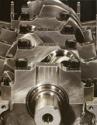
 So I've read numerous threads and many contradict each other regarding the floating rods orientation vs the piston dot. After studying the rods at length this morning I "think" I have it figure out but was hoping for definitive confirmation. Here goes:
The big end of the floating rod has two different sides. One side has a larger flat surface and a rough "as cast" chamfer on the face of the rod bearing hole. The other side has a smaller flat surface and its chamfer is machined. In my opinion this means that the smooth machined chamfers face out toward the crank fillets which then presents the large flat surfaces facing inward towards each other. This makes sense as you would want the smooth machined surface facing towards the rotating fillet of the crankshaft and you would want the larger flat surface of the rods facing towards each other as the larger surface area would allow those surfaces to slid past each other with more stability. More "load bearing" surface if you will.
What this means then is that half the rods would be installed with their dimple facing towards the front of the block and half facing towards the back. That's where the contradiction comes in: everything ive read says the rod dimples (not talking about the piston dimple) all face the same direction with some experts saying it matches the piston dot and others saying the opposite.
Can anyone state with 100% certainty the proper orientation?
Thanks!
S.F.
The big end of the floating rod has two different sides. One side has a larger flat surface and a rough "as cast" chamfer on the face of the rod bearing hole. The other side has a smaller flat surface and its chamfer is machined. In my opinion this means that the smooth machined chamfers face out toward the crank fillets which then presents the large flat surfaces facing inward towards each other. This makes sense as you would want the smooth machined surface facing towards the rotating fillet of the crankshaft and you would want the larger flat surface of the rods facing towards each other as the larger surface area would allow those surfaces to slid past each other with more stability. More "load bearing" surface if you will.
What this means then is that half the rods would be installed with their dimple facing towards the front of the block and half facing towards the back. That's where the contradiction comes in: everything ive read says the rod dimples (not talking about the piston dimple) all face the same direction with some experts saying it matches the piston dot and others saying the opposite.
Can anyone state with 100% certainty the proper orientation?
Thanks!
S.F.
With 100% certainty, I can tell you it doesn't matter. That's why you're reading conflicting statements.
These are on center rods first off, so there's no offset like the older stuff. Secondly, older cranks and afetrmarket cranks have a radius where the journals meet the crank cheeks. This required the bearings and therefore the rods to be orientated such that the chamfer was towards the radius. On a stock LS cranks, there is no radius so it doesn't need the rod to face a certain way to make that chamfer face the radius.
These are on center rods first off, so there's no offset like the older stuff. Secondly, older cranks and afetrmarket cranks have a radius where the journals meet the crank cheeks. This required the bearings and therefore the rods to be orientated such that the chamfer was towards the radius. On a stock LS cranks, there is no radius so it doesn't need the rod to face a certain way to make that chamfer face the radius.
Thread Starter
On The Tree
Joined: Oct 2006
Posts: 176
Likes: 4
With 100% certainty, I can tell you it doesn't matter. That's why you're reading conflicting statements.
These are on center rods first off, so there's no offset like the older stuff. Secondly, older cranks and afetrmarket cranks have a radius where the journals meet the crank cheeks. This required the bearings and therefore the rods to be orientated such that the chamfer was towards the radius. On a stock LS cranks, there is no radius so it doesn't need the rod to face a certain way to make that chamfer face the radius.
These are on center rods first off, so there's no offset like the older stuff. Secondly, older cranks and afetrmarket cranks have a radius where the journals meet the crank cheeks. This required the bearings and therefore the rods to be orientated such that the chamfer was towards the radius. On a stock LS cranks, there is no radius so it doesn't need the rod to face a certain way to make that chamfer face the radius.
S.F.
What he said ^^ However, for the piece of mind, I oriented all of the bearing tangs to face the pan rail on both sides. That oriented the dot on the rods to face opposite directions depending on the side.
They are on center and it does not matter.
However, From the factory the Dimple/ Dot faces the rear of the block on all 8 rods While the dot on the piston faces forward on all 8 pistons.
The older Press pin LS1 rods, The flat side of all 8 rods face forward to the front of the block.
HTH
However, From the factory the Dimple/ Dot faces the rear of the block on all 8 rods While the dot on the piston faces forward on all 8 pistons.
The older Press pin LS1 rods, The flat side of all 8 rods face forward to the front of the block.
HTH

Teching In

Joined: May 2014
Posts: 48
Likes: 0
From: Milwaukee, WI
TIme to wake the dead slightly.
So if i was putting floating rods from a GenIV LQ4 onto a GENIII LQ4 crank, which orientation would I install them?
From what I read it made it sound like the older cranks require you to install in certain matter.
Please let me know,
So if i was putting floating rods from a GenIV LQ4 onto a GENIII LQ4 crank, which orientation would I install them?
From what I read it made it sound like the older cranks require you to install in certain matter.
Please let me know,
TIme to wake the dead slightly.
So if i was putting floating rods from a GenIV LQ4 onto a GENIII LQ4 crank, which orientation would I install them?
From what I read it made it sound like the older cranks require you to install in certain matter.
Please let me know,
So if i was putting floating rods from a GenIV LQ4 onto a GENIII LQ4 crank, which orientation would I install them?
From what I read it made it sound like the older cranks require you to install in certain matter.
Please let me know,
On the pistons, the dot is forward.
Trending Topics
That was pretty funny. Waking from the dead?? LOL. I found this thread through Google. I have a set of untouched Gen 3 rods and pistons from a 4.8 that I can snap a couple pictures of if you want me to.
its up to you
its up to you
LS1 Tech Stories
The Best V8 Stories One Small Block at Time

6 Gifts Neither Your Dad Nor Grad Will Shove Into the 'Trinket Drawer'
Brett Foote
Topdon ONE vs. Artidiag 800 BT2: Which is the Diagnostic Tablet For You?
Pouria Savadkouei
Gas Monkey Built a 6-Wheel Ferrari Testarossa With a Corvette LT4 Engine
Verdad Gallardo
7 Most Reliable High-Performance Engines GM Has Ever Built
Verdad Gallardo
Amazing '71 Camaro Restomod Is Modern Muscle Car Under the Skin
Verdad Gallardo
6 Common C5 Corvette Failures and What's Involved In Repairing Them
Pouria Savadkouei
Retro Modern Bandit Pontiac Trans AM Comes With Burt Reynolds' Autograph
Verdad Gallardo
Top 10 Greatest Cadillac V Series Performance Models Ever, Ranked
Pouria Savadkouei
Top 10 Most Powerful Chevy Trucks Ever Made!
 Piston Guided Rod = Floating
 HI ALL, yes the above "tech" may be correct, just NOT that the Floating Rod is referenced.
A "floating rod" FLOATS on the crank pin with GREAT side clearance, good for oil flow needed to cool the bearing. (also low friction)
I have assembled LS "race" engines that use a Piston Guided rod, a piston I designed and manufactured by Racetec.
Most often the custom FORGED long stroke crankshaft rod/main fillet is VERY large, good for strength in a crack prone area.
MY piston design (piston guided rod) is ALSO good for strength in the "piston boss" area due it's LIMITED width caused by the placement of my 60-2 (GM58x) wheel.
I use this method ALWAYS with the LS-482, a race engine with a 4.5" stroke crankshaft.
Lance
A "floating rod" FLOATS on the crank pin with GREAT side clearance, good for oil flow needed to cool the bearing. (also low friction)
I have assembled LS "race" engines that use a Piston Guided rod, a piston I designed and manufactured by Racetec.
Most often the custom FORGED long stroke crankshaft rod/main fillet is VERY large, good for strength in a crack prone area.
MY piston design (piston guided rod) is ALSO good for strength in the "piston boss" area due it's LIMITED width caused by the placement of my 60-2 (GM58x) wheel.
I use this method ALWAYS with the LS-482, a race engine with a 4.5" stroke crankshaft.
Lance

Registered User
Joined: Jul 2023
Posts: 1
Likes: 0
Rod orientation With 100% certainty, I can tell you it doesn't matter. That's why you're reading conflicting statements.
These are on center rods first off, so there's no offset like the older stuff. Secondly, older cranks and afetrmarket cranks have a radius where the journals meet the crank cheeks. This required the bearings and therefore the rods to be orientated such that the chamfer was towards the radius. On a stock LS cranks, there is no radius so it doesn't need the rod to face a certain way to make that chamfer face the radius.
These are on center rods first off, so there's no offset like the older stuff. Secondly, older cranks and afetrmarket cranks have a radius where the journals meet the crank cheeks. This required the bearings and therefore the rods to be orientated such that the chamfer was towards the radius. On a stock LS cranks, there is no radius so it doesn't need the rod to face a certain way to make that chamfer face the radius.
This is the second reference I’ve read the notates front face direction

Mark (it’s a dot) on the piston top should face the front of the engine, yes. But as far as OEM LS connecting rods go, they can face either way. Although I typically build LS engines with aftermarket rods, I’ve built a few with GM rods and I’ve turned them both directions…ON PURPOSE…to see if it would work out. Those engines are still running today. LS rods are straight-up design (with offset pistons pins) unlike SBC rods that are offset (with a non-offset piston pin), so it doesn’t matter which way the OEM rods face. Now…GM puts the dimples toward the rear at the factory.