




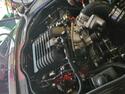

Differences between LS3 427 stroker and LS7

Banned
Joined: Apr 2017
Posts: 948
Likes: 1

You'll have 2 keep Waiting! Think about it, as the market goes so does the engines AKA: Eco boost, or Forced Induction. Smaller is better and not with added consumption of Fossil fuels. 3/4 ton best offerings will be a Duramaxx for Tq or that longer arm your requesting. This isn't 1965 where we'er going from a 396 to 427 then 454 from the factory in production cars...LOL! A iron factory block that would accept a 4.060 (+.040 for mine 4.100) bore standard and they would be cutting there Own throats as far as the aftermarket goes. Dreams are good to have, but not for the Real world. Would be nice. And Cheap.
Banned
Joined: Apr 2017
Posts: 948
Likes: 1
You maybe right......but think about it this way.. The new what ever super corvette will not be rocking a 4.125 bore. And We know bore = HP/TQ. There all FI with smaller displacement. New Benz SLS went from 6.2 to some new 4.5 BS with FI. Ferrari 458 went from 4.5 N/a to 4.2 FI, BMW the same thing 5.0 M3 to Staight-6 FI. Only companies left N/a with a decent engine is Lambo v10 /12 and Ferrari V12. Or the Aston Martin Vulcan 804 bhp. Love the last one it's a 427ci V12 that Sings. Would a larger 427 Ls or Lt be as nice N/a? Not! As it's facing AWD FI V6 cars that eat distances up for breakfast and Light weight. FI is here from now to the future dealing with anything performance wise from the factory. Losing size and mass but the same amount of power for the everyday person also more MPG. I don't like it but I'm not a liker of the newer stuff anyway. LT is the Same engine with DI and heads with new valve angles from the factory. You can get a high compression ratio with DI. Funny you can do the same thing with with Ls platform just add cam to bleed off cylinder pressure and run pump gas. As stated it would fall under the LT umbrella and not the Ls platform.
Last edited by Patron; Jul 27, 2017 at 03:45 PM.

10 Second Club


Joined: May 2009
Posts: 3,427
Likes: 226
From: over dere
I've studied the lt1 a fair bit. I think its overall architecture has more potential than the ls3 it replaced, and it's better out of the box and with bolt ons too. Cam seems to level the two out though. Out of the box the lt1 heads aren't that great tbh
Banned
Joined: Apr 2017
Posts: 948
Likes: 1
Same basic engine:
http://www.chevrolet.com/performance...s/lt1-wet-sump
Part Number: 19328728
Engine Type: Direct Injection spark-ignition Gen-V Small-Block V-8
Displacement (cu. in.): 376 (6.2L)
Bore x Stroke (in.): 4.065 x 3.622 (103.25 x 92mm)
Block (P/N 12619171): Cast aluminum with 6-bolt nodular iron main bearing caps
Crankshaft: Forged steel
Connecting Rods: Forged powdered metal
Pistons (P/N 12662802): Eutectic
Camshaft Type (P/N 12629512): Billet steel roller
Valve Lift (in.): .561 intake / .531 exhaust
Camshaft Duration (@0.050 in.): 200° intake / 212° exhaust
Cylinder Heads (P/N 12620544): Aluminum, rectangular port D/I
Valve Size (in.): .561 intake / .531 exhaust
Compression Ratio: 11.5:1
Rocker Arms (P/N 12619829 int): Investment-cast, roller trunnion
Rocker Arms (P/N 12619829 exh): Investment-cast, roller trunnion
Rocker Arm Ratio: 1.81:1
Recommended Fuel: Premium
Maximum Recommended rpm: 6600
Reluctor Wheel: 58X
Balanced: Internal
http://www.chevrolet.com/performance/crate-engines/ls3
Part Number: 19301326
Engine Type: LS-Series Gen-IV Small-Block V-8
Displacement (cu. in.): 376 (6.2L)
Bore x Stroke (in.): 4.065 x 3.622 (103.25 x 92 mm)
Block (P/N 12623967): Cast-aluminum with six-bolt, cross-bolted main caps
Crankshaft (P/N 12597569): Nodular iron
Connecting Rods (P/N 12607475): Powdered metal
Pistons (P/N 19207287): Hypereutectic aluminum
Camshaft Type (P/N 12603844): Hydraulic roller
Valve Lift (in.): .551 intake / .522 exhaust
Camshaft Duration (@.050 in.): 204° intake / 211° exhaust
Cylinder Heads (P/N 12629063): Aluminum L92-style port; “as cast” with 68-cc chambers
Valve Size (in.): 2.165 intake / 1.590 exhaust
Compression Ratio: 10.7:1
Rocker Arms (P/N 12569167 int): Investment-cast, roller trunnion
Rocker Arms (P/N 10214664 exh): Investment-cast, roller trunnion
Rocker Arm Ratio: 1.7:1
Recommended Fuel: 92 octane
Maximum Recommended rpm: 6600
Reluctor Wheel: 58X
Balanced: Internal
What's the difference besides DI and the valves being moved nothing all that spectacular. Give the Ls3 the lift(or 1.8 ratio rocker) and compression of *11:5 same engine just added technology. They can keep the DI. Any day of the wk and I'd take the Ls! Oh yea they added a Forged crank for the LT, but who wants a 3.6 stroke? LOL!!! 4 inches or better.
In my old man British voice, this thing has some bloody Torques, mum with that crank. LMAO!
http://www.chevrolet.com/performance...s/lt1-wet-sump
Part Number: 19328728
Engine Type: Direct Injection spark-ignition Gen-V Small-Block V-8
Displacement (cu. in.): 376 (6.2L)
Bore x Stroke (in.): 4.065 x 3.622 (103.25 x 92mm)
Block (P/N 12619171): Cast aluminum with 6-bolt nodular iron main bearing caps
Crankshaft: Forged steel
Connecting Rods: Forged powdered metal
Pistons (P/N 12662802): Eutectic
Camshaft Type (P/N 12629512): Billet steel roller
Valve Lift (in.): .561 intake / .531 exhaust
Camshaft Duration (@0.050 in.): 200° intake / 212° exhaust
Cylinder Heads (P/N 12620544): Aluminum, rectangular port D/I
Valve Size (in.): .561 intake / .531 exhaust
Compression Ratio: 11.5:1
Rocker Arms (P/N 12619829 int): Investment-cast, roller trunnion
Rocker Arms (P/N 12619829 exh): Investment-cast, roller trunnion
Rocker Arm Ratio: 1.81:1
Recommended Fuel: Premium
Maximum Recommended rpm: 6600
Reluctor Wheel: 58X
Balanced: Internal
http://www.chevrolet.com/performance/crate-engines/ls3
Part Number: 19301326
Engine Type: LS-Series Gen-IV Small-Block V-8
Displacement (cu. in.): 376 (6.2L)
Bore x Stroke (in.): 4.065 x 3.622 (103.25 x 92 mm)
Block (P/N 12623967): Cast-aluminum with six-bolt, cross-bolted main caps
Crankshaft (P/N 12597569): Nodular iron
Connecting Rods (P/N 12607475): Powdered metal
Pistons (P/N 19207287): Hypereutectic aluminum
Camshaft Type (P/N 12603844): Hydraulic roller
Valve Lift (in.): .551 intake / .522 exhaust
Camshaft Duration (@.050 in.): 204° intake / 211° exhaust
Cylinder Heads (P/N 12629063): Aluminum L92-style port; “as cast” with 68-cc chambers
Valve Size (in.): 2.165 intake / 1.590 exhaust
Compression Ratio: 10.7:1
Rocker Arms (P/N 12569167 int): Investment-cast, roller trunnion
Rocker Arms (P/N 10214664 exh): Investment-cast, roller trunnion
Rocker Arm Ratio: 1.7:1
Recommended Fuel: 92 octane
Maximum Recommended rpm: 6600
Reluctor Wheel: 58X
Balanced: Internal
What's the difference besides DI and the valves being moved nothing all that spectacular. Give the Ls3 the lift(or 1.8 ratio rocker) and compression of *11:5 same engine just added technology. They can keep the DI. Any day of the wk and I'd take the Ls! Oh yea they added a Forged crank for the LT, but who wants a 3.6 stroke? LOL!!! 4 inches or better.
In my old man British voice, this thing has some bloody Torques, mum with that crank. LMAO!
Last edited by Patron; Jul 27, 2017 at 05:08 PM.
Banned
Joined: Apr 2017
Posts: 948
Likes: 1
If anyone knows the 4 basic dynamics of a engine and there all the same.
LT1 427 700 hp
http://www.superchevy.com/how-to/eng...d-performance/
Ls7 427 making 700
http://www.hotrod.com/articles/700hp...own-big-block/
And I know guy's will say wells theirs the other LT that made more than the Katech LT, same can be be said for other n/a Ls combinations. They'll all make around the same power given the same specs no matter what branding it goes under.
LT1 427 700 hp
http://www.superchevy.com/how-to/eng...d-performance/
Ls7 427 making 700
http://www.hotrod.com/articles/700hp...own-big-block/
And I know guy's will say wells theirs the other LT that made more than the Katech LT, same can be be said for other n/a Ls combinations. They'll all make around the same power given the same specs no matter what branding it goes under.
I moticed the LT says "forged powdered metal" and the LS says "powdered metal". Did they change the process? Seems like all powdered metal rods are basically forged, but they could heat them and forge them after the sintering process.
Anybody know?
Anybody know?
LS1 Tech Stories
The Best V8 Stories One Small Block at Time

Gas Monkey Built a 6-Wheel Ferrari Testarossa With a Corvette LT4 Engine
Verdad Gallardo
7 Most Reliable High-Performance Engines GM Has Ever Built
Verdad Gallardo
Amazing '71 Camaro Restomod Is Modern Muscle Car Under the Skin
Verdad Gallardo
6 Common C5 Corvette Failures and What's Involved In Repairing Them
Pouria Savadkouei
Retro Modern Bandit Pontiac Trans AM Comes With Burt Reynolds' Autograph
Verdad Gallardo
Top 10 Greatest Cadillac V Series Performance Models Ever, Ranked
Pouria Savadkouei
Top 10 Most Powerful Chevy Trucks Ever Made!

Hennessey's New Supercharged Silverado ZR2 Has 700 HP
Verdad Gallardo
Coachbuilt N2A Anteros Is an LS2-Powered C6 Corvette In Italian Clothes
Verdad Gallardo


 GM blocks
 The C5R blocks also have pressed in flanged sleeves with a 6" sleeve length, big cut outs for rod clearance and low strength cast iron sleeves as used in other LS blocks including the LS7. It gets difficult to hone the block with a sleeve that long as the bulkhead is 6.25" from the deck. The LS7 sleeve is 5.9" to the end of the tang on the sleeve. Not much support at that little tang. The Darton sleeve may be slightly shorter but the supporting area at the bottom of the sleeve is considerably greater.
I like to keep the stroke at 4.125" for a street build. There's a definite trade off in power vs. longevity with longer strokes in a stock deck height block. The distance between the rods and some cam lobes gets tight at 4.25" stroke with some rod brands and stock rod journal diameters. Best to use a 2" or smaller journal to make room. Otherwise you have to run a smaller base circle cam which is less than desireable. Also as the stroke gets longer the piston skirt has to get shorter to clear the crank counterweights. Shorter skirts equal less skirt area which is good for a race engine but not what you want for respectable engine life in a street engine.
A tall deck block without raising the cam is only going to allow use of longer rods. You need to move the cam up to add stroke.
The LS7 block is the weakest of the factory castings. Material has been removed on the center main bearing bulkhead (housing the thrust bearing) to reduce weight. Other LS blocks have a large fillet between the bulkhead and side walls.
The 5.3 Gen IV aluminum truck block is the best block to sleeve for high power applications. This casting has no breather holes in the main bearing bulkheads. Yes, you will lose some power at high rpm due to lack of breather holes without a good dry sump. However the breather hole blocks crack between the breather holes and cam bearings. This happens in high horsepower endurance racing like the off road desert race trucks I sleeve blocks for. The only factory block that holds up is the 5.3.
Darton sleeves are made from high strength ductile iron approaching 130,000 psi tensile strength. The gray iron in the stock LS blocks roughly 35,000 psi tensile strength. Darton sleeves have more than 3.7 times the strength. The Darton ductile iron sleeves will bend a lot before they break. I get calls every week from guys with cracked sleeves in their LS7 blocks.
Darton supplies sleeves to every NHRA top fuel and funny car team for a reason. They have the best material!
Hope I answered a few of the questions adequately on this thread.
Steve
I like to keep the stroke at 4.125" for a street build. There's a definite trade off in power vs. longevity with longer strokes in a stock deck height block. The distance between the rods and some cam lobes gets tight at 4.25" stroke with some rod brands and stock rod journal diameters. Best to use a 2" or smaller journal to make room. Otherwise you have to run a smaller base circle cam which is less than desireable. Also as the stroke gets longer the piston skirt has to get shorter to clear the crank counterweights. Shorter skirts equal less skirt area which is good for a race engine but not what you want for respectable engine life in a street engine.
A tall deck block without raising the cam is only going to allow use of longer rods. You need to move the cam up to add stroke.
The LS7 block is the weakest of the factory castings. Material has been removed on the center main bearing bulkhead (housing the thrust bearing) to reduce weight. Other LS blocks have a large fillet between the bulkhead and side walls.
The 5.3 Gen IV aluminum truck block is the best block to sleeve for high power applications. This casting has no breather holes in the main bearing bulkheads. Yes, you will lose some power at high rpm due to lack of breather holes without a good dry sump. However the breather hole blocks crack between the breather holes and cam bearings. This happens in high horsepower endurance racing like the off road desert race trucks I sleeve blocks for. The only factory block that holds up is the 5.3.
Darton sleeves are made from high strength ductile iron approaching 130,000 psi tensile strength. The gray iron in the stock LS blocks roughly 35,000 psi tensile strength. Darton sleeves have more than 3.7 times the strength. The Darton ductile iron sleeves will bend a lot before they break. I get calls every week from guys with cracked sleeves in their LS7 blocks.
Darton supplies sleeves to every NHRA top fuel and funny car team for a reason. They have the best material!
Hope I answered a few of the questions adequately on this thread.
Steve
The sleeves are different. The LS7 uses pressed in sleeeves with a flange at the top. All other aluminum LS blocks that I'm aware of use sleeves that are positioned in the mold as the molten aluminum is poured around them.
Tall decks will allow more stroke, but tall deck blocks are not all created equal. Some have longer cylinders than others and some have raised cam tunnels to clear the rods better. Right now, the biggest LS I've ever heard of was 523ci with an RHS tall deck. It made 700whp with ported OEM LS7 heads and a FAST intake.
You can still put a lot of stroke into a standard deck block with stock sleeves if you have a competent engine builder. A 4.100" crank isn't really that much and 4.250" is starting to be more common. You just end up with pistons with thinner crowns which become less tolerant of boost & nitrous.
Tall decks will allow more stroke, but tall deck blocks are not all created equal. Some have longer cylinders than others and some have raised cam tunnels to clear the rods better. Right now, the biggest LS I've ever heard of was 523ci with an RHS tall deck. It made 700whp with ported OEM LS7 heads and a FAST intake.
You can still put a lot of stroke into a standard deck block with stock sleeves if you have a competent engine builder. A 4.100" crank isn't really that much and 4.250" is starting to be more common. You just end up with pistons with thinner crowns which become less tolerant of boost & nitrous.
__________________
Steve Demirjian
Race Engine Development
Oceanside, Ca.
760-630-0450
web: www.raceenginedevelopment.com/
e-mail: race-engine-development@***.net
Steve Demirjian
Race Engine Development
Oceanside, Ca.
760-630-0450
web: www.raceenginedevelopment.com/
e-mail: race-engine-development@***.net
 Ls6
Ls6 I don't get any calls on cracked cylinders in the LS6. I have one in my C5 Z06.
The LS6 however is a Gen III block and can't be dry sleeved, MID only. The LS1 is stronger because it has solid main bearing bulkheads with a drilled breather hole rather than large cast in breather holes.
Steve
The LS6 however is a Gen III block and can't be dry sleeved, MID only. The LS1 is stronger because it has solid main bearing bulkheads with a drilled breather hole rather than large cast in breather holes.
Steve
__________________
Steve Demirjian
Race Engine Development
Oceanside, Ca.
760-630-0450
web: www.raceenginedevelopment.com/
e-mail: race-engine-development@***.net
Steve Demirjian
Race Engine Development
Oceanside, Ca.
760-630-0450
web: www.raceenginedevelopment.com/
e-mail: race-engine-development@***.net
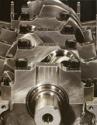
I like to keep the stroke at 4.125" for a street build. There's a definite trade off in power vs. longevity with longer strokes in a stock deck height block. The distance between the rods and some cam lobes gets tight at 4.25" stroke with some rod brands and stock rod journal diameters. Best to use a 2" or smaller journal to make room. Otherwise you have to run a smaller base circle cam which is less than desireable. Also as the stroke gets longer the piston skirt has to get shorter to clear the crank counterweights. Shorter skirts equal less skirt area which is good for a race engine but not what you want for respectable engine life in a street engine.


The 5.3 Gen IV aluminum truck block is the best block to sleeve for high power applications. This casting has no breather holes in the main bearing bulkheads. Yes, you will lose some power at high rpm due to lack of breather holes without a good dry sump. However the breather hole blocks crack between the breather holes and cam bearings. This happens in high horsepower endurance racing like the off road desert race trucks I sleeve blocks for. The only factory block that holds up is the 5.3.
I have one of your sleeved 5.3L blocks. Just a clarification on the above statement. You offer the option of boring a hole through the main bearing bulkheads, correct? Is that different than the bolded comment above? When you add that hole, it would regain any loss as you describe, correct?
Thanx!

 sleeved LS3 vs. stock LS7 block
 I currently charge $2100 to dry sleeve a Gen IV or Gen V block. That includes the Darton sleeves, stress relief, decking, boring within honing range and rod notches. If you already have an LS3 then it is cheaper to sleeve it. However anyway you look at it a Darton sleeved LS3 will have far stronger cylinder walls than the factory LS7 block and the block itself is stronger. It will also go out to 4.185" bore NA and 4.155" with boost or nitrous.
LSx block will weigh 140 lbs. more than a sleeved aluminum block or more than twice as much. A sleeved aluminum block will handle enough power to satisfy most folks. Every so often someone wants a 2000 hp build. Then the LSx or similar Dart LS Next iron would be a better choice as would the aluminum Dart LS Next if pockets are sufficiently deep. I'm a Dart WD for those interested in these blocks.
Steve
LSx block will weigh 140 lbs. more than a sleeved aluminum block or more than twice as much. A sleeved aluminum block will handle enough power to satisfy most folks. Every so often someone wants a 2000 hp build. Then the LSx or similar Dart LS Next iron would be a better choice as would the aluminum Dart LS Next if pockets are sufficiently deep. I'm a Dart WD for those interested in these blocks.
Steve
__________________
Steve Demirjian
Race Engine Development
Oceanside, Ca.
760-630-0450
web: www.raceenginedevelopment.com/
e-mail: race-engine-development@***.net
Steve Demirjian
Race Engine Development
Oceanside, Ca.
760-630-0450
web: www.raceenginedevelopment.com/
e-mail: race-engine-development@***.net

I currently charge $2100 to dry sleeve a Gen IV or Gen V block. That includes the Darton sleeves, stress relief, decking, boring within honing range and rod notches. If you already have an LS3 then it is cheaper to sleeve it. However anyway you look at it a Darton sleeved LS3 will have far stronger cylinder walls than the factory LS7 block and the block itself is stronger. It will also go out to 4.185" bore NA and 4.155" with boost or nitrous.
LSx block will weigh 140 lbs. more than a sleeved aluminum block or more than twice as much. A sleeved aluminum block will handle enough power to satisfy most folks. Every so often someone wants a 2000 hp build. Then the LSx or similar Dart LS Next iron would be a better choice as would the aluminum Dart LS Next if pockets are sufficiently deep. I'm a Dart WD for those interested in these blocks.
Steve
LSx block will weigh 140 lbs. more than a sleeved aluminum block or more than twice as much. A sleeved aluminum block will handle enough power to satisfy most folks. Every so often someone wants a 2000 hp build. Then the LSx or similar Dart LS Next iron would be a better choice as would the aluminum Dart LS Next if pockets are sufficiently deep. I'm a Dart WD for those interested in these blocks.
Steve
LSX block, PN 19260093
Compression ratio 9.0:1
4.125 bore
Diamond -23cc Dish (#112-11595R1)
Mahle 4.127" -4cc Flat-Top
Oliver Billet 6.125", ARP 2000 Bolts
Callies Dragonslayer, Wet Sump 4.000-inch stroke
PRC 6-Bolt 285cc LS7 with Titanium Intake, Stainless Exhaust Valves
Twin turbo and all the supporting mods

