


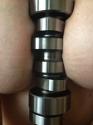


Camshaft Specs

TECH Veteran


Joined: Sep 2014
Posts: 4,893
Likes: 703
From: Mississippi

No that doesn't make a difference.
When they are ported it pumps up both flow numbers and doesn't really change the intake to exhaust flow ratio difference.
You would only do a different cam spec if you were focused more on top end as that where the CNC gains are to take advantage of
When they are ported it pumps up both flow numbers and doesn't really change the intake to exhaust flow ratio difference.
You would only do a different cam spec if you were focused more on top end as that where the CNC gains are to take advantage of
So if we're only going to have a 3500 stall in this thing shouldn't we be trying to build the nastiest fattest chunkiest torque curve from 3500-5000? Shift the thing at 6500 and call it a day. That long grind from 3500 rpm up to 5500-7000 where it'll really be building power is going to be a painful wait with these long duration cams.
LS3 ports can make great torque - you're not at a disadvantage because of having rectangle heads, but you're over camming it for what I think you really want based on all your other posts.
Look at Torquer 110 dyno sheets for the ls7 for example. Shorter duration cams are going to have WAY better throttle response and part throttle power as well.
LS3 ports can make great torque - you're not at a disadvantage because of having rectangle heads, but you're over camming it for what I think you really want based on all your other posts.
Look at Torquer 110 dyno sheets for the ls7 for example. Shorter duration cams are going to have WAY better throttle response and part throttle power as well.

Thread Starter
TECH Addict
Joined: Sep 2010
Posts: 2,898
Likes: 467
I disagree. Example~ im running a 229/244 BTR LS3 cam with stock LS3 821 casting heads. Its no way in hell i would run that cam with a set of TFS 255 LS3 heads... the TFS 255s dont need that much of a split to get good results. Ask NavyBLUE and see what he says.... i bet it will be similar to what i just told you.
I bet it would run good with good low end.
And that the point.
I never said to use a very wide split on TFS ls3 heads.
The intake to exhaust flow ratio would be more balanced.
You need 1.5 degrees of duration favouring the exhaust for every percentage point of difference from the intake and exhaust flow ratio.
TFS heads would require about an 8-10 degree split.
High end cathedrals, even less.
The advantage of a wide split is power past peak.
Even Brian Tooley says the LS3 head, likes wide 15 degree splits. They make more power and torque from 3500 rpm+ compared to cams with less exhaust duration.
This is for the LS3 head, NOT the TFS LS3 head.

TECH Senior Member

Joined: Jun 2016
Posts: 22,298
Likes: 3,619
From: Central Cal.
So Bortous, a stock LS3 cam is 204/211.
Theoretically speaking would one see significant improvements with a 204/219 cam in its place? That would give it a 15 degree split, which is most advantageous as said above.
Obviously for big gains one would use much more duration and lift on both sides.
BTW the late LS6 cam was very close to the above cam.
Theoretically speaking would one see significant improvements with a 204/219 cam in its place? That would give it a 15 degree split, which is most advantageous as said above.
Obviously for big gains one would use much more duration and lift on both sides.
BTW the late LS6 cam was very close to the above cam.
Thread Starter
TECH Addict
Joined: Sep 2010
Posts: 2,898
Likes: 467
So if we're only going to have a 3500 stall in this thing shouldn't we be trying to build the nastiest fattest chunkiest torque curve from 3500-5000? Shift the thing at 6500 and call it a day. That long grind from 3500 rpm up to 5500-7000 where it'll really be building power is going to be a painful wait with these long duration cams.
LS3 ports can make great torque - you're not at a disadvantage because of having rectangle heads, but you're over camming it for what I think you really want based on all your other posts.
Look at Torquer 110 dyno sheets for the ls7 for example. Shorter duration cams are going to have WAY better throttle response and part throttle power as well.
LS3 ports can make great torque - you're not at a disadvantage because of having rectangle heads, but you're over camming it for what I think you really want based on all your other posts.
Look at Torquer 110 dyno sheets for the ls7 for example. Shorter duration cams are going to have WAY better throttle response and part throttle power as well.
It should feel strong all over plus having .660 lift will also help torque.
The 110 torquer cam is not that good.
The IVC is way too early and the EVO is far too late.
This is only a low- mid range camshaft in an ls7.
I saw some dyno sheets and the camshaft torque curve falls off a cliff after 4500rpm. No thanks
LS1 Tech Stories
The Best V8 Stories One Small Block at Time

Gas Monkey Built a 6-Wheel Ferrari Testarossa With a Corvette LT4 Engine
Verdad Gallardo
7 Most Reliable High-Performance Engines GM Has Ever Built
Verdad Gallardo
Amazing '71 Camaro Restomod Is Modern Muscle Car Under the Skin
Verdad Gallardo
6 Common C5 Corvette Failures and What's Involved In Repairing Them
Pouria Savadkouei
Retro Modern Bandit Pontiac Trans AM Comes With Burt Reynolds' Autograph
Verdad Gallardo
Top 10 Greatest Cadillac V Series Performance Models Ever, Ranked
Pouria Savadkouei
Top 10 Most Powerful Chevy Trucks Ever Made!

Hennessey's New Supercharged Silverado ZR2 Has 700 HP
Verdad Gallardo
Coachbuilt N2A Anteros Is an LS2-Powered C6 Corvette In Italian Clothes
Verdad Gallardo Thread Starter
TECH Addict
Joined: Sep 2010
Posts: 2,898
Likes: 467
So Bortous, a stock LS3 cam is 204/211.
Theoretically speaking would one see significant improvements with a 204/219 cam in its place? That would give it a 15 degree split, which is most advantageous as said above.
Obviously for big gains one would use much more duration and lift on both sides.
BTW the late LS6 cam was very close to the above cam.
Theoretically speaking would one see significant improvements with a 204/219 cam in its place? That would give it a 15 degree split, which is most advantageous as said above.
Obviously for big gains one would use much more duration and lift on both sides.
BTW the late LS6 cam was very close to the above cam.
Will probably make a little more power too.
The LS6 cam would have better performance than the ls3 cam.
You need at least a 223 intake duration to make decent power in an LS3.
TECH Senior Member
Joined: Jun 2016
Posts: 22,298
Likes: 3,619
From: Central Cal.
If you put a stock LS3 camshaft with 219 exhaust duration and keep all other specs the same, you will lose some low end but it will carry a bit further up top.
Will probably make a little more power too.
The LS6 cam would have better performance than the ls3 cam.
You need at least a 223 intake duration to make decent power in an LS3.
Will probably make a little more power too.
The LS6 cam would have better performance than the ls3 cam.
You need at least a 223 intake duration to make decent power in an LS3.
Thread Starter
TECH Addict
Joined: Sep 2010
Posts: 2,898
Likes: 467
Originally Posted by G Atsma
So Bortous, a stock LS3 cam is 204/211.
Theoretically speaking would one see significant improvements with a 204/219 cam in its place? That would give it a 15 degree split, which is most advantageous as said above.
Obviously for big gains one would use much more duration and lift on both sides.
BTW the late LS6 cam was very close to the above cam.
Theoretically speaking would one see significant improvements with a 204/219 cam in its place? That would give it a 15 degree split, which is most advantageous as said above.
Obviously for big gains one would use much more duration and lift on both sides.
BTW the late LS6 cam was very close to the above cam.


TECH Senior Member
Joined: Jun 2016
Posts: 22,298
Likes: 3,619
From: Central Cal.
Quite so! However, I doubt there would be that big an issue with the late LS6 cam mentioned above, being it only has 204 intake duration. The 218 exhaust duration would have allowed the power to carry past peak, as has been mentioned here a few times.
Thread Starter
TECH Addict
Joined: Sep 2010
Posts: 2,898
Likes: 467
Big cams do cost for sure.
There are sacrifices no matter what you do.
Unless you have a big *** motor.
So Jake, do you agree with with what Darth said about those two cam spec I listed as the original question?
There are sacrifices no matter what you do.
Unless you have a big *** motor.
So Jake, do you agree with with what Darth said about those two cam spec I listed as the original question?
TECH Senior Member
Joined: Jun 2016
Posts: 22,298
Likes: 3,619
From: Central Cal.
Thread Starter
TECH Addict
Joined: Sep 2010
Posts: 2,898
Likes: 467
From the valve train to the camshaft,
Everything suits.
The 12:3.1 compression requirement for the larger camshaft really made my day as I'm over at 12:8.1
I should not have any sluggishness anywhere in the power band.