When you click on links to various merchants on this site and make a purchase, this can result in this site earning a commission. Affiliate programs and affiliations include, but are not limited to, the eBay Partner Network.
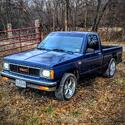
I recently swapped an LM7 engine and 4L60E transmission into my 1988 Chevy S10, which was my first vehicle and my first major project. This truck is my daily driver.
As for the engine, the modifications currently include Speed Engineering swap shorty headers, a Summit 8712R1 cam, LS6 springs, and a non-factory intake with a stock MAF. The motor is otherwise stock. Initially, I had the PCM sent out to have the VATS cleared, and later, I purchased an OBDXPro VX to adjust shift points and pressures. Then when I installed the cam I added a wideband, Although the cam is fairly mild and tuning is not strictly necessary.
The issue I’m experiencing started after installing the cam (though it could have been present earlier and I just didn't notice). I have noticed an audible knock at low RPM, typically between 1800 and 2500 RPM under heavy load when the engine is warm. Based on my limited experience with knock, it sounds fairly pronounced. I attempted to resolve it by pulling 5 or 6 degrees of timing in the affected areas and added fresh 89-octane fuel, thinking it might be an issue with bad gas. I thought that helped but now I am noticing it again, at higher rpm and throttle then before.
I’m unsure whether the tuner I sent my PCM to increased the timing, as it doesn’t appear to be overly aggressive. Is this something that can happen with a cam even a small one, or is it something else? I’ll attach the timing tables.
Any advice or insight would be greatly appreciated.
For a V8 engine Cylinder airmass (in grams) = 15 * Dynamic Airflow / RPM. So starting with your 61.69 MAF value, that comes to 0.52 g/cylinder.
With those values, your Base High Octane spark advance table reads 16.5 degrees. Your graph values show 16 degrees, but that is after a significant amount of Spark Retard. And your graph shows a HUGE drop in spark advance. There is no scale on your graph table, so hard to be sure what the high values are, also no graph for RPM.
There are other tables which modify the final spark advance; most reduce it.
I don't think this is a factor, but looking at some stock Spark Advance tables, I never see max values over 40 degrees; therefore e.g. 56 degrees gives me pause. (I welcome a correction to this or any other of my opinions.)
If you could show us a graph with additional RPM and some load value (.e.g. MAF or G/cylinder) and a scale for these values, we might be able to help you more.
For a V8 engine Cylinder airmass (in grams) = 15 * Dynamic Airflow / RPM. So starting with your 61.69 MAF value, that comes to 0.52 g/cylinder.
With those values, your Base High Octane spark advance table reads 16.5 degrees. Your graph values show 16 degrees, but that is after a significant amount of Spark Retard. And your graph shows a HUGE drop in spark advance. There is no scale on your graph table, so hard to be sure what the high values are, also no graph for RPM.
There are other tables which modify the final spark advance; most reduce it.
I don't think this is a factor, but looking at some stock Spark Advance tables, I never see max values over 40 degrees; therefore e.g. 56 degrees gives me pause. (I welcome a correction to this or any other of my opinions.)
If you could show us a graph with additional RPM and some load value (.e.g. MAF or G/cylinder) and a scale for these values, we might be able to help you more.
Ok before I saw your reply I decided to try ruduceing the timing table a bit more to see if it would help. It did but not very much. It looks like this now.
I'll attach the datalog that i took yesterday. My logger won't log cylinder airmass but I have been calculating it using the same formula you posted and the worst knock usually happens around .52 to .64 and between 1600 and 3500 rpm. Thanks for any help.
Edit to add
This is a timing table I got off a file for a supposedly stock LM7 off of Gearhead Efi I can't guarantee it is stock but anyway it is way lower then mine at full throttle but around the problem area it is about the same. Doesn't clarify anything for me.
Last edited by RustNSmoke; Jan 18, 2025 at 10:41 AM.
Gas Monkey Built a 6-Wheel Ferrari Testarossa With a Corvette LT4 Engine
Slideshow: The controversial Ferrari F6 swaps its original flat-12 for a Corvette Z06-derived LT4 V8 and sends power to four rear wheels through a custom-built drivetrain.
7 Most Reliable High-Performance Engines GM Has Ever Built
Slideshow:These GM engines didn't just make huge power, they survived abuse, boost, track days, and six-digit mileage with a reputation for refusing to quit.
6 Common C5 Corvette Failures and What's Involved In Repairing Them
Slideshow: From wobbling harmonic balancers to failed EBCMs, these are the issues that define long-term C5 ownership and what repairs typically involve.
Retro Modern Bandit Pontiac Trans AM Comes With Burt Reynolds' Autograph
Slideshow: A modern Camaro transformed into a retro icon, this limited-run "Bandit" build blends nostalgia with brute force in a way few revivals manage.
Top 10 Greatest Cadillac V Series Performance Models Ever, Ranked
Slideshow: Cadillac didn't just crash the high-performance luxury vehicle party, it showed up loud, supercharged, and occasionally a little unhinged...


 Excessive Knock