


Removing Dynamat


 Removing Dynamat
 I didn't see any write-ups on here about removing Dynamat, so I figured I'd make one. I'd say most people in the Stereo section are more interested in putting Dynamat in their cars, but you might need to remove it at some point. I did this for a little weight reduction to offset the addition of my 6LE splitter. The Dynamat was already in the car when I bought it, in the trunk.
I started by peeling off as much of the Dynamat as I could by hand. This was a huge pain in the ***. The adhesive part of the Dynamat will usually stay stuck on, while the "foil" part will tear off:
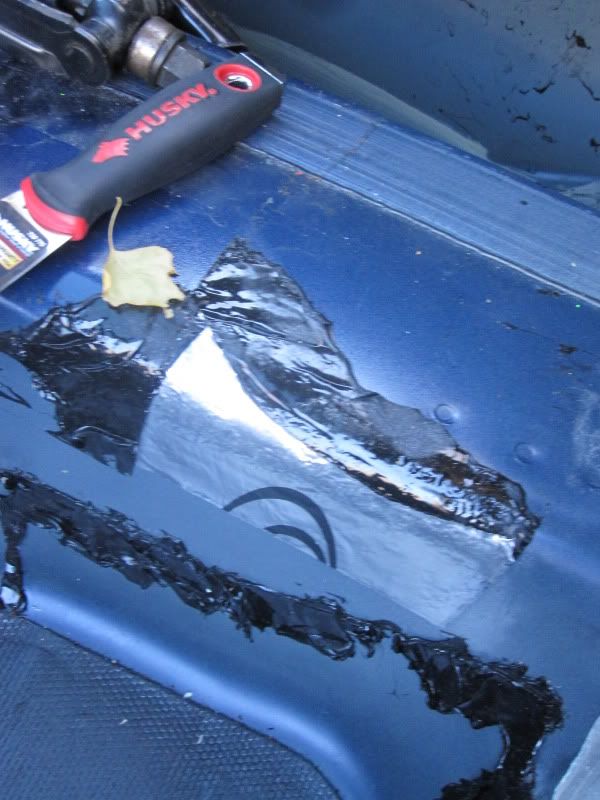
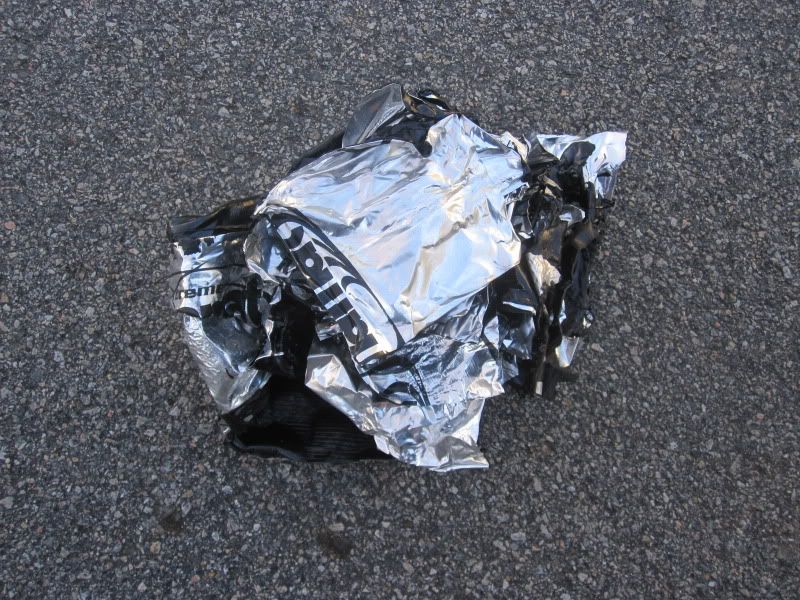
The edges on the "foil" are razor-sharp - I have the cuts on my fingers to prove it. Once I got all of the foil off, it was time to deal with the rubbery adhesive. It sticks really well to itself, so the best way to get it off is to get a little ball of it and use that to remove the rest:

I used a hair dryer to heat up the remaining adhesive. It comes off a little easier when it's warm. You can use a heat gun too, but I've heard that the adhesive is flammable, so the lower heat of a hair dryer might be a better idea. Once the adhesive is warmed up, stick the ball to the adhesive and pull it off. This is time-consuming, but it works better than scraping the adhesive off with a putty knife. Try to keep the adhesive ball cool - it won't stick to your skin as easily. Once I got everything out:
...I was left with a nice clean trunk:
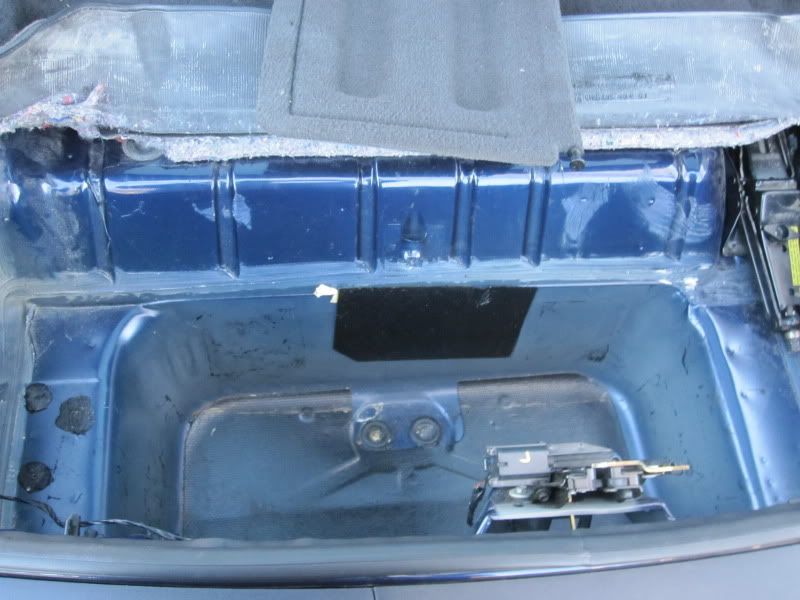
Altogether, the Dynamat weighed about 5 lbs. Every little bit counts, right? There's not really any difference in interior sound, so it's a win-win situation.
I started by peeling off as much of the Dynamat as I could by hand. This was a huge pain in the ***. The adhesive part of the Dynamat will usually stay stuck on, while the "foil" part will tear off:
The edges on the "foil" are razor-sharp - I have the cuts on my fingers to prove it. Once I got all of the foil off, it was time to deal with the rubbery adhesive. It sticks really well to itself, so the best way to get it off is to get a little ball of it and use that to remove the rest:
I used a hair dryer to heat up the remaining adhesive. It comes off a little easier when it's warm. You can use a heat gun too, but I've heard that the adhesive is flammable, so the lower heat of a hair dryer might be a better idea. Once the adhesive is warmed up, stick the ball to the adhesive and pull it off. This is time-consuming, but it works better than scraping the adhesive off with a putty knife. Try to keep the adhesive ball cool - it won't stick to your skin as easily. Once I got everything out:
...I was left with a nice clean trunk:
Altogether, the Dynamat weighed about 5 lbs. Every little bit counts, right? There's not really any difference in interior sound, so it's a win-win situation.

haha, for 5lbs that is too much trouble...it would probably be easier for you to go on a diet for 2 weeks.
i put dynomat in my car though when i installed my stereo system. while it helped eliminate some rattling created by the subwoofers, it did little for road noise reduction. i think later i tried to remove some of it and it was such a PITA that i gave up.
i put dynomat in my car though when i installed my stereo system. while it helped eliminate some rattling created by the subwoofers, it did little for road noise reduction. i think later i tried to remove some of it and it was such a PITA that i gave up.

yeah, that's WAY too much trouble to go through, especially for just 5 lbs.
besides, the only reason i would ever even consider removing any kind of sound deadening material from my car (aside from the stuff that comes stock, the felt padding) would be to be able to get down to bare metal so something could be welded in, such as a roll cage....and even then, i would only remove a small bit of it where the welding needed to be done, and nowhere else.
the sound deadening i've done in my car is WELL worth the few extra lbs. (we're only talking about 50 - 60 lbs here, anyway) that it adds to the car, especially for a daily driver.
and FYI, the "sheet" style sound deadening is NOT meant to stop road noise...if you go into it expecting otherwise, you'll be sorely disappointed, the way tuffluck was.
there are mainly 2 types of sound deadening:
1) sound absorbers
2) sound barriers
the "sheet" style sound deadening (or even the spray-on or brush-on liquid stuff) is a sound absorber, which is meant to stop metal panels from rattling and sounding "tinny" when vibrations are transferred to them, such as hitting the seams on bridges/concrete roads or potholes, etc. in this, it does its job very well.....i haven't even completely coated the entire interior of my car yet, and i can tell a HUGE difference in these types of sounds.
sound barriers are thick, dense "pads" that go in between the "sheet" style sound deadening & the interior carpet. this is the type of sound deadening you want if you want to reduce road noise. instead of absorbing vibrations, it simply blocks them out and reflects them away by their mass & physical properties.
true, both types of sound deadening do both types of sound control (absorbers block sound, and barriers absorb sound), but for the type of sound control it's not designed for, it does to a much lesser degree than the type it's meant for.
just something to keep in mind.....
besides, the only reason i would ever even consider removing any kind of sound deadening material from my car (aside from the stuff that comes stock, the felt padding) would be to be able to get down to bare metal so something could be welded in, such as a roll cage....and even then, i would only remove a small bit of it where the welding needed to be done, and nowhere else.
the sound deadening i've done in my car is WELL worth the few extra lbs. (we're only talking about 50 - 60 lbs here, anyway) that it adds to the car, especially for a daily driver.
and FYI, the "sheet" style sound deadening is NOT meant to stop road noise...if you go into it expecting otherwise, you'll be sorely disappointed, the way tuffluck was.
there are mainly 2 types of sound deadening:
1) sound absorbers
2) sound barriers
the "sheet" style sound deadening (or even the spray-on or brush-on liquid stuff) is a sound absorber, which is meant to stop metal panels from rattling and sounding "tinny" when vibrations are transferred to them, such as hitting the seams on bridges/concrete roads or potholes, etc. in this, it does its job very well.....i haven't even completely coated the entire interior of my car yet, and i can tell a HUGE difference in these types of sounds.
sound barriers are thick, dense "pads" that go in between the "sheet" style sound deadening & the interior carpet. this is the type of sound deadening you want if you want to reduce road noise. instead of absorbing vibrations, it simply blocks them out and reflects them away by their mass & physical properties.
true, both types of sound deadening do both types of sound control (absorbers block sound, and barriers absorb sound), but for the type of sound control it's not designed for, it does to a much lesser degree than the type it's meant for.
just something to keep in mind.....










