






Stroke Only = HP?

Horsepower is a calculation derived from torque, which is in it's basic definiton is a measurement of cylinder pressure. Increase cylinder pressure over time and you increase horsepower.
the longer stroke gives more momentum to the rotating assembly.
how does this extra momentum effect acceleration of the piston what does that do to HP?
a longer stroke also gives more leverage to turn the crankshaft. how do you think this will effect the engines output characteristics.
how does this extra momentum effect acceleration of the piston what does that do to HP?
a longer stroke also gives more leverage to turn the crankshaft. how do you think this will effect the engines output characteristics.
Last edited by disc0monkey; Jan 24, 2011 at 11:05 AM.

Staging Lane
Joined: Mar 2009
Posts: 68
Likes: 0
From: Shelbyville, IN
More stroke = more displacement.
More displacement = more fuel and air.
More fuel and air = more power.
If you only change an engine to increase its stroke, it will make MORE power at ALL RPM. Period.
More displacement = more fuel and air.
More fuel and air = more power.
If you only change an engine to increase its stroke, it will make MORE power at ALL RPM. Period.

TECH Senior Member


Joined: Apr 2002
Posts: 6,080
Likes: 17
From: So.Cal.
It is believed that the leverage effect is offset by the higher friction caused by increased piston speed (they cancel each other out).
So let me get this straight would you guys thinking stroke won't increase power on it's own agree that a 4.8l ls will make as much power as a 5.3l with the same top end parts and cam? Only difference between them will be stroke right
There's a older thread where this was already discussed and elaborated more clearly, with some dyno results as an example.
Well I agree with you that power will increase. I really wasn't asking the question rather pointing out another example for others to look at. There was a post from a guy in the dyno section that just switched to a 383 from his stock ls6 and it did make a huge improvement in torque and still squeeked out a little more peak power at a lower rpm. This is with all the same stock ls6 induction parts. Granted it probably picked up a little SCR from the stroke.
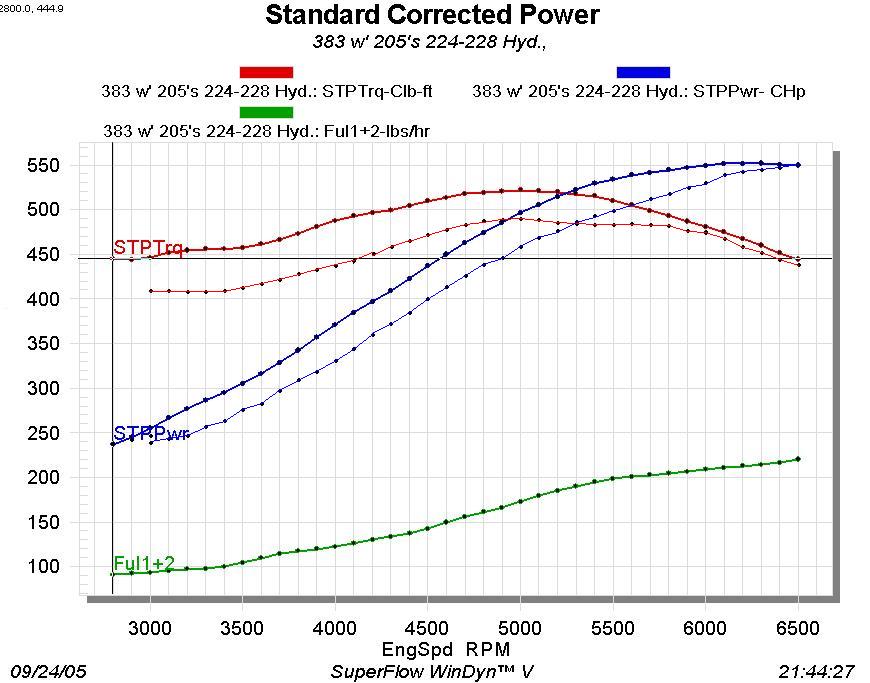
My experience, same cam, similar compression, 346 to 383 was about a 35-40 horse jump in torque and horsepower across the entire powerband to about 5200 RPM. From 5200 RPM to 6200 RPM, the 346's horsepower began catch the 383's and they met at my rev limit of 6200.
That experience has been repeated over and over again.
Here is a very good example from an extremely old thread that will be hard to find from AFR. They posted it 4 or 5 years ago. I am glad I downloaded the pictures.
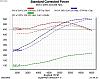
Same cam, same heads, 346 vs. 383 -??cc pistons, but similar compression ratio-
Edit:
Notice that the statement made earlier in the thread that the powerband is effectively moved down is indeed precisely accurate. At any given time, "draw" a horizontal line and notice that the power made is between 300 and 400 RPM lower with the 4" stroke. It makes it a helluva lot of fun to drive, that is for sure!
That experience has been repeated over and over again.
Here is a very good example from an extremely old thread that will be hard to find from AFR. They posted it 4 or 5 years ago. I am glad I downloaded the pictures.
Same cam, same heads, 346 vs. 383 -??cc pistons, but similar compression ratio-
Edit:
Notice that the statement made earlier in the thread that the powerband is effectively moved down is indeed precisely accurate. At any given time, "draw" a horizontal line and notice that the power made is between 300 and 400 RPM lower with the 4" stroke. It makes it a helluva lot of fun to drive, that is for sure!
Last edited by transsam; Feb 12, 2011 at 08:25 PM.
LS1 Tech Stories
The Best V8 Stories One Small Block at Time

Topdon ONE vs. Artidiag 800 BT2: Which is the Diagnostic Tablet For You?
Pouria Savadkouei
Gas Monkey Built a 6-Wheel Ferrari Testarossa With a Corvette LT4 Engine
Verdad Gallardo
7 Most Reliable High-Performance Engines GM Has Ever Built
Verdad Gallardo
Amazing '71 Camaro Restomod Is Modern Muscle Car Under the Skin
Verdad Gallardo
6 Common C5 Corvette Failures and What's Involved In Repairing Them
Pouria Savadkouei
Retro Modern Bandit Pontiac Trans AM Comes With Burt Reynolds' Autograph
Verdad Gallardo
Top 10 Greatest Cadillac V Series Performance Models Ever, Ranked
Pouria Savadkouei
Top 10 Most Powerful Chevy Trucks Ever Made!

Hennessey's New Supercharged Silverado ZR2 Has 700 HP
Verdad Gallardo My experience, same cam, similar compression, 346 to 383 was about a 35-40 horse jump in torque and horsepower across the entire powerband to about 5200 RPM. From 5200 RPM to 6200 RPM, the 346's horsepower began catch the 383's and they met at my rev limit of 6200.
That experience has been repeated over and over again.
Here is a very good example from an extremely old thread that will be hard to find from AFR. They posted it 4 or 5 years ago. I am glad I downloaded the pictures.
Same cam, same heads, 346 vs. 383 -??cc pistons, but similar compression ratio-
Attachment 279055
Edit:
Notice that the statement made earlier in the thread that the powerband is effectively moved down is indeed precisely accurate. At any given time, "draw" a horizontal line and notice that the power made is between 300 and 400 RPM lower with the 4" stroke. It makes it a helluva lot of fun to drive, that is for sure!
That experience has been repeated over and over again.
Here is a very good example from an extremely old thread that will be hard to find from AFR. They posted it 4 or 5 years ago. I am glad I downloaded the pictures.
Same cam, same heads, 346 vs. 383 -??cc pistons, but similar compression ratio-
Attachment 279055
Edit:
Notice that the statement made earlier in the thread that the powerband is effectively moved down is indeed precisely accurate. At any given time, "draw" a horizontal line and notice that the power made is between 300 and 400 RPM lower with the 4" stroke. It makes it a helluva lot of fun to drive, that is for sure!
...the motor that was previously in my car (the stock short AFR 224/228 combination you guys have read tons of info on) on the very same dyno I recently completed testing the 383 on, put down 550 HP / 482 Ft/lbs.
FIRST ROUND OF TESTING
Essentially the exact same combination as the 346 in my car and whose flywheel dyno results I shared with you above (550 HP/ 482 TQ), the ONLY difference being the larger 383 displacement shortblock.
Final Results 552 HP / 522 TQ
Summary:
The results were inline with what I expected...I was questioning whether the larger engine with the same induction/small cam might make less peak power and was glad to see it came in exactly the same. Big increase in TQ was a no-brainer.
FIRST ROUND OF TESTING
Essentially the exact same combination as the 346 in my car and whose flywheel dyno results I shared with you above (550 HP/ 482 TQ), the ONLY difference being the larger 383 displacement shortblock.
Final Results 552 HP / 522 TQ
Summary:
The results were inline with what I expected...I was questioning whether the larger engine with the same induction/small cam might make less peak power and was glad to see it came in exactly the same. Big increase in TQ was a no-brainer.
I do think hidden somewhere in one of the post about the build Tony said the 383 was about 0.4 less SCR also though. Not that it would make a world of difference, but using the same cam the DCR will drop also.
 I was actually trying to validate exactly what you were saying in your last post.

Post 29 sums it up perfectly....Just wanted to throw one more variable in.
When stroke is increased and rod length stays the same, the rod to stroke
ratio worsens. Rod length affects piston dwell time (milliseconds) @ or near
TDC and BDC. Compression ratio limited stock car engines (usually 355 sbc)
make use of the longest rods possible not only to lighten the piston to as few
as 300 grams but to dwell (or stall) the piston @ TDC longer to build more
heat during maximum compression and ignition. Heat (literally in British Thermal
Units) is the transformation of potential energy (fuel source) to kinetic motion
So by increasing stroke, decreasing rod/stroke ratio, and accelerating piston speed @ TDC....the piston's increased change in direction while harder on the
wristpin actually pulls on the combustion chamber/intake port harder. Intake
manifold vacuum and port speed are dramatically increased.....both helping
throttle response and low rpm torque.......just say'n
When stroke is increased and rod length stays the same, the rod to stroke
ratio worsens. Rod length affects piston dwell time (milliseconds) @ or near
TDC and BDC. Compression ratio limited stock car engines (usually 355 sbc)
make use of the longest rods possible not only to lighten the piston to as few
as 300 grams but to dwell (or stall) the piston @ TDC longer to build more
heat during maximum compression and ignition. Heat (literally in British Thermal
Units) is the transformation of potential energy (fuel source) to kinetic motion
So by increasing stroke, decreasing rod/stroke ratio, and accelerating piston speed @ TDC....the piston's increased change in direction while harder on the
wristpin actually pulls on the combustion chamber/intake port harder. Intake
manifold vacuum and port speed are dramatically increased.....both helping
throttle response and low rpm torque.......just say'n

^^ yep. Super Chevy did a test (on an SBC albeit, but same concept). They had a normal 355 H/C package, dynoed that. Then took the same parts and put those on a 383 bottom end with the same compression ratio. I believe torque output passed the 355 at around 3K and the power curve did too not long after that
I'm pretty sure that was the point of the test; to see how an engine reacts to more displacement. Adding a second variable (like CR) to a test onlyskew the results and makes the test invalid.
