



Internal engine stresses

Restricted User
Joined: Mar 2014
Posts: 7,192
Likes: 109
From: Ohio

With a centri, boost will increase with RPM. You will not have random boost spikes. No boost controllers, no dumping 1300+ in a stand-alone to do boost by time/gear/speed/RPM.
Pulley size will determine boost and the boost increase will be perfectly linear with RPM. Going with multi-stage controllers, C02 powered solenoids, etc, to make a turbo behave like a centri blower is exactly what I mean by complicating it.
Pulley size will determine boost and the boost increase will be perfectly linear with RPM. Going with multi-stage controllers, C02 powered solenoids, etc, to make a turbo behave like a centri blower is exactly what I mean by complicating it.

Thread Starter
Teching In
Joined: Jun 2016
Posts: 18
Likes: 0
With a centri, boost will increase with RPM. You will not have random boost spikes. No boost controllers, no dumping 1300+ in a stand-alone to do boost by time/gear/speed/RPM.
Pulley size will determine boost and the boost increase will be perfectly linear with RPM. Going with multi-stage controllers, C02 powered solenoids, etc, to make a turbo behave like a centri blower is exactly what I mean by complicating it.
Pulley size will determine boost and the boost increase will be perfectly linear with RPM. Going with multi-stage controllers, C02 powered solenoids, etc, to make a turbo behave like a centri blower is exactly what I mean by complicating it.
Restricted User
Joined: Mar 2014
Posts: 7,192
Likes: 109
From: Ohio
The fastest 275 tire cars in the world all run Centri blowers, so your point is invalid.
I don't see the reason wanting to go through the trouble of forcing a turbo to act like a Centri blower. How is it more effective? Because by its very nature it does EXACTLY what you're trying to force a turbo to do.
I don't see the reason wanting to go through the trouble of forcing a turbo to act like a Centri blower. How is it more effective? Because by its very nature it does EXACTLY what you're trying to force a turbo to do.
Thread Starter
Teching In
Joined: Jun 2016
Posts: 18
Likes: 0
The fastest 275 tire cars in the world all run Centri blowers, so your point is invalid.
I don't see the reason wanting to go through the trouble of forcing a turbo to act like a Centri blower. How is it more effective? Because by its very nature it does EXACTLY what you're trying to force a turbo to do.
I don't see the reason wanting to go through the trouble of forcing a turbo to act like a Centri blower. How is it more effective? Because by its very nature it does EXACTLY what you're trying to force a turbo to do.
Thread Starter
Teching In
Joined: Jun 2016
Posts: 18
Likes: 0
[QUOTE=Wesleydaisy97;19310283]
Put them cars on the street im talking about durty streets at the track i thank your right
The fastes small tire street car i know of existing is powerd by a lq4 408 with twins and ams1000
Put them cars on the street im talking about durty streets at the track i thank your right
The fastes small tire street car i know of existing is powerd by a lq4 408 with twins and ams1000
Restricted User
Joined: Mar 2014
Posts: 7,192
Likes: 109
From: Ohio
They're local to me, and they're not NEARLY the fastest small tire car in their class. There are at least 2 or 3 other guys that live here in town that are faster than them.
Thread Starter
Teching In
Joined: Jun 2016
Posts: 18
Likes: 0
Im talking about a local racing shop near me and there 1100whp tt 408 thay are actually not very fast at the track for what they are but street racing they are on point with traction i haven't seen them loose raced a 1000whp bbc big tire camaro recently won bye a car but thats not the point i just chank on the street wouldn't a supercharger be out of its place compared to the track conditions
Restricted User
Joined: Mar 2014
Posts: 7,192
Likes: 109
From: Ohio
Lol. I'm talking more in the 1800 HP small tire range.
1100whp isn't exactly king of the street anymore.
And youre still not getting the point. How is a supercharger that makes boost by RPM out of its place when compared to a turbo that has had to go through LOTS of extra BS to become boost by RPM? If anything, you're making the turbo out of its place.
And it's all irrelevant anyway. I run 20 PSI in first gear on a stock 5.3 and haven't broken anything. So have lots of others.
You being here and simply spewing out your crap is complicating the situation lol.
1100whp isn't exactly king of the street anymore.
And youre still not getting the point. How is a supercharger that makes boost by RPM out of its place when compared to a turbo that has had to go through LOTS of extra BS to become boost by RPM? If anything, you're making the turbo out of its place.
And it's all irrelevant anyway. I run 20 PSI in first gear on a stock 5.3 and haven't broken anything. So have lots of others.
You being here and simply spewing out your crap is complicating the situation lol.
LS1 Tech Stories
The Best V8 Stories One Small Block at Time

6 Common C5 Corvette Failures and What's Involved In Repairing Them
Pouria Savadkouei
Retro Modern Bandit Pontiac Trans AM Comes With Burt Reynolds' Autograph
Verdad Gallardo
Top 10 Greatest Cadillac V Series Performance Models Ever, Ranked
Pouria Savadkouei
Top 10 Most Powerful Chevy Trucks Ever Made!

Hennessey's New Supercharged Silverado ZR2 Has 700 HP
Verdad Gallardo
Coachbuilt N2A Anteros Is an LS2-Powered C6 Corvette In Italian Clothes
Verdad Gallardo
Awesome K5 Blazer Restomod Comes With C7 Corvette Power
Verdad Gallardo
10 Camaros You Should Never Buy

10 LS Engine Myths That Refuse to Die
Verdad Gallardo Thread Starter
Teching In
Joined: Jun 2016
Posts: 18
Likes: 0
Lol. I'm talking more in the 1800 HP small tire range.
1100whp isn't exactly king of the street anymore.
And youre still not getting the point. How is a supercharger that makes boost by RPM out of its place when compared to a turbo that has had to go through LOTS of extra BS to become boost by RPM? If anything, you're making the turbo out of its place.
And it's all irrelevant anyway. I run 20 PSI in first gear on a stock 5.3 and haven't broken anything. So have lots of others.
You being here and simply spewing out your crap is complicating the situation lol.
1100whp isn't exactly king of the street anymore.
And youre still not getting the point. How is a supercharger that makes boost by RPM out of its place when compared to a turbo that has had to go through LOTS of extra BS to become boost by RPM? If anything, you're making the turbo out of its place.
And it's all irrelevant anyway. I run 20 PSI in first gear on a stock 5.3 and haven't broken anything. So have lots of others.
You being here and simply spewing out your crap is complicating the situation lol.
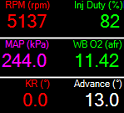
The only issue with 'instant' torque that a rod might have is the control system not responding fast enough to handle a quick increase in delivered air mass. Now while I wouldn't exactly recommend maxing out the connecting rods in terms of compressive strength, you can hit them with as much torque as they'll take within some safety margin. It's not going to matter if its at 2500rpm or 6000rpm. I believe there is a misconception that has been adopted where people have engine problems by bringing in boost too quickly at low rpm. Say you go from a big 80mm turbo down to a 66mm turbo which hits peak boost 1500rpm sooner and pop a head gasket or bend a rod. Instinctively, you might blame the additional boost. But truth be told, it's because those areas weren't calibrated for with the bigger turbo. Even if you ran it through steady state testing on a load bearing dyno, the bigger turbo wouldnt make boost as low down in rpm as the small turbo. Manage your cylinder pressure in the calibration so as to not exceed compressive strength of the connecting rods at all rpms, but optimize for max torque through the entire rpm range, and you'll have a powerful engine that will live.

Restricted User
Joined: Mar 2014
Posts: 7,192
Likes: 109
From: Ohio
Because nobody can wrap their heads around why on earth you would want to go through the significant hassle and associated risk/cost to make a turbo act like a centrifugal blower instead of just buying the blower. It makes absolutely zero sense. You might as well say you want to make your LS run on diesel instead of just buying a diesel.


the wastegate is a tuning tool. A boost controller is a reliable device for telling a wastegate how to behave. All factory turbo cars use wastegates and often include factory electronic controlled solenoids for proper engine behavior in a wide variety of reliable daily driver applications, this is not a "terrible thing to do" to a turbocharger, but rather a necessity when one is trying to achieve maximum performance out of one.
 Boost by Gear
 OK, your question WAS NOT ANSWERED WELL.
YOUR direction was, my answer to that is with my EMS, many "stand alone's", you have control over MAP.
My normal method is a "3-D" table with Air Temperature, RPM, Target Boost.
My boost controllers do the same.
I add "boost by gear" by the use of a Wheel Speed Sensor, a "guess" sure but it works well.
YOUR question : RPM first, then BMEP, then the Ignition Quality.
They DO all work together.
As we know Piston Speed is the first MAJOR concern @ 4000 feet/minute.
The Break Mean Effective Pressure is an average, NOT the peak pressure when Ignition Occurs.
When Detonation Occurs, the Cylinder Pressure is 10X that of normal BMEP.
THIS IS WHAT YOU WANT TO STOP.
We know many common fixes for that, there are TWO most often forgotton.
The FIRST is the accuracy of the Spark Instant with the standard use of my 60-2 (GM 58x) Crankshaft Position Encoding method.
The accuracy IS 1/4 degree @ 2500 RPM Acceleration Rate with a 60-2.
The accuracy IS 2 degrees when the GM 24xe is fitted with 24 tooth.
The next FORGOTON item is Ignition Energy, with the NORMAL comment of "My OEM GM coil works fine, I just 'close' the GAP.
A GOOD STRONG, LONG, Spark will allow for less Spark Advance.
The answer is the best ignition will do more for long engine life, the life of the internal engine components.
Those who use my LS-IGN-1A coil kit report this along with more power, better millage.
Lance
YOUR direction was, my answer to that is with my EMS, many "stand alone's", you have control over MAP.
My normal method is a "3-D" table with Air Temperature, RPM, Target Boost.
My boost controllers do the same.
I add "boost by gear" by the use of a Wheel Speed Sensor, a "guess" sure but it works well.
YOUR question : RPM first, then BMEP, then the Ignition Quality.
They DO all work together.
As we know Piston Speed is the first MAJOR concern @ 4000 feet/minute.
The Break Mean Effective Pressure is an average, NOT the peak pressure when Ignition Occurs.
When Detonation Occurs, the Cylinder Pressure is 10X that of normal BMEP.
THIS IS WHAT YOU WANT TO STOP.
We know many common fixes for that, there are TWO most often forgotton.
The FIRST is the accuracy of the Spark Instant with the standard use of my 60-2 (GM 58x) Crankshaft Position Encoding method.
The accuracy IS 1/4 degree @ 2500 RPM Acceleration Rate with a 60-2.
The accuracy IS 2 degrees when the GM 24xe is fitted with 24 tooth.
The next FORGOTON item is Ignition Energy, with the NORMAL comment of "My OEM GM coil works fine, I just 'close' the GAP.
A GOOD STRONG, LONG, Spark will allow for less Spark Advance.
The answer is the best ignition will do more for long engine life, the life of the internal engine components.
Those who use my LS-IGN-1A coil kit report this along with more power, better millage.
Lance