


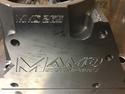






Crancase with Thickwall "proud" sleeves

Thread Starter
TECH Enthusiast
Joined: Aug 2021
Posts: 507
Likes: 190
 Mike Costin Sleeve Tech
 HI ALL, Mike Costin called me for help with the Ignition system AND Ignition Coils for his F1 engine
His Race Engine had a displacement of Two Liters, 120 CID and benched 1400 HP.
My question to him was about head gasket sealing.
He too was concerned with the Crankcase growth difference when an Iron Sleeve was installed in an AL cylinder.
The method he used was to "bake" both of these items and then measure the difference.
His Race Engine had a displacement of Two Liters, 120 CID and benched 1400 HP.
My question to him was about head gasket sealing.
He too was concerned with the Crankcase growth difference when an Iron Sleeve was installed in an AL cylinder.
The method he used was to "bake" both of these items and then measure the difference.
HI ALL, Mike Costin called me for help with the Ignition system AND Ignition Coils for his F1 engine
His Race Engine had a displacement of Two Liters, 120 CID and benched 1400 HP.
My question to him was about head gasket sealing.
He too was concerned with the Crankcase growth difference when an Iron Sleeve was installed in an AL cylinder.
The method he used was to "bake" both of these items and then measure the difference.
His Race Engine had a displacement of Two Liters, 120 CID and benched 1400 HP.
My question to him was about head gasket sealing.
He too was concerned with the Crankcase growth difference when an Iron Sleeve was installed in an AL cylinder.
The method he used was to "bake" both of these items and then measure the difference.
That's Probably a good question for Steve Demirjian at R.E.D. He probably has the most knowledge on this board about that topic considering his background.
@Steve - Race Eng perhaps you can shed some light on this subject?
From what I have seen, depending on the application usually .002 - .003 proud of the block. But certain applications, I have heard can go up to .005.
Here is an example from Steve Morris. He states he uses .003 proud of the block.
https://www.enginebuildermag.com/202...gh-horsepower/
@Steve - Race Eng perhaps you can shed some light on this subject?
From what I have seen, depending on the application usually .002 - .003 proud of the block. But certain applications, I have heard can go up to .005.
Here is an example from Steve Morris. He states he uses .003 proud of the block.
https://www.enginebuildermag.com/202...gh-horsepower/
Step decking Leaving the sleeves proud of the deck surface is called "step decking". This is done mostly on wet Darton MID liner blocks on imports. Typical height is .003" above the deck surface using an MLS gasket. Much more than this will lead to coolant leaks out the side of the block. Also keep in mind that the head will twist a bit which can lead to valve seats leaking until the engine comes up to temp.
On a dry sleeved block where the sleeve sits in the deck surface, not much more that one thou step with MLS else coolant leaks out the sides of the block. I don't recommend doing this on LS, Viper or Coyote blocks. O ring with copper wire works better in these, less chance of leaks or head distortion. I usually machine the grooves in the sleeves to leave the copper wire protruding nine to ten thou. The wire should sit on the flat areas of the head gasket if possible.
With higher boost levels consider using the Vulcan gaskets with stainless steel sealing rings on the dry sleeved blocks. No machine work is required. The blocks are decked flat as are the heads. These work very well if available for your application. SCE sells these.
If running a lot of boost, 90 or more pounds in a billet block fuel hoops with copper gaskets are the way to go. The stainless steel hoops are installed in machined grooves in the head. The hoops press the copper gasket into receiver grooves machined into the sleeves. This takes time to do right as the grooves must line up in the block and heads. Not an inexpensive proposition but neither is a billet block.
[QUOTE=1FastBrick;20559489]That's Probably a good question for Steve Demirjian at R.E.D. He probably has the most knowledge on this board about that topic considering his background.
@Steve - Race Eng perhaps you can shed some light on this subject?
On a dry sleeved block where the sleeve sits in the deck surface, not much more that one thou step with MLS else coolant leaks out the sides of the block. I don't recommend doing this on LS, Viper or Coyote blocks. O ring with copper wire works better in these, less chance of leaks or head distortion. I usually machine the grooves in the sleeves to leave the copper wire protruding nine to ten thou. The wire should sit on the flat areas of the head gasket if possible.
With higher boost levels consider using the Vulcan gaskets with stainless steel sealing rings on the dry sleeved blocks. No machine work is required. The blocks are decked flat as are the heads. These work very well if available for your application. SCE sells these.
If running a lot of boost, 90 or more pounds in a billet block fuel hoops with copper gaskets are the way to go. The stainless steel hoops are installed in machined grooves in the head. The hoops press the copper gasket into receiver grooves machined into the sleeves. This takes time to do right as the grooves must line up in the block and heads. Not an inexpensive proposition but neither is a billet block.
[QUOTE=1FastBrick;20559489]That's Probably a good question for Steve Demirjian at R.E.D. He probably has the most knowledge on this board about that topic considering his background.
@Steve - Race Eng perhaps you can shed some light on this subject?
__________________
Steve Demirjian
Race Engine Development
Oceanside, Ca.
760-630-0450
web: www.raceenginedevelopment.com/
e-mail: race-engine-development@***.net
Steve Demirjian
Race Engine Development
Oceanside, Ca.
760-630-0450
web: www.raceenginedevelopment.com/
e-mail: race-engine-development@***.net
Trending Topics
LS1 Tech Stories
The Best V8 Stories One Small Block at Time

6 Common C5 Corvette Failures and What's Involved In Repairing Them
Pouria Savadkouei
Retro Modern Bandit Pontiac Trans AM Comes With Burt Reynolds' Autograph
Verdad Gallardo
Top 10 Greatest Cadillac V Series Performance Models Ever, Ranked
Pouria Savadkouei
Top 10 Most Powerful Chevy Trucks Ever Made!

Hennessey's New Supercharged Silverado ZR2 Has 700 HP
Verdad Gallardo
Coachbuilt N2A Anteros Is an LS2-Powered C6 Corvette In Italian Clothes
Verdad Gallardo
Awesome K5 Blazer Restomod Comes With C7 Corvette Power
Verdad Gallardo
10 Camaros You Should Never Buy
