When you click on links to various merchants on this site and make a purchase, this can result in this site earning a commission. Affiliate programs and affiliations include, but are not limited to, the eBay Partner Network.
I have a 1966 Chevelle that I have built, I have a blue print engines LS3 using a GM performance controller kit with the tune done by blue print engines. The electrical system in the car outside of the engine control has all been developed by myself using Arduino micro controllers. I currently have a screen displaying the following;
Light indication
oil pressure
fuel pressure
fuel level
front and rear circuit brake pressures
clutch line pressure
check engine light
coolant temp
RPM
speed
All of the signals are coming directly from the individual sensors except for the Coolant, RPM and Speed, those are being provided by an adapter connected to the OBD2 port. I would like to not have to use this adapter and pull this data directly from the loose wires provided in the harness for RPM and speed. I would install an additional sensor for coolant temp.
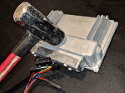
I have recently purchased an oscilloscope and I have tried to test the signal on the engine speed wire, however i cant seem to get any sort of signal out of it. the controller manual says it provides a low voltage square wave signal. I'm no expert using the oscilloscope but I feel like I have it set up correctly. Has anyone ever successfully tested this wire? is it possible I could have shorted or damaged this circuit somehow doing other testing?
A couple years ago I put together some code to read the RPM from this wire, at idle I seemed to be getting accurate results but when I hit the throttle the values jumped all over the place.
For now I'm just trying to get the engine speed wire figured out then I will move on to vehicle speed.
Does anyone have experience testing these wire or puling data from them?
Have you got the oscope probes set to high impedance? Usually theres a switch on the probe, or it may be on the oscope. The ones I recall said ‘10x’ or similar.
It may be that whatever circuit is providing that waveform can’t drive a low impedance load and maintain voltage.
Have you got the oscope probes set to high impedance? Usually theres a switch on the probe, or it may be on the oscope. The ones I recall said ‘10x’ or similar.
It may be that whatever circuit is providing that waveform can’t drive a low impedance load and maintain voltage.
When I tested it the probe was set to 10x and there was a setting in the machine that was set to 10x as well, Are you saying I possible need to try it set to 1x? I just pulled the engine out for some maintenance but once its back in I will try it.
Also, make sure the volts/division on the channel you’re using is something sensible like 1 volt per division. If you had it set higher, that could make a 5 volt square wave disappear
It is the White engine speed wire (circuit # 121) This wire is provided in the GM Ls3 controller kit for tachometers. attached is the wire connector description and signal description from the controller manual.
Hi, are you pulling a signal from the cam or the crank sensor??
The cam uses a hall effect. just back probe the connector or in the circuit.
if doing the crank side, you can write some code for a 24X reluctor.
Or do both and also have cylinder id
Hey bro, you are way too smark. you can just consider it a voltmeter with low level resolution. you will get it fast. they are a must have
I have scopes and a an arduino one. the ones that are actual scopes should have an auto scale button which is what I use, and you should see the clean square wave.
if it isnt reading, it has to be a bad lead, unless the scope itself is faulty.
I can give you the settings you need to scale it yourself. Just advise if you do
If the tach signal doesn't work, you might consider using one of the fuel injector outputs instead. The drawback is that you will occasionally lose the signal if the ECU is tuned with deceleration fuel cutoff. But on the other hand you could also measure the pulse width and use that to calculate miles-per-gallon.
6 Common C5 Corvette Failures and What's Involved In Repairing Them
Slideshow: From wobbling harmonic balancers to failed EBCMs, these are the issues that define long-term C5 ownership and what repairs typically involve.
Retro Modern Bandit Pontiac Trans AM Comes With Burt Reynolds' Autograph
Slideshow: A modern Camaro transformed into a retro icon, this limited-run "Bandit" build blends nostalgia with brute force in a way few revivals manage.
Top 10 Greatest Cadillac V Series Performance Models Ever, Ranked
Slideshow: Cadillac didn't just crash the high-performance luxury vehicle party, it showed up loud, supercharged, and occasionally a little unhinged...
Coachbuilt N2A Anteros Is an LS2-Powered C6 Corvette In Italian Clothes
Slideshow: A one-off sports car that looks like a vintage Italian exotic-but hides a C6 Corvette underneath-just sold for the price of a new mid-engine Corvette.





 oscilloscope Testing of Engine speed wire