


Camshaft Discussion part II

Banned
Joined: Mar 2003
Posts: 603
Likes: 0
From: L.I. NY

I understand that we're discussing cams, but the reason they're able to tune these huge cams (256* at .050 is a helthy number even in a big block) is because they deleted the MAF from the equation. I'm gonna look for the SD post.
Good luck with the GN. I've had 4 TRs since the late 80s and love those cars. But in all fairness, I believe they don't hold a candle to the 98 and up Ls1 cars. That's why I got rid of my last 2 TRs. But I do have my good motor (224/224 cam w/ ported heads) still.
Good luck with the GN. I've had 4 TRs since the late 80s and love those cars. But in all fairness, I believe they don't hold a candle to the 98 and up Ls1 cars. That's why I got rid of my last 2 TRs. But I do have my good motor (224/224 cam w/ ported heads) still.
To J Rod What springs were the Aussies running with the monster lift cams .
Were they using YT rockers and comp R lifters ?
Did they have stock valve covers or are most all custom .
Jesels with tall valve covers,solid roller set up.
Were they using YT rockers and comp R lifters ?
Did they have stock valve covers or are most all custom .
Jesels with tall valve covers,solid roller set up.

TECH Enthusiast
Joined: Nov 2001
Posts: 534
Likes: 0
From: Sydney Australia
Originally Posted by Blktie8
What springs were the Aussies running with the monster lift cams .
Were they using YT rockers and comp R lifters ?
Did they have stock valve covers or are most all custom .
Jesels with tall valve covers,solid roller set up.
Were they using YT rockers and comp R lifters ?
Did they have stock valve covers or are most all custom .
Jesels with tall valve covers,solid roller set up.
All of the above….. All parts are the same over here… If they fit and they work, we’ve got em.


Thread Starter
6600 rpm clutch dump of death Administrator


Joined: Dec 2001
Posts: 4,983
Likes: 13
From: Texas
I saw some cars with stock valve covers. I saw some cars with spacers. I saw some cars with Katech valve covers.
For springs they were using Isky Gold doubles. REmeber, there area other lobes that XE-R's, and just because you have a 263/263 you can still run a .580 or a .615.
I saw 977's and 978's on the shelf @ Sam's shop. I saw Comp-R lifters. All this stuff is dependant on spring pressure, ramp rate, etc...
As for rockers, it just depends on the individual. Some use stock, some use aftermarket. Some of the guys are using stock rockers with 232 and 242 cams...
For springs they were using Isky Gold doubles. REmeber, there area other lobes that XE-R's, and just because you have a 263/263 you can still run a .580 or a .615.
I saw 977's and 978's on the shelf @ Sam's shop. I saw Comp-R lifters. All this stuff is dependant on spring pressure, ramp rate, etc...
As for rockers, it just depends on the individual. Some use stock, some use aftermarket. Some of the guys are using stock rockers with 232 and 242 cams...
Thread Starter
6600 rpm clutch dump of death Administrator
Joined: Dec 2001
Posts: 4,983
Likes: 13
From: Texas
Some neat stuff from another site, all very cam design specific. Lots of good info.
http://www.eng-tips.com/gviewthread....d/71/qid/47381
Hello,
Just discovered this forum. I have been searching for a forum on camshaft design. That is, actual design like ramps, profiles, materials, machining, and so on, as opposed to "what cam should I use?" I found a gear forum but no cam forum. Anyone know of one, or is this forum the appropriate place?
Thanks,
John Woodward
Eng-Tips Forums is Member Supported. Click Here to donate.
jlwoodward (Mechanical) Feb 27, 2003
I have many old SAE papers and the polydyne papers from Machine Design. I worked with Harvey Crane for a while on a new aircraft cam, and also know the guys at Comp Cams as they are across the street from where I used to work. I eventually wrote my own program but I still do not know as much as I want to.
Thanks,
John Woodward
RacerRick (Automotive) Mar 1, 2003
Is there a basic formula for the valve spring pressures need on flat tappet hyd. cams. I'am interest in using as little pressure as possible for max 4500 rpm truck engine. Some cam manufacture recomend 400lbs/in springs and others recomend 250/spring. I liketp find a formula that takes into account the following,,,, valve, retainer and 1/2 the spring wieght, rocker ratio, and lift per deg of rotation. Am I out in left field here?
jlwoodward (Mechanical) Mar 1, 2003
To RacerRick,
There are equations scattered about in the literature but nothing basic. I don't know of any that you can use as is. They usually take a lot of manipulation to put them in a workable form and then they are too time consuming to use unless you write a program.
You have to know the cam profile to get the valve lift and acceleration at every degree. You already have the weight of all your components. For the spring you need to know the compressed load at one point and the spring rate. Basically the formula starts with
Force = Mass x Acceleration
You calculate the inertia force on the valve train created by the cam acceleraton, using the above equation. Plot it for 360 degrees. Next, calculate the spring force applied to the valve at every degree and plot it on top of the inertia force.
There should be more spring force than inertia force at every degree. It is not enough to do the calculation at max lift, as there could be points in the early stages of lift where the curves get close together.
Exhaust pressure also needs to be considered. The exhaust valve has to be opened against cylinder pressure, which can cause high forces, and in a turbo engine the exhaust port pressure cam overcome the spring seating pressure.
Of course, none of this has answered your question. To meet your immediate needs it may be best for you to go by the cam manufacturers recommendation, especially if they offer a kit.
John Woodward
ProgressiveRacing (Automotive) Mar 1, 2003
Racer,
There is a formula in Joseph Harralson's "Design of Racing and High Perforance Engines" that might be of some help to you. If you're not familiar with the book (ISBN 1-56091-601-X) it is basically a collection of SAE papers. Here's the excerpt which deals with abnormal valve motion:
"VALVE MOTION- Abnormal inlet and exhaust valve motion is a major obstacle in the development of high-speed engines. The main factors influencing valve motion are:
1. The degree of ridgidity in the valve train.
2. The equivalent inertia weight of the moving parts in the valve train.
For the tappet-type and rockerarm-type of overhead cam valve mechanisms, we determined the engines speeds at the initiation of abnormal valve motion (such as jumping or bouncing) and plotted these data as a function of the equivalent inertia weight of the valve train.
It can be seen that the abnormal motion begins at a higher engine speed for the tappet-type, which can be attributed to the higher ridgity of this system. The equation generally used in valve mechanism design is expressed as:
Ne = 2C SQRT[(Fs·K)/(W·(-y))]
where:
Ne = engine revolution speed
Fs = valve spring force at maximum lift, kg
K = G(30/pi)^2
W = equivalent inertia weight of valve train, kg
y = maximum negative acceleration, mm/rad^2
g = acceleration of gravity 9.8x10^3, mm/sec^2
C= correction factor
In order to predict the engine speeds at which valve jumping and valve bouncing will begin, we empirically determined the value C as follows:
C = Cj =0.85 (for valve jumping)
C = Cb =1.0 (for valve bouncing)"
Sorry for the length but wanted to get everything into context there.
I post this in hopes that someone can maybe explain it. I'm a sophomore in college working towards an ME degree so I'm kinda stuck waiting til I have a better understanding of kinematics and dynamics before I can extrapolate anything from this on my own. I'm sure someone can shed some light on this though.
Best of luck.
jlwoodward (Mechanical) Mar 1, 2003
Mr Prog.,
Can you supply the SAE number of the paper? I don't have the book but might have the paper.
I usually don't bother with empirical formulae if one can be derived on a scientific basis. You should soon be able to do this, although you may know enough already. It is just a matter of writing F=ma for the valve train inertia, but writing it as a function of cam degrees. Acceleration is from the cam profile. You can get it by differentiating the polynomial equations if known or if you have a lift table find the difference between 2 lift points for velocity and the difference between 2 velocity points for acceleration. The mass comes from the weight of the moving parts in the valve train, taking into consideration the rocker arm ratio. I don't remember the definitions; I can look them up if you want.
Now you have valve train inertia force vs. cam angle. Next you calculate the spring force at each cam angle. If you know the spring force with the valve closed, you then add to it lift x spring rate at each cam degree.
If someone would tell me how, I would like to post an illustration here that would take the place of all these words.
John Woodward
ProgressiveRacing (Automotive) Mar 2, 2003
Thanks for the help John, I need to digest this before I can ask any pertinent questions.
The paper I referred to is, "Research and Development of High-Speed, High-Performance, Small Displacement Honda Engines" SAE #700122
Valve motion is dealt with in the mechanical efficiency section of the paper but only in brief.
Another paper that you might be interested in is, "Modeling and Measurement Techniques for Valve Spring Dynamics in High Revving Internal Combustion Engines" -Ford Motor Company SAE #930615
Of course most of the information in that paper is well above my head at this time but it is very informative.
Thanks for your time,
Allen
victorymotorsports (Automotive) Mar 4, 2003
John,
Specifically, what do you want to know?
RacerRick (Automotive) Mar 4, 2003
John You mention writing a program. Do you know of any good programs that will do the math for me? I looked around the web and there are a few. Now I need to know which one to buck up for? Thank
jlwoodward (Mechanical) Mar 4, 2003
Rick,
Let me know where you found the programs. I would like to look at them. My searches never turned up anything.
The program I have is written in Visual Basic. I obtained the equations from some old SAE papers but they required considerable modification to make them usable, and also to be able to solve them. I added lots of things like ramp calculations, plots, lift tables, etc. Other programs in the group calculate valve spring forces and valve train inertia throughout the range, and cam and lifter stress. The main program is for the design of the profile. A smaller program will generate plots from a lift table.
At one type I worked with Harvey Crane and used his program. My program gives the same results, but to me it is easier to use. It is similar in principle to what they use at Comp Cams but not as sophisticated.
I have half a mind just to give it away to anyone that wants it. Trouble is, I am not sure it will run on another computer without VB being installed.
John Woodward
RacerRick (Automotive) Mar 5, 2003
John Heres one http://www.integralcams.com/springmaster.htm
and another with a demo http://www.soft-engine.com/pagine.web/inglese/cams0.htm
rrohrich (Automotive) Mar 5, 2003
Don Hubbard's "Camshaft Reference Manual" is a very detailed reference on the low level details of camshaft design. Pricey but worth it, and it comes bundled with some very good software.
Professor Gordon Blair of Queen's University of Belfast wrote a very sophisticated cylinder head design package that covers very detailed cam and spring design details.
Details at http://www.profblairandassociates.co...ucts_Main.html
Some good cam design references can be found here:
http://www.audietech.com/CAMBiblio.htm
I hope this helps.
Rich Rohrich
http://www.eng-tips.com/gviewthread....d/71/qid/47381
Hello,
Just discovered this forum. I have been searching for a forum on camshaft design. That is, actual design like ramps, profiles, materials, machining, and so on, as opposed to "what cam should I use?" I found a gear forum but no cam forum. Anyone know of one, or is this forum the appropriate place?
Thanks,
John Woodward
Eng-Tips Forums is Member Supported. Click Here to donate.
jlwoodward (Mechanical) Feb 27, 2003
I have many old SAE papers and the polydyne papers from Machine Design. I worked with Harvey Crane for a while on a new aircraft cam, and also know the guys at Comp Cams as they are across the street from where I used to work. I eventually wrote my own program but I still do not know as much as I want to.
Thanks,
John Woodward
RacerRick (Automotive) Mar 1, 2003
Is there a basic formula for the valve spring pressures need on flat tappet hyd. cams. I'am interest in using as little pressure as possible for max 4500 rpm truck engine. Some cam manufacture recomend 400lbs/in springs and others recomend 250/spring. I liketp find a formula that takes into account the following,,,, valve, retainer and 1/2 the spring wieght, rocker ratio, and lift per deg of rotation. Am I out in left field here?
jlwoodward (Mechanical) Mar 1, 2003
To RacerRick,
There are equations scattered about in the literature but nothing basic. I don't know of any that you can use as is. They usually take a lot of manipulation to put them in a workable form and then they are too time consuming to use unless you write a program.
You have to know the cam profile to get the valve lift and acceleration at every degree. You already have the weight of all your components. For the spring you need to know the compressed load at one point and the spring rate. Basically the formula starts with
Force = Mass x Acceleration
You calculate the inertia force on the valve train created by the cam acceleraton, using the above equation. Plot it for 360 degrees. Next, calculate the spring force applied to the valve at every degree and plot it on top of the inertia force.
There should be more spring force than inertia force at every degree. It is not enough to do the calculation at max lift, as there could be points in the early stages of lift where the curves get close together.
Exhaust pressure also needs to be considered. The exhaust valve has to be opened against cylinder pressure, which can cause high forces, and in a turbo engine the exhaust port pressure cam overcome the spring seating pressure.
Of course, none of this has answered your question. To meet your immediate needs it may be best for you to go by the cam manufacturers recommendation, especially if they offer a kit.
John Woodward
ProgressiveRacing (Automotive) Mar 1, 2003
Racer,
There is a formula in Joseph Harralson's "Design of Racing and High Perforance Engines" that might be of some help to you. If you're not familiar with the book (ISBN 1-56091-601-X) it is basically a collection of SAE papers. Here's the excerpt which deals with abnormal valve motion:
"VALVE MOTION- Abnormal inlet and exhaust valve motion is a major obstacle in the development of high-speed engines. The main factors influencing valve motion are:
1. The degree of ridgidity in the valve train.
2. The equivalent inertia weight of the moving parts in the valve train.
For the tappet-type and rockerarm-type of overhead cam valve mechanisms, we determined the engines speeds at the initiation of abnormal valve motion (such as jumping or bouncing) and plotted these data as a function of the equivalent inertia weight of the valve train.
It can be seen that the abnormal motion begins at a higher engine speed for the tappet-type, which can be attributed to the higher ridgity of this system. The equation generally used in valve mechanism design is expressed as:
Ne = 2C SQRT[(Fs·K)/(W·(-y))]
where:
Ne = engine revolution speed
Fs = valve spring force at maximum lift, kg
K = G(30/pi)^2
W = equivalent inertia weight of valve train, kg
y = maximum negative acceleration, mm/rad^2
g = acceleration of gravity 9.8x10^3, mm/sec^2
C= correction factor
In order to predict the engine speeds at which valve jumping and valve bouncing will begin, we empirically determined the value C as follows:
C = Cj =0.85 (for valve jumping)
C = Cb =1.0 (for valve bouncing)"
Sorry for the length but wanted to get everything into context there.
I post this in hopes that someone can maybe explain it. I'm a sophomore in college working towards an ME degree so I'm kinda stuck waiting til I have a better understanding of kinematics and dynamics before I can extrapolate anything from this on my own. I'm sure someone can shed some light on this though.
Best of luck.
jlwoodward (Mechanical) Mar 1, 2003
Mr Prog.,
Can you supply the SAE number of the paper? I don't have the book but might have the paper.
I usually don't bother with empirical formulae if one can be derived on a scientific basis. You should soon be able to do this, although you may know enough already. It is just a matter of writing F=ma for the valve train inertia, but writing it as a function of cam degrees. Acceleration is from the cam profile. You can get it by differentiating the polynomial equations if known or if you have a lift table find the difference between 2 lift points for velocity and the difference between 2 velocity points for acceleration. The mass comes from the weight of the moving parts in the valve train, taking into consideration the rocker arm ratio. I don't remember the definitions; I can look them up if you want.
Now you have valve train inertia force vs. cam angle. Next you calculate the spring force at each cam angle. If you know the spring force with the valve closed, you then add to it lift x spring rate at each cam degree.
If someone would tell me how, I would like to post an illustration here that would take the place of all these words.
John Woodward
ProgressiveRacing (Automotive) Mar 2, 2003
Thanks for the help John, I need to digest this before I can ask any pertinent questions.
The paper I referred to is, "Research and Development of High-Speed, High-Performance, Small Displacement Honda Engines" SAE #700122
Valve motion is dealt with in the mechanical efficiency section of the paper but only in brief.
Another paper that you might be interested in is, "Modeling and Measurement Techniques for Valve Spring Dynamics in High Revving Internal Combustion Engines" -Ford Motor Company SAE #930615
Of course most of the information in that paper is well above my head at this time but it is very informative.
Thanks for your time,
Allen
victorymotorsports (Automotive) Mar 4, 2003
John,
Specifically, what do you want to know?
RacerRick (Automotive) Mar 4, 2003
John You mention writing a program. Do you know of any good programs that will do the math for me? I looked around the web and there are a few. Now I need to know which one to buck up for? Thank
jlwoodward (Mechanical) Mar 4, 2003
Rick,
Let me know where you found the programs. I would like to look at them. My searches never turned up anything.
The program I have is written in Visual Basic. I obtained the equations from some old SAE papers but they required considerable modification to make them usable, and also to be able to solve them. I added lots of things like ramp calculations, plots, lift tables, etc. Other programs in the group calculate valve spring forces and valve train inertia throughout the range, and cam and lifter stress. The main program is for the design of the profile. A smaller program will generate plots from a lift table.
At one type I worked with Harvey Crane and used his program. My program gives the same results, but to me it is easier to use. It is similar in principle to what they use at Comp Cams but not as sophisticated.
I have half a mind just to give it away to anyone that wants it. Trouble is, I am not sure it will run on another computer without VB being installed.
John Woodward
RacerRick (Automotive) Mar 5, 2003
John Heres one http://www.integralcams.com/springmaster.htm
and another with a demo http://www.soft-engine.com/pagine.web/inglese/cams0.htm
rrohrich (Automotive) Mar 5, 2003
Don Hubbard's "Camshaft Reference Manual" is a very detailed reference on the low level details of camshaft design. Pricey but worth it, and it comes bundled with some very good software.
Professor Gordon Blair of Queen's University of Belfast wrote a very sophisticated cylinder head design package that covers very detailed cam and spring design details.
Details at http://www.profblairandassociates.co...ucts_Main.html
Some good cam design references can be found here:
http://www.audietech.com/CAMBiblio.htm
I hope this helps.
Rich Rohrich
Thread Starter
6600 rpm clutch dump of death Administrator
Joined: Dec 2001
Posts: 4,983
Likes: 13
From: Texas
hitzinger (Automotive) Mar 6, 2003
Dennis,
I would be interested in your cam design sources as well.
If you could e-mail infos, design software and so on to me would be great.
Thanks
Alex
victorymotorsports (Automotive) Mar 7, 2003
I should have posted more the first time...
I work for a major tier 1 supplier of valves and valve train parts. We do not design camshafts, but we are very knowledgable on their design, materials, dynamics, etc.
What specific questions do you have?
Chris Hill
jlwoodward (Mechanical) Mar 7, 2003
Chris,
Lots of questions as I think of them, but let me try this one:
I know how a flat tappet cam is ground, for example, using a Norton grinder and a large wheel. The same lift table can be used for a flat or roller cam, but the shape of the lobe is very different. The large radius of the large grinding wheel approximates a flat lifter. However, it is not very clear to me how a roller tappet cam is ground. Since the profile depends on the roller diameter, what size grinding wheel would be required, and how is it determined?
Equations would be great so that I could add them to my program.
Many thanks to anyone who can provide this information or direct me to it.
John Woodward
InHiding (Mechanical) Mar 22, 2003
jlwoodward,
I've never actually seen a cam being ground, but I do know that different manufacturers will have different concavity limits (minimum allowable amplitude of negative radii), which I assume are determined by the size of the grinding wheel that they use. A program such as Camspring (Ricardo Software) can calculate cam cutting ordinates for just about any combination of valvetrain geometry and follower diameter. Sorry that I can't get you any closer to writing the equations yourself, but if you happen to get a copy of the user manual for Camspring, the equations might be in there (not sure). If you're doing this work for your boss, perhaps you should push him to get a trial copy of some off-the-shelf cam design software. It might be worth the money.
Regards,
Isaac
victorymotorsports (Automotive) Mar 25, 2003
John,
Sorry for taking so long to get back to you...
I'm not real strong in this aspect of cam design, but here goes.
Basically, you have to determine what the radius of curvature of the cam needs to be for a particular lift profile vs. roller diameter. I'm not sure how to explain it though. But I do think some calculus books address this issue.
If you have some dynamics questions I'm better with those.
facty (Automotive) Mar 27, 2003
John & Chris,
The cam profile depends directly on the geometry of the roller follower. You will know/notice that the cam profile for a roller follower may have a concave portion and it is the radius of curvature of this portion that determines the diameter of grinding wheel that can be applied. The max cutter radius is limited to the min absolute value of the rad of curvature in this portion. (otherwise it would physically not fit into the concave!)
RacerRick (Automotive) Mar 28, 2003
Ther are very few cams with IR flanks that can't be ground with a std. wheel and machine. We lay a straight edge across the cam flank to see if its concaved. If it is we use a 14" wheel. You can buy attachment to run a 7"wheel but I have yet to come across a cam that needed it. I checked with a cam doctor. I guess some wild ultradyne or IR crower might need a smaller wheel.
John when grinding any steel cam, we slow the cam rotation way down to prevent chatter. Its no different than grinding a cast cam except for the time it takes.
ShaunT (Automotive) Apr 18, 2003
Get away from Hydraulic cams. If you want to make power, it is time for a clearance ramp cam. Do Not fall victim to the statement: You can't run solid lifters on the street because they have to be adjusted constantly. This is a wide spread mis-guided criticisim of clearance ramp cams. They are constantly being adjusted because the locking method used to lock the rocker arm down is either not utilized or is totally installed wrong by the ameteur. 99% of the cams I personally sell for street/marine engines and 100% for race engines (accept where rules ban me from doing so) are solid flat tappet or solid roller cams. If you take a .025 lash cam and set the lash at .019, the valve train is almost void of any solid lifter noise. Makes a Great Sleeper! The reason you need to run from hydraulics is that they are slow and lazy opening cams compared to clearance ramp cams. For example: a solid with 264degrees advertised duration @.020 is 235 @.050 VS a hyd with 280 advertised @.0045 is about 230 @.050. My point is the 264 opens later thus smoking the much earlier and slower opening hyd at slow engine speeds, and also will beat it up stairs too. You see it is caught the nearly 20 degree bigger hyd by .050, so what do you imagine it did to it up @.200? It is actually bigger!!! It is smaller in the motor before TDC, but bigger after. (It lies to the motor) And since I am ULTRADYNE, I'd like to say that we are the only ones that will show our cams at.200. It's kind of funny when I speak with other cam manufacturers(wanna be cam designers that are largly cam copiers)when they tout their seemingly cool duration @.050 numbers, They are dumbfounded when I ask them what the .200 is. We are the only true mathametically non compromised cam design. Dont be fooled by a so called computer designed cam. It is only as good as the programmer.
PFM (Automotive) Apr 18, 2003
Well ShaunT,
I will not disagree with your reply, a hydraulic cannot keep up with a flat tappet or solid roller. This post originated about cam design and I am shure you could provide input to that as well. I will take up the "other cam grinders not knowing the duration" at other lift numbers. Two come to mind Iski, lists the duration at all lift points up to max lift right in the catalog, second is WebCam, they may not publish the numbers but call and talk with them or in my case stop in and they have that and more.
My question to you is if I call your shop on Monday one week, Tuesday the next week and Thursday the following and ask for a cam recomendation for the same motor: How many different cams will be recomended and why?? What I have not found in cam companies is any remote shred of consistancy in cam recomendations.
This makes me question anyone that claims to know "all the answers". Cam design the original thread still seems to be a black art, some no doubt do it better than others. Some continue on old reputations and others on truly new designs but none seem to have resolved all the questions.
Regards
D Friedeck
Dennis,
I would be interested in your cam design sources as well.
If you could e-mail infos, design software and so on to me would be great.
Thanks
Alex
victorymotorsports (Automotive) Mar 7, 2003
I should have posted more the first time...
I work for a major tier 1 supplier of valves and valve train parts. We do not design camshafts, but we are very knowledgable on their design, materials, dynamics, etc.
What specific questions do you have?
Chris Hill
jlwoodward (Mechanical) Mar 7, 2003
Chris,
Lots of questions as I think of them, but let me try this one:
I know how a flat tappet cam is ground, for example, using a Norton grinder and a large wheel. The same lift table can be used for a flat or roller cam, but the shape of the lobe is very different. The large radius of the large grinding wheel approximates a flat lifter. However, it is not very clear to me how a roller tappet cam is ground. Since the profile depends on the roller diameter, what size grinding wheel would be required, and how is it determined?
Equations would be great so that I could add them to my program.
Many thanks to anyone who can provide this information or direct me to it.
John Woodward
InHiding (Mechanical) Mar 22, 2003
jlwoodward,
I've never actually seen a cam being ground, but I do know that different manufacturers will have different concavity limits (minimum allowable amplitude of negative radii), which I assume are determined by the size of the grinding wheel that they use. A program such as Camspring (Ricardo Software) can calculate cam cutting ordinates for just about any combination of valvetrain geometry and follower diameter. Sorry that I can't get you any closer to writing the equations yourself, but if you happen to get a copy of the user manual for Camspring, the equations might be in there (not sure). If you're doing this work for your boss, perhaps you should push him to get a trial copy of some off-the-shelf cam design software. It might be worth the money.
Regards,
Isaac
victorymotorsports (Automotive) Mar 25, 2003
John,
Sorry for taking so long to get back to you...
I'm not real strong in this aspect of cam design, but here goes.
Basically, you have to determine what the radius of curvature of the cam needs to be for a particular lift profile vs. roller diameter. I'm not sure how to explain it though. But I do think some calculus books address this issue.
If you have some dynamics questions I'm better with those.
facty (Automotive) Mar 27, 2003
John & Chris,
The cam profile depends directly on the geometry of the roller follower. You will know/notice that the cam profile for a roller follower may have a concave portion and it is the radius of curvature of this portion that determines the diameter of grinding wheel that can be applied. The max cutter radius is limited to the min absolute value of the rad of curvature in this portion. (otherwise it would physically not fit into the concave!)
RacerRick (Automotive) Mar 28, 2003
Ther are very few cams with IR flanks that can't be ground with a std. wheel and machine. We lay a straight edge across the cam flank to see if its concaved. If it is we use a 14" wheel. You can buy attachment to run a 7"wheel but I have yet to come across a cam that needed it. I checked with a cam doctor. I guess some wild ultradyne or IR crower might need a smaller wheel.
John when grinding any steel cam, we slow the cam rotation way down to prevent chatter. Its no different than grinding a cast cam except for the time it takes.
ShaunT (Automotive) Apr 18, 2003
Get away from Hydraulic cams. If you want to make power, it is time for a clearance ramp cam. Do Not fall victim to the statement: You can't run solid lifters on the street because they have to be adjusted constantly. This is a wide spread mis-guided criticisim of clearance ramp cams. They are constantly being adjusted because the locking method used to lock the rocker arm down is either not utilized or is totally installed wrong by the ameteur. 99% of the cams I personally sell for street/marine engines and 100% for race engines (accept where rules ban me from doing so) are solid flat tappet or solid roller cams. If you take a .025 lash cam and set the lash at .019, the valve train is almost void of any solid lifter noise. Makes a Great Sleeper! The reason you need to run from hydraulics is that they are slow and lazy opening cams compared to clearance ramp cams. For example: a solid with 264degrees advertised duration @.020 is 235 @.050 VS a hyd with 280 advertised @.0045 is about 230 @.050. My point is the 264 opens later thus smoking the much earlier and slower opening hyd at slow engine speeds, and also will beat it up stairs too. You see it is caught the nearly 20 degree bigger hyd by .050, so what do you imagine it did to it up @.200? It is actually bigger!!! It is smaller in the motor before TDC, but bigger after. (It lies to the motor) And since I am ULTRADYNE, I'd like to say that we are the only ones that will show our cams at.200. It's kind of funny when I speak with other cam manufacturers(wanna be cam designers that are largly cam copiers)when they tout their seemingly cool duration @.050 numbers, They are dumbfounded when I ask them what the .200 is. We are the only true mathametically non compromised cam design. Dont be fooled by a so called computer designed cam. It is only as good as the programmer.
PFM (Automotive) Apr 18, 2003
Well ShaunT,
I will not disagree with your reply, a hydraulic cannot keep up with a flat tappet or solid roller. This post originated about cam design and I am shure you could provide input to that as well. I will take up the "other cam grinders not knowing the duration" at other lift numbers. Two come to mind Iski, lists the duration at all lift points up to max lift right in the catalog, second is WebCam, they may not publish the numbers but call and talk with them or in my case stop in and they have that and more.
My question to you is if I call your shop on Monday one week, Tuesday the next week and Thursday the following and ask for a cam recomendation for the same motor: How many different cams will be recomended and why?? What I have not found in cam companies is any remote shred of consistancy in cam recomendations.
This makes me question anyone that claims to know "all the answers". Cam design the original thread still seems to be a black art, some no doubt do it better than others. Some continue on old reputations and others on truly new designs but none seem to have resolved all the questions.
Regards
D Friedeck
Thread Starter
6600 rpm clutch dump of death Administrator
Joined: Dec 2001
Posts: 4,983
Likes: 13
From: Texas
jlwoodward (Mechanical) Apr 23, 2003
Hello Shaun,
I have a request to ask of you. If we could go back to my original questions at the top of the thread, I wonder if you could share some of your cam design experience with us. Your comments about cam performance are very interesting, but I would like to learn more about the actual design and manufacture. For example, do you design your own profiles, and what tools do you use, such as computer programs or good old intuition. Do you grind your own cams? Please understand, I would in no way ask you to give away any trade secrets that you have worked so hard to learn.
Thanks,
John Woodward
ShaunT (Automotive) Apr 23, 2003
We design and manufacture all of our profiles. We use a program that we created that uses for the most-part, 6,7, or 8 decimal place polynomial equations. We can do this by hand with a calculator, but the computer allows us to do it millions of times faster. In the old days, using a desk-top calculator would many times give a design that might not show up flawed untill it was ground. A couple weeks lost.
Our cams are 6 or 7 different sections, each section can contribute up to 10 million different cams at any given lift in the section. Some would be too big,others small, some could not physically be made, and others might only be different in millionth of an inch increments. Engines react to different curve families and do not notice differences in millionth's of an inch. We have a very slow initial opening to minimize reversion, then we open it fast. We are able to catch cams at .050 lift that are 6-10 degrees bigger at the seat. We also slow the closing down for two reasons. 1:we build so much more port velocity than others because even though we may open the valve later, we start flow sooner because a reversion in the port costs valuable time. A port that starts flow late, will never catch up. Due to our higher percentage of clean air flow, we get to #2: The more velocity I build, the longer cylinder filling will continue to RAM the cylinder after BDC. So, why hurry and shut the valve? Take advantage of inertia! Close it slowly unlike conventional Symmetrical designs. It gives you extra time and it also shuts gentle enough to stay shut taking advantage of ALL of the charge, and (here is the good part) Your intake port does not have a reversion due to a valve bounce during the compression stroke. So when the intake valve opens again, It will fill instead of having several crank degrees try to reverse the reversion. The proof that we pick up the flow is the increased fuel required at high RPM since an increase in air flow demands an increase in fuel also. This is why many Blowers are blowing the burst panels. Years ago, We were the only ones that did not cause this to happen in a test of a Nitro Hemi conducted by a really big name.(Almost a house-hold name to racers) We also picked the motor up nearly 500 HP with ten LBS less boost than any other cam they tried.
Shaun TiedeULTRADYNE Arl,TX(stiede@ev1.net)
camshaft (Automotive) Jun 6, 2003
I love this stuff.
Shaun T ULTRADYNE Arl,TX
ShaunT (Automotive) Jun 12, 2003
There are also manufacturing processes involved. One simole one is the immersion of flat tappet cams into a hot tank of phosphorus. This is the Black stuff on the cam lobes. I have had many cams come back to me for a freshen up. Once i check every lobe for wear and they all check out good as new, I re-phosphate the cam and send it on its way. There are on occasion people who will say they had a cam and it sucked because it broke in two pieces in the first 5 minutes. This is not the fault of a cam grinder accept in one area. He dropped or hit the cam core which fractured it. Usually though, the cam is damaged in transit. There are only Two cam core manufacturers for American V8's in America. Incidentally Crane owns one of them. They are cheaper than others largely because of that and the fact that they "Gang Grind" cams. For ALL of you Ford 5.0 fans out there, Crane also produces the Private labeled Ford Motorsports cams.
Shaun TiedeULTRADYNE Arl,TX(stiede@ev1.net)
furious70 (Computer) Jun 13, 2003
>>>I have half a mind just to give it away to anyone that >>>wants it. Trouble is, I am not sure it will run on >>>another computer without VB being installed.
If you have the full version of VB, you can create an executable out of your program for us all to use. I have the full version and could try to do this for you if you don't.
Speedy5 (Automotive) Jun 13, 2003
Shaun,
I basically understand your theory of cam profiles. One thing I have a question about however, is why we could not open the valve quickly at first? Could not the duration be decreased with a faster initial opening? Or are there other requirements (like peak lift?) that need to be considered?
Thank you!
ShaunT (Automotive) Jun 14, 2003
You can't open it with a high jerk if you want to engineer a cam to live long enough to win and win again. It also will induce valve float due to the inertia load. You will also spit roller bearings out in every direction. When you open it fast before TDC, you induce a ton of unnecessary reversion and hence delay cylinder filling. In terms of power, reversion is the enemy. A port that starts flow late will never catch up. The port with the higher velocity will continue to ram the cylinder after BDC and that is the origional reason for the long and slow closing. It buys time to take advantage of the inertia ram from the port. It also shutsa so softly that it stays shut keeping ALL of the mixture in the cylinder and therefor ALL of that power capability there. The best part is not putting a reversion in the intake port from the flow valve opening on the compression stroke, and hence starting flow sooner on the next intake cycle.
Shaun TiedeULTRADYNE Arl,TX(stiede@ev1.net)
Speedy5 (Automotive) Jun 15, 2003
So let me see if I understand.
The slow initial opening (prior to TDC) is to take up clearance and get the valve moving in a smooth manner. Once past TDC, you want to open the valve as quickly as possible (short of mechanical problems).
Did I interpret that correctly?
ShaunT (Automotive) Jun 16, 2003
You have most of it down. The other reason for slow movement is to minimize port reversion. Virtually all cams open the initial opening much faster than US. We all understand that having no reversion would mean opening at or after TDC. Then we would have to explode off the seat to move any air. All of us here also understand what that would do to our valve train.
Shaun TiedeULTRADYNE Arl,TX(stiede@ev1.net)
naknorm (Industrial) Jun 19, 2003
Not sure what engine types you are refering to but I would suggest contacting KAMS inc in Oklahoma email: jeff@kamsinc.com. They design and build special cams for large diesel engines
ShaunT (Automotive) Jun 20, 2003
Yeah. Some one here in Dallas that I know uses them.After looking at one, I told him I can make one for him that will beat it badly in economy, power, and valve train reliability. But, you know, not a priority with the slow economy now.
Shaun TiedeULTRADYNE Arl,TX(stiede@ev1.net)
ShaunT (Automotive) Jun 24, 2003
There are different acceleration families that are intended by design to do different things. The really fast opening cams are very effective in limited breathing stock cylinder headded motors such as Super Stock class drag racing. They also would be well in lift rule restricted Stock class drag racing that are usually limited to flat tappet cams. The really fast lobes I mention here are very good at making torque and horsepower, but are not stable at 9000+RPM's like a slower opening big lobe lift piece. Such pieces are found in Road Race engines, Endurance, Super Gas, Pro Gas, Comp Eliminator, and of course Pro Stock. Many of the slower cams with big lobe lifts are teamed with high ratio rocker arms to achieve "big" net lifts. when a motor has a big port and one that flows very well, it can hurt power with a very fast ramp because it gents into a situation of having the ability to keep up in terms of port velocity.
We consistently shock the Pro Stock engine builders with the gains in peak and total torque plus the dramatically increased valve spring life and stabilized pressures they discover when using our cams. Most of them find they need to run some rediculous (in my opinion) spring pressures to stop float and bounce associated with many cams. when they are used to throwing away at least half the valve springs every 2-3 runs, you can imagine their satisfaction at keeping them for at least an entire national event race. At upwards of $500.00+ per set, who wouldn't be satisfied?
Shaun TiedeULTRADYNE Arl,TX(stiede@ev1.net)
Hello Shaun,
I have a request to ask of you. If we could go back to my original questions at the top of the thread, I wonder if you could share some of your cam design experience with us. Your comments about cam performance are very interesting, but I would like to learn more about the actual design and manufacture. For example, do you design your own profiles, and what tools do you use, such as computer programs or good old intuition. Do you grind your own cams? Please understand, I would in no way ask you to give away any trade secrets that you have worked so hard to learn.
Thanks,
John Woodward
ShaunT (Automotive) Apr 23, 2003
We design and manufacture all of our profiles. We use a program that we created that uses for the most-part, 6,7, or 8 decimal place polynomial equations. We can do this by hand with a calculator, but the computer allows us to do it millions of times faster. In the old days, using a desk-top calculator would many times give a design that might not show up flawed untill it was ground. A couple weeks lost.
Our cams are 6 or 7 different sections, each section can contribute up to 10 million different cams at any given lift in the section. Some would be too big,others small, some could not physically be made, and others might only be different in millionth of an inch increments. Engines react to different curve families and do not notice differences in millionth's of an inch. We have a very slow initial opening to minimize reversion, then we open it fast. We are able to catch cams at .050 lift that are 6-10 degrees bigger at the seat. We also slow the closing down for two reasons. 1:we build so much more port velocity than others because even though we may open the valve later, we start flow sooner because a reversion in the port costs valuable time. A port that starts flow late, will never catch up. Due to our higher percentage of clean air flow, we get to #2: The more velocity I build, the longer cylinder filling will continue to RAM the cylinder after BDC. So, why hurry and shut the valve? Take advantage of inertia! Close it slowly unlike conventional Symmetrical designs. It gives you extra time and it also shuts gentle enough to stay shut taking advantage of ALL of the charge, and (here is the good part) Your intake port does not have a reversion due to a valve bounce during the compression stroke. So when the intake valve opens again, It will fill instead of having several crank degrees try to reverse the reversion. The proof that we pick up the flow is the increased fuel required at high RPM since an increase in air flow demands an increase in fuel also. This is why many Blowers are blowing the burst panels. Years ago, We were the only ones that did not cause this to happen in a test of a Nitro Hemi conducted by a really big name.(Almost a house-hold name to racers) We also picked the motor up nearly 500 HP with ten LBS less boost than any other cam they tried.
Shaun TiedeULTRADYNE Arl,TX(stiede@ev1.net)
camshaft (Automotive) Jun 6, 2003
I love this stuff.
Shaun T ULTRADYNE Arl,TX
ShaunT (Automotive) Jun 12, 2003
There are also manufacturing processes involved. One simole one is the immersion of flat tappet cams into a hot tank of phosphorus. This is the Black stuff on the cam lobes. I have had many cams come back to me for a freshen up. Once i check every lobe for wear and they all check out good as new, I re-phosphate the cam and send it on its way. There are on occasion people who will say they had a cam and it sucked because it broke in two pieces in the first 5 minutes. This is not the fault of a cam grinder accept in one area. He dropped or hit the cam core which fractured it. Usually though, the cam is damaged in transit. There are only Two cam core manufacturers for American V8's in America. Incidentally Crane owns one of them. They are cheaper than others largely because of that and the fact that they "Gang Grind" cams. For ALL of you Ford 5.0 fans out there, Crane also produces the Private labeled Ford Motorsports cams.
Shaun TiedeULTRADYNE Arl,TX(stiede@ev1.net)
furious70 (Computer) Jun 13, 2003
>>>I have half a mind just to give it away to anyone that >>>wants it. Trouble is, I am not sure it will run on >>>another computer without VB being installed.
If you have the full version of VB, you can create an executable out of your program for us all to use. I have the full version and could try to do this for you if you don't.
Speedy5 (Automotive) Jun 13, 2003
Shaun,
I basically understand your theory of cam profiles. One thing I have a question about however, is why we could not open the valve quickly at first? Could not the duration be decreased with a faster initial opening? Or are there other requirements (like peak lift?) that need to be considered?
Thank you!
ShaunT (Automotive) Jun 14, 2003
You can't open it with a high jerk if you want to engineer a cam to live long enough to win and win again. It also will induce valve float due to the inertia load. You will also spit roller bearings out in every direction. When you open it fast before TDC, you induce a ton of unnecessary reversion and hence delay cylinder filling. In terms of power, reversion is the enemy. A port that starts flow late will never catch up. The port with the higher velocity will continue to ram the cylinder after BDC and that is the origional reason for the long and slow closing. It buys time to take advantage of the inertia ram from the port. It also shutsa so softly that it stays shut keeping ALL of the mixture in the cylinder and therefor ALL of that power capability there. The best part is not putting a reversion in the intake port from the flow valve opening on the compression stroke, and hence starting flow sooner on the next intake cycle.
Shaun TiedeULTRADYNE Arl,TX(stiede@ev1.net)
Speedy5 (Automotive) Jun 15, 2003
So let me see if I understand.
The slow initial opening (prior to TDC) is to take up clearance and get the valve moving in a smooth manner. Once past TDC, you want to open the valve as quickly as possible (short of mechanical problems).
Did I interpret that correctly?
ShaunT (Automotive) Jun 16, 2003
You have most of it down. The other reason for slow movement is to minimize port reversion. Virtually all cams open the initial opening much faster than US. We all understand that having no reversion would mean opening at or after TDC. Then we would have to explode off the seat to move any air. All of us here also understand what that would do to our valve train.
Shaun TiedeULTRADYNE Arl,TX(stiede@ev1.net)
naknorm (Industrial) Jun 19, 2003
Not sure what engine types you are refering to but I would suggest contacting KAMS inc in Oklahoma email: jeff@kamsinc.com. They design and build special cams for large diesel engines
ShaunT (Automotive) Jun 20, 2003
Yeah. Some one here in Dallas that I know uses them.After looking at one, I told him I can make one for him that will beat it badly in economy, power, and valve train reliability. But, you know, not a priority with the slow economy now.
Shaun TiedeULTRADYNE Arl,TX(stiede@ev1.net)
ShaunT (Automotive) Jun 24, 2003
There are different acceleration families that are intended by design to do different things. The really fast opening cams are very effective in limited breathing stock cylinder headded motors such as Super Stock class drag racing. They also would be well in lift rule restricted Stock class drag racing that are usually limited to flat tappet cams. The really fast lobes I mention here are very good at making torque and horsepower, but are not stable at 9000+RPM's like a slower opening big lobe lift piece. Such pieces are found in Road Race engines, Endurance, Super Gas, Pro Gas, Comp Eliminator, and of course Pro Stock. Many of the slower cams with big lobe lifts are teamed with high ratio rocker arms to achieve "big" net lifts. when a motor has a big port and one that flows very well, it can hurt power with a very fast ramp because it gents into a situation of having the ability to keep up in terms of port velocity.
We consistently shock the Pro Stock engine builders with the gains in peak and total torque plus the dramatically increased valve spring life and stabilized pressures they discover when using our cams. Most of them find they need to run some rediculous (in my opinion) spring pressures to stop float and bounce associated with many cams. when they are used to throwing away at least half the valve springs every 2-3 runs, you can imagine their satisfaction at keeping them for at least an entire national event race. At upwards of $500.00+ per set, who wouldn't be satisfied?
Shaun TiedeULTRADYNE Arl,TX(stiede@ev1.net)
Thread Starter
6600 rpm clutch dump of death Administrator
Joined: Dec 2001
Posts: 4,983
Likes: 13
From: Texas
Windsor377 (Automotive) Jun 24, 2003
Shaun,
I hate coming across like a testimonial, but I guess I have to. For those that don't know, I run Ultradyne rollers. Although not big block Pro Stock engines, they are very potent N/A and Nitrous small block engines capable of comfortable 7 second 1/4 mile ETs.
A recent combination went an entire 20 event season on a single set of valve springs. True, valve lift was only .778" and rpm was only 8500, but I still think that is pretty remarkable. Another surprise was, the springs were only 255# on the seat and 715# open.
The valve job looked new at the end of the season as did the entire valve train.
There has to be something you guys do at the "transistion points".
ShaunT (Automotive) Jun 25, 2003
Oh yes indeed!
Shaun TiedeULTRADYNE Arl,TX(stiede@ev1.net)
ShaunT (Automotive) Jun 26, 2003
How many of you have seen the brass colored evidence in the oil form pulverized needle bearings? I have seen this even when the bearings are still in tolerance. If you practice inspecting lifters and rockers in a race engine on a regular basis, you will pay yourself big dollars through avoidable disasters. You can also significantly increase the needle bearing life by using a full synthetic oil such as MOBIL1 or ROYAL PURPLE(not too heavy.) One of the areas you can help to minimize roller lifter tracking on the cam lobe is to throw out lifters with excessive bearing clearance. Some will say "they are about wore-out but they will be okay for a few more races." Then I get a call or Email from someone asking for help in a hurry because the roller lifter came apart and hurt a lobe. I will also tell them to pull the oil pan and inspect rod and main bearings because I am very confident that the trash from the lifter and cam ended up in your oil system and consequently some bearings. I have to re-do their bottom end about half the time.
Guys, It doesn't pay and it usually costs you Big Time, so don't gamble, especially whti the valve train.
Shaun TiedeULTRADYNE Arl,TX(stiede@ev1.net)
ShaunT (Automotive) Jun 26, 2003
First sentence should say "from pulverized needle bearings",
not form pulverized needle bearings. TYPO, sorry!
Shaun TiedeULTRADYNE Arl,TX(stiede@ev1.net)
ShaunT (Automotive) Jun 27, 2003
Here is an example of two cams with the same seat or advertised durations, but intended for different purposes.
310@.020 vs 310@.020
282@.050 vs 275@.050
203@.200 vs 192@.200
One is quite bigger everywhere after.020 Obviously, it will make more power EVERYWHERE, but it will need more spring, and will not be very dynamically stable above 7500-8500 RPM's (depending on rocker ratio)
One is an NHRA Super Stock national event winner, and the other is a 24 Hour Lemans and 24 hour Daytona winner.
Big difference in environments here.
Shaun TiedeULTRADYNE Arl,TX(stiede@ev1.net)
jlwoodward (Mechanical) Jun 27, 2003
Do excessive jerk pulses tear up the needles, or is it just high spring loading? Are needles in rocker arms also affected?
Thanks,
John Woodward
ShaunT (Automotive) Jun 28, 2003
Yes and Yes. Excessive lash settings, higher rocker ratios, and bad rocker arm geometry hurt things too. If you have to run the lash loose to go faster, you are likely lacking in the fuel department, and/or the cam is too big for your needs/RPM range. I have stated before that running solid roller cams with 300+LBS seat pressures in anything other than forced induction(and serious boost at that) is bad. I stand firm in the belief that a cam that has to have that much seat pressure to control the valves in a typical American V8 needs to go in the trash can.
Shaun TiedeULTRADYNE Arl,TX(stiede@ev1.net)
ShaunT (Automotive) Jul 7, 2003
It is a rush to go cruising with customers in their cars. When a customer has an aspirated motor at only 8:1 compression, and no power adders, it makes my day when the car runs so good that everyone thinks it is a really big motor with a solid roller cam and tons of compression. Actually, the most recent case from this last Saturday Night is a very successful combination that utilizes a fast ramp flat tappet cam that has a short seat duration, and a middle of the road LSA of 110 with a 104 intake C/L.
Why? Because it only has 8.17:1 compression. The motor runs hard to 6500. I see low compression (especially carbeurated) motors with some huge seat duration cams with stupidly wide LSA's way too often. They are usually in heavy cars with automatic trannys too. People always ask me what is their best choice for LSA. I like narrow LSA's even when compression is not an issue.
The narrower LSA's aid low comp motors. I feel that most of the choices made by consumers are due to ignorance. Many cams are so lazy in reguards to high lift area, that they only RPM because of their wide LSA. I see this in Pro Stockers daily. I also change their opinions and make them smile daily. But, Pro Stockers are the Extreme and they don't get my recommendation of 106 or even 110LSA cams. I usually preach 114 to them when everyone else is 118.
Economy and emissions aside, and since they flatten and broaden torque curves, low compression motors only need wide LSA's when they have really small cams that are also having to RPM. In Drag cars, the 106 LSA's are hardly ever slower than 112 LSA's especially in heavy cars with automatic tranny's. In dirt track cars, sometimes a 108 will be faster than a 106 simply because the track is slick, or the driver is having trouble controlling it and putting it to the track and he is getting out ran on the top end. Incidently, I recomend 108's to dirt trackers regularly. Many of them are my own loyal customers with 106LSA's who call me reporting a problem such as hard to hook up and also running out of steam a little early. A 108LSA fixes them and usually they win the race. My advice to the big cam wide LSA heavy car with small motor and low compression scenario's is: Either narrow the LSA 4+degrees or remove about 15+degrees of seat duration from the motor, and open the valve faster if you don't want a motor to be a slow reving lazy dog (especially one with low compression) with your wide LSA cam.
Bersides, It will be alot funner to drive and have more hit at idle, which is something most ask for.
Shaun TiedeULTRADYNE Arl,TX(stiede@ev1.net)
ShaunT (Automotive) Jul 16, 2003
I will comment on something I have advised about in the past. When looking at Hydraulic Cam specs, make sure you look at advertised duration. If they are showing it at .006, it is a lie. In other words, the cam will open the valve at approx .0045. This will add SEVERAL degrees of duration to the opening of the valve depending on oil thickness/temp, but it will not add any duration at .050 or any where else. Here is an example of a cam that I LOVE to pick on: Marketed as a 292 Magnum H10 (what a Dog)
It is advertised at .006 with a .050 of 244. However, it is over 300 duration at .0045, hence it is quite a bit bigger in the motor than it is on paper. Even though this is a STUPID mass produced junck camshaft, I will say that if all that was changed was the offering of this cam ground on a 106 LSA, it would be a major improvement in overall performance. I love to sell guys a cam to replace this one. It is awsome to watch their car run a full second or sometimes quicker in the 1/4 mile with the new cam that is many times 20+ degress less advertised duration and still runs over 7000RPM with power. For anyone who has this cam, have you noticed that at WOT the motor seems on the brink of exploding into it's power band, but it never does. It feels like it wants to really bad. It gives me that sensation all the way through the RPM's. It is a let down. Incidentaly, I have never seen anyone buy a cam like that unless they are still very wet behind the ears and wouldn't know what real power feels like. They think they do, but are clueless.
Shaun TiedeULTRADYNE Arl,TX(stiede@ev1.net)
Shaun,
I hate coming across like a testimonial, but I guess I have to. For those that don't know, I run Ultradyne rollers. Although not big block Pro Stock engines, they are very potent N/A and Nitrous small block engines capable of comfortable 7 second 1/4 mile ETs.
A recent combination went an entire 20 event season on a single set of valve springs. True, valve lift was only .778" and rpm was only 8500, but I still think that is pretty remarkable. Another surprise was, the springs were only 255# on the seat and 715# open.
The valve job looked new at the end of the season as did the entire valve train.
There has to be something you guys do at the "transistion points".
ShaunT (Automotive) Jun 25, 2003
Oh yes indeed!
Shaun TiedeULTRADYNE Arl,TX(stiede@ev1.net)
ShaunT (Automotive) Jun 26, 2003
How many of you have seen the brass colored evidence in the oil form pulverized needle bearings? I have seen this even when the bearings are still in tolerance. If you practice inspecting lifters and rockers in a race engine on a regular basis, you will pay yourself big dollars through avoidable disasters. You can also significantly increase the needle bearing life by using a full synthetic oil such as MOBIL1 or ROYAL PURPLE(not too heavy.) One of the areas you can help to minimize roller lifter tracking on the cam lobe is to throw out lifters with excessive bearing clearance. Some will say "they are about wore-out but they will be okay for a few more races." Then I get a call or Email from someone asking for help in a hurry because the roller lifter came apart and hurt a lobe. I will also tell them to pull the oil pan and inspect rod and main bearings because I am very confident that the trash from the lifter and cam ended up in your oil system and consequently some bearings. I have to re-do their bottom end about half the time.
Guys, It doesn't pay and it usually costs you Big Time, so don't gamble, especially whti the valve train.
Shaun TiedeULTRADYNE Arl,TX(stiede@ev1.net)
ShaunT (Automotive) Jun 26, 2003
First sentence should say "from pulverized needle bearings",
not form pulverized needle bearings. TYPO, sorry!
Shaun TiedeULTRADYNE Arl,TX(stiede@ev1.net)
ShaunT (Automotive) Jun 27, 2003
Here is an example of two cams with the same seat or advertised durations, but intended for different purposes.
310@.020 vs 310@.020
282@.050 vs 275@.050
203@.200 vs 192@.200
One is quite bigger everywhere after.020 Obviously, it will make more power EVERYWHERE, but it will need more spring, and will not be very dynamically stable above 7500-8500 RPM's (depending on rocker ratio)
One is an NHRA Super Stock national event winner, and the other is a 24 Hour Lemans and 24 hour Daytona winner.
Big difference in environments here.
Shaun TiedeULTRADYNE Arl,TX(stiede@ev1.net)
jlwoodward (Mechanical) Jun 27, 2003
Do excessive jerk pulses tear up the needles, or is it just high spring loading? Are needles in rocker arms also affected?
Thanks,
John Woodward
ShaunT (Automotive) Jun 28, 2003
Yes and Yes. Excessive lash settings, higher rocker ratios, and bad rocker arm geometry hurt things too. If you have to run the lash loose to go faster, you are likely lacking in the fuel department, and/or the cam is too big for your needs/RPM range. I have stated before that running solid roller cams with 300+LBS seat pressures in anything other than forced induction(and serious boost at that) is bad. I stand firm in the belief that a cam that has to have that much seat pressure to control the valves in a typical American V8 needs to go in the trash can.
Shaun TiedeULTRADYNE Arl,TX(stiede@ev1.net)
ShaunT (Automotive) Jul 7, 2003
It is a rush to go cruising with customers in their cars. When a customer has an aspirated motor at only 8:1 compression, and no power adders, it makes my day when the car runs so good that everyone thinks it is a really big motor with a solid roller cam and tons of compression. Actually, the most recent case from this last Saturday Night is a very successful combination that utilizes a fast ramp flat tappet cam that has a short seat duration, and a middle of the road LSA of 110 with a 104 intake C/L.
Why? Because it only has 8.17:1 compression. The motor runs hard to 6500. I see low compression (especially carbeurated) motors with some huge seat duration cams with stupidly wide LSA's way too often. They are usually in heavy cars with automatic trannys too. People always ask me what is their best choice for LSA. I like narrow LSA's even when compression is not an issue.
The narrower LSA's aid low comp motors. I feel that most of the choices made by consumers are due to ignorance. Many cams are so lazy in reguards to high lift area, that they only RPM because of their wide LSA. I see this in Pro Stockers daily. I also change their opinions and make them smile daily. But, Pro Stockers are the Extreme and they don't get my recommendation of 106 or even 110LSA cams. I usually preach 114 to them when everyone else is 118.
Economy and emissions aside, and since they flatten and broaden torque curves, low compression motors only need wide LSA's when they have really small cams that are also having to RPM. In Drag cars, the 106 LSA's are hardly ever slower than 112 LSA's especially in heavy cars with automatic tranny's. In dirt track cars, sometimes a 108 will be faster than a 106 simply because the track is slick, or the driver is having trouble controlling it and putting it to the track and he is getting out ran on the top end. Incidently, I recomend 108's to dirt trackers regularly. Many of them are my own loyal customers with 106LSA's who call me reporting a problem such as hard to hook up and also running out of steam a little early. A 108LSA fixes them and usually they win the race. My advice to the big cam wide LSA heavy car with small motor and low compression scenario's is: Either narrow the LSA 4+degrees or remove about 15+degrees of seat duration from the motor, and open the valve faster if you don't want a motor to be a slow reving lazy dog (especially one with low compression) with your wide LSA cam.
Bersides, It will be alot funner to drive and have more hit at idle, which is something most ask for.
Shaun TiedeULTRADYNE Arl,TX(stiede@ev1.net)
ShaunT (Automotive) Jul 16, 2003
I will comment on something I have advised about in the past. When looking at Hydraulic Cam specs, make sure you look at advertised duration. If they are showing it at .006, it is a lie. In other words, the cam will open the valve at approx .0045. This will add SEVERAL degrees of duration to the opening of the valve depending on oil thickness/temp, but it will not add any duration at .050 or any where else. Here is an example of a cam that I LOVE to pick on: Marketed as a 292 Magnum H10 (what a Dog)
It is advertised at .006 with a .050 of 244. However, it is over 300 duration at .0045, hence it is quite a bit bigger in the motor than it is on paper. Even though this is a STUPID mass produced junck camshaft, I will say that if all that was changed was the offering of this cam ground on a 106 LSA, it would be a major improvement in overall performance. I love to sell guys a cam to replace this one. It is awsome to watch their car run a full second or sometimes quicker in the 1/4 mile with the new cam that is many times 20+ degress less advertised duration and still runs over 7000RPM with power. For anyone who has this cam, have you noticed that at WOT the motor seems on the brink of exploding into it's power band, but it never does. It feels like it wants to really bad. It gives me that sensation all the way through the RPM's. It is a let down. Incidentaly, I have never seen anyone buy a cam like that unless they are still very wet behind the ears and wouldn't know what real power feels like. They think they do, but are clueless.
Shaun TiedeULTRADYNE Arl,TX(stiede@ev1.net)
LS1 Tech Stories
The Best V8 Stories One Small Block at Time

Gas Monkey Built a 6-Wheel Ferrari Testarossa With a Corvette LT4 Engine
Verdad Gallardo
7 Most Reliable High-Performance Engines GM Has Ever Built
Verdad Gallardo
Amazing '71 Camaro Restomod Is Modern Muscle Car Under the Skin
Verdad Gallardo
6 Common C5 Corvette Failures and What's Involved In Repairing Them
Pouria Savadkouei
Retro Modern Bandit Pontiac Trans AM Comes With Burt Reynolds' Autograph
Verdad Gallardo
Top 10 Greatest Cadillac V Series Performance Models Ever, Ranked
Pouria Savadkouei
Top 10 Most Powerful Chevy Trucks Ever Made!

Hennessey's New Supercharged Silverado ZR2 Has 700 HP
Verdad Gallardo
Coachbuilt N2A Anteros Is an LS2-Powered C6 Corvette In Italian Clothes
Verdad Gallardo Thread Starter
6600 rpm clutch dump of death Administrator
Joined: Dec 2001
Posts: 4,983
Likes: 13
From: Texas
jlwoodward (Mechanical) Jul 16, 2003
Hi Shaun,
Do you mean that both cams are 244 @ .050, while one cam is 300 @ .0045 and the other 280 @ .0045? It sounds like a difference in ramps.
John Woodward
ShaunT (Automotive) Aug 4, 2003
Sorry for the delay. The difference is in the ramps. One is advertised at .020 while the other is advertised at .006. Incidently, one is a Hydraulic, and the other is a Solid. They are the same at .050, but the solid is much smaller at the lash point and much bigger up at .200 and over the nose. You can put these two cams side by side and see a visual difference. One is a pointed nose "Hatchet" cam, and the other one has a nice fat rounded nose.
Shaun TiedeULTRADYNE Arl,TX(stiede@ev1.net)
ShaunT (Automotive) Oct 16, 2003
Here is a tip for those of you who also like to race on dirt. I have several cam profiles that are a little better in rate than the one cam that made us famous, especially in the dirt track arena. It is the 288 296F6 and the 288 296R6. One is a solid flat tappet, and one is a solid roller. Both are on a 106LSA. This cam is very good on tacky dirt tracks as it is very strong off the corner. It has a ton of mid-range. The roller runs hard to 7800 in 350's with 6 inch rods. Especially with Alchohol. I have many clients who swear by this cam, however after I quiz them they tell me that once the track dries before the last race, the car is very hard to put the power to the ground.
Here is my tip: If you need some more RPM and need to soften the shock on the tire when getting back on the throttle out of a turn, try a 108LSA. You will take some of the mid-range "spike" out of the motor, while giving it a little more down low and extending it on top. Once you try this, you will see the motor pull upwards to around 8300RPM before it fades away. If the 106LSA cam is faster around the track after a spark plug wire is disconnected, you need a 108 because the 106 is blowing the tires in the corners.
Shaun TiedeULTRADYNE Arl,TX(stiede@ev1.net)
ShaunT (Automotive) Oct 30, 2003
I spoke with a dirt racer the other day who has a short stroke long rod combination. He told me that I can't take a bunch of seat timing out of the motor because he runs a very limited right rear tire and if I put a bunch more torque in the motor, he won't be able to control it. I explained to him that the shorter seat timing cam with the faster ramp speed than his current favorite, can be more controllable because it won't act like a LIGHT SWITCH.
Here is an update: He is now running lap times that are right in the middle of the 410CID territory. Funny thing is that everyone protested him by saying he was running a 410 inch motor in the 360 inch class. Everyone was STUNNED to find that upon a tear down inspection, it was less than 335 inches. HA HA!
Shaun TiedeULTRADYNE Arl,TX(stiede@ev1.net)
ShaunT (Automotive) Nov 3, 2003
I have been receiving a fair number of comments about people being affraid to run Flat Tappet cams because of lobe failure experiences associated with break in Etc.
While my reply here does not relate to cam profile design, it should shed some light on things and calm some fears.
There are few things that can go wrong with a cams ability to deliver a long life. One big problem that is not too common, but will surely kill a lobe is a block with an out of spec lifter bore angle. Ever continously change cams and lifters only to keep killing the same lobe? It's time to have your blocks lifter bores trued. While you are at it, have them bored to a bigger size too.
Here is a simple break in procedure for flat tappet cams that I personally have never had fail me even on 600+Lift Big Block Chevies with 140lb seat pressures. Keep in mind that all of this is in vain if you grind on the starter for an hour before the engine fires. It's also a waste if you are not practicing Hygiene.Assuming things are ready for assembly, step one is to clean all components with Lacquer Thinner and then visually inspect things. Next, Take some A.R.P moly paste( you know the stuff they give you with their Rod Bolts, it's the best.) put it on the bottom of the lifters and all over the cam lobes. Then, pour some 5W20 non synthetic oil in a clean bowl and dip the lifter in upside down to coat the body. Put some oil in the lifter bores too. This assures the best possible chance for the lifter to spin.(this is why you don't use synthetic oil on break in of a new cam). Make sure that end play of the cam is around .010. Put a thrust button on it if you have to.(You will be amazed at how this really cuts chain stretch,especially in Chevy's) Once it's all installed and valves set(I like to set solid lifters .005 tighter then typical .025 spec, this also means an additional .005 tighter for cold lash on Alum Heads), put some of that 5W20 stuff in the oil pan and filter. Now prime the pump untill the oil comes out of the rocker arms. Once you are ready to fire, assuming the fuel system is primed too, it should light off instantly, and run at 1800+RPM's. After a few minutes, drain the oil and put in a fresh filter and fresh oil. Now, go play.
Shaun TiedeULTRADYNE Arl,TX(stiede@ev1.net)
ShaunT (Automotive) Nov 5, 2003
Has anyone ever seen a square nose cam? Ever rotated a motor and watched the square nose cam toss the lifter off the back side of the cam's nose while watching the valve action? Slam! Bounce,bounce. Too bad we don't have the sound effects from the cartoon's of the 60's. These are cams with extreemly high negative nose deccelerations. The NHRA stocker classes are flooded with cams like this.
Shaun TiedeULTRADYNE Arl,TX(stiede@ev1.net)
ShaunT (Automotive) Nov 5, 2003
????
Shaun TiedeULTRADYNE/LUNATI Arl,TX(stiede@ev1.net)
Speedy5 (Automotive) Nov 7, 2003
It would seem to me that there is little point in that, since a bouncing valve might have a similar leak-effect to a slower closing one? Is that what you're getting at?
ShaunT (Automotive) Nov 8, 2003
What I am getting at is that when a valve bounces, the piston is at or very near max velocity on the compression stroke. Bouncing the valve creates an instant hichup in the intake port. A valve usually bounces open a couple of times. Closing a valve a little slower and hence later creates a tighter packed cylinder if you are using it to compliment the inertia you have created from the opening side of the cams ability to minimize reversion via our design. When the reversion is kept down, more real time has been allowed to build velocity in the port and fill the cylinder. The more velocity (inertia) we build in the port, the longer the port will continue to fill the cylinder with a charge after BDC. This is why our origional consept of a slow closing was born. Remember: a port that starts flow late will never catch up.
Shaun TiedeULTRADYNE/LUNATI Arl,TX(stiede@ev1.net)
jlwoodward (Mechanical) Nov 10, 2003
Square nose cam-
We have a cam that is flat on the top, with a small radius on each corner blending into the flanks. I don't know why it was done like that. The negative acceleration segment has a sudden change over the nose where it drops to zero and then back to negative. There are also extra jerk spikes because of this. I don't know if this was having any effect on the performance, but I just converted it to a smoother polynomial profile. We don't have enough test time yet to tell if it is better. The problem we are having is pounding out the exhaust valves and seats.
John Woodward
InHiding (Mechanical) Nov 11, 2003
If I read you right, you have a dwell profile, where peak lift is maintained for a time. The acceleration profile will show a ramp, a flank, a negative region, a zero region, a negative region, another flank, and another ramp. Sometimes there are constant velocity portions (zero accn) between the flanks and the decel-to-dwell portions of the profile.
That is sometimes done when the cam designer wants to increase the period without increasing peak lift, and wants to maintain the same flank rates. If the springs could take the additional lift (or whatever other constraints weren't there) it would probably be preferable from a vibratory standpoint to use a more "normal" looking profile, and it will probably improve your seating velocities, but sometimes that's not an option. If you keep the same period and peak lift while removing the dwell portion of the profile, you'll be reducing the area under the lift curve, which may have a detrimental effect on breathing.
I'm not sure what your closing ramp looks like (constant velocity? constant accn?), but sometimes you can bring down the seating velocity a bit by changing from a constant velocity closing ramp to a constant acceleration closing ramp, with little change to the valve timings. Making the profile a bit asymetric, such that the opening flank has a lower peak acceleration than the closing flank, can also help sometimes.
Hi Shaun,
Do you mean that both cams are 244 @ .050, while one cam is 300 @ .0045 and the other 280 @ .0045? It sounds like a difference in ramps.
John Woodward
ShaunT (Automotive) Aug 4, 2003
Sorry for the delay. The difference is in the ramps. One is advertised at .020 while the other is advertised at .006. Incidently, one is a Hydraulic, and the other is a Solid. They are the same at .050, but the solid is much smaller at the lash point and much bigger up at .200 and over the nose. You can put these two cams side by side and see a visual difference. One is a pointed nose "Hatchet" cam, and the other one has a nice fat rounded nose.
Shaun TiedeULTRADYNE Arl,TX(stiede@ev1.net)
ShaunT (Automotive) Oct 16, 2003
Here is a tip for those of you who also like to race on dirt. I have several cam profiles that are a little better in rate than the one cam that made us famous, especially in the dirt track arena. It is the 288 296F6 and the 288 296R6. One is a solid flat tappet, and one is a solid roller. Both are on a 106LSA. This cam is very good on tacky dirt tracks as it is very strong off the corner. It has a ton of mid-range. The roller runs hard to 7800 in 350's with 6 inch rods. Especially with Alchohol. I have many clients who swear by this cam, however after I quiz them they tell me that once the track dries before the last race, the car is very hard to put the power to the ground.
Here is my tip: If you need some more RPM and need to soften the shock on the tire when getting back on the throttle out of a turn, try a 108LSA. You will take some of the mid-range "spike" out of the motor, while giving it a little more down low and extending it on top. Once you try this, you will see the motor pull upwards to around 8300RPM before it fades away. If the 106LSA cam is faster around the track after a spark plug wire is disconnected, you need a 108 because the 106 is blowing the tires in the corners.
Shaun TiedeULTRADYNE Arl,TX(stiede@ev1.net)
ShaunT (Automotive) Oct 30, 2003
I spoke with a dirt racer the other day who has a short stroke long rod combination. He told me that I can't take a bunch of seat timing out of the motor because he runs a very limited right rear tire and if I put a bunch more torque in the motor, he won't be able to control it. I explained to him that the shorter seat timing cam with the faster ramp speed than his current favorite, can be more controllable because it won't act like a LIGHT SWITCH.
Here is an update: He is now running lap times that are right in the middle of the 410CID territory. Funny thing is that everyone protested him by saying he was running a 410 inch motor in the 360 inch class. Everyone was STUNNED to find that upon a tear down inspection, it was less than 335 inches. HA HA!
Shaun TiedeULTRADYNE Arl,TX(stiede@ev1.net)
ShaunT (Automotive) Nov 3, 2003
I have been receiving a fair number of comments about people being affraid to run Flat Tappet cams because of lobe failure experiences associated with break in Etc.
While my reply here does not relate to cam profile design, it should shed some light on things and calm some fears.
There are few things that can go wrong with a cams ability to deliver a long life. One big problem that is not too common, but will surely kill a lobe is a block with an out of spec lifter bore angle. Ever continously change cams and lifters only to keep killing the same lobe? It's time to have your blocks lifter bores trued. While you are at it, have them bored to a bigger size too.
Here is a simple break in procedure for flat tappet cams that I personally have never had fail me even on 600+Lift Big Block Chevies with 140lb seat pressures. Keep in mind that all of this is in vain if you grind on the starter for an hour before the engine fires. It's also a waste if you are not practicing Hygiene.Assuming things are ready for assembly, step one is to clean all components with Lacquer Thinner and then visually inspect things. Next, Take some A.R.P moly paste( you know the stuff they give you with their Rod Bolts, it's the best.) put it on the bottom of the lifters and all over the cam lobes. Then, pour some 5W20 non synthetic oil in a clean bowl and dip the lifter in upside down to coat the body. Put some oil in the lifter bores too. This assures the best possible chance for the lifter to spin.(this is why you don't use synthetic oil on break in of a new cam). Make sure that end play of the cam is around .010. Put a thrust button on it if you have to.(You will be amazed at how this really cuts chain stretch,especially in Chevy's) Once it's all installed and valves set(I like to set solid lifters .005 tighter then typical .025 spec, this also means an additional .005 tighter for cold lash on Alum Heads), put some of that 5W20 stuff in the oil pan and filter. Now prime the pump untill the oil comes out of the rocker arms. Once you are ready to fire, assuming the fuel system is primed too, it should light off instantly, and run at 1800+RPM's. After a few minutes, drain the oil and put in a fresh filter and fresh oil. Now, go play.
Shaun TiedeULTRADYNE Arl,TX(stiede@ev1.net)
ShaunT (Automotive) Nov 5, 2003
Has anyone ever seen a square nose cam? Ever rotated a motor and watched the square nose cam toss the lifter off the back side of the cam's nose while watching the valve action? Slam! Bounce,bounce. Too bad we don't have the sound effects from the cartoon's of the 60's. These are cams with extreemly high negative nose deccelerations. The NHRA stocker classes are flooded with cams like this.
Shaun TiedeULTRADYNE Arl,TX(stiede@ev1.net)
ShaunT (Automotive) Nov 5, 2003
????
Shaun TiedeULTRADYNE/LUNATI Arl,TX(stiede@ev1.net)
Speedy5 (Automotive) Nov 7, 2003
It would seem to me that there is little point in that, since a bouncing valve might have a similar leak-effect to a slower closing one? Is that what you're getting at?
ShaunT (Automotive) Nov 8, 2003
What I am getting at is that when a valve bounces, the piston is at or very near max velocity on the compression stroke. Bouncing the valve creates an instant hichup in the intake port. A valve usually bounces open a couple of times. Closing a valve a little slower and hence later creates a tighter packed cylinder if you are using it to compliment the inertia you have created from the opening side of the cams ability to minimize reversion via our design. When the reversion is kept down, more real time has been allowed to build velocity in the port and fill the cylinder. The more velocity (inertia) we build in the port, the longer the port will continue to fill the cylinder with a charge after BDC. This is why our origional consept of a slow closing was born. Remember: a port that starts flow late will never catch up.
Shaun TiedeULTRADYNE/LUNATI Arl,TX(stiede@ev1.net)
jlwoodward (Mechanical) Nov 10, 2003
Square nose cam-
We have a cam that is flat on the top, with a small radius on each corner blending into the flanks. I don't know why it was done like that. The negative acceleration segment has a sudden change over the nose where it drops to zero and then back to negative. There are also extra jerk spikes because of this. I don't know if this was having any effect on the performance, but I just converted it to a smoother polynomial profile. We don't have enough test time yet to tell if it is better. The problem we are having is pounding out the exhaust valves and seats.
John Woodward
InHiding (Mechanical) Nov 11, 2003
If I read you right, you have a dwell profile, where peak lift is maintained for a time. The acceleration profile will show a ramp, a flank, a negative region, a zero region, a negative region, another flank, and another ramp. Sometimes there are constant velocity portions (zero accn) between the flanks and the decel-to-dwell portions of the profile.
That is sometimes done when the cam designer wants to increase the period without increasing peak lift, and wants to maintain the same flank rates. If the springs could take the additional lift (or whatever other constraints weren't there) it would probably be preferable from a vibratory standpoint to use a more "normal" looking profile, and it will probably improve your seating velocities, but sometimes that's not an option. If you keep the same period and peak lift while removing the dwell portion of the profile, you'll be reducing the area under the lift curve, which may have a detrimental effect on breathing.
I'm not sure what your closing ramp looks like (constant velocity? constant accn?), but sometimes you can bring down the seating velocity a bit by changing from a constant velocity closing ramp to a constant acceleration closing ramp, with little change to the valve timings. Making the profile a bit asymetric, such that the opening flank has a lower peak acceleration than the closing flank, can also help sometimes.
Thread Starter
6600 rpm clutch dump of death Administrator
Joined: Dec 2001
Posts: 4,983
Likes: 13
From: Texas
jlwoodward (Mechanical) Nov 11, 2003
Mr. Hiding-
Thanks for the enlightenment. Those old-timers new a lot of things that are not in the books today. The springs do not have much room left before coil bind at max lift, so maybe they had to limit lift. I probably did reduce the lift area but this is a low bmep, 3000 rpm engine so it may not be noticeable.
The cam uses solid lifters with constant velocity opening and closing ramps. The thing that did not seem right to me is that the exhaust clearance is .014 and yet the ramp height is only .008 inches. The exhaust valve may have been hitting the seat at a high velocity. I kept the same end points but changed the ramp to .014 (same ramp velocity of .0005 in/deg) which of course made it much longer.
This is my first attempt at designing a cam, so whether or not I know what I am doing remains to be seen. I wrote a nice program though!
John Woodward
InHiding (Mechanical) Nov 11, 2003
the only reason why I can imagine using more cold clearance than the ramp heights would be if the clearance shrank as the engine heated up (this does happen on some engines).
ShaunT (Automotive) Nov 11, 2003
A tighter clearance can reduce bounce. In the case of a square nose cam, I don't think there is much hope for cutting bounce. I've seen some pretty nice low/mid range torque gains by puting a design in a motor without the square nose. We made one a couple years ago that was over ten degrees less seat timing and over ten degrees bigger at 200 than the current favorite. It took so much reversion out of the port compared to the crowd favorite, that the torque was much better everywhere. We are still trying to make it work, since the reversion picked up the airflow past the point of the fuel system's ability to keep up with the motor. Incase you are wondering, these are stockers and rules RULE. Therefore we can't take care of the obvious and still be legal. We try it on the dyno with unregulated motors and the gains over the other cam are very nice. Enough that some racers would kill for. Too bad it won't work with the rules regulated fuel systems/fuel bowls.
Shaun TiedeULTRADYNE/LUNATI Arl,TX(stiede@ev1.net)
jlwoodward (Mechanical) Nov 11, 2003
It is an air cooled engine with aluminum heads. Valve lash is .008 intake and .014 exhaust. Carved in stone- no one will change it. The intake ramp is .010 high and exhaust ramp is .008 high. Both have the same constant velocity. Of course the exhaust is going to get hit with a much higher velocity by the time the clearance is taken up, and I would think that it would likewise hit the seat at a higher velocity.
I might be interested in trying the accelerated ramp. However, I thought they were only used for hydraulic lifters?
The opinions around here are that it is a temperature problem. However, we are only running part load. Also, valve faces are Stellite, seats are a compatible high temp material, and guides are hardened.
Shimming the springs helped a little but there is not enough room to increase load much before they go solid.
John Woodward
patprimmer (Automotive) Nov 11, 2003
If the loos tappets are carved in stone, would it be to dirty a trick to grind 0.005 off their feeler gauge, and only tell them after the problem is seen to be solved.
Just hope they don't use the gauge on something else in the meantime.
I ran air cooled VW's many years ago. We set them at 0.004 as they opened up considerably as the engine warmed. This was air cooled, alloy head. The aluminium expands a lot more than the pushrod, but the exhaust valve only expands a little more than the head, and the inlet, not as much as the head.
Regards
pat
InHiding (Mechanical) Nov 12, 2003
I might be interested in trying the accelerated ramp. However, I thought they were only used for hydraulic lifters?
Hmmm... I've never heard any such rule. I thought they were used anywhere that dynamic analysis / testing showed that they reduced seating velocities w/o compromising duration.
PolgainCamshafts (Mechanical) Dec 10, 2003
I have seem rectangular cam lobes on old engines circa 1910. I am Manager of a camshaft manufacturing company. We do little design work but plenty of small batch and prototype manufacturing work for engine developers and the OEM. If you need any manufacturing help just as I do this sort of thing every day. Cheers guys
ShaunT (Automotive) Jan 8, 2004
I wish to stress something that I have said before, but a bit off the subject from the last few postings to this thread/subject. As Intake Port volume increases in addition to utilizing longer connecting rods, but not running a longer stroke crank( I.E. higher rod to stroke ratio) one needs to be aware that some(Super Stock style) cams with an extreemly high/fast initial acceleration rate before TDC will drastically hurt power and torque because the piston won't create the velocity in the Intake port. When a longer rod is used in place of a shorter one that was origionally used when the origional engine/hed/cam combination was designed,I usually back off on seat duration and tighten the LSA a couple of degrees and suggest a tight lash cam because it has a bit slower initial(before TDC) opening.
ANother trick for any combo (I will use a small block Chevy in this scenario) is for the guy who wishes to run 1.6 or bigger Rocker Arms. May I suggest keeping the 1.5 on the Exhaust. The bigger ratio on the exhaust really sacrifices the low speed torque for very small gains up stairs. The 1.6 on the intake offers the most bang on the big end but spares the low speed to the guy who needs it. When I became a W.D. for Air Flow Research Heads, I shared this with many dirt racers along with info that the Dyno proved. It has really helped make some wannabe's become very consistent winners. Happy Tuning.
Shaun TiedeULTRADYNE/LUNATI Arl,TX(stiede@ev1.net)
ShaunT (Automotive) Feb 9, 2004
Cam profile design. What about rocker arm geometry and fulcrum points? You can and should always check rocker/push rod geometry anytime a cam is changed or the heads/block is worked. It will take some drag off the motor, and it will save the guides and valve job. As for fulcrum points, it is gratifying to take a motor with all of the springs and components in running condition, and turn the motor with a torque wrench. I have seen 50-70lbs required to turn motors even with the plugs removed. I have also seen the same motors require 20lbs or less when a shaft mounted rocker arm assembly is installed that changes the fulcrum point as compared to the standard stud style seen in your typical small block Chev or Ford. I love to see the leverage work the magic. This is some fairly nice increase in power too. Some of the shaft style rocker systems are becoming pretty affordable too.
I love this stuff!!
Shaun TiedeULTRADYNE/LUNATI Arl,TX(stiede@ev1.net)
xr7755 (Mechanical) Feb 11, 2004
About all this flat tappet cam break in stuff.
And minimum rpm to do such.
I know some of the thoughts on why.
But there are many engines that have flat tappets that never go over 1300 rpms. So kinda blows holes in that one.
InHiding (Mechanical) Feb 11, 2004
hmmm... maybe it's a "minimum average rubbing velocity" question, then? A 1300rpm engine most likely has a larger-diameter cam than a 5000rpm engine... whaddya think?
InHiding (Mechanical) Feb 11, 2004
nah, come to think of it, there are sbc-sized cams in slow engines too, with flat (crowned) followers
patprimmer (Automotive) Feb 11, 2004
It's about throwing enough oil off the crank onto the cam. The 2500 to 3000 rpm I use to break in cams was all on SBC, so I have no experience with other applications.
When I hotrodded air cooled VW's, the boxer configuration with the cam below the crank, ensured plenty of oil, even at idle, so I guess it's horses for courses, depending on variable factors like surface contact area, oil supply, metalurgy, spring pressures, valve train inertia etc etc etc
eng-tips, by professional engineers for professional engineers
Regards
pat
Please see FAQ731-376 for tips on how to make the best use of Eng-Tips Fora.
Mr. Hiding-
Thanks for the enlightenment. Those old-timers new a lot of things that are not in the books today. The springs do not have much room left before coil bind at max lift, so maybe they had to limit lift. I probably did reduce the lift area but this is a low bmep, 3000 rpm engine so it may not be noticeable.
The cam uses solid lifters with constant velocity opening and closing ramps. The thing that did not seem right to me is that the exhaust clearance is .014 and yet the ramp height is only .008 inches. The exhaust valve may have been hitting the seat at a high velocity. I kept the same end points but changed the ramp to .014 (same ramp velocity of .0005 in/deg) which of course made it much longer.
This is my first attempt at designing a cam, so whether or not I know what I am doing remains to be seen. I wrote a nice program though!
John Woodward
InHiding (Mechanical) Nov 11, 2003
the only reason why I can imagine using more cold clearance than the ramp heights would be if the clearance shrank as the engine heated up (this does happen on some engines).
ShaunT (Automotive) Nov 11, 2003
A tighter clearance can reduce bounce. In the case of a square nose cam, I don't think there is much hope for cutting bounce. I've seen some pretty nice low/mid range torque gains by puting a design in a motor without the square nose. We made one a couple years ago that was over ten degrees less seat timing and over ten degrees bigger at 200 than the current favorite. It took so much reversion out of the port compared to the crowd favorite, that the torque was much better everywhere. We are still trying to make it work, since the reversion picked up the airflow past the point of the fuel system's ability to keep up with the motor. Incase you are wondering, these are stockers and rules RULE. Therefore we can't take care of the obvious and still be legal. We try it on the dyno with unregulated motors and the gains over the other cam are very nice. Enough that some racers would kill for. Too bad it won't work with the rules regulated fuel systems/fuel bowls.
Shaun TiedeULTRADYNE/LUNATI Arl,TX(stiede@ev1.net)
jlwoodward (Mechanical) Nov 11, 2003
It is an air cooled engine with aluminum heads. Valve lash is .008 intake and .014 exhaust. Carved in stone- no one will change it. The intake ramp is .010 high and exhaust ramp is .008 high. Both have the same constant velocity. Of course the exhaust is going to get hit with a much higher velocity by the time the clearance is taken up, and I would think that it would likewise hit the seat at a higher velocity.
I might be interested in trying the accelerated ramp. However, I thought they were only used for hydraulic lifters?
The opinions around here are that it is a temperature problem. However, we are only running part load. Also, valve faces are Stellite, seats are a compatible high temp material, and guides are hardened.
Shimming the springs helped a little but there is not enough room to increase load much before they go solid.
John Woodward
patprimmer (Automotive) Nov 11, 2003
If the loos tappets are carved in stone, would it be to dirty a trick to grind 0.005 off their feeler gauge, and only tell them after the problem is seen to be solved.
Just hope they don't use the gauge on something else in the meantime.
I ran air cooled VW's many years ago. We set them at 0.004 as they opened up considerably as the engine warmed. This was air cooled, alloy head. The aluminium expands a lot more than the pushrod, but the exhaust valve only expands a little more than the head, and the inlet, not as much as the head.
Regards
pat
InHiding (Mechanical) Nov 12, 2003
I might be interested in trying the accelerated ramp. However, I thought they were only used for hydraulic lifters?
Hmmm... I've never heard any such rule. I thought they were used anywhere that dynamic analysis / testing showed that they reduced seating velocities w/o compromising duration.
PolgainCamshafts (Mechanical) Dec 10, 2003
I have seem rectangular cam lobes on old engines circa 1910. I am Manager of a camshaft manufacturing company. We do little design work but plenty of small batch and prototype manufacturing work for engine developers and the OEM. If you need any manufacturing help just as I do this sort of thing every day. Cheers guys
ShaunT (Automotive) Jan 8, 2004
I wish to stress something that I have said before, but a bit off the subject from the last few postings to this thread/subject. As Intake Port volume increases in addition to utilizing longer connecting rods, but not running a longer stroke crank( I.E. higher rod to stroke ratio) one needs to be aware that some(Super Stock style) cams with an extreemly high/fast initial acceleration rate before TDC will drastically hurt power and torque because the piston won't create the velocity in the Intake port. When a longer rod is used in place of a shorter one that was origionally used when the origional engine/hed/cam combination was designed,I usually back off on seat duration and tighten the LSA a couple of degrees and suggest a tight lash cam because it has a bit slower initial(before TDC) opening.
ANother trick for any combo (I will use a small block Chevy in this scenario) is for the guy who wishes to run 1.6 or bigger Rocker Arms. May I suggest keeping the 1.5 on the Exhaust. The bigger ratio on the exhaust really sacrifices the low speed torque for very small gains up stairs. The 1.6 on the intake offers the most bang on the big end but spares the low speed to the guy who needs it. When I became a W.D. for Air Flow Research Heads, I shared this with many dirt racers along with info that the Dyno proved. It has really helped make some wannabe's become very consistent winners. Happy Tuning.
Shaun TiedeULTRADYNE/LUNATI Arl,TX(stiede@ev1.net)
ShaunT (Automotive) Feb 9, 2004
Cam profile design. What about rocker arm geometry and fulcrum points? You can and should always check rocker/push rod geometry anytime a cam is changed or the heads/block is worked. It will take some drag off the motor, and it will save the guides and valve job. As for fulcrum points, it is gratifying to take a motor with all of the springs and components in running condition, and turn the motor with a torque wrench. I have seen 50-70lbs required to turn motors even with the plugs removed. I have also seen the same motors require 20lbs or less when a shaft mounted rocker arm assembly is installed that changes the fulcrum point as compared to the standard stud style seen in your typical small block Chev or Ford. I love to see the leverage work the magic. This is some fairly nice increase in power too. Some of the shaft style rocker systems are becoming pretty affordable too.
I love this stuff!!
Shaun TiedeULTRADYNE/LUNATI Arl,TX(stiede@ev1.net)
xr7755 (Mechanical) Feb 11, 2004
About all this flat tappet cam break in stuff.
And minimum rpm to do such.
I know some of the thoughts on why.
But there are many engines that have flat tappets that never go over 1300 rpms. So kinda blows holes in that one.
InHiding (Mechanical) Feb 11, 2004
hmmm... maybe it's a "minimum average rubbing velocity" question, then? A 1300rpm engine most likely has a larger-diameter cam than a 5000rpm engine... whaddya think?
InHiding (Mechanical) Feb 11, 2004
nah, come to think of it, there are sbc-sized cams in slow engines too, with flat (crowned) followers
patprimmer (Automotive) Feb 11, 2004
It's about throwing enough oil off the crank onto the cam. The 2500 to 3000 rpm I use to break in cams was all on SBC, so I have no experience with other applications.
When I hotrodded air cooled VW's, the boxer configuration with the cam below the crank, ensured plenty of oil, even at idle, so I guess it's horses for courses, depending on variable factors like surface contact area, oil supply, metalurgy, spring pressures, valve train inertia etc etc etc
eng-tips, by professional engineers for professional engineers
Regards
pat
Please see FAQ731-376 for tips on how to make the best use of Eng-Tips Fora.

Thread Starter
6600 rpm clutch dump of death Administrator
Joined: Dec 2001
Posts: 4,983
Likes: 13
From: Texas
ShaunT (Automotive) Feb 22, 2004
On the subject of cam profile design as it relates to making cylinder pressure and how this affects performance.
The single most critical element of the cam in this scenario, is the actual point the Intake Valve closes(degrees after BDC) When an intake valve closes, compression begins. Even though the piston may be moving up on the compression stroke, it wont start building the pressure untill the valve closes. It will be Hicupped back into the intake. The sooner it closes, the sooner it starts, and therfore the higherit will go. The sooner you close it, the more detrimental it will be to your goal of making this pressure build when the valve re-opens unintentionally from the valve bounce because cylinder pressures increase RAPIDLY with every degree of crank/piston movement. This also makes for a great hicup/burp into the intake. As I have said many times hence, it will also be the best recipe for murdering Torque and delaying the engines power making RPM range. It can be pretty detrimental to the overall health of the valve train, too.
Some realize this problem from the Dyno's information.(I personally can hear it) Their only way to stop it is to up the valve spring pressure. This is a Band-Aid approach! To a point it is par for the course because the valve train weight must obviously be dealt with, and that is the way. After you have managed that, there comes a point when adding spring pressure to control valve bounce becomes rediculous. The cam may have a very high negative decelleration over the nose, or a high rate of seating velocity, or both. Therefore, I repeat another statement I have said many times:Throw that @$^*&@^ valve train wrecking camshaft in the trash!
Have Fun!
Shaun TiedeULTRADYNE/LUNATI Austin,TX(stiede@ev1.net)
xr7755 (Mechanical) Feb 23, 2004
Question, the new cam shaft has lots of oil. In theory then, no metalic surfaces are then touching. So then what is breaking in then??????
I'm just trying to get the thinking wheels turning here. LOL
jlwoodward (Mechanical) Feb 23, 2004
Bearings normally operate under "hydrodynamic" lubrication where there is plenty of oil and nothing touches. The rotating journal actually pumps the oil through the bearing. Cam and lifters operate closer to "boundary" lubrication where contact can occur. Contact area is small and loads are high, so there is a high unit loading. Engine oils have EP additives to reduce wear under high contact pressure.
John Woodward
xr7755 (Mechanical) Feb 24, 2004
Agree, so then what is breaking in?
For metal to "break in" other wise wear in. It has to have contact. A cam lobe and follower represent a very high pressure contact point. What I'm driving at is if the cam and tappets lube just fine after the so called break in at low speed. Then ????
ShaunT (Automotive) Feb 24, 2004
There will be some wear in. The surface roughness averages are different from the lobe and the lifter. They will lap into each other. There will also be a pattern worn based on where the lifter is contacting the lobe. This can be influenced by lifter bore angle, and wether or not the cam is in a thrust plated block, and therfore wether or not the cam is walking back and forth in the block. Pre 1987 small block Chevies are a good example. WHen the cam is allowed to walk, it not only influences spark timing irregularities, it also reack havoc on the chain. THis of course retards the cam due to stretch, hurting low end power, cylinder pressure, cranking compression, exh valve to piston clearance, etc.
Shaun TiedeULTRADYNE/LUNATI Austin,TX(stiede@ev1.net)
ShaunT (Automotive) Feb 25, 2004
I want to take this thread in a slightly different direction. Not exactly Hi-Jacking it, just a brief spin on a tecnique.
One subject that has been a topic of many questions,(trust me, I'm flooded with them) and quickly becoming a hot one as it trickles down from Pro-Stock Etc, is changing the Firing Order on Small and Big Block Chevy cams. First, to get a visual concept of what I am saying here, you need to isolate the 2 halves of the motor into 2 four Cylinder engines. We can see the Traditional pattern pulses the driver side hedder/induction systems 270* after #1 fires. THe numbers for pulsing on the same side of the motor look like this: 270,180,90 for the driver side, and 90,180,270 for the Pass side. If you swap the 4 and 7, you get:180,90,180 for the driver side, and 270,180,90. The passenger side doesn't change, it just flips. THe driver side however is much more even. THis could be an advantage as far as scavenge/pulses are concearned. It also makes for a little smoother power curve. cam cores are readily available. The extra cost to swap 4/7 is around $40.00 I do see nice gains on big inch big blocks. Usually 20HP minimum.
Shaun TiedeULTRADYNE/LUNATI Austin,TX(stiede@ev1.net)
SMOKEY44211 (Automotive) Feb 25, 2004
Hello Shaun. How about small block Chev.? Anything to be gained there?------Phil
ShaunT (Automotive) Feb 25, 2004
The motor is smoother through out the entire power band.
Some oval tracks bann 4/7 swap cams even in the low buck claimer classes. There is a gain. Unfortunately, I can't give you any feed back on cams accept really big ones in big inch big blocks, and super high rpm small blocks. I am in the process of grinding a short flat tappet for a guy and we will know soon what it is worth in an idle-6000RPM street engine with dual plenum intake. I think $35.00 is a pretty cheap addition to the total price in order to test it in this simple engine. I imagine that most would be willing to gamble that amount, one time, even if they realized no gain in return. It would sure be nice if they were awarded an extra 15 HP or more. That would be money well spent.
Shaun TiedeULTRADYNE/LUNATI Austin,TX(stiede@ev1.net)
rmbuilder (Automotive) Feb 25, 2004
Shawn,
I will be very interested in the results of your dual plenum testing. I have seen the information regarding common plenum use where the advantage is in the fuel distribution onto cylinder #2. In the conventional firing order 5 and 7 pull fuel to the back of the engine and then 2 pulls to the front at the opposite end. This became a problem in BBC because the number 2 and 7 cylinder ports are long. 5 helps 7 pull to the back then 2 tries to pull forward and gets lean. You do not see this on 1 and 8 because they are short runners. By revising order (swap 7 and 4), 8 helps 7 and 4 helps 2 making your fuel distribution more balanced between cylinders. Are you going to be dyno testing your combination or track test?
Thanks,
Bob
furious70 (Computer) Feb 25, 2004
first note, this thread has been going for 1 year!
2nd, I thought the 4/7 swap usually made the motor run less smooth, and that OEM motors were fired in the order they are to make the smoothest motor? I've never even seen a motor with the swap let alone built one, but that's what I've read. You're saying that's not the case Shaun?
http://pentastarpower.com
powered by
Wayne Township Speedshop
ShaunT (Automotive) Feb 25, 2004
I will be track testing. I wish he would dyno it too. Not going to happen this time. Forgive me for sounding dumb, but I am pretty sure that current production V8's such as Corvette are the revised firing order straight from Detroit.I can verify, I just don't have time right this second. There is a matter of fact to what Bob just stated about fuel seperation. Especially on long/short port big blocks. Tjis is why I see a better average of EGT's in these big inch monsters.
Shaun TiedeULTRADYNE/LUNATI Austin,TX(stiede@ev1.net)
Andy330hp (Mechanical) Feb 26, 2004
Shaun,
In your scavengening example, aren't you forgetting the period when the loop completes?
standard firing order (arranged by bank):
1 - (270) - 3 - (180) - 5 - (90) - 7 - (180) - 1
8 - (90) - 4 - (180) - 6 - (270) - 2 - (180) - 8
revised firing order (arranged by bank):
1 - (180) - 7 - (90) - 3 - (180) - 5 - (270) - 1
8 - (270) - 6 - (180) - 4 - (90) - 2 - (180) - 8
No matter what, you have the same 270-180-90-180-270 ad infinitum.
Perhaps what rmbuilder describes is true, but on new engines with equal length runners, this effect should no longer be present. I understood that the change was mostly for torsional vibrations, which would make for a smoother running engine. It is also possible that this reduces cycle-to-cycle variation, which could create a power increase, but not (I would expect) of the level that you describe. I'd like to see if this modification is as effective on engines with proper intake designs. Maybe give an LS1 a SBC firing order and see if power decreases???
patprimmer (Automotive) Feb 26, 2004
The only two ways I know to get uniform exhaust pulses in a V8 is to run a flat plane crank, or an 8:1 exhaust, or crossover pipes on the exhaust.
A flat plane or 180 deg crank cause a lot more vibrations than a cuneiform or 90 deg crank.
8:1 or exhausts with crossovers require long primary pipes and are difficult to route without causing clearance or service access problems
Regards
pat
eng-tips, by professional engineers for professional engineers
Please see FAQ731-376 for tips on how to make the best use of Eng-Tips Fora.
On the subject of cam profile design as it relates to making cylinder pressure and how this affects performance.
The single most critical element of the cam in this scenario, is the actual point the Intake Valve closes(degrees after BDC) When an intake valve closes, compression begins. Even though the piston may be moving up on the compression stroke, it wont start building the pressure untill the valve closes. It will be Hicupped back into the intake. The sooner it closes, the sooner it starts, and therfore the higherit will go. The sooner you close it, the more detrimental it will be to your goal of making this pressure build when the valve re-opens unintentionally from the valve bounce because cylinder pressures increase RAPIDLY with every degree of crank/piston movement. This also makes for a great hicup/burp into the intake. As I have said many times hence, it will also be the best recipe for murdering Torque and delaying the engines power making RPM range. It can be pretty detrimental to the overall health of the valve train, too.
Some realize this problem from the Dyno's information.(I personally can hear it) Their only way to stop it is to up the valve spring pressure. This is a Band-Aid approach! To a point it is par for the course because the valve train weight must obviously be dealt with, and that is the way. After you have managed that, there comes a point when adding spring pressure to control valve bounce becomes rediculous. The cam may have a very high negative decelleration over the nose, or a high rate of seating velocity, or both. Therefore, I repeat another statement I have said many times:Throw that @$^*&@^ valve train wrecking camshaft in the trash!
Have Fun!
Shaun TiedeULTRADYNE/LUNATI Austin,TX(stiede@ev1.net)
xr7755 (Mechanical) Feb 23, 2004
Question, the new cam shaft has lots of oil. In theory then, no metalic surfaces are then touching. So then what is breaking in then??????
I'm just trying to get the thinking wheels turning here. LOL
jlwoodward (Mechanical) Feb 23, 2004
Bearings normally operate under "hydrodynamic" lubrication where there is plenty of oil and nothing touches. The rotating journal actually pumps the oil through the bearing. Cam and lifters operate closer to "boundary" lubrication where contact can occur. Contact area is small and loads are high, so there is a high unit loading. Engine oils have EP additives to reduce wear under high contact pressure.
John Woodward
xr7755 (Mechanical) Feb 24, 2004
Agree, so then what is breaking in?
For metal to "break in" other wise wear in. It has to have contact. A cam lobe and follower represent a very high pressure contact point. What I'm driving at is if the cam and tappets lube just fine after the so called break in at low speed. Then ????
ShaunT (Automotive) Feb 24, 2004
There will be some wear in. The surface roughness averages are different from the lobe and the lifter. They will lap into each other. There will also be a pattern worn based on where the lifter is contacting the lobe. This can be influenced by lifter bore angle, and wether or not the cam is in a thrust plated block, and therfore wether or not the cam is walking back and forth in the block. Pre 1987 small block Chevies are a good example. WHen the cam is allowed to walk, it not only influences spark timing irregularities, it also reack havoc on the chain. THis of course retards the cam due to stretch, hurting low end power, cylinder pressure, cranking compression, exh valve to piston clearance, etc.
Shaun TiedeULTRADYNE/LUNATI Austin,TX(stiede@ev1.net)
ShaunT (Automotive) Feb 25, 2004
I want to take this thread in a slightly different direction. Not exactly Hi-Jacking it, just a brief spin on a tecnique.
One subject that has been a topic of many questions,(trust me, I'm flooded with them) and quickly becoming a hot one as it trickles down from Pro-Stock Etc, is changing the Firing Order on Small and Big Block Chevy cams. First, to get a visual concept of what I am saying here, you need to isolate the 2 halves of the motor into 2 four Cylinder engines. We can see the Traditional pattern pulses the driver side hedder/induction systems 270* after #1 fires. THe numbers for pulsing on the same side of the motor look like this: 270,180,90 for the driver side, and 90,180,270 for the Pass side. If you swap the 4 and 7, you get:180,90,180 for the driver side, and 270,180,90. The passenger side doesn't change, it just flips. THe driver side however is much more even. THis could be an advantage as far as scavenge/pulses are concearned. It also makes for a little smoother power curve. cam cores are readily available. The extra cost to swap 4/7 is around $40.00 I do see nice gains on big inch big blocks. Usually 20HP minimum.
Shaun TiedeULTRADYNE/LUNATI Austin,TX(stiede@ev1.net)
SMOKEY44211 (Automotive) Feb 25, 2004
Hello Shaun. How about small block Chev.? Anything to be gained there?------Phil
ShaunT (Automotive) Feb 25, 2004
The motor is smoother through out the entire power band.
Some oval tracks bann 4/7 swap cams even in the low buck claimer classes. There is a gain. Unfortunately, I can't give you any feed back on cams accept really big ones in big inch big blocks, and super high rpm small blocks. I am in the process of grinding a short flat tappet for a guy and we will know soon what it is worth in an idle-6000RPM street engine with dual plenum intake. I think $35.00 is a pretty cheap addition to the total price in order to test it in this simple engine. I imagine that most would be willing to gamble that amount, one time, even if they realized no gain in return. It would sure be nice if they were awarded an extra 15 HP or more. That would be money well spent.
Shaun TiedeULTRADYNE/LUNATI Austin,TX(stiede@ev1.net)
rmbuilder (Automotive) Feb 25, 2004
Shawn,
I will be very interested in the results of your dual plenum testing. I have seen the information regarding common plenum use where the advantage is in the fuel distribution onto cylinder #2. In the conventional firing order 5 and 7 pull fuel to the back of the engine and then 2 pulls to the front at the opposite end. This became a problem in BBC because the number 2 and 7 cylinder ports are long. 5 helps 7 pull to the back then 2 tries to pull forward and gets lean. You do not see this on 1 and 8 because they are short runners. By revising order (swap 7 and 4), 8 helps 7 and 4 helps 2 making your fuel distribution more balanced between cylinders. Are you going to be dyno testing your combination or track test?
Thanks,
Bob
furious70 (Computer) Feb 25, 2004
first note, this thread has been going for 1 year!
2nd, I thought the 4/7 swap usually made the motor run less smooth, and that OEM motors were fired in the order they are to make the smoothest motor? I've never even seen a motor with the swap let alone built one, but that's what I've read. You're saying that's not the case Shaun?
http://pentastarpower.com
powered by
Wayne Township Speedshop
ShaunT (Automotive) Feb 25, 2004
I will be track testing. I wish he would dyno it too. Not going to happen this time. Forgive me for sounding dumb, but I am pretty sure that current production V8's such as Corvette are the revised firing order straight from Detroit.I can verify, I just don't have time right this second. There is a matter of fact to what Bob just stated about fuel seperation. Especially on long/short port big blocks. Tjis is why I see a better average of EGT's in these big inch monsters.
Shaun TiedeULTRADYNE/LUNATI Austin,TX(stiede@ev1.net)
Andy330hp (Mechanical) Feb 26, 2004
Shaun,
In your scavengening example, aren't you forgetting the period when the loop completes?
standard firing order (arranged by bank):
1 - (270) - 3 - (180) - 5 - (90) - 7 - (180) - 1
8 - (90) - 4 - (180) - 6 - (270) - 2 - (180) - 8
revised firing order (arranged by bank):
1 - (180) - 7 - (90) - 3 - (180) - 5 - (270) - 1
8 - (270) - 6 - (180) - 4 - (90) - 2 - (180) - 8
No matter what, you have the same 270-180-90-180-270 ad infinitum.
Perhaps what rmbuilder describes is true, but on new engines with equal length runners, this effect should no longer be present. I understood that the change was mostly for torsional vibrations, which would make for a smoother running engine. It is also possible that this reduces cycle-to-cycle variation, which could create a power increase, but not (I would expect) of the level that you describe. I'd like to see if this modification is as effective on engines with proper intake designs. Maybe give an LS1 a SBC firing order and see if power decreases???
patprimmer (Automotive) Feb 26, 2004
The only two ways I know to get uniform exhaust pulses in a V8 is to run a flat plane crank, or an 8:1 exhaust, or crossover pipes on the exhaust.
A flat plane or 180 deg crank cause a lot more vibrations than a cuneiform or 90 deg crank.
8:1 or exhausts with crossovers require long primary pipes and are difficult to route without causing clearance or service access problems
Regards
pat
eng-tips, by professional engineers for professional engineers
Please see FAQ731-376 for tips on how to make the best use of Eng-Tips Fora.
Thread Starter
6600 rpm clutch dump of death Administrator
Joined: Dec 2001
Posts: 4,983
Likes: 13
From: Texas
ShaunT (Automotive) Feb 26, 2004
Perhaps. Could get interesting.As for the Loop, yes, I didn't mention it. Sorry.
Shaun TiedeULTRADYNE/LUNATI Austin,TX(stiede@ev1.net)
ShaunT (Automotive) Feb 26, 2004
I like the 8 into 1 exhaust. The slower the engine runs, the more the single pipe shines. It also takes the place of tight LSA cams. Great dirt track stuff!!
Shaun TiedeULTRADYNE/LUNATI Austin,TX(stiede@ev1.net)
jlwoodward (Mechanical) Feb 27, 2004
Andy and Pat have made the correct point that the only way to make a significant change in a V8 firing order is to use the flat plane crank. This is done in several racing engines but I an not aware of any street engines. Somewhere in these forums there is a long thread about it.
John Woodward
patprimmer (Automotive) Feb 27, 2004
The last flat plane V8 I saw was on a Formula 5000, back in the late 70's. The vibrations were so bad, you felt like youe eyeballs would pop out, but it made more power due to the better exhaust scavaging.
The engine effectivly acts as two inline fours, with each bank having 180 deg between power strokes. Two cylinders (one on each bank) fire simultainiously.
The 8:1 or crassover 4:1's I have seen on V8's have all been in circuit race boats where the pipes normally rise from the head and roll over the tappet covers and collect near the engine centreline, behind the induction system. The tail pipes run over the transom. This packaging is generally not suitable for anything but boats.
I heard some NASCAR guys used to run pipes under the sump to arrange the pipes in 180 deg sets of four.
Regards
pat
eng-tips, by professional engineers for professional engineers
Please see FAQ731-376 for tips on how to make the best use of Eng-Tips Fora.
bobqzzi (Automotive) Feb 27, 2004
If I'm not mistaken Cosworth DFV's and some derivations were 180 degree V-8s.
dereka7 (Automotive) Feb 29, 2004
Can Mr Haywood let me have a copy of the cam profile design programme?
derek.jones1952@virgin.net
jlwoodward (Mechanical) Mar 1, 2004
The Cosworth, Ilmor Chev V8, and I think a Mercedes V8 used the flat plane crank. Also, somewhere along the line I read that the first V8s used a flat plane crank because they were easier to make, but the change to a 2 plane was made because the engine had to compete with a straight eight, which was much smoother.
I don't think 2 cylinders fire at the same time. They are spaced 180 apart in each bank and fire in an inline 4 pattern (end cylinder followed by inside cylinder), but overall there is 90 deg between each firing.
John Woodward
patprimmer (Automotive) Mar 1, 2004
Way back in the 70's, I saw one turned by hand with the head of. As I remember, 4 pistons were at TDC at the same time, but I am recalling this to memory from over 30 years ago
Regards
pat
eng-tips, by professional engineers for professional engineers
Please see FAQ731-376 for tips on how to make the best use of Eng-Tips Fora.
Perhaps. Could get interesting.As for the Loop, yes, I didn't mention it. Sorry.
Shaun TiedeULTRADYNE/LUNATI Austin,TX(stiede@ev1.net)
ShaunT (Automotive) Feb 26, 2004
I like the 8 into 1 exhaust. The slower the engine runs, the more the single pipe shines. It also takes the place of tight LSA cams. Great dirt track stuff!!
Shaun TiedeULTRADYNE/LUNATI Austin,TX(stiede@ev1.net)
jlwoodward (Mechanical) Feb 27, 2004
Andy and Pat have made the correct point that the only way to make a significant change in a V8 firing order is to use the flat plane crank. This is done in several racing engines but I an not aware of any street engines. Somewhere in these forums there is a long thread about it.
John Woodward
patprimmer (Automotive) Feb 27, 2004
The last flat plane V8 I saw was on a Formula 5000, back in the late 70's. The vibrations were so bad, you felt like youe eyeballs would pop out, but it made more power due to the better exhaust scavaging.
The engine effectivly acts as two inline fours, with each bank having 180 deg between power strokes. Two cylinders (one on each bank) fire simultainiously.
The 8:1 or crassover 4:1's I have seen on V8's have all been in circuit race boats where the pipes normally rise from the head and roll over the tappet covers and collect near the engine centreline, behind the induction system. The tail pipes run over the transom. This packaging is generally not suitable for anything but boats.
I heard some NASCAR guys used to run pipes under the sump to arrange the pipes in 180 deg sets of four.
Regards
pat
eng-tips, by professional engineers for professional engineers
Please see FAQ731-376 for tips on how to make the best use of Eng-Tips Fora.
bobqzzi (Automotive) Feb 27, 2004
If I'm not mistaken Cosworth DFV's and some derivations were 180 degree V-8s.
dereka7 (Automotive) Feb 29, 2004
Can Mr Haywood let me have a copy of the cam profile design programme?
derek.jones1952@virgin.net
jlwoodward (Mechanical) Mar 1, 2004
The Cosworth, Ilmor Chev V8, and I think a Mercedes V8 used the flat plane crank. Also, somewhere along the line I read that the first V8s used a flat plane crank because they were easier to make, but the change to a 2 plane was made because the engine had to compete with a straight eight, which was much smoother.
I don't think 2 cylinders fire at the same time. They are spaced 180 apart in each bank and fire in an inline 4 pattern (end cylinder followed by inside cylinder), but overall there is 90 deg between each firing.
John Woodward
patprimmer (Automotive) Mar 1, 2004
Way back in the 70's, I saw one turned by hand with the head of. As I remember, 4 pistons were at TDC at the same time, but I am recalling this to memory from over 30 years ago
Regards
pat
eng-tips, by professional engineers for professional engineers
Please see FAQ731-376 for tips on how to make the best use of Eng-Tips Fora.
Thread Starter
6600 rpm clutch dump of death Administrator
Joined: Dec 2001
Posts: 4,983
Likes: 13
From: Texas
motorsportsdesign (Automotive) Mar 2, 2004
Flat crank V8s have only 2 pistons at TDC at any time so 2 cylinders do not fire at once.
There are many current and recent applications of flat cranks. I made them for drag racing in Pro Stock and Fuel classes. They also had some flat cranks at HPD in 94 when I worked there.
Jonathan T. Schmidt
http://www.motorsportsdesign.com
ShaunT (Automotive) Mar 3, 2004
Valve spring tech has certainly come a long way in the last ten years. I used to avoid designing some cams that were mostly ideas because I knew there wern't spring available at the time to handle the job. To an extent, cams have evolved from the advances in springs, too.
Shaun TiedeULTRADYNE/LUNATI Austin,TX(stiede@ev1.net)
TTmotors (Automotive) Mar 4, 2004
Shaun T do you do any work on any import/domestic 4 valves? Im in a crunch for some cams to a 3.0L v6 duratec by ford.
nicolasbo (Mechanical) Mar 7, 2004
Hi,
New member of this very informative forum.
I hope this is the appropriate place to ask, so here goes.
I am finding some time and rebuilding an "older" , 1978 Peugeot XR5 motor, 1472 cc, 4 cyl, 75Hp, 8 valve SOHC, with rockers acting directly on the cam, and hope for some enlighnment. It's been ~20 years since I played "car" last, rebuilding trick Volvo B20 motors....
1. WHile I've found some sources for sleeves and pistons from MSI, I've yet to locate a performance cam and gear/chain set. Can someone make any recommendation of a reputable cam supplier in for this motor. Better yet, any knowledgeable regrinder out there that can regrind my old cam. The application is for street, low and mid range. My main use of the car is to drive 20Km on the highway to work and back. as TTmotors above asked, does ShaunT do any work for 4cyl?
What durations/profiles/lift maybe recommedned here? The only company I found was a German firm that simply stated a 272 degree duration good for an additional 10-12 hp...I know theres more to it than simple duration (I am familiar of the ramps, "area under the curve" stuff...
2. As with the cam, I am also looking for info/head service for the head. It is reportedly a "bi-hemispheric" design... What the hell is that outside of what may be inferred? Typical flow capabilities....
3. The CR of the stock motor is 9.2:1, as would be the rebuild (outside off skimming the pistons crowns a bit, to drop it. Gas is really poor here in Greece)
4. The cam drive is a single roller chain type. Ayy generic gear/chain drive companies that may have a dual roller assy?
5. Finally, this motor simple does not like to rev as easily as your typical 4 cyl FIAT. The intake runners are ~ 32-35 mm with a single 35mm butterfly mm. Maybe this is the culprit?
Anyway, please excuse this long post, I'm still finding my way around here..
regards,
nicolas
ShaunT (Automotive) Mar 7, 2004
I don't produce over head cams. The tooling to manufacture is quite different. Let me do some checking.
The head could benefit from a trick 4 or 5 angle C.N.C valve job using a machine such as a Newen GII. The goal is to keep intake seat angles about .038 wide and exhaust about .060. Back cutting the intake may help too.
Shaun TiedeULTRADYNE/LUNATI Austin,TX(stiede@ev1.net)
TTmotors (Automotive) Mar 8, 2004
Thanks for looking into it. From the way you talk it makes it sound like most cam manufacturers have NO CLUE on what they are doing. Cat cams of britain has quite a few diffrent sets of cams for this engine but they are symmetric and the way you talk symmetric is NOT the way to go to acheive maximium power. They also seem to be pretty slow opening. THey come with a very hefty price tag of about 1540 + shipping dollars and they arnt built around your application. Further the duratec heads have a serious problem of overlap flow. As seen in this SAE article http://www.bath.ac.uk/mech-eng/auto/txnet/983038.pdf
This makes me really wonder about if they got the cams right, because all the duratecs seem to suffer from severe overscavaging. Any help or recommendations would be greatly appreciated.
ShaunT (Automotive) Mar 8, 2004
I guess I have made myself sound really Arrogant. I just don't have too high of an opinion of other cams. I feel that a product that has to be marketed to death with a couple of $Mill/yr shows it is inadequate. To some, I come accross as biased. I feel that is easy for one to think that untill he tries one of our cams. Then, the scepticisim goes right out the door.
Have you played wth the intake and exhaust centerlines of the stock cam? This is a dual over head cam isn't it? If it is, you can move both cams around in the motor independantly. This can help with scavenging. It definately effects cylinder pressure and cranking compression.
Symmetrical cams are a compromise.
Shaun TiedeULTRADYNE/LUNATI Austin,TX(stiede@ev1.net)
TTmotors (Automotive) Mar 9, 2004
Iv thought about this but machining adjustable cam sprocket assemblies is pretty difficult. Moving the cam a tooth is really unacceptable to be considered tuning. The cam wheels physically lock into the end of the camshaft so tuning this way is pretty hard to do.
Now on previous 4 cylinders they were held on by friction and they could be installed off center of tdc in either direction or they had a huge aftermarket like the zetec does and i had teh availibility of adjustables.
It seems like SOMEONE ANYONE could make 4 camshafts fit to my exact vehicle/specifications/mods for 1500 dollars. Its just a high price to pay for something that isnt exactly what i want.
nicolasbo (Mechanical) Mar 10, 2004
Hi again,
As I requested previously, can anyone recommend a regrinder for SOHC? I would assume that SOHC designs must have different profiles, as they act on rockers directly. I feel that this type of design is easily prone to severe lobe/rocker pad, so a well thought out profile is mandatory.
The only ref. I've found was Racer Brown used to make/makes, cams for the Datsun L motor which is a SOC motor as well.
Any input on this company? I think years ago, my '69 Dodge, "slant rust" engine had a Racer Brown cam...
I also forgot to mention that the cyl head is your typical cross-flow, with the intakes on one side the exhaust on the others....
rmbuilder (Automotive) Mar 10, 2004
This is the last contact info I have on Racer Brown
Racer Brown
8001 Philadelphia Rd.
Baltimore
MD
21237
1-410 - 866 - 7660
Bob
bobqzzi (Automotive) Mar 11, 2004
Web-Cam, Elgin come to mind
Flat crank V8s have only 2 pistons at TDC at any time so 2 cylinders do not fire at once.
There are many current and recent applications of flat cranks. I made them for drag racing in Pro Stock and Fuel classes. They also had some flat cranks at HPD in 94 when I worked there.
Jonathan T. Schmidt
http://www.motorsportsdesign.com
ShaunT (Automotive) Mar 3, 2004
Valve spring tech has certainly come a long way in the last ten years. I used to avoid designing some cams that were mostly ideas because I knew there wern't spring available at the time to handle the job. To an extent, cams have evolved from the advances in springs, too.
Shaun TiedeULTRADYNE/LUNATI Austin,TX(stiede@ev1.net)
TTmotors (Automotive) Mar 4, 2004
Shaun T do you do any work on any import/domestic 4 valves? Im in a crunch for some cams to a 3.0L v6 duratec by ford.
nicolasbo (Mechanical) Mar 7, 2004
Hi,
New member of this very informative forum.
I hope this is the appropriate place to ask, so here goes.
I am finding some time and rebuilding an "older" , 1978 Peugeot XR5 motor, 1472 cc, 4 cyl, 75Hp, 8 valve SOHC, with rockers acting directly on the cam, and hope for some enlighnment. It's been ~20 years since I played "car" last, rebuilding trick Volvo B20 motors....
1. WHile I've found some sources for sleeves and pistons from MSI, I've yet to locate a performance cam and gear/chain set. Can someone make any recommendation of a reputable cam supplier in for this motor. Better yet, any knowledgeable regrinder out there that can regrind my old cam. The application is for street, low and mid range. My main use of the car is to drive 20Km on the highway to work and back. as TTmotors above asked, does ShaunT do any work for 4cyl?
What durations/profiles/lift maybe recommedned here? The only company I found was a German firm that simply stated a 272 degree duration good for an additional 10-12 hp...I know theres more to it than simple duration (I am familiar of the ramps, "area under the curve" stuff...
2. As with the cam, I am also looking for info/head service for the head. It is reportedly a "bi-hemispheric" design... What the hell is that outside of what may be inferred? Typical flow capabilities....
3. The CR of the stock motor is 9.2:1, as would be the rebuild (outside off skimming the pistons crowns a bit, to drop it. Gas is really poor here in Greece)
4. The cam drive is a single roller chain type. Ayy generic gear/chain drive companies that may have a dual roller assy?
5. Finally, this motor simple does not like to rev as easily as your typical 4 cyl FIAT. The intake runners are ~ 32-35 mm with a single 35mm butterfly mm. Maybe this is the culprit?
Anyway, please excuse this long post, I'm still finding my way around here..
regards,
nicolas
ShaunT (Automotive) Mar 7, 2004
I don't produce over head cams. The tooling to manufacture is quite different. Let me do some checking.
The head could benefit from a trick 4 or 5 angle C.N.C valve job using a machine such as a Newen GII. The goal is to keep intake seat angles about .038 wide and exhaust about .060. Back cutting the intake may help too.
Shaun TiedeULTRADYNE/LUNATI Austin,TX(stiede@ev1.net)
TTmotors (Automotive) Mar 8, 2004
Thanks for looking into it. From the way you talk it makes it sound like most cam manufacturers have NO CLUE on what they are doing. Cat cams of britain has quite a few diffrent sets of cams for this engine but they are symmetric and the way you talk symmetric is NOT the way to go to acheive maximium power. They also seem to be pretty slow opening. THey come with a very hefty price tag of about 1540 + shipping dollars and they arnt built around your application. Further the duratec heads have a serious problem of overlap flow. As seen in this SAE article http://www.bath.ac.uk/mech-eng/auto/txnet/983038.pdf
This makes me really wonder about if they got the cams right, because all the duratecs seem to suffer from severe overscavaging. Any help or recommendations would be greatly appreciated.
ShaunT (Automotive) Mar 8, 2004
I guess I have made myself sound really Arrogant. I just don't have too high of an opinion of other cams. I feel that a product that has to be marketed to death with a couple of $Mill/yr shows it is inadequate. To some, I come accross as biased. I feel that is easy for one to think that untill he tries one of our cams. Then, the scepticisim goes right out the door.
Have you played wth the intake and exhaust centerlines of the stock cam? This is a dual over head cam isn't it? If it is, you can move both cams around in the motor independantly. This can help with scavenging. It definately effects cylinder pressure and cranking compression.
Symmetrical cams are a compromise.
Shaun TiedeULTRADYNE/LUNATI Austin,TX(stiede@ev1.net)
TTmotors (Automotive) Mar 9, 2004
Iv thought about this but machining adjustable cam sprocket assemblies is pretty difficult. Moving the cam a tooth is really unacceptable to be considered tuning. The cam wheels physically lock into the end of the camshaft so tuning this way is pretty hard to do.
Now on previous 4 cylinders they were held on by friction and they could be installed off center of tdc in either direction or they had a huge aftermarket like the zetec does and i had teh availibility of adjustables.
It seems like SOMEONE ANYONE could make 4 camshafts fit to my exact vehicle/specifications/mods for 1500 dollars. Its just a high price to pay for something that isnt exactly what i want.
nicolasbo (Mechanical) Mar 10, 2004
Hi again,
As I requested previously, can anyone recommend a regrinder for SOHC? I would assume that SOHC designs must have different profiles, as they act on rockers directly. I feel that this type of design is easily prone to severe lobe/rocker pad, so a well thought out profile is mandatory.
The only ref. I've found was Racer Brown used to make/makes, cams for the Datsun L motor which is a SOC motor as well.
Any input on this company? I think years ago, my '69 Dodge, "slant rust" engine had a Racer Brown cam...
I also forgot to mention that the cyl head is your typical cross-flow, with the intakes on one side the exhaust on the others....
rmbuilder (Automotive) Mar 10, 2004
This is the last contact info I have on Racer Brown
Racer Brown
8001 Philadelphia Rd.
Baltimore
MD
21237
1-410 - 866 - 7660
Bob
bobqzzi (Automotive) Mar 11, 2004
Web-Cam, Elgin come to mind
Thread Starter
6600 rpm clutch dump of death Administrator
Joined: Dec 2001
Posts: 4,983
Likes: 13
From: Texas
http://www.engr.colostate.edu/~allan...e1/page1f.html
**EDIT** Also found here: http://www.altsale.com/frm.htm
Valve performance plays a significant role in the overall power production of an engine. If the valves are too small, the air flow will be restricted, and the engine torque will decrease. The airflow through the inlet and the exhaust ports of an engine is unsteady, due to the periodic opening and closing of the inlet and the exhaust valves.
There are several types of valves that are used: a poppet, rotary, disc and a sleeve. The most common valve is the poppet valve. The poppet valve is inexpensive and has good sealing properties, making it such a popular choice. The following evaluation will assume poppet valves are used for both the inlet and exhaust ports.
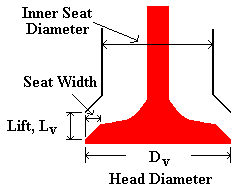
Figure 1. Schematic of the Valve and Valve Port
Generally the inlet port is circular, and about 44-48% of the size of the cylinder bore, no larger than needed to produce the desired power.
Another geometric parameter of a valve is the lift. When the value is just above the seat, it is considered to be low lift. At low lift the inlet flow remains attached to the valve seat, taking the form of a wall jet. At intermediate lift, the flow begins to separate from the valve head at the inner edge of the valve seat. Finally at high lift, the flow separates from the inner edge of the valve seat as well, taking the form of a free jet.
The following two applets shows the behavior of the flow as the value opens.
Intake:
http://www.engr.colostate.edu/~allan...et/poppet.html
Exhaust:
http://www.engr.colostate.edu/~allan.../expoppet.html
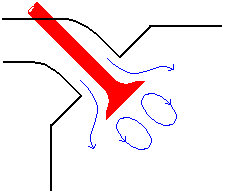
Due to the constant opening and closing of the valves, the cross sectional area through which the flow passes through changes. This area is referred to as the effective area. This area is defined as:
Ae = Ac (q ) Cd(q)
Where:
Ac = curtain area
Cd = discharge coefficient
The curtain area, Ac, can be defined in several ways. A simple definition of the curtain area is given by:
Ac = 3.14159*Dv Lv
Where:
Dv = diameter of the valve
Lv = lift
The lift and the discharge coefficient both vary with the crank angle. The discharge coefficient is determined experimentally. This coefficient accounts for the real gas flow effects. The discharge coefficient decreases slightly with lift since the jet fills less of the reference curtain area as it transforms from an attached jet to a separated free jet. A representative value of the discharge coefficient is Cd = 0.6.
The lift and Cd are determined from experiment. If the lift and Cd profiles are known , the effective area can be found as a function of the crank angle. The following applet, Intake Effective Area Applet http://www.engr.colostate.edu/~allan...a/effarea.html , determines the effective area as defined above.
The exhaust process is broken up into two parts: the exhaust blowdown and the exhaust stroke. The exhaust blowdown is modeled as a constant volume process, and the exhaust stroke is modeled as a constant pressure process. When the exhaust valve opens, the cylinder pressure is usually high enough so that sonic flow occurs at the valve and blowdown is very rapid.
The opening and closing of the exhaust and inlet valve overlap each other. The following figure shows the overlapping of the two valves.
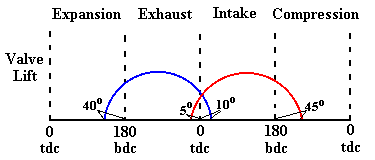
Figure 3. Intake and Exhaust Valve Timing
The inlet valve begins to open before top dead center so that there will be a large effective area, Ae, at the start of induction. The exhaust valve begins to open before bottom dead center to give the combustion products time to escape
The speed of the engine determines how early the exhaust valve opens. At low RPM's the valve opens early and at high RPM's the valve opens late.
Intake and Exhaust Tuning
By proper choice of the length of the intake and exhaust piping, the performance of internal combustion engines can be increased. Inlet and exhaust valve opening and closing creates a compressible flow process in which pressure waves flow back and forth through the inlet and exhaust system. The appropriate pipe length can be estimated through solution of the compressible flow equations. Alternatively, a number of heuristic pipe length equations have been developed.
A pressure wave is created when an intake or exhaust valve is opened. The wave propagates through the the fluid in the pipe at the speed of sound c. When this wave encounters a change in cross sectional area, such as the end of the pipe, a wave of opposite sign will be reflected from the end of the pipe. Based on the time it takes for this wave to return back to the valve, the length of the pipe can be determined.
Intake Valve
For example,when the inlet valve opens, a rarefaction wave is sent upstream from the valve. When this wave encounters a change in area such as the intake manifold, a compression wave is generated and sent downstream back to the inlet valve. This compression wave increases the local density of the inlet flow, a process called the "ram effect".
Experimentally, it has been found that a significant gain in volumetric efficiency is attained when the reflected compression wave returns when the piston is at a crank angle of 90o. At this point the piston velocity is maximum. Matching the time it takes for the wave to return with the characteristic piston time, the required length of the pipe can be found.
The velocity of the wave is given by:
velocity = distance / time
The distance is twice the pipe length, 2L. The time is found from the engine speed.
Solving for the pipe length, L, results in:

The term c is the speed of sound. It is dependent on the temperature T (in degrees Kelvin) of the incoming flow, the air ideal gas constant R, and the specific heat ratio k. The speed of sound is given by the following equation:

Exhaust Valve
When the exhaust valve opens, a compression wave is sent downstream and reflects back as a rarefaction wave when an opening in the exhaust system is encountered. Experimentally it has been found that the optimum position of the piston when the wave returns is 120o. At this position the remaining exhaust gas can be scavenged from the combustion chamber. The required length of the exhaust pipe can then be determined.
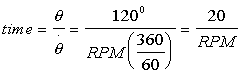

The intake and exhaust pipe length can be determined from the Intake and Exhaust Pipe Length Applet.
http://www.engr.colostate.edu/~allan...ngth/pipe.html
**EDIT** Also found here: http://www.altsale.com/frm.htm
Valve performance plays a significant role in the overall power production of an engine. If the valves are too small, the air flow will be restricted, and the engine torque will decrease. The airflow through the inlet and the exhaust ports of an engine is unsteady, due to the periodic opening and closing of the inlet and the exhaust valves.
There are several types of valves that are used: a poppet, rotary, disc and a sleeve. The most common valve is the poppet valve. The poppet valve is inexpensive and has good sealing properties, making it such a popular choice. The following evaluation will assume poppet valves are used for both the inlet and exhaust ports.
Figure 1. Schematic of the Valve and Valve Port
Generally the inlet port is circular, and about 44-48% of the size of the cylinder bore, no larger than needed to produce the desired power.
Another geometric parameter of a valve is the lift. When the value is just above the seat, it is considered to be low lift. At low lift the inlet flow remains attached to the valve seat, taking the form of a wall jet. At intermediate lift, the flow begins to separate from the valve head at the inner edge of the valve seat. Finally at high lift, the flow separates from the inner edge of the valve seat as well, taking the form of a free jet.
The following two applets shows the behavior of the flow as the value opens.
Intake:
http://www.engr.colostate.edu/~allan...et/poppet.html
Exhaust:
http://www.engr.colostate.edu/~allan.../expoppet.html
Due to the constant opening and closing of the valves, the cross sectional area through which the flow passes through changes. This area is referred to as the effective area. This area is defined as:
Ae = Ac (q ) Cd(q)
Where:
Ac = curtain area
Cd = discharge coefficient
The curtain area, Ac, can be defined in several ways. A simple definition of the curtain area is given by:
Ac = 3.14159*Dv Lv
Where:
Dv = diameter of the valve
Lv = lift
The lift and the discharge coefficient both vary with the crank angle. The discharge coefficient is determined experimentally. This coefficient accounts for the real gas flow effects. The discharge coefficient decreases slightly with lift since the jet fills less of the reference curtain area as it transforms from an attached jet to a separated free jet. A representative value of the discharge coefficient is Cd = 0.6.
The lift and Cd are determined from experiment. If the lift and Cd profiles are known , the effective area can be found as a function of the crank angle. The following applet, Intake Effective Area Applet http://www.engr.colostate.edu/~allan...a/effarea.html , determines the effective area as defined above.
The exhaust process is broken up into two parts: the exhaust blowdown and the exhaust stroke. The exhaust blowdown is modeled as a constant volume process, and the exhaust stroke is modeled as a constant pressure process. When the exhaust valve opens, the cylinder pressure is usually high enough so that sonic flow occurs at the valve and blowdown is very rapid.
The opening and closing of the exhaust and inlet valve overlap each other. The following figure shows the overlapping of the two valves.
Figure 3. Intake and Exhaust Valve Timing
The inlet valve begins to open before top dead center so that there will be a large effective area, Ae, at the start of induction. The exhaust valve begins to open before bottom dead center to give the combustion products time to escape
The speed of the engine determines how early the exhaust valve opens. At low RPM's the valve opens early and at high RPM's the valve opens late.
Intake and Exhaust Tuning
By proper choice of the length of the intake and exhaust piping, the performance of internal combustion engines can be increased. Inlet and exhaust valve opening and closing creates a compressible flow process in which pressure waves flow back and forth through the inlet and exhaust system. The appropriate pipe length can be estimated through solution of the compressible flow equations. Alternatively, a number of heuristic pipe length equations have been developed.
A pressure wave is created when an intake or exhaust valve is opened. The wave propagates through the the fluid in the pipe at the speed of sound c. When this wave encounters a change in cross sectional area, such as the end of the pipe, a wave of opposite sign will be reflected from the end of the pipe. Based on the time it takes for this wave to return back to the valve, the length of the pipe can be determined.
Intake Valve
For example,when the inlet valve opens, a rarefaction wave is sent upstream from the valve. When this wave encounters a change in area such as the intake manifold, a compression wave is generated and sent downstream back to the inlet valve. This compression wave increases the local density of the inlet flow, a process called the "ram effect".
Experimentally, it has been found that a significant gain in volumetric efficiency is attained when the reflected compression wave returns when the piston is at a crank angle of 90o. At this point the piston velocity is maximum. Matching the time it takes for the wave to return with the characteristic piston time, the required length of the pipe can be found.
The velocity of the wave is given by:
velocity = distance / time
The distance is twice the pipe length, 2L. The time is found from the engine speed.
Solving for the pipe length, L, results in:
The term c is the speed of sound. It is dependent on the temperature T (in degrees Kelvin) of the incoming flow, the air ideal gas constant R, and the specific heat ratio k. The speed of sound is given by the following equation:
Exhaust Valve
When the exhaust valve opens, a compression wave is sent downstream and reflects back as a rarefaction wave when an opening in the exhaust system is encountered. Experimentally it has been found that the optimum position of the piston when the wave returns is 120o. At this position the remaining exhaust gas can be scavenged from the combustion chamber. The required length of the exhaust pipe can then be determined.
The intake and exhaust pipe length can be determined from the Intake and Exhaust Pipe Length Applet.
http://www.engr.colostate.edu/~allan...ngth/pipe.html
Thread Starter
6600 rpm clutch dump of death Administrator
Joined: Dec 2001
Posts: 4,983
Likes: 13
From: Texas
Some other info on calculating exhaust system as a function of Exhaust valve opening.
When an exhaust pulse leaves the end of an exhaust pipe a shock wave travels back up the exhaust system. If the pulse arrives at the engine just as the exhaust valve starts to open, it expels the gas without using up excess energy. You can ensure that the pulse will meet the valve at exactly the right moment by calculating the exact length and diameter of the pipe required for the pulse to arrive at the valve at this optimum moment.
Ray advises anyone interested in tuning an exhaust to begin by measuring the engine's RPM using an optical hand-held tachometer. When this is held behind a spinning propeller you will obtain a digital readout of the RPM. If you are wondering about cost and availability, most inspectors have one for calibrating the rev. counter for Permit renewals.
Naturally, you will also need to determine the capacity of your engine, by using the number of cylinders and the capacity of each. Finally, to discover the best length and diameter of pipe for your engine, you will need to know the exhaust valve timing; that is the number of degrees before bottom dead center that the valve starts to open. with this knowledge you can then set about making a tuned exhaust system by working out the following formula and applying it to your own engine:
850 (180 + N)
L = ------------- - P
RPM
where L = length of pipe in inches
N = degree before BDC exhaust valve opens
P = distance from exhaust valve to manifold
and RPM = desired RPM
The diameter of the pipe needs to be calculated so that the volume of the exhaust pipe attached to each cylinder is twice the volume of each cylinder. The exact diameter of the pipe, incidentally, is not critical and should only be used as a guide in determining which standard sized pipe diameter should be used.
As a guide, these are Ray's calculations for the A65 engine. He began with the knowledge that the exhaust valve opens 50 degrees before BDC. The engine capacity was 700 cc per cylinder and the RPM ran at 2,200. His calculations were as follows:
850 (180 + 50)
L = -------------- - 3 in = 223 cm = 88 inches.
2,200
To find the diameter of pipe, Ray used the following formula:
pi r^2 L = 2 * 700cc
pi r^2 * 223 cm = 1400cc
r = 1.4 cm
Diameter = 2.8 cm or 1.1 in
Addendum, by Daniel J.J. Adam
Object: Correction of your assumption concerning the echo of the exhaust: "...Just how he maximizes power and decreases noise is down to two operations; adding a silencer and tuning the exhaust pipes so that the engine will use the least power to drive out the gases in the standard cruise. When an exhaust pulse leaves the end of an exhaust pipe a shock wave travels back up the exhaust system. If the pulse arrives at the engine just as the exhaust valve starts to open, it expels the gas without using up excess energy. You can ensure that the pulse will meet the valve at exactly the right moment by calculating the exact length ..."
Explanation:
When the compression wave (blowdown shock wave) reach the opened end of the pipe, it's return an expansion wave to the exhaust port.
If this expansion wave reach the opened exhaust valve just before closing (ex: crank angle > plus 10 deg), but after the intake valve opend (ex: crank angle > minus 5 deg), and the effective cylinder volme is small (near TDC), the expansion wave will flow through the intake port upto the intake atmosphere increasing the aspiration.
In the graphed case, the exhaust pipe lenght, in degree, is [ (40+180+10) / 2 ] 115 degrees (divided by two because back & forth travel) at the maximum targeted RPM and Exhaust Gaz Temperature, Tk, (in kelvin).
Always in the graphed case, the intake pipe lenght, in degree, is [ (5+180+45) / 2 ] 115 degrees (divided by two because back & forth travel) at the maximum targeted RPM and Intake Gaz Temperature, Tk, (in kelvin).
Consider the wave speed, Ws, formula as [ Ws = sqrt( Gg * Ry * Tk ) ], where Ge is the "specific heat ratio" for exhaust or intake gaz, and Ry is the "ideal gaz constant". By use, the maximum targeted RPM is the RPM where you actually reach the maximum HP.
At a lower RPM than the maximum targeted RPM, the expansion wave will reach the exhaust port before the exhaust valve close, and may be before the intake valve open, therefore, causing suction into the cylinder chamber (that is very good).
Conclusion:
Then, to resume the correction of your assumption concerning the echo of the exhaust, the echo should return before the exhaust valve closed instead of the next opening. This correction reduce the overall length (and weight) of the pipe.
Important remark: The assertion "The expansion wave, from the opened end pipe, should return at the exhaust valve closure" is applicable only and only if it's a 4-stroke engine. For a 2-stroke engine, a more complex explanation is necessary.
When an exhaust pulse leaves the end of an exhaust pipe a shock wave travels back up the exhaust system. If the pulse arrives at the engine just as the exhaust valve starts to open, it expels the gas without using up excess energy. You can ensure that the pulse will meet the valve at exactly the right moment by calculating the exact length and diameter of the pipe required for the pulse to arrive at the valve at this optimum moment.
Ray advises anyone interested in tuning an exhaust to begin by measuring the engine's RPM using an optical hand-held tachometer. When this is held behind a spinning propeller you will obtain a digital readout of the RPM. If you are wondering about cost and availability, most inspectors have one for calibrating the rev. counter for Permit renewals.
Naturally, you will also need to determine the capacity of your engine, by using the number of cylinders and the capacity of each. Finally, to discover the best length and diameter of pipe for your engine, you will need to know the exhaust valve timing; that is the number of degrees before bottom dead center that the valve starts to open. with this knowledge you can then set about making a tuned exhaust system by working out the following formula and applying it to your own engine:
850 (180 + N)
L = ------------- - P
RPM
where L = length of pipe in inches
N = degree before BDC exhaust valve opens
P = distance from exhaust valve to manifold
and RPM = desired RPM
The diameter of the pipe needs to be calculated so that the volume of the exhaust pipe attached to each cylinder is twice the volume of each cylinder. The exact diameter of the pipe, incidentally, is not critical and should only be used as a guide in determining which standard sized pipe diameter should be used.
As a guide, these are Ray's calculations for the A65 engine. He began with the knowledge that the exhaust valve opens 50 degrees before BDC. The engine capacity was 700 cc per cylinder and the RPM ran at 2,200. His calculations were as follows:
850 (180 + 50)
L = -------------- - 3 in = 223 cm = 88 inches.
2,200
To find the diameter of pipe, Ray used the following formula:
pi r^2 L = 2 * 700cc
pi r^2 * 223 cm = 1400cc
r = 1.4 cm
Diameter = 2.8 cm or 1.1 in
Addendum, by Daniel J.J. Adam
Object: Correction of your assumption concerning the echo of the exhaust: "...Just how he maximizes power and decreases noise is down to two operations; adding a silencer and tuning the exhaust pipes so that the engine will use the least power to drive out the gases in the standard cruise. When an exhaust pulse leaves the end of an exhaust pipe a shock wave travels back up the exhaust system. If the pulse arrives at the engine just as the exhaust valve starts to open, it expels the gas without using up excess energy. You can ensure that the pulse will meet the valve at exactly the right moment by calculating the exact length ..."
Explanation:
When the compression wave (blowdown shock wave) reach the opened end of the pipe, it's return an expansion wave to the exhaust port.
If this expansion wave reach the opened exhaust valve just before closing (ex: crank angle > plus 10 deg), but after the intake valve opend (ex: crank angle > minus 5 deg), and the effective cylinder volme is small (near TDC), the expansion wave will flow through the intake port upto the intake atmosphere increasing the aspiration.
In the graphed case, the exhaust pipe lenght, in degree, is [ (40+180+10) / 2 ] 115 degrees (divided by two because back & forth travel) at the maximum targeted RPM and Exhaust Gaz Temperature, Tk, (in kelvin).
Always in the graphed case, the intake pipe lenght, in degree, is [ (5+180+45) / 2 ] 115 degrees (divided by two because back & forth travel) at the maximum targeted RPM and Intake Gaz Temperature, Tk, (in kelvin).
Consider the wave speed, Ws, formula as [ Ws = sqrt( Gg * Ry * Tk ) ], where Ge is the "specific heat ratio" for exhaust or intake gaz, and Ry is the "ideal gaz constant". By use, the maximum targeted RPM is the RPM where you actually reach the maximum HP.
At a lower RPM than the maximum targeted RPM, the expansion wave will reach the exhaust port before the exhaust valve close, and may be before the intake valve open, therefore, causing suction into the cylinder chamber (that is very good).
Conclusion:
Then, to resume the correction of your assumption concerning the echo of the exhaust, the echo should return before the exhaust valve closed instead of the next opening. This correction reduce the overall length (and weight) of the pipe.
Important remark: The assertion "The expansion wave, from the opened end pipe, should return at the exhaust valve closure" is applicable only and only if it's a 4-stroke engine. For a 2-stroke engine, a more complex explanation is necessary.


Thread Starter
6600 rpm clutch dump of death Administrator
Joined: Dec 2001
Posts: 4,983
Likes: 13
From: Texas
Here is a novel thought. We have discussed how many folks go for the LSA myth. As said before if you need a wide LSA, then the duration is too big for the job. Now, lets look at a wide LSA cam vs a cam that was spec'd for a specific purpose.
This is from GMHTP in an article by David Vizard. David took a stock cam for a GenI SBC, and then swapped it out for a "box" cam. Then he switched if for a custom grind which took the important engine paramters into consideration.
The Stock type cam was a 260/270 (gross duration) with a 112 LSA and 41 degrees of overlap.
The cam was swapped for a Brand X off the shelf cam (278/290 114LSA 56 degrees of overlap ( I think I actually used to have this cam in my 383 I think it is a Crane HMV-278). Anyhow, this cam was a bit soggy under 3000RPM, but over 3500 it woke up and made a 45 HP increase over the stock cam (which isn't bad).
Now, when you actually look at what the motor needs you end up with a cam that is radically different. You end up really needing a cam that is a 272/278 on a 108 LSA with 58 degrees of overlap.
So, what happens?
Not only does this cam make more top end power, more mid range power, but it also made more low end power. In other words, and increase across the board. At low end it was +15HP over stock. The stock cam idles at 18" of vac, and @ 600RPM. Both aftermarket cams made 15-16" of Vac and idled @ 650.
So, you are saying, there is no way a cam with a 108LSA can idle like a cam with a 114. The simple answer is, yes it can. And on top of it it can drive better and make more power...
The simple answer is that a correctly spec'd cam may look a bit odd, but if designed correctly it'll make more power thana "box" cam and do it better than a generic box cam that has a million and one possible uses, none of them particularly ideal...
BTW when you run the numbers on the three cams in a 3200 lb car with a 2200 stall here is how they shake out in some drag race software.
Stock - 13.55 @100.4
Box - 13.01@106.93
Custom - 12.80@108.31
Which one do you want?
This is from GMHTP in an article by David Vizard. David took a stock cam for a GenI SBC, and then swapped it out for a "box" cam. Then he switched if for a custom grind which took the important engine paramters into consideration.
The Stock type cam was a 260/270 (gross duration) with a 112 LSA and 41 degrees of overlap.
The cam was swapped for a Brand X off the shelf cam (278/290 114LSA 56 degrees of overlap ( I think I actually used to have this cam in my 383 I think it is a Crane HMV-278). Anyhow, this cam was a bit soggy under 3000RPM, but over 3500 it woke up and made a 45 HP increase over the stock cam (which isn't bad).
Now, when you actually look at what the motor needs you end up with a cam that is radically different. You end up really needing a cam that is a 272/278 on a 108 LSA with 58 degrees of overlap.
So, what happens?
Not only does this cam make more top end power, more mid range power, but it also made more low end power. In other words, and increase across the board. At low end it was +15HP over stock. The stock cam idles at 18" of vac, and @ 600RPM. Both aftermarket cams made 15-16" of Vac and idled @ 650.
So, you are saying, there is no way a cam with a 108LSA can idle like a cam with a 114. The simple answer is, yes it can. And on top of it it can drive better and make more power...
The simple answer is that a correctly spec'd cam may look a bit odd, but if designed correctly it'll make more power thana "box" cam and do it better than a generic box cam that has a million and one possible uses, none of them particularly ideal...
BTW when you run the numbers on the three cams in a 3200 lb car with a 2200 stall here is how they shake out in some drag race software.
Stock - 13.55 @100.4
Box - 13.01@106.93
Custom - 12.80@108.31
Which one do you want?

On The Tree
Joined: Jul 2004
Posts: 161
Likes: 0
That seems kinda odd, that the stock cam actually had higher trap speeds than either of the aftermarket cams even though they made more power.
Care to explain that one?
Didn't DV also compare a nitrous grind in that article? What issue was it?
Care to explain that one?
Didn't DV also compare a nitrous grind in that article? What issue was it?