



Effects of piston speed.

TECH Fanatic
Joined: Jun 2002
Posts: 1,979
Likes: 3
From: Upstate NY

Originally Posted by foryorent
OK, so with all high end engine internals could you use a stock LS7 bore and stroke to make peak power at 6800 or where ever it makes peak power now, but be able to rev to 8,000 rpm when you want to without blowing up the engine or having it last only a year or two. I know power would be down at 8,000 rpm, but I would not go there too often. Just want to be able to run out gears longer and hear the magic of 8,000 rpm once and a while.
So can you run a 4" or larger stroke at 8,000 rpm?
So can you run a 4" or larger stroke at 8,000 rpm?
8000 stresses the internals about 30% more than 7000. If you are talking LS7 with it's Ti rods and fairly lightweight piston and it's 7000 rev limit, I suspect you might shorten it's life considerably buzzing to 8000 unless you lighten the piston/pin/ring package considerably, say 125-150 gms. Remember those piston loads (@ TDC) are not only trying to pull the cap off the rod, they are also pulling on the crank.
When GM Racing did the Cadillac CTSV-R engine which originally was allowed to race @ 7900 max by the sanctioning body, they basically put a 4.8L crank stroke in an LS7 to get 5.7L! That's 83 mm or about 3.27 in. vs. 4.00 inches. That took about 1000 ft/min out of the 7.0 L piston speed. That didn't last long because the car was so fast at Sebring, so they got limited to about 7100. My guess its they thought that might happen during the initial design.
Sure you can run a 4 inch stroke @ 8000 if your valvetrain can control things. The question is how long will the engine tolerate it? If you feel lucky, go to it. I wouldn't because I'd rather not run over my crank. I would rather put in a non-linear tach that read 6000 @ 6000, 7000 @ 6500, 7500 @ 6800 and 8000 @ 7100 or so. I just wouldn't tell whoever I let drive it (magazine writer?) about the tach.


On The Tree
Joined: Nov 2005
Posts: 184
Likes: 0

There is a lot of print worthy info in this column! I want to add this to subject: what about piston speed effects on ring stability, flutter and seal? Wouldnt this sealing control dictate power peak? Rpm is probably just as important as a influence to this as piston speed. I would think Pro stock motor at 10k would be fighting for productive ring seal as much as valve control. What do you guys think?

TECH Resident
Joined: Dec 2004
Posts: 845
Likes: 0
From: K-W, Ontario
It's tough to speculate on this level, but I'd like to throw out my ideas:
I'm thinking valve control at high RPM is a definite concern - especially upon
closing. Any sort of bounce is going to kill combustion pressure.
I've seen huge benefits of spring changes, or REV kits on street motors in the
5000-7000 RPM range, so I can believe there is power to be made with valve
control at 10,000 +.
There are several articles claiming power gains by eliminating mass at the valve,
retainer, upper spring area, etc. so I'll agree valve control is a limiting factor.
I have no idea how fluids/gas react at extreme piston speeds, but I would
assume a gas under vacuum will behave better than a gas which is 'pushed'
into the cylinder due to its viscosity.
When it comes to piston mass and high RPM, I think it's equally as important
as valve mass. 300+ grams at 10,000 RPM can certainly exceed tensile limits
of rod caps in a hurry I'm sure, and increase the maintenance period.
All the talk about Inertia can't be ignored. The time it will take to accelerate
the piston with a heavier mass will change how the air flows through the port.
Having 8 pistons slugging around is certainly going to reduce the efficiency of
the motor (energy required to turn rotating assembly). This would result in
poor BSFC correct?
My last thoughts are RPM brings heat. Oil cooling, heat transfer from the piston
crown to the cylinder walls must be considered.
Ring flutter and crankcase pressures and pressure above the piston increase
as the piston speed/RPM increases. Gas porting is probably a good idea.
How about the profile of the ring itself (contact area)?
All I have to say is, I've brainstormed for about 20 minutes and I'm sure these
engine builders have days of considerations beyond what we're coming up with.
Cheers to you both in this discussion!
I'm thinking valve control at high RPM is a definite concern - especially upon
closing. Any sort of bounce is going to kill combustion pressure.
I've seen huge benefits of spring changes, or REV kits on street motors in the
5000-7000 RPM range, so I can believe there is power to be made with valve
control at 10,000 +.
There are several articles claiming power gains by eliminating mass at the valve,
retainer, upper spring area, etc. so I'll agree valve control is a limiting factor.
I have no idea how fluids/gas react at extreme piston speeds, but I would
assume a gas under vacuum will behave better than a gas which is 'pushed'
into the cylinder due to its viscosity.
When it comes to piston mass and high RPM, I think it's equally as important
as valve mass. 300+ grams at 10,000 RPM can certainly exceed tensile limits
of rod caps in a hurry I'm sure, and increase the maintenance period.
All the talk about Inertia can't be ignored. The time it will take to accelerate
the piston with a heavier mass will change how the air flows through the port.
Having 8 pistons slugging around is certainly going to reduce the efficiency of
the motor (energy required to turn rotating assembly). This would result in
poor BSFC correct?
My last thoughts are RPM brings heat. Oil cooling, heat transfer from the piston
crown to the cylinder walls must be considered.
Ring flutter and crankcase pressures and pressure above the piston increase
as the piston speed/RPM increases. Gas porting is probably a good idea.
How about the profile of the ring itself (contact area)?
All I have to say is, I've brainstormed for about 20 minutes and I'm sure these
engine builders have days of considerations beyond what we're coming up with.
Cheers to you both in this discussion!

TECH Junkie
Joined: Aug 2002
Posts: 3,726
Likes: 0
From: Fort Collins, CO
Yes you can absolutely build an 8,000 RPM 4.000" stroke LS1. You can use steel rods and hollow-stem valves and a street-roller camshaft and have one bad dude engine. The FAST 90 intake will be a huge restriction so you might have to go to a sheet-metal intake or a carburated style intake, even though I'm not sure how good those things are. They might be worse than a Fast 90 afterall.
8000+ rpm? If you have heads and intake that will let you make power up there, then 8000 is not a prob if drag racing. I spun my last 4" stroke ls1 above 8000 at the track, because it was still making some power. Not once did I ever have a bearing problem, or oiling issue. Granted, this was using billet rods, and a good crank, but a rather heavy piston. Bearings looked like new upon teardown after about a year.
When GM Racing did the Cadillac CTSV-R engine which originally was allowed to race @ 7900 max by the sanctioning body, they basically put a 4.8L crank stroke in an LS7 to get 5.7L!
IMHO, it's the best b/s combination.


Thread Starter
Teching In
Joined: Jan 2006
Posts: 18
Likes: 0
Don't you loose a lot of your power by destroking. You drop from 7 to 5.7L. Is the power still good in the lower RPM range?
The LS& already uses forged psitons, right. So how could I possibly reduce the weight of the piston/pin/ring package by 100 - 150 grams?
The LS& already uses forged psitons, right. So how could I possibly reduce the weight of the piston/pin/ring package by 100 - 150 grams?
Don't you loose a lot of your power by destroking. You drop from 7 to 5.7L. Is the power still good in the lower RPM range?
The LS7 already uses forged psitons, right.
LS1 Tech Stories
The Best V8 Stories One Small Block at Time

Top 10 Greatest Cadillac V Series Performance Models Ever, Ranked
Pouria Savadkouei
Top 10 Most Powerful Chevy Trucks Ever Made!

Hennessey's New Supercharged Silverado ZR2 Has 700 HP
Verdad Gallardo
Coachbuilt N2A Anteros Is an LS2-Powered C6 Corvette In Italian Clothes
Verdad Gallardo
Awesome K5 Blazer Restomod Comes With C7 Corvette Power
Verdad Gallardo
10 Camaros You Should Never Buy

10 LS Engine Myths That Refuse to Die
Verdad Gallardo
Five Reasons the Camaro Was the Most Pivotal Player in the Pony Car Wars 2.0
Brett Foote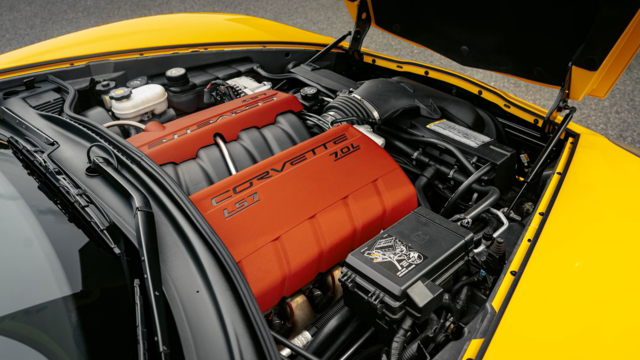
10 Reasons the LS7 Is GM's Most Extreme Naturally Aspirated V8 Engine Ever
Verdad Gallardo TECH Fanatic
Joined: Jun 2002
Posts: 1,979
Likes: 3
From: Upstate NY
Originally Posted by foryorent
Don't you loose a lot of your power by destroking. You drop from 7 to 5.7L. Is the power still good in the lower RPM range?
The LS& already uses forged psitons, right. So how could I possibly reduce the weight of the piston/pin/ring package by 100 - 150 grams?
The LS& already uses forged psitons, right. So how could I possibly reduce the weight of the piston/pin/ring package by 100 - 150 grams?
The displacement limit for the CTSVR was 5.7L, but instead of the 3.9 x 3.62 LS1/6 b/s they went the big bore short stroke way. Sure if 7L was allowed like on the C5R/C6R they'd use it. FWIW, even though LeMans C6Rs have an intake restrictor, you might be surprised at the rpm they run. 5's not 6's or 7's. HP curve peaks very early and stays basically flat.
A large weight reduction would be the problem. Enough money spent with the correct piston people would help. F1 folks initially had piston problems when they went to 2 races on a engine. They did a lot of development of piston configuration to make 'em stronger and yet shave off a few grams. Some may have gone from aluminum to Metal Matrix Composite (MMC) but they wouldn't say one way or the other. There are some new shapes/structures in Cup pistons being tried, but they have a minimum weight rule. Nothing says you can't make the structure work more efficiently or move the heat around more evenly.
Piston cooling with oil spraying under the crown is common and necessary on many race engines. Of course it's also used in some production engines. Too little oil and the piston gets too hot, while too much oil flails around and increases friction hp loss. Better aiming of the oil helps.

TECH Resident
Joined: Dec 2004
Posts: 881
Likes: 1
Boy, this thread is all over the place. An a little hostile at times.
Basically, there is always a limitation. It could be a function of the stiffness, strength, elasticity, flow, packaging, heat dissapation, rules Something.
Most of the racing issues focus around rules. For example, why else would you build a 9,000 rpm wet sump LS1?
You could take a 10,000 rpm engine and change the piston pin to make it a 7,000 rpm engine. Or a valve spring. Or the intake port shape.
An LS7 has production car parts. It is a cast piston. 480gms is a weight for a 500hp, 7000rpm STEEL rod (Crower Maxilite 94 with Honda journals). You could probably take a lot off the piston, pin, rings, and rod. And that would result it a bit off the crank.
You will need solid lifters and big springs. Which probably means an aftermarket head.
Any sort of decent 8,000 rpm 427 will be way over 650hp. You probably couldn't hear the difference. And your electronics will need to be custom.
In NJ, you wouldn't be able to title an Ultima with tht engine because of emissions rules.
If you are building an Ultima, presumably with a $100k budget or so, building an 8000 rpm 350 - 366, say 4.155x3.335, with a Harrop or similar ITB, appropriate heads and cam would allow you to have real 8000 rpm 650hp motor that is fully streetable. Valve springs may be part of your normal maintenace, say annual or 15k mile replacement.
However, a stock LS7 with a nice exhaust will probably sound the same for practical purposes and might get past emissions.
Basically, there is always a limitation. It could be a function of the stiffness, strength, elasticity, flow, packaging, heat dissapation, rules Something.
Most of the racing issues focus around rules. For example, why else would you build a 9,000 rpm wet sump LS1?
You could take a 10,000 rpm engine and change the piston pin to make it a 7,000 rpm engine. Or a valve spring. Or the intake port shape.
An LS7 has production car parts. It is a cast piston. 480gms is a weight for a 500hp, 7000rpm STEEL rod (Crower Maxilite 94 with Honda journals). You could probably take a lot off the piston, pin, rings, and rod. And that would result it a bit off the crank.
You will need solid lifters and big springs. Which probably means an aftermarket head.
Any sort of decent 8,000 rpm 427 will be way over 650hp. You probably couldn't hear the difference. And your electronics will need to be custom.
In NJ, you wouldn't be able to title an Ultima with tht engine because of emissions rules.
If you are building an Ultima, presumably with a $100k budget or so, building an 8000 rpm 350 - 366, say 4.155x3.335, with a Harrop or similar ITB, appropriate heads and cam would allow you to have real 8000 rpm 650hp motor that is fully streetable. Valve springs may be part of your normal maintenace, say annual or 15k mile replacement.
However, a stock LS7 with a nice exhaust will probably sound the same for practical purposes and might get past emissions.

FormerVendor
Joined: Nov 2001
Posts: 3,065
Likes: 6
From: Houston, Tx.

Originally Posted by Old SStroker
Too bad. I thought we might have a little out of the box brainstorming going on. As a parting thought on this subject, could it be max. piston acceleration, not piston speed that is a limiting fator, or could that be a benefit rather than a limit? Perhaps only the gas particles in the inlet tract and Mother Nature know for sure.
It's been a slice of life, Eric.
Stay cool.
Jon
"We now return you to our regularly scheduled reality programming."
It's been a slice of life, Eric.
Stay cool.
Jon
"We now return you to our regularly scheduled reality programming."
FormerVendor
Joined: Nov 2001
Posts: 3,065
Likes: 6
From: Houston, Tx.
Originally Posted by foryorent
OK, so with all high end engine internals could you use a stock LS7 bore and stroke to make peak power at 6800 or where ever it makes peak power now, but be able to rev to 8,000 rpm when you want to without blowing up the engine or having it last only a year or two. I know power would be down at 8,000 rpm, but I would not go there too often. Just want to be able to run out gears longer and hear the magic of 8,000 rpm once and a while.
So can you run a 4" or larger stroke at 8,000 rpm?
So can you run a 4" or larger stroke at 8,000 rpm?
FormerVendor
Joined: Nov 2001
Posts: 3,065
Likes: 6
From: Houston, Tx.
Originally Posted by LSwonderfull
There is a lot of print worthy info in this column! I want to add this to subject: what about piston speed effects on ring stability, flutter and seal? Wouldnt this sealing control dictate power peak? Rpm is probably just as important as a influence to this as piston speed. I would think Pro stock motor at 10k would be fighting for productive ring seal as much as valve control. What do you guys think?
TECH Resident
Joined: Dec 2004
Posts: 881
Likes: 1
While we are on the subject, what parts are made out of titanium or even more exotic materials. We known about valves, retainers, keepers, and rods in titanium. What about springs and pins? What about other materials? What about pistons?
FormerVendor
Joined: Nov 2001
Posts: 3,065
Likes: 6
From: Houston, Tx.
We also see again when we look at the 510 inch engine that won the latest Engine Masters Challenge that it is also a smaller bore longer stroke engine all over again that took the money as it has been year after year. Lennart Bervquist ran a 4.250 stock bore big block chevy with a Sonny Bryant 4.480 custom stroker crank to come out on top this time. Lennart also builds various race engines including PS and yet chose as other PS engine builders did that entered this contest to run a huge stroke and small bore and this time also 11.5 to one compression as well. Kaase was close but ran too much compression and ate his Pontiac motor up. It was also a small bore long stroke engine as usual.
Keep in mind that these guys do run huge 4.700+ bore stuff too on all out competition engines but when they don't need the bore for breathing they usually shrink it up and add stroke to get the rest of their inches and here it is in action and winning the competion too.
Keep in mind that these guys do run huge 4.700+ bore stuff too on all out competition engines but when they don't need the bore for breathing they usually shrink it up and add stroke to get the rest of their inches and here it is in action and winning the competion too.
FormerVendor
Joined: Nov 2001
Posts: 3,065
Likes: 6
From: Houston, Tx.
Originally Posted by DavidNJ
While we are on the subject, what parts are made out of titanium or even more exotic materials. We known about valves, retainers, keepers, and rods in titanium. What about springs and pins? What about other materials? What about pistons?

Originally Posted by racer7088
We also see again when we look at the 510 inch engine that won the latest Engine Masters Challenge that it is also a smaller bore longer stroke engine all over again that took the money as it has been year after year.
I'm sure "we" also won, PS and Nextel Cup championships this year.... funny thing is that every super smart SAM grad I've ever met has all told me the same thing, they learn a ton more after school than they do in it. They just learn the basics much faster with you guys and the hands on stuff. I've even taught a few guys more about camshafts in a hour than they said they learned the whole time they were there.
Eric, I don't know about you but I can only claim that a motor I turned a nut on is something that I built, or a cam/valvetrain I designed and sold to a customer is something I am a part of. Thanks are always great when you get a guy where he wants to go, but they always do the hard part, paying for it and wrenching on it.
Just venting.... you gain some respect from me every now and then and then do something stupid like this thread and well.... go back on the **** list.
I really think you should move up to F1 if you are as smart as you think you are, maybe that "we" in your statements can be BMW, Toyota or Renault..... hell who knows it probably is already, I'm sure a buddy of a friend of a brother of yours does something for them.
Back to the real world.
Bret
TECH Resident
Joined: Dec 2004
Posts: 881
Likes: 1
Originally Posted by racer7088
The pins and springs are made of steel and the pistons are aluminum or course.
It is my understanding that coated Ti pins and Ti valve springs are used in high level racing. Obviously F-1 uses pneumatic valve springs.
The Ti springs especially seem like they would be a good fit for the small spring LS1/2/6 heads.
Does the LSx have any oiling problems?
Last edited by DavidNJ; Jan 20, 2006 at 11:30 PM.
FormerVendor
Joined: Nov 2001
Posts: 3,065
Likes: 6
From: Houston, Tx.
Originally Posted by SStrokerAce
Yeah right, how's that drive to work from Houston to Florida everyday?
I said WE as in US in this thread looking at that engine! You need to probably listen more and talk less and read more carefully yourself on these threads. You were simply WRONG about this topic and now you can't deal with it. Just grow up and admit that piston speed is not the best indicator of a mechanical limit on an engine. I have provided AMPLE examples to prove my point and you can provide NONE to support yours. That's all there is to it. Your dad has conceded that piston speed is not going to tell you how much load is on a rotating assembly and he is a degreed engineer. Don't you believe him either?
Your extreme jealously of the school is totally obvious to EVERYONE on LS1Tech and makes you look like a complete buffon. I receive emails about it just like your asinine comments about Rick's car and it having problems with a stock block (LT1) that was going almost 180 mph with bargain basement parts! Let's see you do anything like this yourself as I've already done it. I've built 178 engines at my shop in the last 2 years at my shop Bret and I have had precious few problems either. These included deals running in the 7s, 8s, 9s, 10s and slower. I hope you know I run my own shop as well as teach up there at the school.
I also know 100 times as many of our students as you do! OF COURSE they continue learning after they leave as I would sure hope they do! Every student that has come through SAM knows me and I talk with many every week. They are in every cup shop and ps shop out there. I have three guys I was in College with and one that was a roomate for several years that works in England on F1 engines. I'm real sorry if that makes you mad but that's just the way it's worked out.

PS. BTW Bret we do have a former student (Justin Haws) that did those heads for Lennart but does not work at Autoshop in case you didn't know (which I know you don't) and he was at our shop right here in Houston before he found that job. Again do you also think Lennart is a fool for running so much stroke and only the stock bore on his BBC EMC engine? I don't.

