


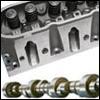




Ls3

Originally Posted by chuntington101
ok i have a question, why is GM doing this?? what do they intend to use this engine in?? why didn't thye just use the LS7 in a detuned version??
also on a more technical note what do you guys think GM could get out of the LS7 heads in term of flow?? are they at their limits now as far as a production unit is concerned??
also on a more technical note what do you guys think GM could get out of the LS7 heads in term of flow?? are they at their limits now as far as a production unit is concerned??
The second reason would be to sell volumes of a lower output powerplant for the potential cost savings. If the heads are being CNC machined at a high cost, they may be able to run them as cast on a less exotic 7.0L engine for trucks. By less exotic I mean pistons, rods and valvetrain more suited for lower rpm and lower accelerations at the valves. I still doubt this engine would replace the 8.1L BBC, but that would be the only way I'd see it happening.
Now whether or not it is a possiblity for the upcoming Camaro is hard to say. There are seveal engines out there to choose from. Seems the L92 might be a good candidate. One thing has changed since the introduction of the LT1 engine - GM has been continually developing their powerplants ever since. If you can believe what you read, the old SBC assembly line had been in use so long it was ready to fall apart. Now newer innovations are coming our way in a span of 5-7 years.
LT1 - 1992, Vortec L31 heads - 1996
LS1 - 1997, LS6 - 2001, LS2 - 2005
LS7 - 2006, L92 - 2007, ???
Originally Posted by treyZ28
Have you ever seen a 4.6 DOHC ford engine? Its huge compared a 6.0 GM OHV engine with 25% less displacement! And those engines have very small bores and long strokes. If that thing was even square, it would be much bigger.
I never said OHC was "too" complex; I said it was "more" complex.
All things equal, BSFC is worse with DOHC, which is what I said if you read the fine print. "4 valves... (assuming it requires OHC) "
I never said OHC was "too" complex; I said it was "more" complex.
All things equal, BSFC is worse with DOHC, which is what I said if you read the fine print. "4 valves... (assuming it requires OHC) "
Originally Posted by RussStang
Why is HP/L for morons? Just because it is an attribute of an engine that pushrod engines typically don't fare as well in compared to their OHC counterparts? How about torque/L? Can we look at that, and not be considered morons? OHC engines typically do better in that department as well.

TECH Fanatic
Joined: Oct 2002
Posts: 1,842
Likes: 0
From: Dallas, North Mexico
Originally Posted by Bud M
As a matter of fact I happen to own a 96 Lincoln with a DOHC 4.6. You say its huge but the fact is that if fits fine in a car that is pretty much the same dimensions as a 4th gen F body. And what you think is an engine with a small bore and long stroke has a bore x stroke of 3.55 x 3.54 in. And you keep claiming that a different valve actuation arrangement will make an engine inherently less efficient without offering any supporting evidence. Do you just make this stuff up as you go?
Are we dancing around the obvious? a DOHC engine is better than a OHC engine. Therefore, the OHC engine can fit in a smaller engine bay: Advantage.
More bore = longer V engine = bigger engine. i
Sorry, it was the 5.4 that was way under square; the 4.6 is just barely undersquare. Either way, both engines are huge and they have less displacement than a gm LSx engine.
Dancing around the obvious. Hmmm... how bout this for obvious? 3.55 bore and 3.54 stroke is not "slightly undersquare".
Still waiting for you to back up your claim that OHC is inherently less efficient in terms of BSFC.
Still waiting for you to back up your claim that OHC is inherently less efficient in terms of BSFC.
TECH Fanatic
Joined: Oct 2002
Posts: 1,842
Likes: 0
From: Dallas, North Mexico
Originally Posted by Bud M
Dancing around the obvious. Hmmm... how bout this for obvious? 3.55 bore and 3.54 stroke is not "slightly undersquare".
Still waiting for you to back up your claim that OHC is inherently less efficient in terms of BSFC.
Still waiting for you to back up your claim that OHC is inherently less efficient in terms of BSFC.
Apparently, we gave up on reading too

Sorry, it was the 5.4 that was way under square; the 4.6 is just barely undersquare.
When you have some sort of data to tell me that spinning 4 cams, opening/closing 2x as many valves and having a much, much longer timing chain is more efficient, I'll say "sorry, I was misinformed." Until then, I'm going to believe what i've heard because it inherently makes more sense.
I'm still waiting to hear about how having a larger engine is advantagous
Last edited by treyZ28; Oct 29, 2006 at 10:59 AM.
TECH Fanatic
Joined: Oct 2002
Posts: 1,842
Likes: 0
From: Dallas, North Mexico
Sorry if logic and a professor's lecture is inadequate for you
I'd still awaiting the source of your information, namely that bigger physical size is completely irrelivant and DOHC has better BSFC qualities
I'd still awaiting the source of your information, namely that bigger physical size is completely irrelivant and DOHC has better BSFC qualities
LS1 Tech Stories
The Best V8 Stories One Small Block at Time

6 Gifts Neither Your Dad Nor Grad Will Shove Into the 'Trinket Drawer'
Brett Foote
Topdon ONE vs. Artidiag 800 BT2: Which is the Diagnostic Tablet For You?
Pouria Savadkouei
Gas Monkey Built a 6-Wheel Ferrari Testarossa With a Corvette LT4 Engine
Verdad Gallardo
7 Most Reliable High-Performance Engines GM Has Ever Built
Verdad Gallardo
Amazing '71 Camaro Restomod Is Modern Muscle Car Under the Skin
Verdad Gallardo
6 Common C5 Corvette Failures and What's Involved In Repairing Them
Pouria Savadkouei
Retro Modern Bandit Pontiac Trans AM Comes With Burt Reynolds' Autograph
Verdad Gallardo
Top 10 Greatest Cadillac V Series Performance Models Ever, Ranked
Pouria Savadkouei
Top 10 Most Powerful Chevy Trucks Ever Made!


I wish all these guys wanting dohc 4v motors would go buy them. Then I could show'em my p-rod 2v taillights. I ain't had a dohc motor come around me yet. By the way all this comparing to Bmw and Merc is a joke. Go price a crate motor from them. The M3 6 cyl motor costs about 25k. The M5 motor os more than that. Try to modify themm to get more power, you need custom everything$$$$$. Look at the ford cammer motors, alota dough and not much go.

Launching!
Joined: Mar 2004
Posts: 231
Likes: 0
From: Exton, Pennsylvania
Originally Posted by black_knight
Anything/L is meaningless. The only place it matters is in displacement-limited racing.
I think what you meant to say was anything that makes a pushrod engine look remotely bad is meaningless.
Launching!
Joined: Mar 2004
Posts: 231
Likes: 0
From: Exton, Pennsylvania
Originally Posted by treyZ28
Sorry if logic and a professor's lecture is inadequate for you
I'd still awaiting the source of your information, namely that bigger physical size is completely irrelivant and DOHC has better BSFC qualities
I'd still awaiting the source of your information, namely that bigger physical size is completely irrelivant and DOHC has better BSFC qualities
Your statement about the 4.6 being slightly undersquare was completely wrong, and yet you ignored the correction completely. Again, you are not making a very strong point with these practices.
Launching!
Joined: Mar 2004
Posts: 231
Likes: 0
From: Exton, Pennsylvania
Originally Posted by HioSSilver
I wish all these guys wanting dohc 4v motors would go buy them. Then I could show'em my p-rod 2v taillights. I ain't had a dohc motor come around me yet. By the way all this comparing to Bmw and Merc is a joke. Go price a crate motor from them. The M3 6 cyl motor costs about 25k. The M5 motor os more than that. Try to modify themm to get more power, you need custom everything$$$$$. Look at the ford cammer motors, alota dough and not much go.
Blown Cobra motors are a lot of dough, but that are also a hell of a lot of go.
Originally Posted by RussStang
Torque/L is meaningless? Is torque/L not a rudimentary way to gauge how effective the engine is at bringing air in. Engines are air pumps after all; this stat is interesting.
I think what you meant to say was anything that makes a pushrod engine look remotely bad is meaningless.
I think what you meant to say was anything that makes a pushrod engine look remotely bad is meaningless.
Yes, Tq/L makes a certain degree more sense than HP/L since hp can be cheated by revving higher. But you miss the larger point that selecting for less liters is nonsense. Having less liters won't provide a single iota of performance advantage; in fact it is a big disadvantage. Generally speaking, you want the engine with more liters, not less.
This is not a question of OHC or OHV, although it often comes into play with such debates.
So I maintain my position that HP (or anything else) per liter is pure and total IDIOCY.


TECH Addict
Joined: Aug 2004
Posts: 2,866
Likes: 4
Originally Posted by hammertime
The way I see it, there are two reasons to de-tune the engine. If it is really on the ragged edge, meaning that it is making enough power that it could self destruct in what is considered a normal operating parameter, then detuning by lowerining the output through one of many ways should make it last longer. I don't see this being the issue, as the durability testing I've heard they perform is treacherous stuff - things nobody would ever do to their car. They've tested the platform to a point where they are comfotable that any failures that occur in the field would have happened at any persons hands, not because an enthusaist pushed it too far.
The second reason would be to sell volumes of a lower output powerplant for the potential cost savings. If the heads are being CNC machined at a high cost, they may be able to run them as cast on a less exotic 7.0L engine for trucks. By less exotic I mean pistons, rods and valvetrain more suited for lower rpm and lower accelerations at the valves. I still doubt this engine would replace the 8.1L BBC, but that would be the only way I'd see it happening.
Now whether or not it is a possiblity for the upcoming Camaro is hard to say. There are seveal engines out there to choose from. Seems the L92 might be a good candidate. One thing has changed since the introduction of the LT1 engine - GM has been continually developing their powerplants ever since. If you can believe what you read, the old SBC assembly line had been in use so long it was ready to fall apart. Now newer innovations are coming our way in a span of 5-7 years.
LT1 - 1992, Vortec L31 heads - 1996
LS1 - 1997, LS6 - 2001, LS2 - 2005
LS7 - 2006, L92 - 2007, ???
The second reason would be to sell volumes of a lower output powerplant for the potential cost savings. If the heads are being CNC machined at a high cost, they may be able to run them as cast on a less exotic 7.0L engine for trucks. By less exotic I mean pistons, rods and valvetrain more suited for lower rpm and lower accelerations at the valves. I still doubt this engine would replace the 8.1L BBC, but that would be the only way I'd see it happening.
Now whether or not it is a possiblity for the upcoming Camaro is hard to say. There are seveal engines out there to choose from. Seems the L92 might be a good candidate. One thing has changed since the introduction of the LT1 engine - GM has been continually developing their powerplants ever since. If you can believe what you read, the old SBC assembly line had been in use so long it was ready to fall apart. Now newer innovations are coming our way in a span of 5-7 years.
LT1 - 1992, Vortec L31 heads - 1996
LS1 - 1997, LS6 - 2001, LS2 - 2005
LS7 - 2006, L92 - 2007, ???
all i was trying to say was why not use the LS7 "bits" rather than build a whole new head for a smaller motor?
i guess it was a "in the air" questiuon really but thanks for voicing your opinion.

anyone else want to say something about the WHY????
thanks Chris.
TECH Fanatic
Joined: Oct 2002
Posts: 1,842
Likes: 0
From: Dallas, North Mexico
Originally Posted by RussStang
Your statement about the 4.6 being slightly undersquare was completely wrong, and yet you ignored the correction completely. Again, you are not making a very strong point with these practices.
Sorry, it was the 5.4 that was way under square; the 4.6 is just barely undersquare.

TECH Fanatic
Joined: Oct 2002
Posts: 1,842
Likes: 0
From: Dallas, North Mexico
Originally Posted by RussStang
Torque/L is meaningless? Is torque/L not a rudimentary way to gauge how effective the engine is at bringing air in. Engines are air pumps after all; this stat is interesting.
I think what you meant to say was anything that makes a pushrod engine look remotely bad is meaningless.
I think what you meant to say was anything that makes a pushrod engine look remotely bad is meaningless.
Launching!
Joined: Mar 2004
Posts: 231
Likes: 0
From: Exton, Pennsylvania
Originally Posted by black_knight
I think you totally don't get my point. Bringing liters into the bottom of the equation only serves to select for less liters. From a performace perspective you want MORE liters, not less. You want to select for more power and a better power band with less weight, cost, external size.
Yes, Tq/L makes a certain degree more sense than HP/L since hp can be cheated by revving higher. But you miss the larger point that selecting for less liters is nonsense. Having less liters won't provide a single iota of performance advantage; in fact it is a big disadvantage. Generally speaking, you want the engine with more liters, not less.
This is not a question of OHC or OHV, although it often comes into play with such debates.
So I maintain my position that HP (or anything else) per liter is pure and total IDIOCY.
Yes, Tq/L makes a certain degree more sense than HP/L since hp can be cheated by revving higher. But you miss the larger point that selecting for less liters is nonsense. Having less liters won't provide a single iota of performance advantage; in fact it is a big disadvantage. Generally speaking, you want the engine with more liters, not less.
This is not a question of OHC or OHV, although it often comes into play with such debates.
So I maintain my position that HP (or anything else) per liter is pure and total IDIOCY.
TECH Fanatic
Joined: Oct 2002
Posts: 1,842
Likes: 0
From: Dallas, North Mexico
Originally Posted by RussStang
Read it again, for a third or fourth time. The 4.6 is not undersquare at all. So yes, I think ignored is the appropriate term.
I'm not sure how much more attention you want me to give to this slip up. Not that it changes anything, you have a smaller bore engine with less displacement taking up more volume.