





Offset bores?
 Offset bores?
 I was reading some stuff the other day about the Honda Insight engine using offset bores to move the connecting rod inline with the piston during peak cylinder pressure. I know it would require a custom one off block and I'm not really interested in trying this out myself just curious to see if its ever been done on anything but this motor. Valvetrain would probably also be beyond wacky, when is GM supposed to come out with that OHC LS motor?
Stolen from InsightCentral.net
"The engine block has a unique, offset cylinder design in which the bore center is offset 14mm from the crank center. Maximum combustion pressure occurs at a point where the connecting rod is straight up and down in the cylinder. In this position there is zero lateral force so friction and piston slap are reduced.
As a result of the offset construction, the combustion pressure is used more efficiently since the rod is near it maximum leverage point with the crankshaft."

Stolen from InsightCentral.net
"The engine block has a unique, offset cylinder design in which the bore center is offset 14mm from the crank center. Maximum combustion pressure occurs at a point where the connecting rod is straight up and down in the cylinder. In this position there is zero lateral force so friction and piston slap are reduced.
As a result of the offset construction, the combustion pressure is used more efficiently since the rod is near it maximum leverage point with the crankshaft."

TECH Fanatic
Joined: Jun 2002
Posts: 1,979
Likes: 3
From: Upstate NY
Not long after the highest ambient temperature in Hades is -1°C. Keep your eye on www.weather.com.
Jon
Jon

TECH Fanatic
Joined: Mar 2004
Posts: 1,017
Likes: 0
From: Laguna Niguel, CA
Not long after the highest ambient temperature in Hades is -1°C. Keep your eye on www.weather.com.
Jon
Jon
Agreed, none of the OHC engines can go 200K+ miles without anything but an oil change and plugs. But I'm not debating how proven pushrods are. Is the offset bores thing too far outside of the box? Less piston slap and skirt scuffing as well as a few extra HP seems awsome if you can bring it in with the OEM design.
TECH Fanatic
Joined: Jun 2002
Posts: 1,979
Likes: 3
From: Upstate NY
When GM decided to go with pushrods for the LS series of engines vs. Ford's Modular OHC approach, they committed hundreds of millions, perhaps a billion $ or more by now to the design, development and especially tooling to build the LS pushrod engines for many years. Perhaps it won't run 50 years like the Gen I SBC, but ya' never know.
I have not seen anything that would indicate an LS redesign for OHC. Rather GM has designed, developed and built other OHC engines like the HighValue 3.6L V6. The DI version @ 300+ hp is right in there with the rest of the world's similar engines. However, when bigger NA power or torque is needed, the LS family is avaiable. A 6.0L LS3 version in the G8 is about 1 second quicker in the quarter mile than the similar weight CTS 3.6L DI. The CTS-V is going to get a blown version of the (pushrod) LS engine. I guess we'll see if the 550hp CTS-V competes well with the DOHC entries from the other countries.
FWIW, that's my elaboration of "When Hell freezes over."
Jon
I have not seen anything that would indicate an LS redesign for OHC. Rather GM has designed, developed and built other OHC engines like the HighValue 3.6L V6. The DI version @ 300+ hp is right in there with the rest of the world's similar engines. However, when bigger NA power or torque is needed, the LS family is avaiable. A 6.0L LS3 version in the G8 is about 1 second quicker in the quarter mile than the similar weight CTS 3.6L DI. The CTS-V is going to get a blown version of the (pushrod) LS engine. I guess we'll see if the 550hp CTS-V competes well with the DOHC entries from the other countries.
FWIW, that's my elaboration of "When Hell freezes over."
Jon

TECH Enthusiast
Joined: May 2005
Posts: 689
Likes: 0
From: Perth, Australia
I see the advantage for the power stroke......but wouldn't rod angularity, scuffing,lateral force, slap and friction also be increased (due to the offset) on both of the upstrokes ? No mention of that in the article.
Trending Topics

TECH Enthusiast
Joined: Apr 2005
Posts: 540
Likes: 0
When GM decided to go with pushrods for the LS series of engines vs. Ford's Modular OHC approach, they committed hundreds of millions, perhaps a billion $ or more by now to the design, development and especially tooling to build the LS pushrod engines for many years. Perhaps it won't run 50 years like the Gen I SBC, but ya' never know.
I have not seen anything that would indicate an LS redesign for OHC. Rather GM has designed, developed and built other OHC engines like the HighValue 3.6L V6. The DI version @ 300+ hp is right in there with the rest of the world's similar engines. However, when bigger NA power or torque is needed, the LS family is avaiable. A 6.0L LS3 version in the G8 is about 1 second quicker in the quarter mile than the similar weight CTS 3.6L DI. The CTS-V is going to get a blown version of the (pushrod) LS engine. I guess we'll see if the 550hp CTS-V competes well with the DOHC entries from the other countries.
FWIW, that's my elaboration of "When Hell freezes over."
Jon
I have not seen anything that would indicate an LS redesign for OHC. Rather GM has designed, developed and built other OHC engines like the HighValue 3.6L V6. The DI version @ 300+ hp is right in there with the rest of the world's similar engines. However, when bigger NA power or torque is needed, the LS family is avaiable. A 6.0L LS3 version in the G8 is about 1 second quicker in the quarter mile than the similar weight CTS 3.6L DI. The CTS-V is going to get a blown version of the (pushrod) LS engine. I guess we'll see if the 550hp CTS-V competes well with the DOHC entries from the other countries.
FWIW, that's my elaboration of "When Hell freezes over."
Jon
GM decided to take the so called 'old school' approach. Pushrod V-8 with a Supercharger. Just look how far they took that technology.. amazingly high flowing and efficient cylinder heads, used a 75+% efficient supercharger.. and made 550hp... and they certified it for 100,000+ miles.. That deserves some credit in my book. Just think what it took to have a 550hp engine 10-20 years ago.. there was no way it was going to be as fuel efficient or be as durable.
LS1 Tech Stories
The Best V8 Stories One Small Block at Time

Gas Monkey Built a 6-Wheel Ferrari Testarossa With a Corvette LT4 Engine
Verdad Gallardo
7 Most Reliable High-Performance Engines GM Has Ever Built
Verdad Gallardo
Amazing '71 Camaro Restomod Is Modern Muscle Car Under the Skin
Verdad Gallardo
6 Common C5 Corvette Failures and What's Involved In Repairing Them
Pouria Savadkouei
Retro Modern Bandit Pontiac Trans AM Comes With Burt Reynolds' Autograph
Verdad Gallardo
Top 10 Greatest Cadillac V Series Performance Models Ever, Ranked
Pouria Savadkouei
Top 10 Most Powerful Chevy Trucks Ever Made!

Hennessey's New Supercharged Silverado ZR2 Has 700 HP
Verdad Gallardo
Coachbuilt N2A Anteros Is an LS2-Powered C6 Corvette In Italian Clothes
Verdad Gallardo Good call on that, I didn't even think of how horribly lateral the rod is going to be just after BDC of the up stroke.


I think the offset argument is BS.
Expansion of the gasses is pushing the piston down evenly so no side loading or scuffing there. When the piston is moving down to fill the cylinder there is little loading on it compared to the power stroke so wear can't be as much even if the rod is making it scuff some due to geometry.
Something doesn't sit right with me. I know I took college classes a long time ago but I remember that even if forces are supposed to be transferred into the walls of the cylinder due to the geometry I think they can't if there is not alot of friction between them.
I would think due to its design and lubrication it acts mostly like a roller instead of heavily scuffing the cylinder walls. Oh well. I am not a mechanical. Just slightly interests me.
I still call the argument BS.
Expansion of the gasses is pushing the piston down evenly so no side loading or scuffing there. When the piston is moving down to fill the cylinder there is little loading on it compared to the power stroke so wear can't be as much even if the rod is making it scuff some due to geometry.
Something doesn't sit right with me. I know I took college classes a long time ago but I remember that even if forces are supposed to be transferred into the walls of the cylinder due to the geometry I think they can't if there is not alot of friction between them.
I would think due to its design and lubrication it acts mostly like a roller instead of heavily scuffing the cylinder walls. Oh well. I am not a mechanical. Just slightly interests me.
I still call the argument BS.
TECH Enthusiast
Joined: May 2005
Posts: 689
Likes: 0
From: Perth, Australia
It wouldn't be the first time Honda has designed and built something that had 1 advantage......despite the fact it may be a nightmare to tool up for,build,operate and maintain.
Does anyone remember the oval cylinder and piston NR500/NR750 race bikes ?
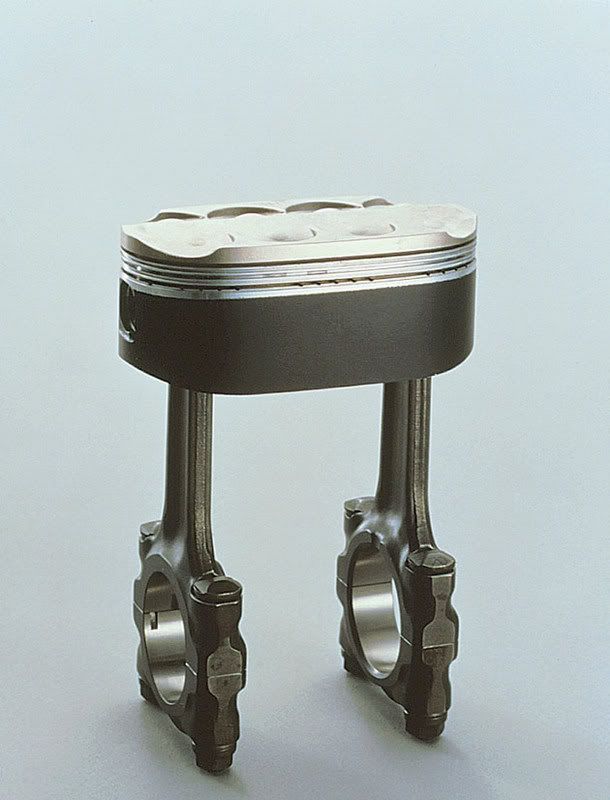
Does anyone remember the oval cylinder and piston NR500/NR750 race bikes ?
HAHA, yeah, talk about a nightmare.
B. What kind of cylinder head design?! What kind of advantage does it have? I would think with such an open design you have less control over turbluance and airflow... Seems very complex to plan for but interesting.


TECH Addict
Joined: Aug 2004
Posts: 2,866
Likes: 4
but its ideas like this that move things on. they are not to be laughed at.
Chris.

It was also a $60k+ bike back in the early 90's..

I lusted after that bike, even though I would never own one..
Actually, IIRC, the reasoning for it was a weight penalty (by the sanctioning body) for more cylinders.. They were wanting to run a V8 bike with tiny *** pistons so it would rev to 15k+, but the weight penalty was too much, but they figured if they siamesed the pistons together, viola'! It's just a V-4.
It was also a $60k+ bike back in the early 90's..
I lusted after that bike, even though I would never own one..
It was also a $60k+ bike back in the early 90's..
I lusted after that bike, even though I would never own one..
*edit* Nevermind, it was a 4 stroke, was mistaking it for an NSR. The NR500 revved to over 20k in race trim though!
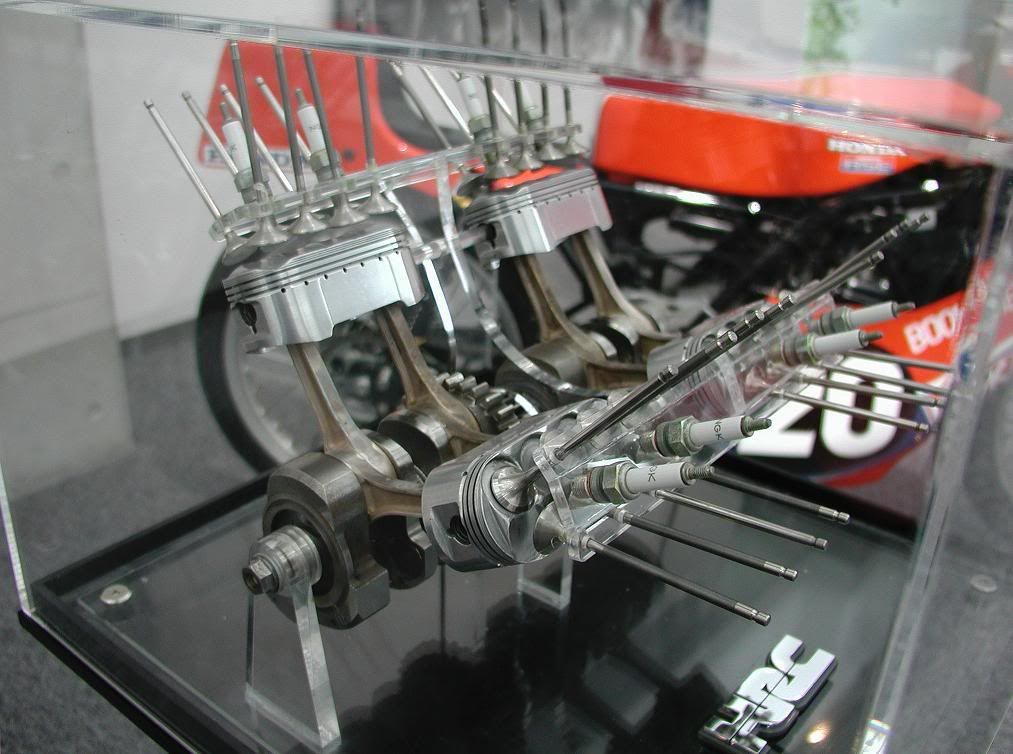
Last edited by Drew04GTO; Mar 18, 2008 at 11:57 AM. Reason: changed that enormous pictAr
I can't imagine ballancing that was any worse than Honda's V-5 (yes, a V-5) MotoGP bike that used varrying bores and to ballance the rotating assembly. Its funny how quickly this thread has turned into a "look at all this crazy **** Hondas doing
