


controlling trans temps.


 controlling trans temps.
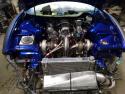
 im running a 4l80 rossler trans with a brake in a twin turbo setup. ive been having problems controlling temp both on the street on hot days and long drives and at the track when bumping in on the 2 step on the brake. I upgraded my trans cooler to a bigger unit with a fan and relocated it to the back of the car. its mounted behind the rear bumper and angled away from the bumper support with several holes and material removed for airflow. im going to try and make a deflector to ram more air up there which might help with the street driving. for the track im probably on the brake 4-5 seconds i would think by the time i stage, get in on the second light and go. im running the LAT trans fluid now which seemed to help a little at the track. anyone have other ideas? also what is considered too hot? ive been told over 200 but there seems to be a lot of conflicting answers out there.

Joined: Aug 2007
Posts: 24,241
Likes: 89
From: Turnin' Wrenches Infractions: 005
If you're at 200 you're good. Most people like lower then that (me included) but I dont have any solid data as to why exactly its better. You arent still running through the radiator cooler are you?

Registered User
Joined: Sep 2016
Posts: 3
Likes: 0
I would imagine that having only a liquid to air cooler would be the main issue with temps. Since water has 27 times the cooling capacity of air, you would need an extremely large cooler to equal the capacity of a small liquid to liquid cooler. Converter outlet temps on the lights can go as high as 300º or more, so trying to cool all that with nothing but air is difficult.
Something i have done that works extremely well, but is a little costly, is to install a brazed plate heat exchanger to cool the fluid. The pros of doing this is the heat exchanger can be mounted right beside the tranny, limiting line length, and the fact that it is closed loop and separate from the engine. The downside is the added front mount radiator, pump, lines, and reservoir for the water side of the cooler.
These heat exchangers dissipate a tremendous amount of heat given their small size.
Something i have done that works extremely well, but is a little costly, is to install a brazed plate heat exchanger to cool the fluid. The pros of doing this is the heat exchanger can be mounted right beside the tranny, limiting line length, and the fact that it is closed loop and separate from the engine. The downside is the added front mount radiator, pump, lines, and reservoir for the water side of the cooler.
These heat exchangers dissipate a tremendous amount of heat given their small size.
Joined: Aug 2007
Posts: 24,241
Likes: 89
From: Turnin' Wrenches Infractions: 005
That's actually an excellent idea. Trying to cool hot trans fluid with cool water makes sense, the idiots who think the cooler in the radiator that injects the trans fluid in hot coolant will cool the trans are the ones who dont grasp physics and mechanical systems. You cannot cool one fluid any cooler then the other fluid already is. Jeez.
Registered User
Joined: Sep 2016
Posts: 3
Likes: 0
I have been doing some extensive testing on tranny fluid cooling the past couple of months. What i have found is the radiator cooler does an excellent job when I am towing heavy loads, or on high stall converters. The problem comes in when you aren't producing high converter outlet temps. Installing a thermostatic bypass to only open when the temps get above radiator coolant temps is the best. I now see cruising temps of around 120º and only see higher temps when towing.
The problems with keeping the radiator cooler are tranny fluid temps tend to run higher, and it takes more effort to keep the coolant cool.
My electric fans never come on anymore. I have to sit still in traffic for more than 10min before low speed activates. I do have a 10" pusher for the a/c though. It runs pretty much all the time.
To the op, due your due dilligence and figure out exactly what your fluid temps are at each stage in the cycle. Example: converter outlet, return from cooler, and pan temps. You should have no problem figuring out where the extra BTU needs to be removed.
The problems with keeping the radiator cooler are tranny fluid temps tend to run higher, and it takes more effort to keep the coolant cool.
My electric fans never come on anymore. I have to sit still in traffic for more than 10min before low speed activates. I do have a 10" pusher for the a/c though. It runs pretty much all the time.
To the op, due your due dilligence and figure out exactly what your fluid temps are at each stage in the cycle. Example: converter outlet, return from cooler, and pan temps. You should have no problem figuring out where the extra BTU needs to be removed.

Moderator


Joined: Aug 2010
Posts: 7,321
Likes: 527
From: Ann Arbor, MI
I suspect many people don't fully realize how much heat a transbrake creates.
Lets say you are giving partial throttle of 300HP with the transbrake engaged or even just holding the brake pedal. 300HP is 223,5000 watts! In other words the equivalent of 200 plug-in heaters hitting your transmission at once! Or 762,000 BTU which far exceeds any cooler.
I have read that the trans fluid temperature rises by over 50F per second.
Lets say you are giving partial throttle of 300HP with the transbrake engaged or even just holding the brake pedal. 300HP is 223,5000 watts! In other words the equivalent of 200 plug-in heaters hitting your transmission at once! Or 762,000 BTU which far exceeds any cooler.
I have read that the trans fluid temperature rises by over 50F per second.
Trending Topics
Registered User
Joined: Sep 2016
Posts: 3
Likes: 0
You mean my 40k btu cooler that takes up half my radiator isn't big enough? Lol
Those are some numbers to put things into perspective. Given that a typical household A/C is between 36k-60k btu, it would take a nuclear cooling tower to keep the fluid from rising on the 2-step. Most people go the cheaper route and install a very large pan, or reservoir to dampen the effect, although it does add to the cooling time too. Thanks for those numbers.
Here is an idea....next time you want to drag race, just make sure you have a lake at the end of the strip. The water will cool it down in no time! J/K
Those are some numbers to put things into perspective. Given that a typical household A/C is between 36k-60k btu, it would take a nuclear cooling tower to keep the fluid from rising on the 2-step. Most people go the cheaper route and install a very large pan, or reservoir to dampen the effect, although it does add to the cooling time too. Thanks for those numbers.
Here is an idea....next time you want to drag race, just make sure you have a lake at the end of the strip. The water will cool it down in no time! J/K
The brazed plate cooler is a great idea but check out a fluid to fluid cooler, simple, cheap. I saw these originally in my Ford days setup to cool A2W SC setups using freon piped in as the cooler and no heat exchanger. Search Killer Chiller, same idea and no reason it wouldn't work for tranny fluid they're typically used for industrial hydraulics anyhow. I see them all over our hydraulic systems at work now that I actually know what they are.
RyanR
RyanR

