


Converter Experts >>> Question about stall

Thread Starter

Joined: Nov 2001
Posts: 10,060
Likes: 33
From: Canton, GA
 Converter Experts >>> Question about stall
 If my Yank Converter is supposed to be 4000 stall, why does my car start pushing through the brakes at 2800 rpm?
My guess is that flash stall is higher than brake stall? Sucks when I want to fott brake, but I can't bring the rpm up enough to take off hard.
What's going on?
My guess is that flash stall is higher than brake stall? Sucks when I want to fott brake, but I can't bring the rpm up enough to take off hard.
What's going on?
 Re: Converter Experts >>> Question about stall
 Todd, this is straight off the Yank website, but it's a good explanation.
What is the difference between "brake stall" and "flash stall"?
Flash stall is the maximum your engine's torque can stall a torque converter. In essence flash stall and full stall are nearly identical. If you had a transbrake, you could find full stall by putting your foot to the floor and reading your tach. For argument sake, let's say we're testing a 3500 stall Yank ST 3500. If you had a transbrake, you would see around 3500 rpms. If your motor was at idle and then you suddenly floored the throttle, you might see slightly more (maybe 100 rpm more) stall for a half second as the momentum of the motor's internals "flashed" the converter a small bit above its true stall rating.
Brake stall, on the other hand is a very subjective thing. For most, it's the highest stall you can achieve before your tires spin. This varies greatly based on many factors: Traction, gearing, brake clamping force, and engine torque. With a ST3500, I may only be able to get 2200rpm "brake stall" on the street with street tires...any higher rpm and the motor torque would overwhelm the tires. But if I was at the track with racing slicks on the starting line, I might be able to get 3200 brake stall before the motor torque overwhelmed the tires. See...brake stall is very subjective.
Yank rates their converters based on their intended application. A ST 3500 will stall 3500 rpms in a stock LS1. If you had a 422 and wanted a ST 3500, the converter you received would still stall 3500 because it would be built around the torque of a 422, not a stock displacement LS1. Yank checks the stall of their converters and their competitors by using either a trasmission dyno or a "tranny tricker" in the vehicle tested. With the tranny tricker, you can place the vehicle in 2nd or 3rd gear and stab the throttle to the floor...making it easy to read both flash stall and full stall.
Hopefully, this answers your question.
What is the difference between "brake stall" and "flash stall"?
Flash stall is the maximum your engine's torque can stall a torque converter. In essence flash stall and full stall are nearly identical. If you had a transbrake, you could find full stall by putting your foot to the floor and reading your tach. For argument sake, let's say we're testing a 3500 stall Yank ST 3500. If you had a transbrake, you would see around 3500 rpms. If your motor was at idle and then you suddenly floored the throttle, you might see slightly more (maybe 100 rpm more) stall for a half second as the momentum of the motor's internals "flashed" the converter a small bit above its true stall rating.
Brake stall, on the other hand is a very subjective thing. For most, it's the highest stall you can achieve before your tires spin. This varies greatly based on many factors: Traction, gearing, brake clamping force, and engine torque. With a ST3500, I may only be able to get 2200rpm "brake stall" on the street with street tires...any higher rpm and the motor torque would overwhelm the tires. But if I was at the track with racing slicks on the starting line, I might be able to get 3200 brake stall before the motor torque overwhelmed the tires. See...brake stall is very subjective.
Yank rates their converters based on their intended application. A ST 3500 will stall 3500 rpms in a stock LS1. If you had a 422 and wanted a ST 3500, the converter you received would still stall 3500 because it would be built around the torque of a 422, not a stock displacement LS1. Yank checks the stall of their converters and their competitors by using either a trasmission dyno or a "tranny tricker" in the vehicle tested. With the tranny tricker, you can place the vehicle in 2nd or 3rd gear and stab the throttle to the floor...making it easy to read both flash stall and full stall.
Hopefully, this answers your question.
__________________
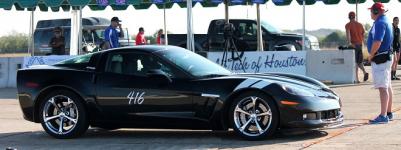
2013 Corvette Grand Sport A6 LME forged 416, Greg Good ported TFS 255 LS3 heads, 222/242 .629"/.604" 121LSA Pat G blower cam, ARH 1 7/8" headers, ESC Novi 1500 Supercharger w/8 rib direct drive conversion, 747rwhp/709rwtq on 93 octane, 801rwhp/735rwtq on race fuel, 10.1 @ 147.25mph 1/4 mile, 174.7mph Half Mile.
2016 Corvette Z51 M7 Magnuson Heartbeat 2300 supercharger, TSP LT headers, Pat G tuned, 667rwhp, 662rwtq, 191mph TX Mile.
2009.5 Pontiac G8 GT 6.0L, A6, AFR 230v2 heads. 506rwhp/442rwtq. 11.413 @ 121.29mph 1/4 mile, 168.7mph TX Mile
2000 Pewter Ram Air Trans Am M6 heads/cam 508 rwhp/445 rwtq SAE, 183.092 TX Mile
2022 Cadillac Escalade 6.2L A10 S&B CAI, Corsa catback.
2023 Corvette 3LT Z51 soon to be modified.
Custom LSX tuning in person or via email press here.
2013 Corvette Grand Sport A6 LME forged 416, Greg Good ported TFS 255 LS3 heads, 222/242 .629"/.604" 121LSA Pat G blower cam, ARH 1 7/8" headers, ESC Novi 1500 Supercharger w/8 rib direct drive conversion, 747rwhp/709rwtq on 93 octane, 801rwhp/735rwtq on race fuel, 10.1 @ 147.25mph 1/4 mile, 174.7mph Half Mile.
2016 Corvette Z51 M7 Magnuson Heartbeat 2300 supercharger, TSP LT headers, Pat G tuned, 667rwhp, 662rwtq, 191mph TX Mile.
2009.5 Pontiac G8 GT 6.0L, A6, AFR 230v2 heads. 506rwhp/442rwtq. 11.413 @ 121.29mph 1/4 mile, 168.7mph TX Mile
2000 Pewter Ram Air Trans Am M6 heads/cam 508 rwhp/445 rwtq SAE, 183.092 TX Mile
2022 Cadillac Escalade 6.2L A10 S&B CAI, Corsa catback.
2023 Corvette 3LT Z51 soon to be modified.
Custom LSX tuning in person or via email press here.
Thread Starter
Joined: Nov 2001
Posts: 10,060
Likes: 33
From: Canton, GA
Re: Converter Experts >>> Question about stall Thanks Pat....that's what I was thinking. That Mike has all kinds of good info on his site. I have a t-brake, but it is wired up wrong at the moment (tried to wire it with the 2-step). I will have to rectify that if I want to launch harder. I think my back brakes need bleeding as well. Prolly didn't help me <img border="0" title="" alt="[Sad]" src="gr_sad.gif" />
Todd
Todd