



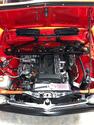






1966 GTO Refresh

Thread Starter
On The Tree

Joined: Aug 2008
Posts: 109
Likes: 12
From: Memphis, Tennessee

Calculating speeds - looks like you should be something closer to 81-82 mph at 2000 in 6th, so speedo or tach (or both) may be a bit off -- just food for thought.
The Wallace Racing data that Andrew referenced above for critical speed makes an assumption about wall thickness --- you don't happen to know what wall thickness tubing was actually used on your DS do you? In any event, if my brain/calc didn't let me down, you're spinning the DS at about 4920 rpm at 100 mph, and that's not very far from getting into the 5856 rpm critical speed referenced above.
All that to say -- yup, I think a move to a 3.5" aluminum unit (minimum) and a check of the driveline angles are in order. As for a CV joint on one end of the DS, I think Andrew can tell you all about that... Good luck!
The Wallace Racing data that Andrew referenced above for critical speed makes an assumption about wall thickness --- you don't happen to know what wall thickness tubing was actually used on your DS do you? In any event, if my brain/calc didn't let me down, you're spinning the DS at about 4920 rpm at 100 mph, and that's not very far from getting into the 5856 rpm critical speed referenced above.
All that to say -- yup, I think a move to a 3.5" aluminum unit (minimum) and a check of the driveline angles are in order. As for a CV joint on one end of the DS, I think Andrew can tell you all about that... Good luck!

Teching In
Joined: Jun 2013
Posts: 40
Likes: 0
From: Dublin, Georgia
Did you update you interior with newer GTO seats? You had another post to this site of someone with a silver and dark blue GTO convertible with the newer GTO seats. I cannot locate the pictures of his car now and would love to see more. How big of a hassle is it to fit those seats into the old body? I am sure the comfort level is much better. Is it worth doing?
Thread Starter
On The Tree
Joined: Aug 2008
Posts: 109
Likes: 12
From: Memphis, Tennessee
Did you update you interior with newer GTO seats? You had another post to this site of someone with a silver and dark blue GTO convertible with the newer GTO seats. I cannot locate the pictures of his car now and would love to see more. How big of a hassle is it to fit those seats into the old body? I am sure the comfort level is much better. Is it worth doing?
Teching In
Joined: Jun 2013
Posts: 40
Likes: 0
From: Dublin, Georgia
drive line vibration I am running the T-56 magnum 6 speed transmission to a 3.89 Ford 9 inch. My drive shaft is 57 inches long and we are getting the vibration from 70 mph up. The angles are set at 3.5 degrees at each end and had the drive shaft balanced and still get the vibration. Have you had any success with this issue? I wonder what Andrew has to say about the CV joint. Aside from cost, is there a downside to adding the CV joint? To which end did he add the CV joint?
Andrew should weigh in -- CV joints MUCH more tolerant of more acute angles (think FWD halfshafts....). I believe he runs his at the front. Designed properly -- no downside that I can think of perhaps, except, more rotational weight than a u-joint.
The front operating angle in my GTO is 6 degrees. I think that if I was to swap to the Holley mounts and 302-2 pan, this can be decreased. Todd can maybe speak to this, although I know that ride height plays a factor.
Andrew
LS1 Tech Stories
The Best V8 Stories One Small Block at Time

6 Common C5 Corvette Failures and What's Involved In Repairing Them
Pouria Savadkouei
Retro Modern Bandit Pontiac Trans AM Comes With Burt Reynolds' Autograph
Verdad Gallardo
Top 10 Greatest Cadillac V Series Performance Models Ever, Ranked
Pouria Savadkouei
Top 10 Most Powerful Chevy Trucks Ever Made!

Hennessey's New Supercharged Silverado ZR2 Has 700 HP
Verdad Gallardo
Coachbuilt N2A Anteros Is an LS2-Powered C6 Corvette In Italian Clothes
Verdad Gallardo
Awesome K5 Blazer Restomod Comes With C7 Corvette Power
Verdad Gallardo
10 Camaros You Should Never Buy

10 LS Engine Myths That Refuse to Die
Verdad Gallardo Here is the tech bulletin.
http://www.markwilliams.com/servicebull/sb0049.pdf
Andrew
Teching In
Joined: Jun 2013
Posts: 40
Likes: 0
From: Dublin, Georgia
Hey, any progress on the interior change out to the newer GTO seating? What all has to be changed to put the newer seats into your car? I have put over a thousand miles on my car. Seems I forgot how uncomfortable the old seats are, even with new upholstery. Got a fine drive shaft now, but the vibration, though way less than before, is still noticeable over 75. Kind of upsetting with all that horsepower!
Thread Starter
On The Tree
Joined: Aug 2008
Posts: 109
Likes: 12
From: Memphis, Tennessee
Hey, any progress on the interior change out to the newer GTO seating? What all has to be changed to put the newer seats into your car? I have put over a thousand miles on my car. Seems I forgot how uncomfortable the old seats are, even with new upholstery. Got a fine drive shaft now, but the vibration, though way less than before, is still noticeable over 75. Kind of upsetting with all that horsepower!
I have upgraded the front spindles to C5 corvette, upgraded the rear upper control arms and am about to install the new 3.5 aluminum driveshaft. The car has been in "rehab" since early July and I want it back on the road this weekend. We leave for our big trip in the GTO on August 29. Memphis to Glacier NP via Mt. Rushmore and Yellowstone, then down through the mountains to Vegas, then heading east to Dallas before arriving back in Memphis about September 15. Time is SHORT. I will post pictures of the upgrades this weekend when I figure out how to do pictures in the post Photobucket world.
Ricky
Teching In
Joined: Jun 2013
Posts: 40
Likes: 0
From: Dublin, Georgia
Thanks for the follow up post! Got our drive shaft from Mark Williams. One fine impressive piece of work! Wish we could sort out the vibration. Much less vibration with the new drive shaft, but some still there. We lowered the car, so I am questioning that as a possible cause. Running a Ford 9 inch from Johns 9 inch with 3.89 gears. Hope that is not the issue.

Banned
Joined: Feb 2013
Posts: 3,540
Likes: 207
I didn't read anywhere where you mentioned what engine mounts and transmission crossmember you are using, but you may want to perform a plumb bob/string line layout on your car to confirm there is no horizontal plane misalignment between your engine/trans and your rear end pinion that could be adding compound angular disparity to your U-joint operating angles.

I have been driving the car most days (over 12,000 miles in the last 12 months). The driveshaft vibration is still there from 85 mph on - so I just keep it under that limit. I swapped in the ZO6 camshaft, and then had the car retuned for premium gas. On the dyno it ran out of breath (and the injectors were at their limit) around 6,000 but put down 378 hp at the rear wheels.
My wife and I have rooms in West Yellowstone, MT for Labor day weekend - I am driving the GTO to Bozeman, MT and picking her up at the airport. We will spend several days in Yellowstone and then we are headed up to Glacier and on in to Canada (Calgary) after that. I will have the driveline issues corrected before then, and some other upgrades. I will post pictures as I do the upgrades.
Ricky
My wife and I have rooms in West Yellowstone, MT for Labor day weekend - I am driving the GTO to Bozeman, MT and picking her up at the airport. We will spend several days in Yellowstone and then we are headed up to Glacier and on in to Canada (Calgary) after that. I will have the driveline issues corrected before then, and some other upgrades. I will post pictures as I do the upgrades.
Ricky
Teching In
Joined: Jun 2013
Posts: 40
Likes: 0
From: Dublin, Georgia
We removed the Pontiac Chassis mounts and substituted the Chevy small block mounts. We used the Hooker Headers 12611 LS Engine Swap mount Plates on the engine. We used the Prothane 7-1901-BL motor and transmission mounts from Jegs. We used the stock manual transmission cross member, but relocated the frame mounting tabs towards the rear to match up with the transmission attachment point. We had to cut the transmission tunnel to get the T-56 magnum transmission to fit. The driveshaft alignment angles are less than 3.5 degrees.
Banned
Joined: Feb 2013
Posts: 3,540
Likes: 207
If your actual U-joint working angles are around 3.5" then they exceed the designed maximum operating angle that U-joints can actually cancel out; 3 degrees of operating angle is the maximum design limit and it's highly RPM dependent...the faster you spin them, the less angle they will tolerate before vibration begins to be noticeable.
The Hooker 12611HKR swap plates are a universal design and don't allow a low enough installed engine height in an A-body to be able to achieve optimized U-joint working angles without performing major surgery on the trans tunnel to be able to get the rear of the transmission up to a proper height.
The Hooker A-body specific engine brackets and transmission crossmembers (and the Holley 302-2 oil pan) were designed to eliminate this issue without having to cut the transmission tunnel in most cases and without the usual inner tie-rod interference with the oil pan.
The Hooker 12611HKR swap plates are a universal design and don't allow a low enough installed engine height in an A-body to be able to achieve optimized U-joint working angles without performing major surgery on the trans tunnel to be able to get the rear of the transmission up to a proper height.
The Hooker A-body specific engine brackets and transmission crossmembers (and the Holley 302-2 oil pan) were designed to eliminate this issue without having to cut the transmission tunnel in most cases and without the usual inner tie-rod interference with the oil pan.
Teching In
Joined: Jun 2013
Posts: 40
Likes: 0
From: Dublin, Georgia
I used the Holley 302-2 oil pan and cut the trans tunnel for the trans to fit. We used the stock manual trans cross member, but relocated the mounting tabs rearward to fit the T-56 trans. Car was lowered about 2inches. I may try raising the rear to see if it helps.