



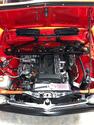




Driveline vibration

Correct. The same bell will also accept the TKO -- so if the LS3 ends up being too much for the T5z, I can change the clutch disc to a 26 spline and bolt the TKO on -- with a mod to the tranny x-member. I'm really limited on tire size (8"-8.5" wheel - 235, maybe a 245 section tire) so tires are the fuse in lower gears. And I'm old and not too hard on the car. So I think the T5z is going to be fine.
Last edited by Michael Yount; Nov 2, 2016 at 08:28 PM.
Appreciate your perspective Doug -- Wheel/tire imbalance -- 4 smooth rolling 8x17" Voxx wheels with Conti Extreme Contract DW's on them - about 7k miles on the package. Balanced by that family connection as I stood by and "helped"; worked on wheel/tire positioning to minimize weight needed - all 4 balanced with minimal weight. Rolled smooth as silk when the car went down for the swap 10/15. I'd have them checked if someone can help me understand how they'd go out of balance sitting in my garage for the last 14 months. Front two were off the car stored in dehumidified, insulated garage with the car. Already explored possible flat spots on the rear tires - appears to not be an issue. So, no evidence that balance is an issue. And a lot of prior operating evidence that indicates wheel/tire balance is just fine. BTW, family connection is 160 mi/2.5 hours away - so it's a bit more involved to spin them up again at that location than you might have thought.
I have a pinion flange set up -- both u-joints (front/rear) have to be pressed into place and secured with retaining clips. To remove the DS, you unbolt 4 bolts that secure the DS rear flange to the pinion flange. It (DS/u-joints) can only be put together one way. So phasing isn't an issue. Have had it in/out multiple times over the life of the car --- never an issue. In fact, I've never even marked the two flanges to assure that it bolts up in the same 4 holes each time. Never had any vibrations like this before. The driveshaft, like the wheels and tires, didn't go out of balance or phase sitting in the garage for 14 months. And my run out measurements confirm that it's every bit as straight as it was before. There's no evidence that points to driveshaft straightness or balance being an issue. And a lot of evidence that points to phasing, balance and straightness being just fine.
Not sure what you mean by "....vibration occurs only at a steady speed...." It begins to be noticeable at about 55 mph and by 60 mph is noticeable enough that I don't want to run it much faster than that. It acts as if it is going to vibrate worse the more speed increases.
Edit - after a good night's sleep and a Cubs WS win, there's the matter of the nature of the vibration -- which IS evidence that points to some sort of imbalance. More head scratching...
I have a pinion flange set up -- both u-joints (front/rear) have to be pressed into place and secured with retaining clips. To remove the DS, you unbolt 4 bolts that secure the DS rear flange to the pinion flange. It (DS/u-joints) can only be put together one way. So phasing isn't an issue. Have had it in/out multiple times over the life of the car --- never an issue. In fact, I've never even marked the two flanges to assure that it bolts up in the same 4 holes each time. Never had any vibrations like this before. The driveshaft, like the wheels and tires, didn't go out of balance or phase sitting in the garage for 14 months. And my run out measurements confirm that it's every bit as straight as it was before. There's no evidence that points to driveshaft straightness or balance being an issue. And a lot of evidence that points to phasing, balance and straightness being just fine.
Not sure what you mean by "....vibration occurs only at a steady speed...." It begins to be noticeable at about 55 mph and by 60 mph is noticeable enough that I don't want to run it much faster than that. It acts as if it is going to vibrate worse the more speed increases.
Edit - after a good night's sleep and a Cubs WS win, there's the matter of the nature of the vibration -- which IS evidence that points to some sort of imbalance. More head scratching...
Last edited by Michael Yount; Nov 3, 2016 at 05:31 AM.

9 Second Club
Joined: Nov 2003
Posts: 13,616
Likes: 185
From: Norn Iron
Keep it simple.
What length is the shaft ? Material ? diameter ?
What rear end ratio ?
And if you want to test whether it's a wheel/tyre issue or shaft issue.
Simple, put the car on axle stands remove the wheels and run the car in gear up to whatever speed you think the problem occurs at. If it is still there, clearly it is not a wheel/tyre problem.
And unless your driveshaft has actually been balanced at real world speeds....there is no guarantee it is good for all real world speeds. That isnt to say it isnt balanced though. Most machines only spin at a fraction of what they will see in the car...for practical and safety reasons.
In my car at max speed, my shaft is turning at nearly 10,000rpm. It'd take a hell of a balancing machine to do that !
What length is the shaft ? Material ? diameter ?
What rear end ratio ?
And if you want to test whether it's a wheel/tyre issue or shaft issue.
Simple, put the car on axle stands remove the wheels and run the car in gear up to whatever speed you think the problem occurs at. If it is still there, clearly it is not a wheel/tyre problem.
And unless your driveshaft has actually been balanced at real world speeds....there is no guarantee it is good for all real world speeds. That isnt to say it isnt balanced though. Most machines only spin at a fraction of what they will see in the car...for practical and safety reasons.
In my car at max speed, my shaft is turning at nearly 10,000rpm. It'd take a hell of a balancing machine to do that !
It's about as simple as it gets Stevie -- the shaft has been in the car working perfectly for 15 years/50-60k miles.  44" eye to eye, steel, 2.75", 3.55 gears
Most DS balancing machines balance in the 3000 rpm range. 3000 DS rpm in my car is right at 102 mph --- so the balancing speed range is well within the area that the vibration is occurring - it's starting at about 1600 DS rpm. But as detailed in the thread in multiple areas, no reason to think it's a shaft balance or run out issue.
44" eye to eye, steel, 2.75", 3.55 gears Most DS balancing machines balance in the 3000 rpm range. 3000 DS rpm in my car is right at 102 mph --- so the balancing speed range is well within the area that the vibration is occurring - it's starting at about 1600 DS rpm. But as detailed in the thread in multiple areas, no reason to think it's a shaft balance or run out issue.
9 Second Club
Joined: Nov 2003
Posts: 13,616
Likes: 185
From: Norn Iron
Ah right, I thought the first post said you changed from a 2 to 1 piece and then the problem occurred.
And are you sure about your shaft rpm calcs ?
On my car when I had a 3.55 rear and 245/45x16 tyres, 120mph was around 5200rpm shaft speed.
For a 3000rpm shaft speed to equate to 102mph road speed and 3.55 gears, you'd need around 40" tyres.
With a 26" tyre you'd be closer to 5,000rpm shaft speed.
Either way, testing with the car on ramps or in the air, wheels off and on would still give some info. And from underneath maybe you might see something moving when it does vibrate.
And are you sure about your shaft rpm calcs ?
On my car when I had a 3.55 rear and 245/45x16 tyres, 120mph was around 5200rpm shaft speed.
For a 3000rpm shaft speed to equate to 102mph road speed and 3.55 gears, you'd need around 40" tyres.
With a 26" tyre you'd be closer to 5,000rpm shaft speed.
Either way, testing with the car on ramps or in the air, wheels off and on would still give some info. And from underneath maybe you might see something moving when it does vibrate.

TECH Resident
Joined: Apr 2010
Posts: 926
Likes: 18
From: Central Texas
I just gotta ask this, have you checked the flywheel and or the harmonic balancer. I had a bad torque converter in my 96 Impals SS that drove me nuts till I narrowed it down to that. New U-joints , balanced the drive shaft, Liked to wore out my welcome at Discount Tire to no avail, took it back to the Trans shop and changed the converter and all is well..
Ah right, I thought the first post said you changed from a 2 to 1 piece and then the problem occurred.
And are you sure about your shaft rpm calcs ?
On my car when I had a 3.55 rear and 245/45x16 tyres, 120mph was around 5200rpm shaft speed.
For a 3000rpm shaft speed to equate to 102mph road speed and 3.55 gears, you'd need around 40" tyres.
With a 26" tyre you'd be closer to 5,000rpm shaft speed.
Either way, testing with the car on ramps or in the air, wheels off and on would still give some info. And from underneath maybe you might see something moving when it does vibrate.
And are you sure about your shaft rpm calcs ?
On my car when I had a 3.55 rear and 245/45x16 tyres, 120mph was around 5200rpm shaft speed.
For a 3000rpm shaft speed to equate to 102mph road speed and 3.55 gears, you'd need around 40" tyres.
With a 26" tyre you'd be closer to 5,000rpm shaft speed.
Either way, testing with the car on ramps or in the air, wheels off and on would still give some info. And from underneath maybe you might see something moving when it does vibrate.
LS1 Tech Stories
The Best V8 Stories One Small Block at Time

6 Common C5 Corvette Failures and What's Involved In Repairing Them
Pouria Savadkouei
Retro Modern Bandit Pontiac Trans AM Comes With Burt Reynolds' Autograph
Verdad Gallardo
Top 10 Greatest Cadillac V Series Performance Models Ever, Ranked
Pouria Savadkouei
Top 10 Most Powerful Chevy Trucks Ever Made!

Hennessey's New Supercharged Silverado ZR2 Has 700 HP
Verdad Gallardo
Coachbuilt N2A Anteros Is an LS2-Powered C6 Corvette In Italian Clothes
Verdad Gallardo
Awesome K5 Blazer Restomod Comes With C7 Corvette Power
Verdad Gallardo
10 Camaros You Should Never Buy

10 LS Engine Myths That Refuse to Die
Verdad Gallardo I just gotta ask this, have you checked the flywheel and or the harmonic balancer. I had a bad torque converter in my 96 Impals SS that drove me nuts till I narrowed it down to that. New U-joints , balanced the drive shaft, Liked to wore out my welcome at Discount Tire to no avail, took it back to the Trans shop and changed the converter and all is well..
Ah right, I thought the first post said you changed from a 2 to 1 piece and then the problem occurred.
And are you sure about your shaft rpm calcs ?
On my car when I had a 3.55 rear and 245/45x16 tyres, 120mph was around 5200rpm shaft speed.
For a 3000rpm shaft speed to equate to 102mph road speed and 3.55 gears, you'd need around 40" tyres.
With a 26" tyre you'd be closer to 5,000rpm shaft speed.
Either way, testing with the car on ramps or in the air, wheels off and on would still give some info. And from underneath maybe you might see something moving when it does vibrate.
And are you sure about your shaft rpm calcs ?
On my car when I had a 3.55 rear and 245/45x16 tyres, 120mph was around 5200rpm shaft speed.
For a 3000rpm shaft speed to equate to 102mph road speed and 3.55 gears, you'd need around 40" tyres.
With a 26" tyre you'd be closer to 5,000rpm shaft speed.
Either way, testing with the car on ramps or in the air, wheels off and on would still give some info. And from underneath maybe you might see something moving when it does vibrate.
9 Second Club
Joined: Nov 2003
Posts: 13,616
Likes: 185
From: Norn Iron
Are you using a transaxle ?
If not, then whether overdrive or not is irrelevant as this does not change shaft speed which is a fixed drive to the diff/tyres so continually increases with road speed. It does not get lower higher/lower as you change gear.
If roadspeed increases, shaft speed increases.
If not, then whether overdrive or not is irrelevant as this does not change shaft speed which is a fixed drive to the diff/tyres so continually increases with road speed. It does not get lower higher/lower as you change gear.
If roadspeed increases, shaft speed increases.
9 Second Club
Joined: Nov 2003
Posts: 13,616
Likes: 185
From: Norn Iron
sit down and think about exactly what has changed ? If it isnt engine rpm related, do the static test I mentioned without the wheels. That should then direct you to either driveline again, or to the wheel/tyre areas.
Out to the garage....
Thanks to everyone --- you've really helped me see that the only course is to throw out all my assumptions about what could or couldn't have changed with the swap, and just check everything. So I began that today.
Confirmed that pinion flange and tranny output shaft are parallel to a tenth of a degree. As expected, pinion angles equal and opposite - 2.5 degrees. Depending on whether I zeroed on frame rail, door jamb or floor pan, engine down in back 2.5-2.8 degrees. Nothing amiss there that I can see.
Removed the 22 gauge reluctor that was in between the pinion flange and the driveshaft. Bolted the driveshaft directly to the flange -- more engagement with the pinion 'hub'. Also removed 5mm spacers on the front wheels I'd been using for 3 years or so since I added my current coilovers. There was a slight interference between the strut tube coil over support and the back of the wheel. The spacers made the front wheel fit lug-centric instead of hub-centric. Run out was minimal, and never noticed any vibration -- but who knows?? 30 seconds with the grinder removed the interference point -- front wheels now hub-centric again. Also found a tiny amount of play in each front wheel bearing. Grease caps off, slight tightening of spindle bolt, new cotters - no more play.
I'll drive tomorrow and see if anything changed. If not, on to other assumptions including letting local shop spin up drive shaft and wheels/tires to check balance. Thanks again for helping me get 'my mind right'.....


Confirmed that pinion flange and tranny output shaft are parallel to a tenth of a degree. As expected, pinion angles equal and opposite - 2.5 degrees. Depending on whether I zeroed on frame rail, door jamb or floor pan, engine down in back 2.5-2.8 degrees. Nothing amiss there that I can see.
Removed the 22 gauge reluctor that was in between the pinion flange and the driveshaft. Bolted the driveshaft directly to the flange -- more engagement with the pinion 'hub'. Also removed 5mm spacers on the front wheels I'd been using for 3 years or so since I added my current coilovers. There was a slight interference between the strut tube coil over support and the back of the wheel. The spacers made the front wheel fit lug-centric instead of hub-centric. Run out was minimal, and never noticed any vibration -- but who knows?? 30 seconds with the grinder removed the interference point -- front wheels now hub-centric again. Also found a tiny amount of play in each front wheel bearing. Grease caps off, slight tightening of spindle bolt, new cotters - no more play.
I'll drive tomorrow and see if anything changed. If not, on to other assumptions including letting local shop spin up drive shaft and wheels/tires to check balance. Thanks again for helping me get 'my mind right'.....





You need to measure the angle of the driveshaft along with the angle of the engine and the pinion gear. Equal and opposite is only one requirement for a smooth drive line. The other is that the operating angles must be as small as possible (less than 3 degrees, ideally much less), but not zero. Without knowing the angle of the driveshaft it's impossible to calculate the operating angles. Referencing the frame is meaningless.
Andrew
Andrew
You need to measure the angle of the driveshaft along with the angle of the engine and the pinion gear. Equal and opposite is only one requirement for a smooth drive line. The other is that the operating angles must be as small as possible (less than 3 degrees, ideally much less), but not zero. Without knowing the angle of the driveshaft it's impossible to calculate the operating angles. Referencing the frame is meaningless.
Andrew
Andrew
I checked two ways -- measure angle between slip yoke and shaft; measure angle between pinion yoke and shaft; then remove driveshaft and measure face of pinion flange vs face of the tranny output shaft. That gives you a double check that pinion and output shaft are parallel. Pinion is a little less than an inch lower than tranny output shaft -- front u-joint shallow V is inverted, rear shallow V is not inverted.
Removed reluctor, bolted up driveshaft and re-checked DS runout. Same as it was with the reluctor in place - .005"-.006". Didn't get to drive today -- in the morning a short ride and see what we've got. Then on to the next thing. I can remove a shim or two from tranny mount and raise the pinion a hair. That will reduce u-joint angles to about 1.5 degrees if my rough measurements/math are right. Although I don't think that's the issue. Next step will be to have wheels/tires spun up and balance checked, and the same with the DS/joints/reluctor.
Removed reluctor, bolted up driveshaft and re-checked DS runout. Same as it was with the reluctor in place - .005"-.006". Didn't get to drive today -- in the morning a short ride and see what we've got. Then on to the next thing. I can remove a shim or two from tranny mount and raise the pinion a hair. That will reduce u-joint angles to about 1.5 degrees if my rough measurements/math are right. Although I don't think that's the issue. Next step will be to have wheels/tires spun up and balance checked, and the same with the DS/joints/reluctor.
Keep at it! I love a good mystery!
Here is what I have learned from experience. Tire balance issues tend to have a very different sensation that drive line imbalance. Tires spin much slower, and an they presents itself more like a thump...thump...thump... A drive line issue is at a higher frequency and will present itself as more of a buzz and you can feel in your seat and will make the rear view mirror get blurry.
Just something to keep in mind.
Andrew
Here is what I have learned from experience. Tire balance issues tend to have a very different sensation that drive line imbalance. Tires spin much slower, and an they presents itself more like a thump...thump...thump... A drive line issue is at a higher frequency and will present itself as more of a buzz and you can feel in your seat and will make the rear view mirror get blurry.
Just something to keep in mind.
Andrew

Banned
Joined: Feb 2013
Posts: 3,540
Likes: 207
All of the angular measurements you've shared thus far have been related to the vertical plane alignment of your drivetrain components, which means you could have a discrepancy between the front and rear U-joints in the horizontal plane. What did you use for engine mounting brackets with your LS engine install? Did you stringline/plumb bob your installation to ensure the engine/trans are parallel to the centerline of your car? Just a thought.