







Driveline vibration
 Driveline vibration
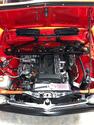
 Help me think this one through. 82 Volvo 242 w/new crate LS3. Car was powered by a 5.0L Mustang motor for 19 years before this. 2-piece Volvo driveshaft was ditched for a 1-piece steel with original swap in 96. Everything smooth as silk before swap. Now I have a vibration that becomes noticeable around 60 mph - and seems to get worse as speed increases. I've been backing off when I feel it -- and I need some time on smooth pavement to run the speed up a bit more and confirm what happens. It's not window-rattling or anything like that - but you can clearly feel it. My wife commented "it seems like it's coming from the center of the car"....which had me wondering about driveline angles. Slip it into neutral and coast at 65mph or change from 5th to 4th to 3rd, no change, keeps vibrating. And the shift handle is smooth as silk while the vibration is occurring. Poly engine/tranny mounts -- but this engine seems smoother/quieter than the old Ford was in RUBBER/OEM mounts. And there doesn't seem to be any vibration noticeable under acceleration or deceleration -- just at speed.
I worked hard to get the LS into the same position (angle and crank height at front) as the 5.0L. And put the tranny back in the same place as before. Measurements and a slight pinion angle adjustment have the tranny output shaft and the pinion parallel within .2-.3 degree. Which means front/rear angles are almost identical. U-joints seemed fine (30,000 miles or so over 12-13 years) but I put a new set in anyway. The new joints and pinion angle adjustment made no difference to the vibration.
Today I measured some run outs -- driveshaft at front, back and middle -- all were .006" max. Also measured the input yoke shaft (slips over tranny output shaft) and the machined surface around the circumference of the pinion flange -- both were .001"-.002". Seems like most DS builders are looking for new shafts to run out no worse than .010"-.020" (depending on who you're talking to), so my .006" doesn't seem like it should be a problem.
Front wheels/tires off the car for 14 months during swap. Rear tires on car during that time but in a dolly with a curved surface. Don't think it's flat spots or I'd feel it at lower speeds. In any event, friends with cars that sit longer on flat surfaces and no problems with flat spots -- they usually 'round out' within the first 5-10 miles.
I have about 350 miles since the swap including a 200 mile roundtrip on the hwy. Vibration noticeable enough that I limited speed to 60-65 mph during that trip.
Thoughts/ideas?
I worked hard to get the LS into the same position (angle and crank height at front) as the 5.0L. And put the tranny back in the same place as before. Measurements and a slight pinion angle adjustment have the tranny output shaft and the pinion parallel within .2-.3 degree. Which means front/rear angles are almost identical. U-joints seemed fine (30,000 miles or so over 12-13 years) but I put a new set in anyway. The new joints and pinion angle adjustment made no difference to the vibration.
Today I measured some run outs -- driveshaft at front, back and middle -- all were .006" max. Also measured the input yoke shaft (slips over tranny output shaft) and the machined surface around the circumference of the pinion flange -- both were .001"-.002". Seems like most DS builders are looking for new shafts to run out no worse than .010"-.020" (depending on who you're talking to), so my .006" doesn't seem like it should be a problem.
Front wheels/tires off the car for 14 months during swap. Rear tires on car during that time but in a dolly with a curved surface. Don't think it's flat spots or I'd feel it at lower speeds. In any event, friends with cars that sit longer on flat surfaces and no problems with flat spots -- they usually 'round out' within the first 5-10 miles.
I have about 350 miles since the swap including a 200 mile roundtrip on the hwy. Vibration noticeable enough that I limited speed to 60-65 mph during that trip.
Thoughts/ideas?
Seems unlikely as there was no change in any of that. They're high quality wheels and tires, balanced with very little weight and rolled smooth as silk before the swap. In my experience over the decades, Ujoints/DS/rearend problems can vibrate noticeably without feeling anything in the shift handle....
that would be the opposite of my experience.
but you really only have a two logical places to go from here,
either have the wheel balance checked or have the shaft balance checked.
pinion angle would come and go as the ujoint speeds went in and out of phase.
other things that have caused vibrations at speed for me:
wheel lug nuts loose (DOH!)
trans contacting floor pan
yoke bushing on output shaft bad
yoke seated too far into trans
but you really only have a two logical places to go from here,
either have the wheel balance checked or have the shaft balance checked.
pinion angle would come and go as the ujoint speeds went in and out of phase.
other things that have caused vibrations at speed for me:
wheel lug nuts loose (DOH!)
trans contacting floor pan
yoke bushing on output shaft bad
yoke seated too far into trans
Thanks Doug -- all ideas are helpful. Again - can't imagine how the shaft, which balanced out nicely when new, would simply go out of balance while standing on it's end. I was quite careful with it - it was never dropped or banged around during the time it was out of the car.
I'm going to rotate rear tires to front and see if I pick up the vibe in the steering. Perhaps the rear tires took a 'set' and that's what I'm feeling. Also I installed a 9 tooth reluctor between pinion flange and shaft (.022" thick) that reduces the amount of engagement between the pinion flange "hub" and the recess on the shaft. If that were the issue I'd think that would've shown up in the run out measurements. But it's easy enough to remove the reluctor and take a test drive.
I'm going to rotate rear tires to front and see if I pick up the vibe in the steering. Perhaps the rear tires took a 'set' and that's what I'm feeling. Also I installed a 9 tooth reluctor between pinion flange and shaft (.022" thick) that reduces the amount of engagement between the pinion flange "hub" and the recess on the shaft. If that were the issue I'd think that would've shown up in the run out measurements. But it's easy enough to remove the reluctor and take a test drive.

On The Tree
Joined: Feb 2014
Posts: 132
Likes: 1
I would replace the u joints with name brand quality pieces. I had a brand new driveshaft that came with a T5 swap kit for my mustang. Car had a funny vibration when I would let out of the gas between 40-70 mph. I checked everything before I said **** it and replaced the u joints with some moog joints and that solved the problem.
TECH Regular

Joined: Sep 2007
Posts: 443
Likes: 3
From: Kansas City, MO
I bet it's the poly trans mount. I have one on my e36 swap and get a bad vibration. I've contemplated getting a rubber trans mount, but I don't have much room for trans movement so I haven't changed it to see.
Trending Topics
LS1 Tech Stories
The Best V8 Stories One Small Block at Time

6 Common C5 Corvette Failures and What's Involved In Repairing Them
Pouria Savadkouei
Retro Modern Bandit Pontiac Trans AM Comes With Burt Reynolds' Autograph
Verdad Gallardo
Top 10 Greatest Cadillac V Series Performance Models Ever, Ranked
Pouria Savadkouei
Top 10 Most Powerful Chevy Trucks Ever Made!

Hennessey's New Supercharged Silverado ZR2 Has 700 HP
Verdad Gallardo
Coachbuilt N2A Anteros Is an LS2-Powered C6 Corvette In Italian Clothes
Verdad Gallardo
Awesome K5 Blazer Restomod Comes With C7 Corvette Power
Verdad Gallardo
10 Camaros You Should Never Buy

10 LS Engine Myths That Refuse to Die
Verdad Gallardo From original post -- "U-joints seemed fine (30,000 miles or so over 12-13 years) but I put a new set in anyway. The new joints......made no difference to the vibration."
I've put poly mounts in many vehicles over the decades -- know what that feels like. In my experience, you feel that in the shifter and it definitely changes with engine revs, not road speed. The shifter is butter smooth in mine -- no change at all with engine revs; this vibe changes with road speed, not engine revs.
General rules of thumb call for engine/tranny angles of 1-3 degrees down from front to back. I'm 2.5 degrees down (tranny lower than front of engine) and pinion is 2.3 degrees up --- in original post I mentioned that they're parallel within .2-.3 degrees. So I do have angle on the driveline. Is that what you meant? Relevant I think - I came real close to matching the engine angle and height of the 5.0L in the car before -- which ran without this vibration.
Tonight I measured some noticeable circumferential run out on the driver's side rear tire. Going to explore that some more --- possible that it decided to take a 'set' from sitting 14 months in the dolly. The vibration acts like it could be tire related - comes on at same speed every time and gets worse with more speed. With driveline "stuff" you usually see some cause/effect during acceleration/deceleration -- which I'm not getting.
Thanks guys -- it all helps me think it through.
Tonight I measured some noticeable circumferential run out on the driver's side rear tire. Going to explore that some more --- possible that it decided to take a 'set' from sitting 14 months in the dolly. The vibration acts like it could be tire related - comes on at same speed every time and gets worse with more speed. With driveline "stuff" you usually see some cause/effect during acceleration/deceleration -- which I'm not getting.
Thanks guys -- it all helps me think it through.

Sounds like flat spots in the tires to me as well. Mine does it every spring. See if it gets less noticeable as you drive more. Taking them out and smoking them up a bit helps make them round again.



......
General rules of thumb call for engine/tranny angles of 1-3 degrees down from front to back. I'm 2.5 degrees down (tranny lower than front of engine) and pinion is 2.3 degrees up --- in original post I mentioned that they're parallel within .2-.3 degrees. So I do have angle on the driveline. ....
General rules of thumb call for engine/tranny angles of 1-3 degrees down from front to back. I'm 2.5 degrees down (tranny lower than front of engine) and pinion is 2.3 degrees up --- in original post I mentioned that they're parallel within .2-.3 degrees. So I do have angle on the driveline. ....
Andrew


On The Tree
Joined: May 2013
Posts: 195
Likes: 0
Tires are certainly a possibility and usually easy to swap and see. The "Measurements and a slight pinion angle adjustment have the tranny output shaft and the pinion parallel within .2-.3 degree. Which means front/rear angles are almost identical" statement caught my eye because they sounded near parallel which I believe is a no-no. The Tremec app mentioned might be helpful to tell. I assume the driveshaft is fairly long too since it originally had a center bearing, I think that might make having things worse if it's too parallel. Others who've got more experience please chime in - I've been lucky not to have to fight this but have read about it. Seem to recall there's a YouTube video explaining why some angle is needed too, I'll try to find it 
This isn't what I was looking for but seems helpful in explaining things. Perhaps of help if this isn't tires.
This isn't what I was looking for but seems helpful in explaining things. Perhaps of help if this isn't tires.
Last edited by BLKMGK; Nov 1, 2016 at 04:40 PM.

Thanks guys. Pretty sure I'm ok on u-joint angles and driveshaft angle. You want u-joint angles the same or less than a degree apart -- this is the same thing as saying you want the pinion and tranny output shaft parallel. And a bit of driveshaft angle (relative to pinion/tranny) helps assure that the u-joints don't wear quickly (basically from the needle bearings sitting in the same place all the time), but doesn't affect potential vibration. I've got 1-1.5 degrees on the shaft and parallel pinion/tranny with a couple tenths of a degree. All that is confirmed in the great video above. The other factor here is that I worked hard to put the new engine/tranny in the same location as the old one -- and that combo worked flawlessly for 19 years/50k miles.
I've been out of town -- I'll get the spare on the driver's side rear this afternoon and go for a ride. That'll tell me what impact the .110" run out on that tire was/is having.
I'll leave the drivetrain apps to you guys....me and apps don't get along. Hell, I found my angle finder app almost useless in this process. When you're looking for small differences and the force of your hand holding the phone against something bends it enough to cause 1/2 degree fluctuations (skimpy iPhone)....just not good enough. I found analog angle finders and carpenter's square/ruler + geometry to be much more helpful.
I've been out of town -- I'll get the spare on the driver's side rear this afternoon and go for a ride. That'll tell me what impact the .110" run out on that tire was/is having.
I'll leave the drivetrain apps to you guys....me and apps don't get along. Hell, I found my angle finder app almost useless in this process. When you're looking for small differences and the force of your hand holding the phone against something bends it enough to cause 1/2 degree fluctuations (skimpy iPhone)....just not good enough. I found analog angle finders and carpenter's square/ruler + geometry to be much more helpful.
Last edited by Michael Yount; Nov 2, 2016 at 07:04 AM.
Other things to look at would be slip yoke bushing in the trans or a driveshaft that is too short. You said that you replaced the ujoints, but was the shaft checked for balance afterwards? Might be worth a look.
Andrew
Andrew
Well -- put the spare on this afternoon; checked for run out - notably less than the wheel/tire that came off. Went for ride. This clip best sums it up:
So, back up on the dollies for more fiddling and measurements. My brother's been in the wheel/tire business for 35 years -- and didn't think flat spotting was an issue, also wasn't concerned about the amount of circumferential run out I measured. Should've listened to big brother, but at least I can check that off the list. I was kinda lookin' forward to a new set of tires! ...heavy sigh....

Thanks Andrew. Keep in mind -- tranny function and driveshaft function/length all perfect before the swap. Tranny is in exactly the same place it was before (same tranny, mount, cross-member) - so yoke position and driveshaft length/balance that worked perfectly for 15 years are all the same. Did not rebalance after u-joint swap -- but in 4.5 decades of playing with these things, I've never rebalanced a DS after putting new u-joints in. Never a problem before - not a guarantee, but very unlikely to be an issue. And the fact that the vibration didn't change at all after the u-joint swap tells me that there was nothing wrong with the old ones or the new ones, or any significant impact on DS balance.
Next I'll try removing the pinion flange mounted reluctor and see if .022" more 'connection' between DS flange and pinion hub does anything. And then I'll mark flange/DS and rotate 90 degrees 3 times to see of that accomplishes anything. Given that the run out on the flange, yoke and DS was so small, I'm doubtful -- but it eliminates more possible variables. I'll also set up the dial indicator again and see how much play I have at the tranny output shaft and the pinion flange (bearing/bushing check).
Last, I'll go back and measure angles again --- maybe I measured incorrectly before...
So, back up on the dollies for more fiddling and measurements. My brother's been in the wheel/tire business for 35 years -- and didn't think flat spotting was an issue, also wasn't concerned about the amount of circumferential run out I measured. Should've listened to big brother, but at least I can check that off the list. I was kinda lookin' forward to a new set of tires! ...heavy sigh....

Thanks Andrew. Keep in mind -- tranny function and driveshaft function/length all perfect before the swap. Tranny is in exactly the same place it was before (same tranny, mount, cross-member) - so yoke position and driveshaft length/balance that worked perfectly for 15 years are all the same. Did not rebalance after u-joint swap -- but in 4.5 decades of playing with these things, I've never rebalanced a DS after putting new u-joints in. Never a problem before - not a guarantee, but very unlikely to be an issue. And the fact that the vibration didn't change at all after the u-joint swap tells me that there was nothing wrong with the old ones or the new ones, or any significant impact on DS balance.
Next I'll try removing the pinion flange mounted reluctor and see if .022" more 'connection' between DS flange and pinion hub does anything. And then I'll mark flange/DS and rotate 90 degrees 3 times to see of that accomplishes anything. Given that the run out on the flange, yoke and DS was so small, I'm doubtful -- but it eliminates more possible variables. I'll also set up the dial indicator again and see how much play I have at the tranny output shaft and the pinion flange (bearing/bushing check).
Last, I'll go back and measure angles again --- maybe I measured incorrectly before...
It didn't change -- at least from the tranny/DS perspective. QT bell, McLeod alum flywheel, press plate and disc. Tranny is the T5z Tremec which was in the car before. The reason I stuck with my tranny was that it was in flawless shape, and because I had it behind the 5.0L, I could put the tranny exactly where it was before (same tranny, mount/x-member) and let it position the engine. My rationale was that would allow me to minimize driveline angle/vibration issues (great plan! Ha!) while getting things set up. And then if the tranny 'resigned under pressure' - I'd put an A5 or TKO in.
So, same tranny that was behind the 5.0L in the same position it was before.
I think I'm going to have to make some tools that allow me to take angle measurements that I'm more confident in. Using the angle finder on the phone is useless with the surfaces I have to deal with.
So, same tranny that was behind the 5.0L in the same position it was before.
I think I'm going to have to make some tools that allow me to take angle measurements that I'm more confident in. Using the angle finder on the phone is useless with the surfaces I have to deal with.

Banned
Joined: Feb 2013
Posts: 3,540
Likes: 207
It didn't change -- at least from the tranny/DS perspective. QT bell, McLeod alum flywheel, press plate and disc. Tranny is the T5z Tremec which was in the car before. The reason I stuck with my tranny was that it was in flawless shape, and because I had it behind the 5.0L, I could put the tranny exactly where it was before (same tranny, mount/x-member) and let it position the engine. My rationale was that would allow me to minimize driveline angle/vibration issues (great plan! Ha!) while getting things set up. And then if the tranny 'resigned under pressure' - I'd put an A5 or TKO in.
So, same tranny that was behind the 5.0L in the same position it was before.
I think I'm going to have to make some tools that allow me to take angle measurements that I'm more confident in. Using the angle finder on the phone is useless with the surfaces I have to deal with.
So, same tranny that was behind the 5.0L in the same position it was before.
I think I'm going to have to make some tools that allow me to take angle measurements that I'm more confident in. Using the angle finder on the phone is useless with the surfaces I have to deal with.