









Steam lines?

Thread Starter
Launching!
Joined: Jul 2016
Posts: 286
Likes: 6
 Steam lines?
 Hey guys,
I have a small roll of 3/16" NiCopp line arriving today so that I can finish up my rear brake lines. I won't be using all of it, so I've started wondering if that would work for my steam lines, or would it likely be too small??
Thanks guys!
I have a small roll of 3/16" NiCopp line arriving today so that I can finish up my rear brake lines. I won't be using all of it, so I've started wondering if that would work for my steam lines, or would it likely be too small??
Thanks guys!
Thread Starter
Launching!
Joined: Jul 2016
Posts: 286
Likes: 6

Hey, does anyone have any suggestions as to which fittings I need to use in order to connect my NiCopp lines to my steam fittings?? My engine is an L92 FWIW.
I thought that I had that info saved, but the file that I saved a lot of that data in has apparently gotten corrupted, & I don't have it in my PMs. Finally, I've tried doing a search through topics that contain the word steam, but although I've learned a lot of good "theory", I haven't learned how to use hard line/tubing with my steam ports.
Also - I assume that I'll need to flare the tubing, but I'm not sure which type of flare to create...
Thanks in advance guys, I appreciate any help.
I thought that I had that info saved, but the file that I saved a lot of that data in has apparently gotten corrupted,
& I don't have it in my PMs. Finally, I've tried doing a search through topics that contain the word steam, but although I've learned a lot of good "theory", I haven't learned how to use hard line/tubing with my steam ports.Also - I assume that I'll need to flare the tubing, but I'm not sure which type of flare to create...
Thanks in advance guys, I appreciate any help.
Trending Topics
You can get adapter blocks that will allow you to use AN fittings, in which case you would use a 37* flare. there are also fittings that use NPT, in which case you could either adapt to 37* AN flare or you could adapt to 45* inverted flare (which is most likely what you used for your brake lines. There are also kits that include all the fittings and lines.
LS1 Tech Stories
The Best V8 Stories One Small Block at Time

Topdon ONE vs. Artidiag 800 BT2: Which is the Diagnostic Tablet For You?
Pouria Savadkouei
Gas Monkey Built a 6-Wheel Ferrari Testarossa With a Corvette LT4 Engine
Verdad Gallardo
7 Most Reliable High-Performance Engines GM Has Ever Built
Verdad Gallardo
Amazing '71 Camaro Restomod Is Modern Muscle Car Under the Skin
Verdad Gallardo
6 Common C5 Corvette Failures and What's Involved In Repairing Them
Pouria Savadkouei
Retro Modern Bandit Pontiac Trans AM Comes With Burt Reynolds' Autograph
Verdad Gallardo
Top 10 Greatest Cadillac V Series Performance Models Ever, Ranked
Pouria Savadkouei
Top 10 Most Powerful Chevy Trucks Ever Made!

Hennessey's New Supercharged Silverado ZR2 Has 700 HP
Verdad Gallardo Thread Starter
Launching!
Joined: Jul 2016
Posts: 286
Likes: 6


This is exactly the question that I have.
On my lunch hour today, I found a set of NPT adapters for LSx steam lines - but they're sized at 1/8" instead of the 3/16" that I have!! 
That depends entirely on what type of fitting you use. The stock steam lines are all brazed together. The rear ports are capped because they aren't used. There is some technical info out there someplace on blocked rear vs. 4 connected steam lines if you look hard enough and plenty of debate on the subject, but the factory has not used a 4 port steam setup in a factory application since the early LS days. From the factory the rear ports are only there to make the heads interchangeable left to right.
You can get adapter blocks that will allow you to use AN fittings, in which case you would use a 37* flare. there are also fittings that use NPT, in which case you could either adapt to 37* AN flare or you could adapt to 45* inverted flare (which is most likely what you used for your brake lines. There are also kits that include all the fittings and lines.
You can get adapter blocks that will allow you to use AN fittings, in which case you would use a 37* flare. there are also fittings that use NPT, in which case you could either adapt to 37* AN flare or you could adapt to 45* inverted flare (which is most likely what you used for your brake lines. There are also kits that include all the fittings and lines.


Remember - all hard line between something fixed (rad) and something that moves (engine) is a recipe for breaking something over time...that's why radiator hoses, brake lines, power steering, a/c, fuel lines, etc. all have a flexible component somewhere. And, fwiw, small hydrocarbon molecules finding their way through non-barricaded hose (not the right type to use with fuel btw) is an entirely different thing than steam/water finding it's way through...
BTW, the polished cunifer lines can look really good under the hood.
BTW, the polished cunifer lines can look really good under the hood.
I agree with Michael. Whatever you end up with, you will want to use a soft line between the steam lines and the radiator.
I used the OEM steam line for a 2010 Camaro. Not to step on anyone's toes, but other than cosmetics, I don't see any reason to do otherwise.
I used the OEM steam line for a 2010 Camaro. Not to step on anyone's toes, but other than cosmetics, I don't see any reason to do otherwise.

I was worried in my 5.3 Swap because I read that when installed into trucks the 5.3 does not tilt forward, it is tiled to the rear. Meaning they may have blocked the rear steam ports because air would naturally wander forward to the higher place.
In my install, the engine is nearly flat, no tilt. I used 4-corner steam lines from an LS1 for insurance against issues. You read too many threads where #7 went "hot".
Put the line into the upper radiator tank, I drill a hole and weld an aluminum fitting in there.
In my install, the engine is nearly flat, no tilt. I used 4-corner steam lines from an LS1 for insurance against issues. You read too many threads where #7 went "hot".
Put the line into the upper radiator tank, I drill a hole and weld an aluminum fitting in there.
Thread Starter
Launching!
Joined: Jul 2016
Posts: 286
Likes: 6
I was worried in my 5.3 Swap because I read that when installed into trucks the 5.3 does not tilt forward, it is tilted to the rear. Meaning they may have blocked the rear steam ports because air would naturally wander forward to the higher place.
In my install, the engine is nearly flat, no tilt. I used 4-corner steam lines from an LS1 for insurance against issues. You read too many threads where #7 went "hot".
In my install, the engine is nearly flat, no tilt. I used 4-corner steam lines from an LS1 for insurance against issues. You read too many threads where #7 went "hot".
I'm not entirely certain whether I'll open up the rear holes & vent all four, but this engine has been built for boost, & I want to run some road courses & open-road events, so temperature control definitely IS a concern...
I would not use fuel line for a (relatively) high temp application. You need something designed to handle antifreeze at 250F and 20 psig or so. I used high temp/pressure/hydrocarbon rated black silicone hose on mine.
Thread Starter
Launching!
Joined: Jul 2016
Posts: 286
Likes: 6
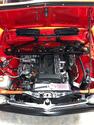
Thought that I'd note this just in case anyone's following this thread hoping to learn what fittings I used - turns out I don't need to get any. I just went out to the garage to double-check exactly what I needed, & found that my engine already has the steam lines installed, I just need to connect the vertical pipe fitting to the radiator.
(And yes, it is somewhat annoying that my mis-remembering caused me to waste a bit of time & effort trying to fix a non-existent problem...)


TECH Senior Member


Joined: Jun 2016
Posts: 22,308
Likes: 3,623
From: Central Cal.

I was worried in my 5.3 Swap because I read that when installed into trucks the 5.3 does not tilt forward, it is tiled to the rear. Meaning they may have blocked the rear steam ports because air would naturally wander forward to the higher place.
In my install, the engine is nearly flat, no tilt. I used 4-corner steam lines from an LS1 for insurance against issues. You read too many threads where #7 went "hot".
In my install, the engine is nearly flat, no tilt. I used 4-corner steam lines from an LS1 for insurance against issues. You read too many threads where #7 went "hot".
I'm curious to hear more about this. I read at some point that opening the rear ports reduces the coolant flow circulating rear to front, which normally would strip trapped steam pockets/bubbles from other areas in the heads. Therefore opening the four ports instead of using just two could, in theory, create hot pockets in other areas of the heads and lead to issues. I have no idea if there's truth to this. I tend to agree with your approach if the engine sits roughly level.
Yall are lookin at it from the wrong angle. Having more water flow out of an engine fro mmore places and into the radiator without having to upgrade anything is a bonus. We should be using every port on the engine to take hot coolant out as quickly as we can. If I was into serious racing I might even be looking to enlarge those ports, enlarge all the hoses and cooling passages, and even maybe drill some new ones and make new hoses for coolant to get out of the engine in a hurry and into the radiator. If you look at 2000 horsepower 3.0L and similar you will see some crazy huge lines coming off the heads for coolant that wasn't there before. You call these things "steam port" well I call them "extra cooling passages that I would be stupid not to use".
