






Any issues with your Aerospace brakes?

Thread Starter
TECH Enthusiast
iTrader: (8)
Joined: Dec 2001
Posts: 705
Likes: 0
From: Westland, MI.
 Any issues with your Aerospace brakes?
 Front "drag race" set-up to be exact. I'm having some problems with mine. (Rotor hitting caliper, mushy pedal feel, won't hold w/line lock, etc.) Just curious if anyone else has had similar experience. I bought mine through Billingsley so I'm not worried, Amber and Jay are awesome and I know they'll get me straightened out but I was wondering if others have ran into any of these issues.
Thanks,
Eric
Thanks,
Eric

I have heard a few weird stories of calipers sticking and such and I know madman doesnt use them for this reason. As far as mushy pedal feel and line lock not holding, was the line lock installed at the same time or did you update to manual brakes with this swap? Maybe the line lock itself could be on its last breath.
Nate
Nate
Had them on the front of two different cars and didnt have a problem with either set. Line lock held fine on my old car with manual brakes and this one with power.
Did you shim the caliper so its centered over the rotor?
Bleeders on top? well bled?
What part is hitting the rotors?
I know the install instructions are pretty vague but honestly I am more then happy with these on both cars.
Did you shim the caliper so its centered over the rotor?
Bleeders on top? well bled?
What part is hitting the rotors?
I know the install instructions are pretty vague but honestly I am more then happy with these on both cars.
Thread Starter
TECH Enthusiast
iTrader: (8)
Joined: Dec 2001
Posts: 705
Likes: 0
From: Westland, MI.

First off, let me go on record as saying that I am not attacking Areorspaces' quality or product. Nor am I holding Billingsley responsible for any of this, they are great people and have always gone out of there way to help. I'm simply asking if others have had similar issues. For all know my installation could be the problem but I don't believe this to be the case. To give you a little back ground on my set-up, I have the stock power brake booster, a SJM line lock that I've had on the car for 2 years, Billingsley ABS delete block and stock rear brakes. I installed my Aerospace "Drag Racing" front brake kit a few months ago. During the install, I had trouble with getting any kind of pedal at all. We bled these things six ways from Sunday. Front to back, back to front, closest to master cylinder, farthest, etc., etc. Absolutely no air bubbles in any of the lines. (Bleeders up by the way.) I called Areospace and asked about which fluid they recommended and they told me DOT 3 and that they did not suggest using synthetic brake fluid with there kits. After finally getting some pedal, (about the last 7/8th's of it's travel, I took the car out and did the recommended bedding procedure. The next day I went to the track, made a total of 4 passes and it seemed to stop the car o.k. (still no pedal to speak of) then I put her away for the past month or so. I talked to Jay and explained what was going on and he suggested I check a few things. Never having had these before, I thought maybe this is the way "drag" brakes feel when you use them with the power booster? Jay said he hadn't heard of this problem before and was interested to see what I came up with.
So I started with the pass. side and everything looked good. Pad wear looked even, pistons seemed to be protruding and retracting into the caliper evenly, etc. When I got into the drivers side, I immediately noticed some gouging of the rotor due to contact with the caliper in two places. Also, I noticed that the pressed in threaded inserts in the brackets that hold the caliper were being pulled slightly out by the bolts that hold the caliper to said bracket. This would pull the caliper towards the inside fare of the rotor. (KP mentioned a good point about shimming the calipers to center over the rotor, I did not do that. and looling at it, I'm not sure how you could.) Judging by the gouging of the pads and rotor, some of the billet aluminum from the caliper got between the two and tore into it pretty good. Also, with the pads removed, I push on the brake pedal to get the pistons to come out and I noticed that one of them seemed to come out farther than the other. I don't think this would have anything to do with the rotor hitting the caliper but it could explain why the front brakes/line lock won't hold the car. Now, with all that said, I still don't know why I can't get any pedal! I have some good pictures but I don't know how to post them. Maybe I could email them to someone and they could post/host them if people wanted to see them.
So I started with the pass. side and everything looked good. Pad wear looked even, pistons seemed to be protruding and retracting into the caliper evenly, etc. When I got into the drivers side, I immediately noticed some gouging of the rotor due to contact with the caliper in two places. Also, I noticed that the pressed in threaded inserts in the brackets that hold the caliper were being pulled slightly out by the bolts that hold the caliper to said bracket. This would pull the caliper towards the inside fare of the rotor. (KP mentioned a good point about shimming the calipers to center over the rotor, I did not do that. and looling at it, I'm not sure how you could.) Judging by the gouging of the pads and rotor, some of the billet aluminum from the caliper got between the two and tore into it pretty good. Also, with the pads removed, I push on the brake pedal to get the pistons to come out and I noticed that one of them seemed to come out farther than the other. I don't think this would have anything to do with the rotor hitting the caliper but it could explain why the front brakes/line lock won't hold the car. Now, with all that said, I still don't know why I can't get any pedal! I have some good pictures but I don't know how to post them. Maybe I could email them to someone and they could post/host them if people wanted to see them.
Trending Topics
If you are pulling out the bushings on the caliper brackets you have the brackets installed backwards. I use washers to shim the calipers so that they are centered on the rotors. I also use slightly longer bolts to retain the calipers. That way all of the threads are engaged in the bushings. I have never experienced a problem with the Aerospace brakes on either of my cars.
Daren
Daren
LS1 Tech Stories
The Best V8 Stories One Small Block at Time

Gas Monkey Built a 6-Wheel Ferrari Testarossa With a Corvette LT4 Engine
Verdad Gallardo
7 Most Reliable High-Performance Engines GM Has Ever Built
Verdad Gallardo
Amazing '71 Camaro Restomod Is Modern Muscle Car Under the Skin
Verdad Gallardo
6 Common C5 Corvette Failures and What's Involved In Repairing Them
Pouria Savadkouei
Retro Modern Bandit Pontiac Trans AM Comes With Burt Reynolds' Autograph
Verdad Gallardo
Top 10 Greatest Cadillac V Series Performance Models Ever, Ranked
Pouria Savadkouei
Top 10 Most Powerful Chevy Trucks Ever Made!

Hennessey's New Supercharged Silverado ZR2 Has 700 HP
Verdad Gallardo
Coachbuilt N2A Anteros Is an LS2-Powered C6 Corvette In Italian Clothes
Verdad Gallardo Thread Starter
TECH Enthusiast
iTrader: (8)
Joined: Dec 2001
Posts: 705
Likes: 0
From: Westland, MI.
During the original install, it seemed logical to install the brackets with the bushings facing away from the calipers but when I attempted this it threw the caliper WAY off center of the rotor. With the supplied spacers and hardware, installing the brackets the way I did everything lined up perfectly.  And like someone mentioned, the directions are not very, well....descriptive. I would think they would at least supply a few washers and make mention of the possible need to shim the calipers in the directions. But I'm just a stupid Electrician!
And like someone mentioned, the directions are not very, well....descriptive. I would think they would at least supply a few washers and make mention of the possible need to shim the calipers in the directions. But I'm just a stupid Electrician! They do supply extra washers to shim them, at least both of mine did and I even had a few left over. They are just thin stainless 3/8 flat washers, ACE has them here.. And as gizmo stated those inserts need to be facing so the bigger steel part is on the inside or the inserts will pull out of the bracket. The thin stainless washers go between the bracket (or between the caliper and spacer) and the thick spacers they give you. You can take the 9/16 bolts out with the rotor on (no lugs holding it) usng an open end wrench to shim it, its kind of a pain but you only have to do it once or twice then you are done.
What happens when the caliper isnt centered is when you apply the brakes it will bend the bracket over and when you let off it the bracket returning will push those pistons back in and you will never get a good hard pedal since the pistons are pushed back in when you let off them.
ANY race brake since they are low drag you will lose some pedal on the first press, and if the rotors run out some the pedal will feel even lower on the first press since the pistons are getting pushed in bt the rotor wobbling some. After a while you will learn the 'quick pump' the first time to get the pedal up higher but its not really necessary. Thats how drag race brakes are, if you want a perfect stock pedal leave the stock brakes on
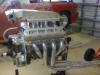
Anyhow you can see the thin washers used to center the caliper between the caliper and spacer in this pic and how the bracket needs to be so the inserts dont pull out. I pulled a wheel off just for you guys, if the bracket is on the other way the caliper will pull of the bracket eventually..
What happens when the caliper isnt centered is when you apply the brakes it will bend the bracket over and when you let off it the bracket returning will push those pistons back in and you will never get a good hard pedal since the pistons are pushed back in when you let off them.
ANY race brake since they are low drag you will lose some pedal on the first press, and if the rotors run out some the pedal will feel even lower on the first press since the pistons are getting pushed in bt the rotor wobbling some. After a while you will learn the 'quick pump' the first time to get the pedal up higher but its not really necessary. Thats how drag race brakes are, if you want a perfect stock pedal leave the stock brakes on
Anyhow you can see the thin washers used to center the caliper between the caliper and spacer in this pic and how the bracket needs to be so the inserts dont pull out. I pulled a wheel off just for you guys, if the bracket is on the other way the caliper will pull of the bracket eventually..
And another thing, do not overtighten the bolt that holds the pads in on the top, if you gp crazy on it it will warp the housings and the calipers WILL stick when they get hot. Just snug it and let the lock nut do the work, always use a new lock nut if you pull the pads off. The strange brakes use a spacer between there so that doesnt happen, aerospace should also but they dont..
Last edited by kp; Oct 2, 2005 at 10:41 AM.

Originally Posted by SlickVert
Much ET and MPH are they worth?
Besides the weight/friction you can also bolt any 15" front drag wheel you want on the car without spacers/grinding which is nice.
GM Muscle, those are metric ARP front wheel studs, they are not included. These pads work fine and I dont know whats available for different compunds, I drive mine quite a bit and they are hardly even worn. They are a little noisy though but these dont have any anti-rattle hardware so expect some odd noises..
Originally Posted by SlickVert
Much ET and MPH are they worth?
 I thought dyno #'s might increase, but they didn't either.
Originally Posted by Pro Stock John
Kevvie, did you have to cut the ear off the spindle or something? Any install hints? I'm pulling together funds for the front brakes right now.
Its a pretty simple install, no 'tricks' really. As long as it looks like the pic I posted thats pretty much it.. I use a 5.00 advanced auto 'one man' brake bleeder and it took like 15 minutes to bleed them.
Thread Starter
TECH Enthusiast
iTrader: (8)
Joined: Dec 2001
Posts: 705
Likes: 0
From: Westland, MI.

Thanks for all the input KP. I went back out this morning and pulled everything back apart and flipped the brackets and shimmed the calipers to be center over the rotor. I knew putting it on the first time they weren't right so that's my stupidity  With what came with the kit and the not-so-descriptive instructions, it's the only way it would even come close to lining up. I had to go to the hardware and pick up some washers as I didn't get any extras with my kit. I gained some clearance by doing that. It was only off center a little but apparently it was enough to cause the rotor and caliper to touch. I put it all back together and took it around the block. Pedal feels the same. The brakes will only engage in the last 7/8th's of it's travel but it does seem to stop a little firmer. Like KP said, they are race brakes and are not going to feel like stock. I am going to manual brakes this winter so we will see how they feel then.
Looking at the situation a little closer, I think this is one of those common occurrences that pop up when a novice like myself really begins to transform a car (especially a car like a 4th Gen F-body that hasn't been around that long, unlike say a '69 Camaro or a Fox body Ford that have years of after market support) into a "race" car and leave the safe realm of the "bolt-on" parts world. As a credit to this site, and the people who post here, since 2002, I have been able to put together a low 11 sec. car entirely in my garage (except for tuning) with no real previous experience to speak of and a "relatively" small amount of money. I guess I'm just throwing this out there for the guys that were in my position a year or two ago to let them know it can be done and you don't have to have a unlimited budget to make it work. A lot of credit has to go to GM and the LSx based engines for giving us a hell of a starting platform!
Oh but in my defense, the directions were kinda sucky!
Thanks again for the insight fellas.
Eric
With what came with the kit and the not-so-descriptive instructions, it's the only way it would even come close to lining up. I had to go to the hardware and pick up some washers as I didn't get any extras with my kit. I gained some clearance by doing that. It was only off center a little but apparently it was enough to cause the rotor and caliper to touch. I put it all back together and took it around the block. Pedal feels the same. The brakes will only engage in the last 7/8th's of it's travel but it does seem to stop a little firmer. Like KP said, they are race brakes and are not going to feel like stock. I am going to manual brakes this winter so we will see how they feel then.Looking at the situation a little closer, I think this is one of those common occurrences that pop up when a novice like myself really begins to transform a car (especially a car like a 4th Gen F-body that hasn't been around that long, unlike say a '69 Camaro or a Fox body Ford that have years of after market support) into a "race" car and leave the safe realm of the "bolt-on" parts world. As a credit to this site, and the people who post here, since 2002, I have been able to put together a low 11 sec. car entirely in my garage (except for tuning) with no real previous experience to speak of and a "relatively" small amount of money. I guess I'm just throwing this out there for the guys that were in my position a year or two ago to let them know it can be done and you don't have to have a unlimited budget to make it work. A lot of credit has to go to GM and the LSx based engines for giving us a hell of a starting platform!
Oh but in my defense, the directions were kinda sucky!
Thanks again for the insight fellas.
Eric
Last edited by 02 Silver Z; Oct 2, 2005 at 08:05 PM.
The instructions kind of assume you have done it 20 times before, I have put all kinds of race brakes on cars over the years so I just glanced at them and figured it out pretty quick but a few more paragraphs an a few pics sure wouldnt hurt for someone that doesnt 20+ years of automotive experience  I'm sure you will get used to them quick enough.
If you pump the once quick it should get a little firmer but you wont get that hard as a rock stock pedal on the first push. When I put the strange brakes on the rear the pedal got pretty mushy but it still stops fine - just takes some getting used to.
I had a manual master on my last car and wasnt real happy with it, it was OK on the track but I was always afraid I was going to rear end someone on the street. Yes I drilled the brake pedal higher to get more leverage
I have driven plenty of 'real' manual brake street/race cars and they stopped way better then than that one did, maybe it was the stock rear brakes but trying to stop quick at like 40mph was a little scary. I would leave the power if you make enough vacuum to run it and you street drive a lot, the booster doesnt weigh much at all.
I'm sure you will get used to them quick enough.If you pump the once quick it should get a little firmer but you wont get that hard as a rock stock pedal on the first push. When I put the strange brakes on the rear the pedal got pretty mushy but it still stops fine - just takes some getting used to.
I had a manual master on my last car and wasnt real happy with it, it was OK on the track but I was always afraid I was going to rear end someone on the street. Yes I drilled the brake pedal higher to get more leverage
I have driven plenty of 'real' manual brake street/race cars and they stopped way better then than that one did, maybe it was the stock rear brakes but trying to stop quick at like 40mph was a little scary. I would leave the power if you make enough vacuum to run it and you street drive a lot, the booster doesnt weigh much at all.